Luke addresses uncertainty in uncertain times with a comforting witness:
.. many have undertaken .. a narrative .. from eyewitnesses ..
.. it seemed good to me also, having followed all things closely for some time past, to write an orderly account for you,
.. that you may have certainty concerning the things you have been taught. – Excerpt Luke 1:1-4
Consider events of this past week or most recent months? Any good news of consequence other than feel-good fluff? Uncertainty seems to rule the day.
We live in a world filled with headlines of hopelessness and endless debates of speculative fear. And as I consider unexpected wars between rich rulers I sense only uncertain futures in these times.
Yet do not despair, beloved friend; for we proclaim a gospel of hope in times of hopelessness. We preach a gospel of certainty in uncertain times, life eternal in Christ Jesus.
What Gospel after the Resurrection?
Transitions bring uncertainty even to those comfortable with trusting God. Jesus’ disciples had just fifty more days to learn to trust in a new and certain covenant with the Lord. Then upon His ascension into the clouds the Holy Spirit would confirm their new certainty.
The opening words of the meticulous physicianhistorian Luke affirm his purpose:
‘that you may have certainty concerning the things you have been taught.’
Jesus taught the Disciples, who subsequently taught others with His authority. Like Paul and Mark, Luke was a follower of The Way who had access to the Jesus’ Disciples.
Luke records their certain witness near the end of the first century, A.D. in Luke-Acts, a two-scroll history.
More to Come
In this next series we will examine the transitional time of uncertainty just a few years after the ascension of Jesus. We will also take a look back to Joshua, who led the Hebrew people through another transitional time after the death of Moses.
Conquering the Promised Land in many ways parallels the uncertain task of Jesus’ followers proclaiming the Gospel to the entire world. The old and new commissions both depend on the Lord. And lest we forget, our own uncertain times in this 21st century after Christ require much faith.
Trust in the LORD forever,
for the LORD GOD is an everlasting rock.
We began this series with the priest of the second Temple Ezra, Looking Back at times preceding the fall of Jerusalem and the first Temple. Continuing with contrasts of Looking Back in real time from our 21st century, we examined a recent history of the Sadducees, whose auspicious beginnings were relatively new in the time of Jesus.
The question of the preceding centuries before Christ addressed who is in charge in a captive Israel, rather than that those in charge must first serve God.
We learned that the Sadducees had only been around since only about 175 years at the time of Christ’s teachings. In fact, the Essenes, like John the Baptist, and also the Pharisees could only trace their roots back to this same time.
Again, think of it in terms of today as looking back to the time of the American Civil War between the divided 33 states of the U.S. Yet the larger question to all generations is: should we look to our leaders for morality?
Jesus said to them, “Watch and beware of the leaven of the Pharisees and Sadducees.” – Matthew 16:6
Sadducees had it wrong, because they did not believe the evidence of the resurrection. They filtered scriptural knowledge of others by their own strict literal Hebrew translation, which may or may not have been accurate. The other two parties of Jewish belief were the Pharisees and the Essenes.
Pharisees and the Essenes
John the Baptist had withdrawn from the towns ruled by Romans and the religious controversies of power. He believed as the Essenes in a continuing spiritual life after death if we forsake our worldly ways in this mortal life.
In those days John the Baptist came preaching in the wilderness of Judea,2 “Repent, for the kingdom of heaven is at hand.” …
5 Then Jerusalem and all Judea and all the region about the Jordan were going out to him, 6 and they were baptized by him in the river Jordan, confessing their sins.
7 But when he saw many of the Pharisees and Sadducees coming to his baptism, he said to them, “You brood of vipers! Who warned you to flee from the wrath to come? 8 Bear fruit in keeping with repentance.
Even though the Pharisees believed in the resurrection, they also believed more in intellectual wisdom than in following the foolishness of the Lord. The Essenes on the other hand were seeking the Messiah of Scripture, the promised Teacher of All Righteousness. This is why John sent his disciples to Jesus and asked, “Are You the Coming One, or do we look for another?” – Matthew 11:3b – NKJV
Pharisees would have seen Jesus agreeing with them on the resurrection as a victory. Yet Jesus cautioned the crowds against their hypocrisy even more than opposing practices of Sadducees, Scribes or other political leaders.
Pharisees had likely been complicite in the elimination of their popular Essene rival, the prophet John, who Herod beheaded. Now the most popular opposition in Israel (which was, of course, a nation no more) was Jesus of Nazareth. Perhaps this charismatic itinerant rabbi is no more knowledgeable of Scripture than a common carpenter’s son. He cannot have done the miracles to which the multitudes give witness. They should easily be able to convince the crowds against this Jesus.
Then the Pharisees went and plotted how to entangle him in his words. And they sent their disciples to him, along with the Herodians, saying,
“Teacher, we know that you are true and teach the way of God truthfully, and you do not care about anyone’s opinion, for you are not swayed by appearances. Tell us, then, what you think. Is it lawful to pay taxes to Caesar, or not?”
But Jesus, aware of their malice, said, “Why put me to the test, you hypocrites?”
Not real complementary of these religious leaders of Jerusalem. Jesus did not speak against Herod with the prior intensity of John the Baptist or against their Roman governors. Now the Lord shows the Pharisees a Roman coin and tells them to pay their taxes and ‘give to Caesar what is Caesar’s.” – v.21a
Jesus also reminds us: ‘and (give) to God the things that are God’s.” – v.21b
Matthew, the gospel writer, Disciple and former tax collector records the reaction of the Pharisees to Jesus’ answer to the question Pharisees had carefully crafted to trip Him up.
When they heard it, they marveled. And they left him and went away. –Matthew 22:22
Thriving on Controversy
Pharisees were common people just like you and me, but ambitious to many faults.
In many ways Pharisees are no different than the politicians and self-absorbed religious leaders of today.They argued amongst themselves endlessly about subtleties of religion and culture they thought most applied in these changed times. They legislated their own interpretations of the Law of Moses to educate their disciples to obey as equal to written Scripture and the Torah.
Pharisees interpreted Law written for Priests and worship into laws forced upon all Jews by additional strict rules of interpretation. These oral laws given to fill in the gaps of what the Law does not prescribe required their own scholarly interpretation, as well as obedient application in everyday life by followers of the Pharisees. A few centuries later these new oral traditions would evolve into various versions of modern judaism.
Jesus challenged the elevation of Pharisees and other religious participants into authority and glory reserved for Almighty God. The Pharisees sought to dethrone Jesus the Nazarene by catching the Lord off guard in His exclusive claims to powers reserved for God. Even the Scribes agreed of His blasphemy. For no man, after all, can forgive sins; but many have witnessed that Jesus spoke these words to those He healed:
Picture the priest Ezra speaking to the builders and worshipers in Jerusalem:
You know well how we have come to this place and the work which is before us.
In the first year of Cyrus king of Persia, that the word of the LORD by the mouth of Jeremiah might be fulfilled, the LORD stirred up the spirit of Cyrus king of Persia, so that he made a proclamation throughout all his kingdom and also put it in writing:
“Thus says Cyrus king of Persia: The LORD, the God of heaven, has given me all the kingdoms of the earth, and he has charged me to build him a house at Jerusalem, which is in Judah.
Our focus in Ezra’s story today begins in ‘the eighteenth year of King Jeroboam.’ Ezra chronicles time beginning with genealogies from Adam to the tribes of Israel. Then he proceeds to the united kingdom of David and Solomon. Finally he reveals a story fromabout five hundred years before the construction of the second Temple.
If today you and I looked back 500 years we would record important events of the 16th century. From our contemporary perspective it would compare to chronicling the turbulent times of Martin Luther.
Our forefathers fled wars in Europe which had caused the deaths of 10-20% of the population. Therefore colonies of the new world became a promised land for those persecuted for varying religious beliefs.
Return now to Ezra’s perspective of history looking back as if you were telling the story of the US in the 1600’s. Once again, imagine Ezra telling the story.
A Story from Israel’s Past
While we rebuild the Temple of the Lord let me tell you a story from the chronicles of our history.
2 Chronicles 13:
Now there was war between Abijah and Jeroboam… 9 Have you not driven out the priests of the Lord, the sons of Aaron, and the Levites, and made priests for yourselves like the peoples of other lands? Whoever comes for ordination with a young bull or seven rams becomes a priest of what are not gods… so there fell slain of Israel 500,000 chosen men.
Imagine: a half million men chosen by God fell on the battlefield due to the sins of Israel.
2 Chronicles 14:
Abijah slept with his fathers, and they buried him in the city of David.
And Asa his son reigned in his place. In his days the land had rest for ten years. 2 And Asa did what was good and right in the eyes of the Lord his God. 3 He took away the foreign altars and the high places and broke down the pillars and cut down the Asherim 4 and commanded Judah to seek the Lord, the God of their fathers, and to keep the law and the commandment…
Do we 'Seek the LORD..and keep the law and commandment?'
9 Zerah the Ethiopian came out against them with an army of a million men and 300 chariots, and came as far as Mareshah.
Many of their fathers had been slain on the battlefield and now a defeated army of Israel must face a million mighty warriors.
10 And Asa went out to meet him, and they drew up their lines of battle in the Valley of Zephathah at Mareshah. 11 And Asa cried to the Lord his God,
“O Lord, there is none like you to help, between the mighty and the weak. Help us, O Lord our God, for we rely on you, and in your name we have come against this multitude. O Lord, you are our God; let not man prevail against you.”
12 So the Lord defeated the Ethiopians before Asa and before Judah, and the Ethiopians fled. 13 Asa and the people who were with him pursued them as far as Gerar, and the Ethiopians fell until none remained alive, for they were broken before the Lord and his army.
The Spirit of God came upon Azariah the son of Oded, 2 and he went out to meet Asa and said to him, “Hear me, Asa, and all Judah and Benjamin:
The Lord is with you while you are with him. If you seek him, he will be found by you, but if you forsake him, he will forsake you.
3 For a long time Israel was without the true God, and without a teaching priest and without law, 4 but when in their distress they turned to the Lord, the God of Israel, and sought him, he was found by them.
Do we do that? In our current distress will we turn to the Lord?
5 In those times there was no peace to him who went out or to him who came in, for great disturbances afflicted all the inhabitants of the lands. 6 They were broken in pieces. Nation was crushed by nation and city by city, for God troubled them with every sort of distress.
7 But you, take courage! Do not let your hands be weak, for your work shall be rewarded.”
Asa Takes Action
8 As soon as Asa heard these words, the prophecy of Azariah the son of Oded:
he took courage
and put away the detestable idols..
and he repaired the altar of the Lord..
9 And he gathered all Judah and Benjamin..
10 They were gathered at Jerusalem in the third month of the fifteenth year of the reign of Asa. 11 They sacrificed to the Lord on that day..
12 And they entered into a covenant to seek the Lord, the God of their fathers, with all their heart and with all their soul,
13 but that whoever would not seek the Lord, the God of Israel, should be put to death, whether young or old, man or woman. 14 They swore an oath to the Lord with a loud voice and with shouting and with trumpets and with horns.
15 And all Judah rejoiced over the oath, for they had sworn with all their heart and had sought him with their whole desire, and he was found by them, and the Lord gave them rest all around.
16 Even Maacah, his mother, King Asa removed from being queen mother because she had made a detestable image for Asherah. Asa cut down her image, crushed it, and burned it at the brook Kidron. 17 But the high places were not taken out of Israel.
Nevertheless, the heart of Asa was wholly true all his days. 18 And he brought into the house of God the sacred gifts of his father and his own sacred gifts, silver, and gold, and vessels. 19 And there was no more war until the thirty-fifth year of the reign of Asa.
Looking Back – Ezra’s lessons for US
Americans and others tend to look back only briefly at historywith eyes that will not see. And any mention of Christ Jesus or the Lord God will quickly repulse those with ears which refuse to hear.
We evaluate our present dilemma in terms of who we think has wronged US.
Justice and righteousness fail in our palaces of partisan politics where mention of the Lord is anathema to reelection.
A cynical nation cries out to the masses without one plea to Almighty God. Do we not justify our ungodly actions and inattentive inactions by a tolerant accomodation of our own self-righteousness?
Why do we not cry out to the God of our founders? (That is what King Asa did when he faced certain defeat.)
WE THE PEOPLE have forgotten the Lord. Surely the decline of our nation will outpace the fall of forgotten mighty empires.
As Lesson for US from Ezra Looking Back
Will it take a leader of another nation to lead US back to the Lord? That was the history behind the story Ezra tells here.
And I, even I Artaxerxes the king, do make a decree to all the treasurers which are beyond the river, that whatsoever Ezra the priest, the scribe of the law of the God of heaven, shall require of you, it be done speedily.. – Ezra 7:21
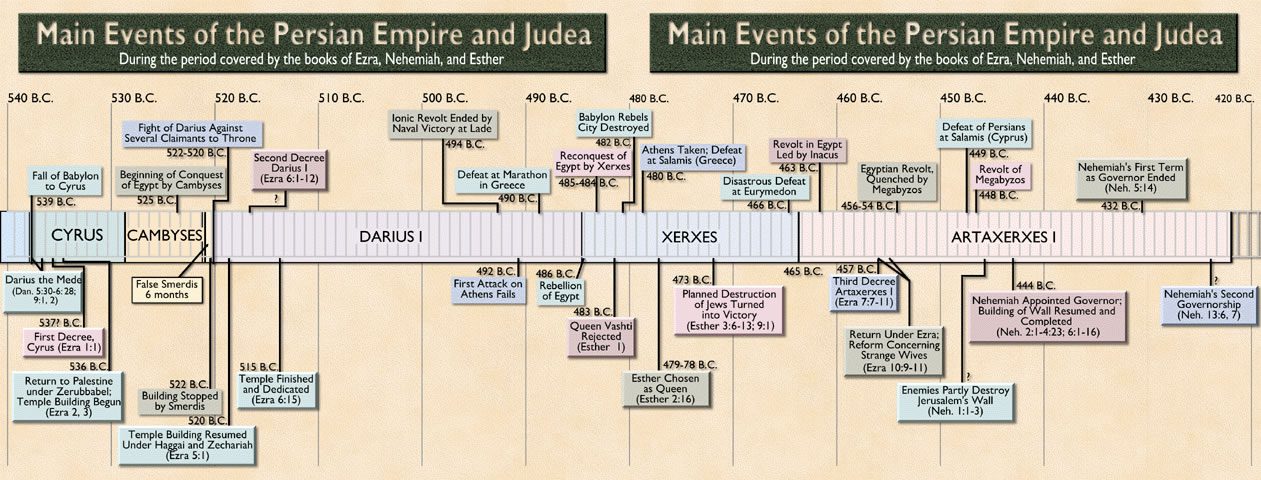
Ezra was living in Babylon when in the seventh year ( c. 457 BCE) of Artaxerxes, king of Persia, the king sent him to Jerusalem to teach the laws of God to any who did not know them. source
In the 20th year of Artaxerxes, king of Persia, (445/444 BC), Nehemiah was cup-bearer to the king. Learning that the remnant of Jews in Judah were in distress and that the walls of Jerusalem were broken down, he asked the king for permission to return and rebuild the city.
Ezra tells of a King Asa, five centuries earlier, who the Lord used to restore Jerusalem (for a time). Then Nehemiah follows with the proclamation from Artaxerxes, king of Persia, to rebuild Jerusalem.
Yet Israel will again turn from the Lord and captive Israel will await a Messiah to save them from evil.
When will the nations of these last days remember the love of the Lord?
For the Messiah Jesus has come to us. He was sacrificed for our sins and rose from the grave in victory! And our Lord will return on the clouds in victory over sin and death. Jesus calls out to the downtrodden souls of humble sinners.
God rules over the nations and loves our worship and praise. He came to us in Person in Christ Jesus.
When will you look up and cry out to the Lord?
Cookie Consent
We use cookies to improve your experience on our site. By using our site, you consent to cookies.
Used to monitor number of Google Analytics server requests
10 minutes
__utmb
Used to distinguish new sessions and visits. This cookie is set when the GA.js javascript library is loaded and there is no existing __utmb cookie. The cookie is updated every time data is sent to the Google Analytics server.
30 minutes after last activity
__utmc
Used only with old Urchin versions of Google Analytics and not with GA.js. Was used to distinguish between new sessions and visits at the end of a session.
End of session (browser)
__utmz
Contains information about the traffic source or campaign that directed user to the website. The cookie is set when the GA.js javascript is loaded and updated when data is sent to the Google Anaytics server
6 months after last activity
__utmv
Contains custom information set by the web developer via the _setCustomVar method in Google Analytics. This cookie is updated every time new data is sent to the Google Analytics server.
2 years after last activity
__utmx
Used to determine whether a user is included in an A / B or Multivariate test.
18 months
_ga
ID used to identify users
2 years
_gali
Used by Google Analytics to determine which links on a page are being clicked
30 seconds
_ga_
ID used to identify users
2 years
_gid
ID used to identify users for 24 hours after last activity
24 hours
_gat
Used to monitor number of Google Analytics server requests when using Google Tag Manager
1 minute
_gac_
Contains information related to marketing campaigns of the user. These are shared with Google AdWords / Google Ads when the Google Ads and Google Analytics accounts are linked together.