I recommend that you read 1 Cor 16 here [in the link above], since I will not detail much of this closing chapter (into which of course Paul's letters were not divided) in this brief synopsis.
Paul closes his epistle to the Corinthian saints first by asking for their charity to help the struggling and persecuted church in Jerusalem. (Their regimen should be like what the Apostle set in place for the Galatian churches.
Part of the collection of gifts and delivery of other epistles (letters) always depends upon who may be available at the time.
Paul is not in person, which is why he writes, and neither is Apollos.
The Apostle closes his letter with several detailed instructions, explanations of where and why they travel with the Gospel, and specific mention of several individuals (to whom we will get after looking back at Paul’s entire epistle to the Corinthians).
Basically, this is his personal closing like any of us would end a personal letter to loved ones.
Corrective Behavior – Guided by Love
Now these three remain: faith, hope, and love [agapē] — but the greatest of these is love.
John MacArthur introduces Paul’s first letter to the Corinthians:
Although the major thrust of this epistle is corrective of behavior rather than of doctrine, Paul gives seminal teaching on many doctrines that directly relate to the matters of sin and righteousness.
In one way or another, wrong living always stems from wrong belief.
Paul’s great dilemma in ‘fathering’ the Corinthians was to correct some of these disobedient children in the faith with the love Christ commands for each of us who claim Jesus as Lord.
The Wisdom of Mature Love in Christ
What do you want? Should I come to you with a rod, or in love and a spirit of gentleness?
1 Corinthians 4:21 CSB
Now about food sacrificed to idols: We know that “we all have knowledge.” Knowledge puffs up, but love builds up...
But if anyone loves God, he is known by him.
1 Corinthians 8:1,3 CSB
Speaking of human wisdom, Paul compares it by saying that ‘knowledge makes arrogant’ [KJV] gnōsisphysioō;
The opening and closing of Paul’s epistle both appeal to the individual love [agapē] of the Corinthians the Apostle knew and loved so well.
He contrasted the morals and behaviors of those who challenged their faith in Christ Jesus to the childish ways of the wisdom of the world worshipping SELF — even with the crowds in Corinth’s temples of worship of myths and wisdom of the logic of mythological man-created gods and goddesses.
Paul loved the Corinthian saints as Christ has loved us.
The Apostle closes his epistle with these important points:
Plans and communication are important for and effective gospel ministry.
Personal relationships and communication are important for and effective gospel ministry.
In closing, let's look at what the Apostle writes to the leaders and saints of Corinth — and to the pastors and Sunday sheep of our Common Era christian flocks.

After all, when you write to someone you love, don't you want to leave them with a final thought about you and what you write to them?
Final Exhortation
16:13
γρηγορέω – Be alert
“Therefore be alert, because you don’t know either the day or the hour.[in which the Son of Man is coming.]
Let anyone who has no love for the Lord be accursed.
Don't get to hung up on the specific words — or English parts of speech.
The seriousness of the Apostle’s line-in-the-sand for Christians cannot be missed.
The term “curse” translates from the Greek “anathema,” meaning something devoted to destruction.
In the Jewish context, it referred to things set apart for God, often through destruction, as seen in Joshua 6:17 with the fall of Jericho.
Paul uses strong language to stress the seriousness of rejecting Christ,
aligning with Galatians 1:8-9, where he condemns any gospel contrary to the one he preached. This reflects the early church’s struggle against false teachings and the necessity of maintaining doctrinal purity.
Paul wanted his churches to exhibit a modesty and propriety recognized by the surrounding culture, especially in worship.
(1 Corinthians 14)
THE BAKER ILLUSTRATED BIBLE COMMENTARY P.1303
An Overview of Paul’s Epistle
Most outlines of Paul’s first letter to the Corinthians include what we are about to read next under a smaller heading of ‘spiritual gifts’ or ‘the gifts of tongues and prophesy’ as part of a larger section of the epistle — as a conclusion of the previous chapters.
Remember that like our letters to anyone it had no chapters.
Without returning to my original introduction to 1 Corinthians, I would like to point to these larger points of Paul’s letter here:
Introduction & reason for writing to the Corinthians
Response to their questions [chaps. 7-16]
Recommendation of others & closing
One of the central cultural issues of propriety and order the Apostle has addressed in response to several Corinthian questions is that of the role of women.
Within the Apostle’s response to the Corinthian elders some of these issues include:
* Immorality in the Church (5:1–6:20)
These issues applied to men certainly affect all women.
But actually, I wrote you not to associate with anyone who claims to be a brother or sister and is sexually immoral or greedy, an idolater or verbally abusive, a drunkard or a swindler. Do not even eat with such a person.
1 Cor 5:2
Flee sexual immorality! Every other sin a person commits is outside the body, but the person who is sexually immoral sins against his own body.
1 Cor 6:18
Marriage in the Church (7:1–40)
3 A husband should fulfill his marital duty to his wife, and likewise a wife to her husband.
10 To the married I give this command — not I, but the Lord — a wife is not to leave her husband.
Liberty in the Church (8:1–11:1)
This section ends with Paul's personal example:
Imitate me, as I also imitate Christ.
AND — (as introduction to our current larger section of his epistle) — the Apostle continues by encouraging those who have done so.
Worship in the Church (11:2–14:40)
Now I praise you because you remember me in everything and hold fast to the traditions just as I delivered them to you.
3 But I want you to know that Christ is the head of every man, and the man is the head of the woman, and God is the head of Christ.
Intro to Apostolic instructions about Head Coverings
Roles of Men and Women in the Church (11:2–16)
The Lord’s Supper (11:17–34)
Spiritual Gifts (12:1–14:40)
The Context of Worship – A.D. 55 or 2025 CE
As you can see, the Apostle has introduced this smaller section of his letter about spiritual gifts in the context of worship
AND that he has already addressed some of the roles of men and of women who worship the Lord Jesus Christ as the Apostle has ‘delivered‘ ‘the traditions’ to them.
What is propriety?
for a first century Corinthian
or (for example) a 21st c.Cincinnatian
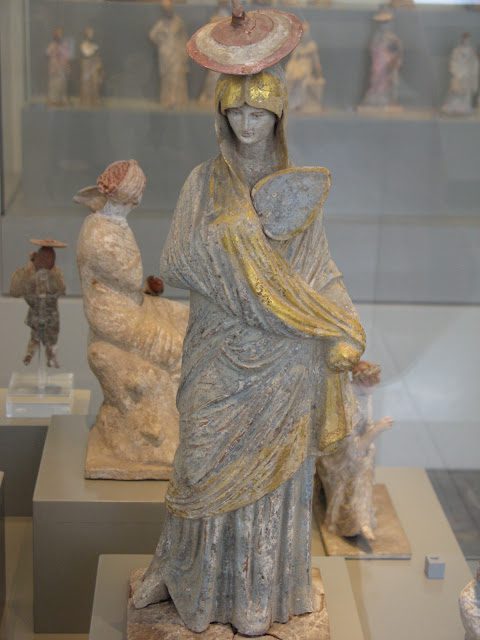
This photo next to the BAKER commentary for 1 Corinthians 14 got my attention to focus back on
the propriety and modesty of a classic Corinthian woman.
Propriety – conformity in socially acceptable conduct and speech, appropriateness, fear of offending against conventional rules of behavior especially between the sexes.
In light of this, consider propriety from the earlier BAKER quote.
At Corinth he [Paul] was particularly concerned about women’s reputation. For women modest draped clothing with a head covering was common. (see 1 Corinthians 11:2-16),
as seen here in a sculpture from 300 BC (Tanagra, Greece)
ibid.
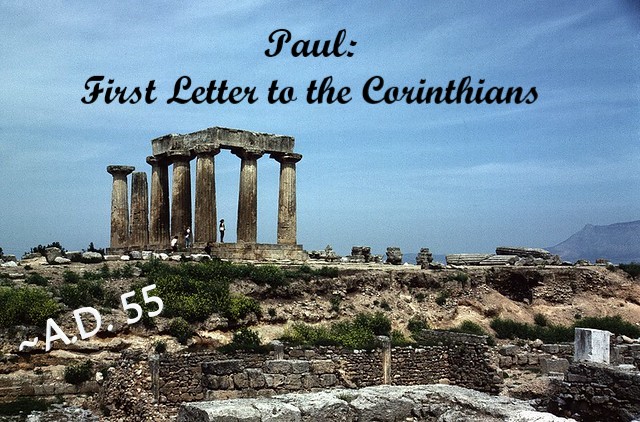
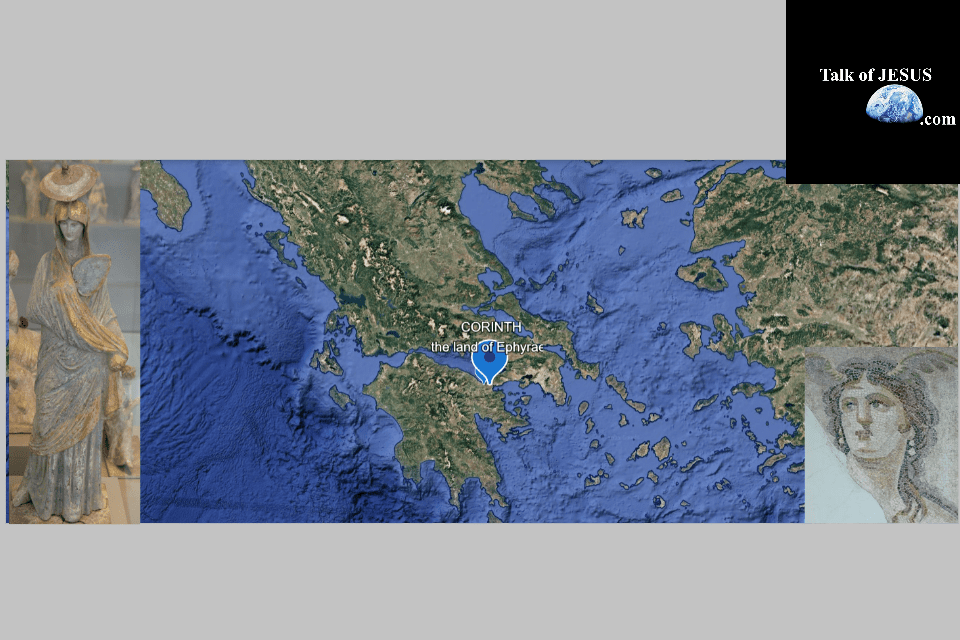
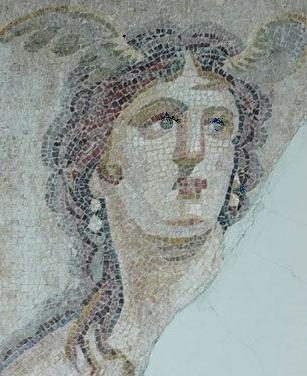
Here is more background on the culture of Corinth named for a goddess descended from the Greek Titans [also pictured on our cover to this post].
In Greek mythology, Tethys was Consort of Oceanus, father of the river gods and goddesses including a Greek goddess who founded Corinth named Ephyra.
The Greeks and Romans honored many gods and goddesses of culture and worshipped these with some order and propriety, while worship of others included temple prostitutes, so much debauchery and excess witnessed in festive celebrations.
(Sound familiar, 21st c. christian?)
Yet the modesty of a proper woman is important to the Corinthians, both men and women, thus the Apostle’s insistence on the propriety of head-coverings in worship of the church.
Pursue love and desire spiritual gifts, and especially that you may prophesy.
.. The person who prophesies is greater than the person who speaks in tongues, unless he interprets so that the church may be built up.
.. — since you are zealous for spiritual gifts, seek to excel in building up the church.
13Therefore the person who speaks in a tongue should pray that he can interpret.
Who’s in charge?
Using several references from Paul's letters to the Corinthians in "DIVINE PROVIDENCE," STEPHEN CHARNOCK [pub. AD 1680, updated 2022] provides us with a helpful overview of the Apostle's thinking:
The edification of the church is the great end that we are commanded to work toward:
Stephen Charnock – DIVINE PROVIDENCE, p.146
Since you are eager for manifestations of the Spirit, strive to excel in building up the church.”
1 Cor, 14:13 – ibid.
Then, under the heading 'The Gifts and Common Grace of Bad Men and Women' Charnock addresses Paul's order of propriety mentioned in this and other epistles.
God is the giver of gifts, Christ is the governor of those gifts, and all is for your sake.
ibid.
I find this particularly helpful.
Think of it:
God the Father (or because of their Oneness in substance, God the Father, Son and Holy Spirit) — who created ALL things —
charges CHRIST (Jesus, the Person of the Son of Man and Son of God) — THE CORNERSTONE of the Church — as its governor —
with perfect distribution of the gifts to the church — gifts that GOD has given to the church for the LORD’s divine purpose for the sake of those chosen before creation to worship him .
Now think of Jesus' parable of the wheat and the tares for this next one:
There are some husks that come up among men and women, and God uses them to shelter the church in common works, and he [GOD] restrains these men and women through the knowledge of Christ.
God gives gifts to them out of love for his church, not out of love for them.
DIVINE PROVIDENCE, P.147
Get a grip on this: it’s not about YOU — God’s love is about HIS CHURCH.
Do you take this bond of your church tohave and to hold..?
OR is our desire to try out relationships of LOVE —
to try outchurch es
— NOT having or holding any commitment to Christ Jesus and His body the Church?
What then, brothers?
We realize that this is not a politically correct question in this common era (and some English translations soften it), but Paul uses the Greek word ἀδελφός - adelphos - a masculine noun for brethren.
What then, brothers? When you come together, each one has a hymn, a lesson, a revelation, a tongue, or an interpretation.
Each of you (brothers).. (not the sisters.. and not ONLY the pastor in charge under Christ).
What then is it, brothers? When you may come together, each has a psalm, has a teaching, has a revelation, has a tongue, has an interpretation.
Let all things be done for edification.
1 Corinthians 14:26 Berean Literal Bible – [more study]
Tongues?
two or three at most
in turn &
must have interpretation
Prophets?
two or three
others weigh in on what is said
IF a personal revelation is made to one present, the man receiving it must remain silent.
all may profit by learn and be encouraged by (this kind of) prophesy
prophets are subordinate [hypotassōto] to each other
Now do not be offended by Paul's next orderly instruction for worship — for it uses the same Greek word [hypotassō] — for the Corinthian women of propriety and modesty expected in worship.
For God is not a God of confusion but of peace.
As in all the churches of the saints, the women should keep silent in the churches.
For they are not permitted to speak, but should be in submission , as the Law also says.
Note that the Apostle — who has been addressing order and propriety in worship throughout his epistle to the saints of Corinth — also speaks to ALL the CHURCHES [ekklēsia] of the SAINTS [hagios].
ARE YOU, beloved 21st century worshipers of the Lord Jesus Christ, not also His saints?
and we have believed, and have come to know, that you are the Holy One [hagios] of God.”
Yes, the women of Corinth and of your 21st century church could be of the Holy Ones - saints - of God; so don't be offended by what the Apostle Paul next instructs the saints by the Spirit - even if God formed you as a woman.
If there is anything they desire to learn, let them ask their husbands at home. For it is shameful for a woman to speak in church.
Paul then proceeds to instruct ‘the brothers’ in those issues the apostle has already addressed, prophesies and spiritual gifts (essentially reiterating ‘listen to me about these things).
And the Apostle Paul’s conclusion to this large section of his letter to the Corinthian saints
— who are of course free from the Law (as servants of God, Christ and each other) —
But let all things be done properly and with order.
Used to monitor number of Google Analytics server requests
10 minutes
__utmb
Used to distinguish new sessions and visits. This cookie is set when the GA.js javascript library is loaded and there is no existing __utmb cookie. The cookie is updated every time data is sent to the Google Analytics server.
30 minutes after last activity
__utmc
Used only with old Urchin versions of Google Analytics and not with GA.js. Was used to distinguish between new sessions and visits at the end of a session.
End of session (browser)
__utmz
Contains information about the traffic source or campaign that directed user to the website. The cookie is set when the GA.js javascript is loaded and updated when data is sent to the Google Anaytics server
6 months after last activity
__utmv
Contains custom information set by the web developer via the _setCustomVar method in Google Analytics. This cookie is updated every time new data is sent to the Google Analytics server.
2 years after last activity
__utmx
Used to determine whether a user is included in an A / B or Multivariate test.
18 months
_ga
ID used to identify users
2 years
_gali
Used by Google Analytics to determine which links on a page are being clicked
30 seconds
_ga_
ID used to identify users
2 years
_gid
ID used to identify users for 24 hours after last activity
24 hours
_gat
Used to monitor number of Google Analytics server requests when using Google Tag Manager
1 minute
_gac_
Contains information related to marketing campaigns of the user. These are shared with Google AdWords / Google Ads when the Google Ads and Google Analytics accounts are linked together.