Tag: Luke

  • Ashes to Ashes

    Ashes to Ashes

    Genesis 18:27 KJV And Abraham answered and said, Behold now, I have taken upon me to speak unto the Lord, which am but dust and ashes:

    Do you know the context of this? (Answer in a moment; but first another quote and some additional background.)

    Forasmuch as it hath pleased Almighty God of his great mercy to take unto himself the soul of our dear brother here departed, we therefore commit his body to the ground; earth to earth, ashes to ashes, dust to dust; in sure and certain hope of the Resurrection to eternal life, through our Lord Jesus Christ; who shall change our vile body, that it may be like unto his glorious body, according to the mighty working, whereby he is able to subdue all things to himself.

    Remember: you are dust and to dust you will return.

    Genesis 3:4 But the serpent said to the woman, “You will not surely die. 5 For God knows that when you eat of it your eyes will be opened, and you will be like God, knowing good and evil.”

    17 And to Adam he said,

    “Because you have listened to the voice of your wife
    and have eaten of the tree
    of which I commanded you,
    ‘You shall not eat of it,’
    cursed is the ground because of you…
    19 By the sweat of your face
    you shall eat bread,
    till you return to the ground,
    for out of it you were taken;
    for you are dust,
    and to dust you shall return.”

    Numbers 19

    9 And a man who is clean shall gather up the ashes of the heifer and deposit them outside the camp in a clean place. And they shall be kept for the water for impurity for the congregation of the people of Israel; it is a sin offering. 10 And the one who gathers the ashes of the heifer shall wash his clothes and be unclean until evening. And this shall be a perpetual statute for the people of Israel, and for the stranger who sojourns among them.

    The ashes are a sin offering to the Lord for the altar of worship.

    Returning to Abraham in Genesis 18:

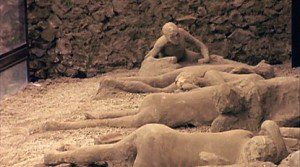
    Pompeii2Abraham is standing before God pleading for mercy for the people of his nephew Lot’s city. It is a city and a place full of sin on which God will rain down His Almighty wrath and judgment – the city of Sodom.
    26 And the Lord said, “If I find at Sodom fifty righteous in the city, I will spare the whole place for their sake.”

    27 Abraham answered and said, “Behold, I have undertaken to speak to the Lord, I who am but dust and ashes. 28 Suppose five of the fifty righteous are lacking. Will you destroy the whole city for lack of five?” And he said, “I will not destroy it if I find forty-five there.” 29 Again he spoke to him and said, “Suppose forty are found there.” He answered, “For the sake of forty I will not do it.” 30 Then he said, “Oh let not the Lord be angry, and I will speak. Suppose thirty are found there.” He answered, “I will not do it, if I find thirty there.” 31 He said, “Behold, I have undertaken to speak to the Lord. Suppose twenty are found there.” He answered, “For the sake of twenty I will not destroy it.” 32 Then he said, “Oh let not the Lord be angry, and I will speak again but this once. Suppose ten are found there.” He answered, “For the sake of ten I will not destroy it.” 33 And the Lord went his way, when he had finished speaking to Abraham, and Abraham returned to his place.

    It is the office of the Priest to intercede for the sins of the people. Abraham, in this instance, is a Priest before Almighty God.

    Christians have a greater Priest and Perfect Sin Offering, Christ Jesus the Very Son of God.

    Abraham failed in saving Sodom, because not even ten righteous men could be found; only Lot. Even Lot’s wife (who did not obey the Lord) was lost for her sin. The wrath of God brought quick and unexpected justice against the entire town and valley.

    Ashes rained down and purified the sinful.

    God had formerly judged the whole earth and purified it by water, saving only Noah and his family. Yet God kept His covenant to never destroy the whole earth again by water. Part of it? Yes. Cities by fire? Yes. By war? Certainly. God confirms in scripture His support of enemies to purify the unfaithful Chosen who by obedience to God’s Law are supposed to live with God’s righteousness.

    Time after time and Prophet after Prophet, up until John the Baptist and even the teaching of our Lord, Christ Jesus; the message of God does not change.

    Repent. Return to God. Turn from your sin. Return to righteousness.

    Repent to dust and ashes and bow down in worship to the Lord, your God.

    We have been following Jesus’ early ministry and many miracles in Galilee. (This is not even to mention His Sacrifice of the Cross for your sins and for mine.)

    Do you recall what Jesus said of repentance to these towns where He has just preached to the multitudes, yet most would not follow Him by faith?

    Here is Jesus’ warning to those who refuse to hear the Gospel from us:

    Luke 10

    10 But whenever you enter a town and they do not receive you, go into its streets and say, 11 ‘Even the dust of your town that clings to our feet we wipe off against you. Nevertheless know this, that the kingdom of God has come near.’

    12 I tell you, it will be more bearable on that day for Sodom than for that town.

    Woe to Unrepentant Cities

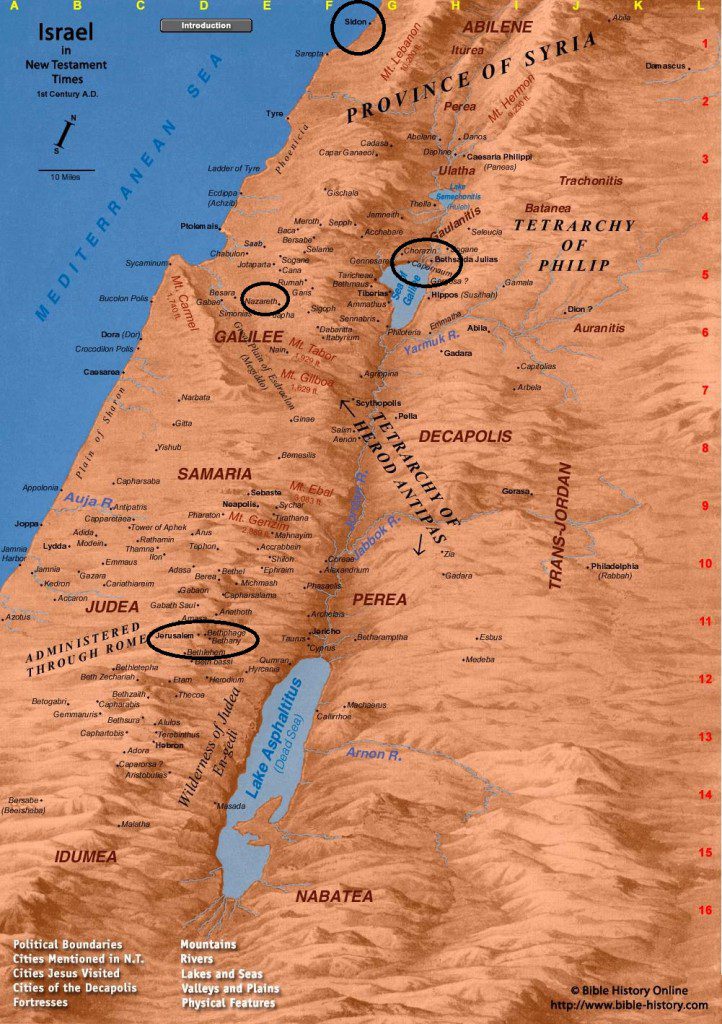
    13 “Woe to you, Chorazin!

    Woe to you, Bethsaida!

    For if the mighty works done in you had been done in Tyre and Sidon, they would have repented long ago, sitting in sackcloth and ashes. 14 But it will be more bearable in the judgment for Tyre and Sidon than for you.

    15 And you, Capernaum, will you be exalted to heaven?

    You shall be brought down to Hades.

    16 “The one who hears you hears me, and the one who rejects you rejects me, and the one who rejects me rejects him who sent me.”

    Therefore, dear brother or sister in Christ Jesus, know that as you call on the world around you to repent to dust and ashes and they will not listen; neither did they hear our Lord. For they hung Him in disgrace on a Cross, for all to see His Sacrifice for the sins of the world.

    The Blood of Christ, sacrificed in Jerusalem, cries out from the Altar of all Righteousness for the wrath of God to rain down, even as His mercy has been sacrificed for us.

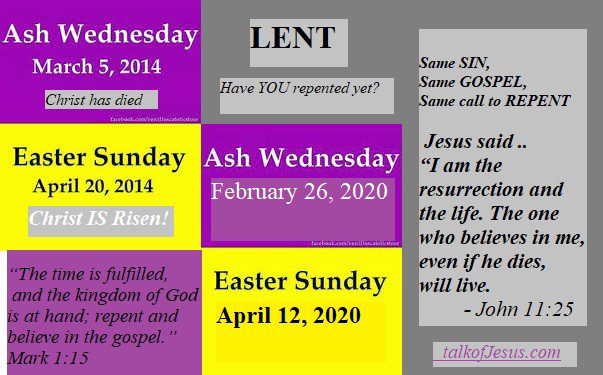
    It is Ash Wednesday – a time for repentance, in these last days.

    It is a time of urgency for us to proclaim the love of our Lord and Savior Christ Jesus, who gave Himself that we might have eternal life.


  • Jesus – Disaster & Sin – Tower of Siloam

    Jesus – Disaster & Sin – Tower of Siloam

    “I tell you, no! But …

    What day’s NEWS doesn’t HEADLINE: DISASTER? The world asks why God would allow this. Were those killed worse sinners than others, so God punished them by death?

    This is how we think. Even if we acknowledge sin (in others) we want to blame God for punishment, especially in providential ‘acts of God’ which end lives unexpectedly.

    The Good News of Luke briefly describes two such incidents.

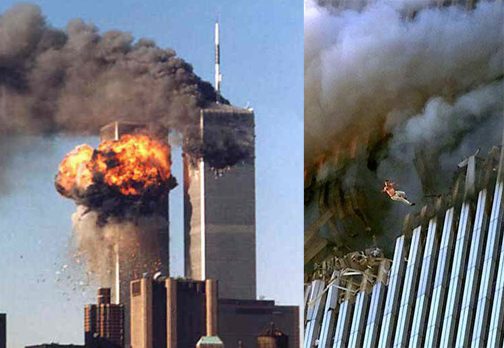
    world trade center towers burning on 9-11-2001

    Such disasters do imprint our memories for a time, for example in this 21st century just mention of NINE-ELEVEN.

    Like the unexpected question, Who Sinned? , here Jesus gives a similar answer to disaster similar to the “WHY” about a man born blind from birth.

    This time the crowds had complained of persecution of Galileans by the Roman Prefect of Judea Pontius Pilate. Jesus responds to the crowds with a rhetorical question about sin. (You need to think about what the Lord tells us here about the nature of sin and how we must approach it.)

    Unless you repent …

    Luke 13:

    2 Jesus answered, “Do you think that these Galileans were worse sinners than all the other Galileans because they suffered this way? 3 I tell you, no!

    But unless you repent, you too will all perish.”

    Were these who died at the hand of Pilate worse sinners? NO.

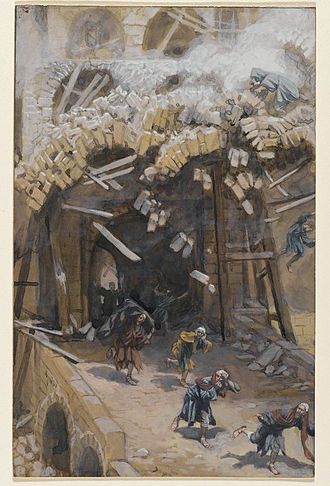
    The Messiah then addresses a local disaster, a recent act of God well-known to Jerusalem.

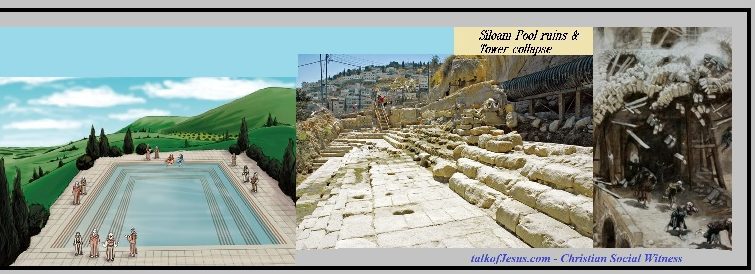
    painting of tower of Siloam crumbling on men of Jerusalem

    4 Or those eighteen who died when the tower in Siloam fell on them—do you think they were more guilty than all the others living in Jerusalem?

    5 I tell you, no!

    But unless you repent, you too will all perish.”

    ‘Unless WE REPENT,’ the Messiah’s listeners must have thought? This rabbi preaches the same message as John the Baptizer and the Prophets of old.

    Then in typical His typical teaching technique, Jesus tells a symbolic parable to illustrate his point that we must repent or we will also perish.

    The fig tree, an ancient symbol of life in Israel and the middle east, represents prosperity, peace and righteousness throughout the Bible.

    Parable of the Fig Tree

    6 Then he told this parable:

    “A man had a fig tree growing in his vineyard, and he went to look for fruit on it but did not find any.

    No life in the tree, no prosperity for the owner of the vineyard, no peace here in Jerusalem where fig trees blossom and bear fruit.

    7 Then he said to the keeper of his vineyard,

    ‘Look, for three years I have come seeking fruit on this fig tree and find none. Cut it down; why does it use up the ground?’

    The Son of Man, the Messiah has been sowing righteousness in the land for three years. Does Jesus ask this crowd of Jews (keeper of God’s vineyard), ‘Why has your faith not yielded fruit?’

    Some Jews have believed and followed their Messiah. A faithful servant in God’s vineyard would plea for mercy for the vine. So his repentant answer would ask the Owner of the vineyard for mercy. He will promise to do his Lord’s work of righteousness once more.

    8 “‘Sir,’ the man replied, ‘leave it alone for one more year, and I’ll dig around it and fertilize it. 9 If it bears fruit next year, fine! If not, then cut it down.’”

    You too will all perish

    There’s something about disaster and death which gets demands our attention: our own mortality.

    Any story of suffering and sudden death of others reminds us of our own helpless before Almighty God. And some will recall their own past sins and immediacy of repentance.

    One recent story of annual flooding in Jerusalem reminds us of the suddenness of the expected. These events often reveal the heritage of our past in addition to the mortality of its victims.

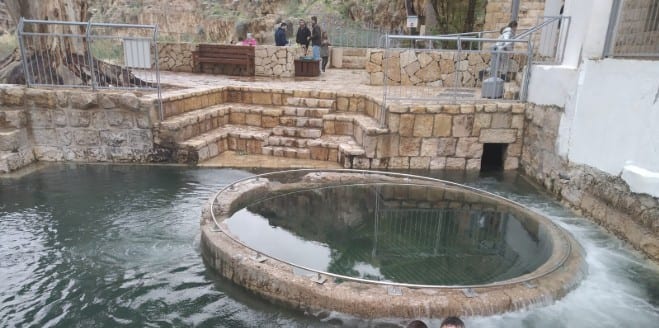
    Siloam was an area just outside the walls of Jerusalem on the southeast side of the city. A spring-fed pool was there, which was the scene of one of Christ’s miracles (John 9). The tower of Siloam may have been part of an aqueduct system or a construction project that Pilate had begun. In any case, the tower fell, and eighteen people were killed in the catastrophe.

    Why did Jesus mention the tower of Siloam in Luke 13:4?

    Why mention a recent disaster?

    Second COVID-19 death sparks fears, lockdown in Italian towns – Agence France-Presse
    Posted at Feb 22 2020 08:08 PM [local time]

    I could have chosen pictures & NEWS from just this month, February 2020, even from contemporary Jerusalem where Jesus addressed sin and disaster in speaking of both the tower and pool of Siloam.

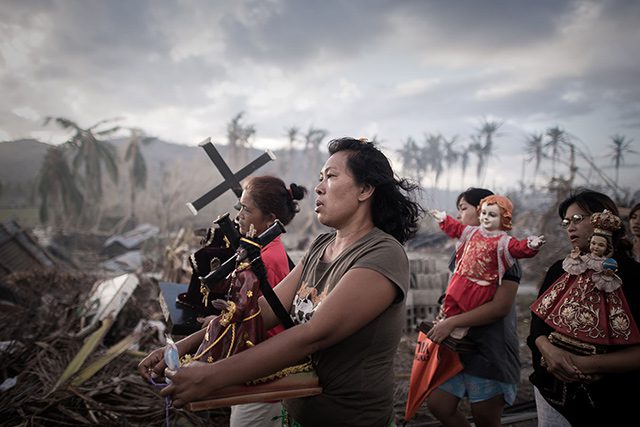
    Refugees of natural disasters, even so common as annual hurricanes or typhoons (as pictured here from 2013 in the Philippines) remind us that our earthly home is temporary. The displaced ships in Luzon Philippines (above) are part of a witness by Pastor BERMIE DIZON who lived there at the time. He witnesses comparison to Jesus’ teachings about the tower and pool of Siloam.

    “I was only a few miles away from the volcano, Mt. Pinatubo when it exploded in 1991. At that very moment of explosion, I really thought my family and I will die buried like those in the ancient city of Pompeii.

    Pastor Bermie Dizon of GCI Ministries, Luzon Philippines bermiedizon.com/disasters/

    I ask the same question of Jesus of those who perished in the fall of the Tower of Siloam:

    Contemporary application by paraphrase of Jesus’ questions

    “Do you think that these FILIPINOS were more sinful than all the other FILIPINOS because they suffered these things?

    3 No, I tell you; but unless you repent, you will all perish as well.

    COVID-19 tally: 76,785 cases, 2,249 deaths, 34 cases in the U.S.
    Published: Feb 21, 2020 2:50 p.m. ET

    “Or those two thousand killed by the #Coronavirus —do you think they were more sinful than all the other people who live in China and other places in this world?

    5 No, I tell you; but unless you repent, you will all perish as well.”

    Therefore, feed your faith

    “‘… Perhaps it will produce fruit next year, but if not, you can cut it down.’”

    Luke 13:9 CSB – Jesus’ Parable of the Barren Fig Tree
    God-willing we will return to the pool of Siloam in John 9.
    To be continued... 
  • Jesus – True Light Siloam the Darkness

    Jesus – True Light Siloam the Darkness

    Who sinned?

    What an odd question we think. Disciples of Jesus ask Him as they observe a man blind from birth. Their rabbi instructs them that neither the sin of the man nor the sin of his parents caused his blindness. Then amazingly Jesus puts mud on the man’s eyes and sends him to the pool of Siloam, where the man will regain his sight!

    We have been following John’s gospel where he shows several signs of miracles of Jesus proving He IS the Messiah. (Some count giving this blind man sight as a sixth sign.)

    John 9:

    3 Jesus answered, “It was neither that this man sinned, nor his parents; but it was so that the works of God might be displayed in him. 4 We must work the works of Him who sent Me as long as it is day; night is coming when no one can work.

    While I am in the world, I am the Light of the world.”

    John 9:5 NIV – instruction of the Messiah Jesus

    6 When He had said this, He spat on the ground, and made clay of the spittle, and applied the clay to his eyes, 7 and said to him,

    “Go, wash in the pool of Siloam” (which is translated, Sent).

    So he went away…

    Light sent to darkness

    Beginning with my title which seems not to translate in English, look once more to John 9:6. “Go, wash in the pool of Siloam” (which is translated, Sent). – NASB

    Therefore: Jesus – True Light (sent to) the Darkness.

    Do not miss in His miracle the Messiah’s mission of purpose. Jesus Siloam – Jesus is sent to our world of darkness from which Light has been hidden.

    Σιλωάμ Silōam sē-lō-ä’m, Hebrew שִׁלֹחַ

    8:6 יַעַן כִּי מָאַס הָעָם הַזֶּה אֵת מֵי הַשִּׁלֹחַ הַהֹלְכִים לְאַט וּמְשֹׂושׂ אֶת־רְצִין וּבֶן־רְמַלְיָֽהוּ׃

    John’s Gospel reminds us of translation into the Greek from Hebrew Scripture. Isaiah 8:6 serves the Jews a background of the famous pool of Siloam (see-low-awm’) in Jerusalem.

    Sent to – Jesus sent the blind man with ‘mud in the eyes’ to wash, just as Isaiah chastised those Jews who refuse to obey the LORD.

    He did not send the blind man to Siloam to be healed. The pool of Siloam did not give the blind man the Light of his sight. The Lord Jesus sent him to it and by the blind man’s obedience he was healed by the Lord.

    translated sent – ἀποστέλλω

    First century Jerusalem, Ephesus (where John likely penned the Gospel), Judea and Palestine were all places where many people were multilingual. They had to be. Latin speaking Romans ruled many lands, but Rome governed locally with the international language of the day, Greek.

    In Jerusalem where Hebrew remained the language of faith, Jews also conversed daily in several local Aramaic dialects, but the language of commerce was Greek.

    When John writes, “Siloam” (which is translated, Sent), the Apostle uses a Greek word which should sound familiar to the Christian of this day: apostellō, ἀποστέλλω related to the word “Apostle,” ἀπόστολος – apostolos.

    Later, Jesus will instruct His Apostles:

    “For I gave you an example that you also should do as I did to you.

    “Truly, truly, I say to you, a slave is not greater than his master, nor is one who is sent greater than the one who sent him.

    John 13:15-16 NASB – instructions of Jesus to His Apostles

    This cleansing prior to His crucifixion is also related to sending out the Apostles into the darkness of this world.

    The Cleansing of Sin

    THE LORD GOD IS HOLY!

    John later writes in his first letter to the church:

    And this is the message we have heard from Him and announce to you: God is light, and in Him there is no darkness at all.

    1 John 1:5 Berean Study Bible

    What does cleansing have to do with sin? Can purification in the baths and pools wash the guilt from your past? Was John’s baptism more than just ritual purification?

    All point to the Light of Life, permanent change sanctifying a sinful flesh to be HOLY in the Presence of the LORD GOD.

    The Apostle John later notes at a time the Jews are plotting to kill Jesus what seems an insignificant detail to 21st century readers:

    “When it was almost time for the Jewish Passover, many went up from the country to Jerusalem for their ceremonial cleansing before the Passover. – John 11:55 NIV

    The Pool of Siloam

    For archaeological photos and some history of The Pool of Siloam visit this source from Bibleplaces.com 

    This is a tradition-filled history familiar to the listeners of Jesus at the time the Lord healed this man blind from birth.

    In order to understand the importance of this cleansing, ritual purification or baptism, next we will examine another mention of Siloam from Luke’s Gospel.

    To be continued...