Tag: mark

  • For you will always have the poor

    For you will always have the poor

    Why mention the poor?

    Once again, Jesus makes what appears to be an offhand remark about the poor. Jesus often criticized the leaders of Temple and Pharisees for their treatment of the poor; doesn’t this remark catch you off guard?

    It would be easy enough to lose the context of Jesus’ apparent ambivalence toward the poor in the rush of events surrounding Passover week. Jesus’ final entry into Jerusalem has many seemingly more important things going on than what to us would first appear to be a slip of the tongue (sort of like cursing the fig tree).  Yet like in our previous series you may find some subtleties worthy of note that impact more than just the poor.

    The Gospel Quotes:

    Prior to examining Jesus’ point of the comment, which we will do later in this series, let’s begin quotes from the view points of three different gospel writers.

    Mark 14:7

    For you always have the poor with you, and whenever you want, you can do good for them.

    Matthew 26:7

    For you always have the poor with you, but you will not always have me.

    John 12:8

    For the poor you always have with you, but you do not always have me.”

    The 5 W’s

    Now to discover the context we must examine all three stories asking:

    Who, what, where, when and why?

    You will find some variation in the three Gospel stories and some similarities. We begin today with Mark’s gospel.


    Mark 14:

    It was now two days before the Passover and the Feast of Unleavened Bread. And the chief priests and the scribes were seeking how to arrest him by stealth and kill him, 2 for they said, “Not during the feast, lest there be an uproar from the people.”


    We have the ‘when:’ two days before the Passover, which in this particular year with the Passover on a Thursday, was Tuesday.
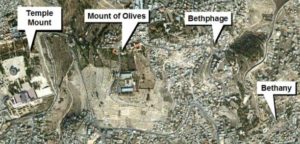

    3 And while he was at Bethany in the house of Simon the leper, as he was reclining at table, a woman came with an alabaster flask of ointment of pure nard, very costly, and she broke the flask and poured it over his head.

    4 There were some who said to themselves indignantly, “Why was the ointment wasted like that? 5 For this ointment could have been sold for more than three hundred denarii and given to the poor.” And they scolded her. 6 But Jesus said, “Leave her alone. Why do you trouble her? She has done a beautiful thing to me. 7 For you always have the poor with you, and whenever you want, you can do good for them. But you will not always have me. 8 She has done what she could; she has anointed my body beforehand for burial. 9 And truly, I say to you, wherever the gospel is proclaimed in the whole world, what she has done will be told in memory of her.”


    Where? In the house of Simon the Leper, in Bethany, near Jerusalem.

    Bethany is today el ‘Azareyeh (“the place of Lazarus”- the L being displaced to form the article).

    Who is present? Jesus, of course; Simon, host of the meal (who Jesus had likely healed from leprosy; ‘some,’ likely the Twelve and others; and an unidentified woman who enters Simon’s home.

    What happens? She pours out some very expensive oil on Jesus, an act of great humility and worship.

    (More about her and her gracious act later.)


    To be continued…
     

  • for it was not the season for figs – 1

    for it was not the season for figs – 1

    Whoever tends a fig tree will eat its fruit,
    and he who guards his master will be honored.

    – Proverbs 27:18

    Consider the Creator of the garden approaching a fig tree before its season. Who will guard the Son of Man as He enters the Temple and fast-approaches the reproach of the Cross?

    Prologue to this series (in case you missed it)

    Mark 11: [ESV]

    Jesus Curses the Fig Tree

    12 On the following day, when they came from Bethany, he was hungry.13 And seeing in the distance a fig tree in leaf, he went to see if he could find anything on it. When he came to it, he found nothing but leaves, for it was not the season for figs. 14 And he said to it, “May no one ever eat fruit from you again.” And his disciples heard it.

    Jesus Cleanses the Temple

    15 And they came to Jerusalem. And he entered the temple and began to drive out those who sold and those who bought in the temple, and he overturned the tables of the money-changers and the seats of those who sold pigeons…


    A triumphal entry into Jerusalem, as an anointed King of Israel. Jesus stays in a nearby town (Bethany) for the night, then returns to Jerusalem. A fig tree is not an uncommon sight along the rural roads leading to the gates of Jerusalem. He curses the tree with no fruit, then enters the Holy City, clearing the Holy Temple of unrighteousness.

    The authorities will have to plot against this powerful and righteous Son of Man, lest their comfortable authority would be overthrown.


    19 And when evening came they went out of the city.

    Jesus leaves town. 

    Another night away from Jerusalem (probably once again with disciples in Bethany).

    The Lesson from the Withered Fig Tree

    Mark 11:20-21 http://talkofJesus.com

    20 As they passed by in the morning, they saw the fig tree withered away to its roots.

    21 And Peter remembered and said to him, “Rabbi, look! The fig tree that you cursed has withered.”

    22 And Jesus answered them, “Have faith in God. 23 Truly, I say to you, whoever says to this mountain, ‘Be taken up and thrown into the sea,’ and does not doubt in his heart, but believes that what he says will come to pass, it will be done for him.


    Another miracle (kind of a scary one, though). Jesus had cursed a tree and it withered and died in a day.

    (Have you ever thought that your life could pass just as quickly?)

    Now, in typical rabbi fashion Jesus makes a teaching moment from fulfillment of His curse.


    24 Therefore I tell you, whatever you ask in prayer, believe that you have received it, and it will be yours.

    And whenever you stand praying, forgive, if you have anything against anyone, so that your Father also who is in heaven may forgive you your trespasses.

    Mark 11:25

    “Even a holy week spent in prayer is of no value to the unforgiving worshiper. You with ears to hear, forgive ,” learn the lesson of the fig tree.

    Forgive, “… so that your Father also who is in heaven may forgive you your trespasses.”


    Tend the tree of life and forgiveness. 
    Bear the fruit of love. 
    Guard the Lord, our Master and Savior.
    He will curse the tree without fruit at the Judgment.
    Roger@talkofJesus.com

    Scripture has much more to say about the fig tree. Jesus does not choose such an important symbol of Israel to curse without cause.

    To be continued

  • for it was not the season for figs – prologue

    for it was not the season for figs – prologue

    Lost in the glory of the entrance of Jesus into Jerusalem on Palm Sunday we find a brief story much overlooked. The story of Jesus cursing a fig tree not only seems much out of character for the Lord, but relatively insignificant. I cannot recall ever hearing it preached simply on its own merits.

    In a brief series (for a single post does not give this story its due) we will examine in more depth the significance of the fig tree. As an introduction let’s begin with one telling of the story by the Gospel writer, John Mark, a disciple introduced in Acts.

    Mark 11: [ESV]

    Jesus Curses the Fig Tree

    12 On the following day, when they came from Bethany, he was hungry.13 And seeing in the distance a fig tree in leaf, he went to see if he could find anything on it. When he came to it, he found nothing but leaves, for it was not the season for figs. 14 And he said to it, “May no one ever eat fruit from you again.” And his disciples heard it.

    Gospel of Mark 11:12-14 ESV

    That’s it.

    Prior to this Mark records:

    And many spread their cloaks on the road, and others spread leafy branches that they had cut from the fields.And those who went before and those who followed were shouting, “Hosanna! Blessed is he who comes in the name of the Lord! 10 Blessed is the coming kingdom of our father David! Hosanna in the highest!”

    11 And he entered Jerusalem and went into the temple. And when he had looked around at everything, as it was already late, he went out to Bethany with the twelve.


    The story of Palm Sunday, as we have become so familiar, nearly too familiar.

    Jesus comes riding up the road to Jerusalem, received like a King and Messiah, followed and worshiped by hundreds. He takes a look at the Temple, it’s late, they head to a local town to stay the night.

    The fig tree encounter takes place the next day. Yet like the Apostles  and hundreds of followers who would fall away before the trial and crucifixion of Jesus, we miss the point of the fig tree.

    Mark continues the commentary of the next day with actions of Jesus from another, most-familiar story:

    Jesus Cleanses the Temple

    15 And they came to Jerusalem. And he entered the temple and began to drive out those who sold and those who bought in the temple, and he overturned the tables of the money-changers and the seats of those who sold pigeons. 16 And he would not allow anyone to carry anything through the temple. 17 And he was teaching them and saying to them, “Is it not written, ‘My house shall be called a house of prayer for all the nations’? But you have made it a den of robbers.” 18 And the chief priests and the scribes heard it and were seeking a way to destroy him, for they feared him, because all the crowd was astonished at his teaching.

    Gospel of Mark 11:15-18 ESV

    But what of the fig tree?

    To be continued…