Tag: numbers

  • A River of Redemption Flowing from Eden – Joseph

    Joseph Unlike Moses

    “Can we find anyone like this, a man who has God’s spirit in him?” … Pharaoh said to Joseph, “I am Pharaoh and no one will be able to raise his hand or foot in all the land of Egypt without your permission.” Pharaoh gave Joseph the name Zaphenath-paneah… – Genesis 41

    None can dispute that Joseph and Moses were both redeemers of the Hebrews, but they were very different men. The Lord called Moses to bring Israel from Egypt, but used Joseph to save both Egypt and Israel. Joseph, or Zaphenath-paneah as he was known in all of Egypt, preceded Moses by some generations. You will encounter two very different men by comparing the beginnings of their contrasting lives.

    Moses

    We read in Number 12: Moses was a very humble man, more so than anyone on the face of the earth. The Lord, speaking to Aaron & Miriam said:

    “Listen to what I say:
    If there is a prophet among you from the Lord,
    I make myself known to him in a vision;
    I speak with him in a dream.
    7 Not so with my servant Moses;
    he is faithful in[a] all my household.
    8 I speak with him directly,
    openly, and not in riddles;
    he sees the form of the Lord.

    What could be more humbling than standing before the form of the Lord, hearing the words of the Almighty directly?

    Moses was born into humble circumstances, raised in knowledge of both power and lowliness and willingly obeyed the Lord’s commands. Though brought up as a prince of Egypt for two decades, his mother sewed humility into Moses’ heart, as his servant nursemaid.

    Because he was a prince, Moses could easily escape to Midian for twenty more years to live a humble life in freedom. His choice to defend Hebrew slaves would have been self-indictment of disobedience to the King’s commands and conviction resulting in his own death. A return to Egypt at age eighty in obedience to the Lord showed only humility in the face of certain powerful opposition from Pharaoh.

    Moses is raised, educated and served by slaves in an Egyptian palace of perhaps the most powerful man on earth in his time. Joseph, by contrast, comes to Egypt by birth, but as a seventeen-year-old slave.

    Joseph

    Unlike Moses, Joseph was by no means a humble young man. He was blessed with good intellect and great favor, but learned humility later in life. He lived in the land of Canaan and tended sheep with his brothers. 

    (Do you recall from our previous post what Pharaoh thought of shepherds?) Joseph would not only enter Egypt as a shepherd, but as a captive slave.

    Genesis 37:

    3 Now Israel [Jacob] loved Joseph more than his other sons because Joseph was a son born to him in his old age, and he made a robe of many colors for him.

    Trouble waiting to happen. This teenager, Joseph, is favorite of his father (his mother, deceased) who makes him look like an administrator over his adult working brothers. Joseph is anything but humble and in fact appears to his brothers to be full of himself, even arrogant.

    5 Then Joseph had a dream. When he told it to his brothers, they hated him even more. 6 He said to them, “Listen to this dream I had: 7 There we were, binding sheaves of grain in the field. Suddenly my sheaf stood up, and your sheaves gathered around it and bowed down to my sheaf.”

    8 “Are you really going to reign over us?” his brothers asked him. “Are you really going to rule us?” So they hated him even more because of his dream and what he had said.


    We know God’s purpose for Joseph and that the outcome would finally prove Joseph’s dream to be true. In fact, Joseph would become a redeemer of Egypt because of his dreams from the Lord.

    … So Joseph set out after his brothers and found them at Dothan.

    18 They saw him in the distance, and before he had reached them, they plotted to kill him. 19 They said to one another, “Oh, look, here comes that dream expert! 20 So now, come on, let’s kill him and throw him into one of the pits…

    … his brothers pulled Joseph out of the pit and sold him for twenty pieces of silver to the Ishmaelites, who took Joseph to Egypt.

    Joseph, betrayed by his brothers for twenty pieces of silver, becomes a slave in Egypt.

    The Lord was with Joseph

    How can you say that the Lord is with someone betrayed, taken into the hands of God’s enemies and condemned to exile? The evil hand of his own brothers perhaps betrayed him to eventual death. Why does God allow it?

    As Joseph’s story unfolds we learn the answer of the Lord from the very words of Joseph to his brothers.

    Genesis 39:

    2 The Lord was with Joseph, and he became a successful man, serving in the household of his Egyptian master. 3 When his master saw that the Lord was with him and that the Lord made everything he did successful, 4 Joseph found favor with his master and became his personal attendant. Potiphar also put him in charge of his household and placed all that he owned under his authority…

    … the Lord blessed the Egyptian’s house because of Joseph. The Lord’s blessing was on all that he owned, in his house and in his fields. 6 He left all that he owned under Joseph’s authority…

    But Joseph again suffers unexpected consequence due to false accusation by his master’s wife.  His master then obligingly sends Joseph to prison.

    21 But the Lord was with Joseph and extended kindness to him. He granted him favor with the prison warden. 22 The warden put all the prisoners who were in the prison under Joseph’s authority, and he was responsible for everything that was done there. 23 The warden did not bother with anything under Joseph’s authority, because the Lord was with him, and the Lord made everything that he did successful.

    Although Joseph must remain in Pharaoh’s prison, in fact by the Lord’s purpose he is given authority.

    Dreams and Prophesy

    Prior to this and before betrayal by his own brothers Joseph had had another dream, which turns out to be prophesy.

    Genesis 37: “Look,” he said, “I had another dream, and this time the sun, moon, and eleven stars were bowing down to me.”

    10 He told his father and brothers, and his father rebuked him.

    Now in prison Joseph has another prophetic dream. Remember, he is in charge of and this time no doubt respected by his fellow prisoners.

    Genesis 40:

    5 The king of Egypt’s cupbearer and baker, who were confined in the prison, each had a dream. Both had a dream on the same night, and each dream had its own meaning…

    9 So the chief cupbearer told his dream to Joseph… 16 When the chief baker saw that the interpretation was positive, he said to Joseph, “I also had a dream.

    18 “This is its interpretation,” Joseph replied. “The three baskets are three days. 19 In just three days Pharaoh will lift up your head—from off you—and hang you on a tree.

    And so it happened that not only was the baker hanged, but the cupbearer was released, forgetting about Joseph. 

    Genesis 41:

    At the end of two years Pharaoh had a dream… 9 Then the chief cupbearer said to Pharaoh, “Today I remember my faults… 

    12 Now a young Hebrew, a slave of the captain of the guards, was with us there. We told him our dreams, he interpreted our dreams for us, and each had its own interpretation. 13 It turned out just the way he interpreted them to us: I was restored to my position, and the other man was hanged.”

    14 Then Pharaoh sent for Joseph…

    This brings us to the historical scenario where the Lord shows a coming famine, seven years into the future. The King of Egypt trusts Joseph to help them prepare. The severity of the middle east famine will eventually bring Israel to send his other sons from Canaan to Egypt for grain.

    A Prophet of Two Lands

    The Lord’s purpose in Joseph’s captivity and rise to power in Egypt is to save two lands from famine and prepare Israel for the promised land. As you know, he is brought before Pharaoh and interprets dreams of prophesy.

    15 Pharaoh said to Joseph, “I have had a dream, and no one can interpret it. But I have heard it said about you that you can hear a dream and interpret it.”

    16 “I am not able to,” Joseph answered Pharaoh. “It is God who will give Pharaoh a favorable answer.”

    It is always God who brings true prophesy. The truth of Joseph’s predictions make Pharaoh a believer in the Lord God!

    “Can we find anyone like this, a man who has God’s spirit in him?”

    39 So Pharaoh said to Joseph, “Since God has made all this known to you, there is no one as discerning and wise as you are. 40 You will be over my house, and all my people will obey your commands. Only I, as king, will be greater than you.”

    Contrary to Culture

    “Only I, as king, will be greater than you,” Pharaoh states. He is not a god, but a most-powerful man dependent upon God and his true Prophet. 

    Note that the changes ahead for Egypt will take fourteen years. Israel’s sons will enter the land as immigrants in need, bowing humbly to this leader, second in command to the King.

    So he placed him over all the land of Egypt. 44 Pharaoh said to Joseph, “I am Pharaoh and no one will be able to raise his hand or foot in all the land of Egypt without your permission.”

    45 Pharaoh gave Joseph the name Zaphenath-paneah and gave him a wife, Asenath daughter of Potiphera, priest at On.  And Joseph went throughout the land of Egypt.

    Joseph’s Administration
    46 Joseph was thirty years old when he entered the service of Pharaoh king of Egypt. Joseph left Pharaoh’s presence and traveled throughout the land of Egypt.


    To be continued…
     

  • Balaam – Inauguration of a Politician’s Prophet – 3

    Balaam – Inauguration of a Politician’s Prophet – 3

    Journey to an Inauguration Interrupted

    [In case you missed Part 1 or Part 2 of our long journey] We heard Balaam’s inaugural address in part in Numbers 24:3-9, first introduced in Part 1. Now we return to his journey toward the ceremonies of that momentous occasion.

    [ctt title=”Then the Lord opened the eyes of Balaam, and he saw the angel of the Lord standing in the way, with his drawn sword in his hand. And he bowed down and fell on his face.” tweet=”Numbers 22:31 after an ass had to tell a prophet to see the angel of the Lord.” coverup=”8dHCr”]

    Numbers 22:

    32 And the angel of the Lord said to him, “Why have you struck your donkey these three times? Behold, I have come out to oppose you because your way is perverse before me. 33 The donkey saw me and turned aside before me these three times.


    How about this: your way is ‘perverse’ יָרַט [yarat] before the Lord!  Your self-driven actions precipitate, push headlong and drive recklessly. You oppose the LORD! In fact, even your ass [אָתוֹן] saw the Angel of the Lord, but you did not.

    Can you imagine the reaction of the prophet Balaam? First, his ass rebukes him, and now he finally sees the Angel of the Lord with a drawn sword asking why he struck his faithful donkey.

    “… If she had not turned aside from me, surely just now I would have killed you and let her live.”

    34 Then Balaam said to the angel of the Lord, “I have sinned, for I did not know that you stood in the road against me. Now therefore, if it is evil in your sight, I will turn back.”


    Awoken from Sin

    35 And the angel of the Lord said to Balaam, “Go with the men, but speak only the word that I tell you.” So Balaam went on with the princes of Balak.

    [At the end of their long 400 mile journey a King prepares for the Inauguration of a new era with the great prophet of God on his side, so he thinks.]

    38 Balaam said to Balak, “Behold, I have come to you! Have I now any power of my own to speak anything? The word that God puts in my mouth, that must I speak.”

    [Indeed, what can a man or woman belonging to the Lord say, except the word of the Lord?]

    41 And in the morning Balak took Balaam and brought him up to Bamoth-baal, and from there he saw a fraction of the people.

    Numbers 23:

    Next, we see ceremonies of the high event planned by Balaak. Seven altars become the focus of Inauguration events. But Balaam does the unexpected and blesses Israel.

    “From Aram Balak has brought me,
    the king of Moab from the eastern mountains:
    ‘Come, curse Jacob for me,
    and come, denounce Israel!’
    8 How can I curse whom God has not cursed?
    How can I denounce whom the Lord has not denounced?

    … 11 And Balak said to Balaam, “What have you done to me? I took you to curse my enemies, and behold, you have done nothing but bless them.” …

    18 And Balaam took up his discourse and said,

    “Rise, Balak, and hear;
    give ear to me, O son of Zippor:

    19 [ctt title=”God is not man, that he should lie, or a son of man, that he should change his mind. ” tweet=”Has he said, and will he not do it? Or has he spoken, and will he not fulfill it? – Numbers 23:19″ coverup=”97P9C”]

    Balak objects once more and desperately takes Balaam to a third place to worship and proclaim the ‘good omen’ of inauguration of a new era where Israel will not prevail. If you recall Balaam’s inaugural address from the beginning of our story, the speech follows from the third mountain ahead.

    Numbers 24:

    When Balaam saw that it pleased the Lord to bless Israel, he did not go, as at other times, to look for omens, but set his face toward the wilderness. 2 And Balaam lifted up his eyes and saw Israel camping tribe by tribe. And the Spirit of God came upon him, 3 and he took up his discourse and said,

    “The oracle of Balaam the son of Beor,
    the oracle of the man whose eye is opened…

    … 14 And now, behold, I am going to my people. Come, I will let you know what this people will do to your people in the latter days.”

    Prophesy of the latter days

    15 And he took up his discourse and said,

    “The oracle of Balaam the son of Beor,
    the oracle of the man whose eye is opened,
    16 the oracle of him who hears the words of God,
    and knows the knowledge of the Most High,
    who sees the vision of the Almighty,
    falling down with his eyes uncovered:


    Balaam will now speak of things to come.

    I would like to turn to the King James translation, revealing from the original Hebrew much more than a clashing of kings. My conclusion and image from the wilderness of this parable may challenge your perspective of this inauguration. Here I will share links to the scripture for your further Bible study.

    Numbers 24:17b KJV
    and a Sceptre shall rise out of Israel, and shall smite the corners of Moab

    I shall see him, but not now: I shall behold him, but not nigh: there shall come a Star [ כּוֹכָב ] out of Jacob [יַעֲקֹב], and a Sceptre [שֵׁבֶט] shall rise [קוּם] out of Israel [יִשְׂרָאֵל], and shall smite the corners of Moab, and destroy all the children of Sheth.

    An apocalypse spoken for the land of Moab and all the descendants of Sheth [שֵׁת ]. The land of Moab destroyed; but who are these ‘children of Sheth?’

    Let those with ears to hear hear the parable of Balaam, a parable of veiled meaning. שֵׁת [pronounced, shāth] means, “compensation,” but you will recognize the proper Hebrew name for which שֵׁת is used, “Seth,” third son of Adam.

    Consider the destruction of all the sons of Seth!

    [ctt title=”Could another inauguration of evil in the high places bring about completion of these last days? For even brash sons of perdition and a prophet turned from God would not heed the warnings of an ass.” tweet=”Hear the parable of Balaam for another unexpected inauguration.” coverup=”Fos4Z”]


    Let us pray that leaders of powerful countries heed the Word of the Lord.

    “I am the Son of David, the Lion of Judah, Redeemer of Israel, Savior of the nations.

    Glory to the Father and to the Son and to the Holy Ghost. Amen.

    +


  • Balaam – Inauguration of a Politician’s Prophet – 2

    Balaam – Inauguration of a Politician’s Prophet – 2

    Previously

    For those of you who missed Part 1 of our story of Balaam, we began by noting Balaam’s best inaugural speech in Numbers 24, to which we will return chronologically in Part 3. Now turning back to some background and the beginning of our story, King Balak of Moab sent diplomats to Balaam to urge him to prophesy against Israel, whose tribes have invaded nearby Canaan.


    Numbers 22:

    … Moab was overcome with fear of the people of Israel. 4 And Moab said to the elders of Midian, “This horde will now lick up all that is around us, as the ox licks up the grass of the field.” So Balak the son of Zippor, who was king of Moab at that time, 5 sent messengers to Balaam the son of Beor at Pethor, which is near the River in the land of the people of Amaw, to call him, saying,

    “Behold, a people has come out of Egypt. They cover the face of the earth, and they are dwelling opposite me. 6 Come now, curse this people for me, since they are too mighty for me. Perhaps I shall be able to defeat them and drive them from the land, for I know that he whom you bless is blessed, and he whom you curse is cursed.”


    Some beckoning!

    This foreign king gives great compliment to a prophet living miles away in another land (modern day, Iraq). We may be familiar with a western perspective from Egypt of the Hebrew people crossing of the Sea of Reeds. Perhaps we recall the fall of the major Canaanite city, Jericho. But let’s look at these events as reported to a Prophet living by the Euphrates River. The invasion of Canaan by the Hebrews coming into Canaan looks different from the west beyond Moab.

    …  9 And God came to Balaam…

    What happens next, of course, is that Balaam listens to God and tells Balak’s ambassadors, “Go to your own land, for the Lord has refused to let me go with you.”

    Later they return with a more money for Balak’s campaign.

    20 And God came to Balaam at night and said to him, “If the men have come to call you, rise, go with them; but only do what I tell you.” 21 So Balaam rose in the morning and saddled his donkey and went with the princes of Moab.


    Seems fairly simple for a man to whom God speaks – a man who princes and kings know hear, a mere mortal who speaks the word of the Lord.

    So Balaam joins the entourage of important men for their long return journey to Moab. King Balak believes inviting Balaam will be the inauguration (under good omens) of a new era in his land near the Jordan.


    22 But God’s anger was kindled because he went, and the angel of the Lord took his stand in the way as his adversary.

    Wait just a minute

    Something’s wrong here. Why would God be angry with Balaam; for the Lord had said, “go with them?”

    Balaam’s attitude at a second return of more men with more political promises of riches in Moab must have swayed his original steadfastness to just send these politicians of Balak back home empty-handed. Look closely at some of the detail leading to Balaam’s return on this second journey of the Moabites and Midianites.


    Prior to the first diplomatic mission to Balaam:

    7 So the elders of Moab and the elders of Midian departed with the fees for divination in their hand… 13 So Balaam rose in the morning and said to the princes of Balak, “Go to your own land, for the Lord has refused to let me go with you.”

    I see no mention of acceptance of their ‘fees for divination.’


    Second Diplomatic Junket

    Take a look at Balaam’s challenge of the second mission of these diplomats from the Jordan River valley, a land promised to Israel by the Lord.

    15 Once again Balak sent princes, more in number and more honorable than these. 16 And they came to Balaam and said to him, “Thus says Balak the son of Zippor: ‘Let nothing hinder you from coming to me, 17 for I will surely do you great honor, and whatever you say to me I will do. Come, curse this people for me.’”


    Hear once more Balaam’s reply the first time:  “Go to your own land, for the Lord has refused to let me go with you.” (No room for negotiation in his words.)

    Listen to the subtlety of his second reply:

    “Though Balak were to give me his house full of silver and gold, I could not go beyond the command of the Lord my God to do less or more. 19 So you, too, please stay here tonight, that I may know what more the Lord will say to me.”


    If I’m a negotiator in the middle east, it sure sounds like an opening to me.

    ‘I’ll sleep on it. I’ll ask the Lord again. (Maybe God will change His mind.)

    Do you ask the Lord to command you twice?

    In response to these high officials coming again to him with promises of power and influence, after already having received the Lord’s answer, Balaam went to the Lord once more. “Are you sure.” he asked?

    Do we ask the Lord, “Are you sure?” Of course we do (even though the Lord’s command to us is clear).

    Pethor on the Euphrates – 400 miles from Moab

    Now comes the familiar story of Balaam’s journey with the princes and diplomats to the powerful capitals of their kings. It could be (if the Lord would allow) a great career move for Balaam.

    Now the prophet, distracted by men of influence and dreams of earthly riches, misses the Lord’s message for him. In fact, Balaam’s procession to this inauguration puts him in great danger.


    Balaam and his Donkey

    You probably know this story and like many, smirk at its absurdity.

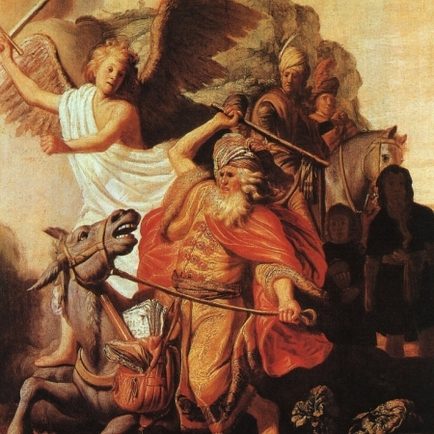
    Now he was riding on the donkey, and his two servants were with him. 23 And the donkey saw the angel of the Lord standing in the road, with a drawn sword in his hand. And the donkey turned aside out of the road and went into the field.

    And Balaam struck the donkey, to turn her into the road. 24 Then the angel of the Lord stood in a narrow path between the vineyards, with a wall on either side. 25 And when the donkey saw the angel of the Lord, she pushed against the wall and pressed Balaam’s foot against the wall.

    So he struck her again. 26 Then the angel of the Lord went ahead and stood in a narrow place, where there was no way to turn either to the right or to the left. 27 When the donkey saw the angel of the Lord, she lay down under Balaam.

    And Balaam’s anger was kindled, and he struck the donkey with his staff.


    Balaam’s hopes for the inauguration

    Balaam certainly expected a reward at the end the journey of about 400 miles. rather than trouble at the beginning. Perhaps this new year will offer us opportunity to consider Balaam’s failure to go forward without listening to God.

    [ctt title=”Do your New Year\’s goals include God?” tweet=”What path does the LORD lead you to follow this year?” coverup=”6Gmbd”]

    28 Then the Lord opened the mouth of the donkey, and she said to Balaam, “What have I done to you, that you have struck me these three times?” 29 And Balaam said to the donkey, “Because you have made a fool of me. I wish I had a sword in my hand, for then I would kill you.”


    Again, let’s overlook the humor for a moment of an ass rebuking a prophet of God. And while we are at it, let’s not be so quick to miss that God can make an ass speak that is obedient to His will, when a man will not speak God’s will (as a prophet is expected to do).


    30 And the donkey said to Balaam, “Am I not your donkey, on which you have ridden all your life long to this day? Is it my habit to treat you this way?” And he said, “No.”

    31 Then the Lord opened the eyes of Balaam, and he saw the angel of the Lord standing in the way, with his drawn sword in his hand. And he bowed down and fell on his face. 32 And the angel of the Lord said to him, “Why have you struck your donkey these three times? Behold, I have come out to oppose you because your way is perverse before me.

    Are your ways contrary to the Lord?

    The leaders of Midian and the leaders of Moab led lives in opposition to the Lord. Their sacrifices to idol gods offended the Lord. (Surely Balaam knew of this.)

    Like Abraham he was willing to travel this great distance. Unlike Abraham, Balaam traveled because he refused to listen to command of the Lord. Even so, the Lord was merciful here and spared Balaam’s life.


    Balaam – Inauguration of a Politician’s Prophet – To be continued…