What have we observed most in Luke’s early accounts of Acts?
Clearly, the further power of the Holy Spirit, which Luke also notes in his Gospel as having descended on Jesus.
And the Holy Ghost descended in a bodily shape like a dove upon him, and a voice came from heaven, which said, Thou art my beloved Son; in thee I am well pleased… And Jesus being full of the Holy Ghost returned from Jordan, and was led by the Spirit into the wilderness, Being forty days tempted of the devil.
"Holy" AND "Spirit"
occurs 111 times in 53 verses in your custom selection ' in 'Luke-Acts'' in the NASB20.
Source: BlueLetterBible.orgREAD ALL fifty-three verses recorded by Luke and you will be convinced not only of the Trinity, but also of the POWER of the HOLY SPIRIT of the Lord God.
https://talkofjesus.com/acts-of-the-holy-spirit/
ACTS 1 opens with Jesus’ Promise of the Holy Spirit.
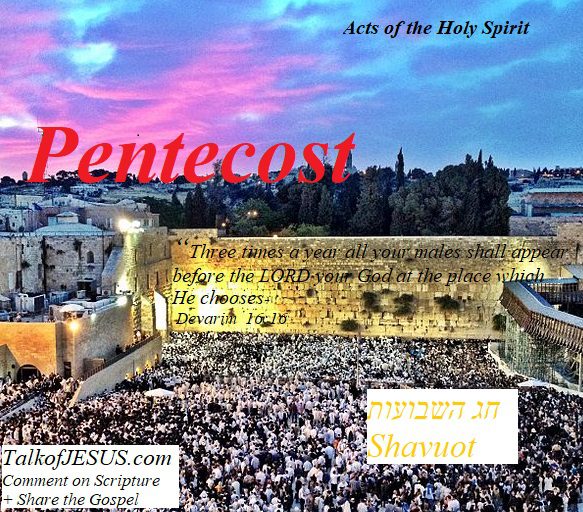
On the day of Pentecost the crowds in Jerusalem witness with wonder the AWESOME power of the Holy Spirit!
Although the HEADING for ACTS 2 in one of my Bibles refers to The Coming of the Holy Spirit, from the next HEADING, Peter’s Sermon at Pentecost, we learn of the convicting POWER of the Holy Spirit in Peter’s words.
“Therefore let all the house of Israel know assuredly that God has made this Jesus, whom you crucified, both Lord and Christ.”
Acts 2:36 NKJV
A pall of silence most likely falls upon many in the massive crowd listening to Peter as he stands with all the Apostles and preaches Christ crucified and risen from the power of death.
Now when they heard this, they were pierced to the heart,
and said to Peter and the rest of the apostles,
“Brothers, what are we to do?”
Acts 2:37 NASB
J.B. Phillips paraphrases this passage following Luke’s account of Peter’s sermon:
When they heard this they were cut to the quick, and they cried to Peter and the other apostles, “Men and fellow-Jews, what shall we do now?”
Sounds painful, reminding us of reference to Jesus’ gruesome crucifixion on a Cross preceding the previous Passover ‘festival’ of the Jews.
Yet one of the soldiers pierced His [Jesus‘] side with a spear, and immediately blood and water came out.
Gospel of John 19:34
Perhaps some of these Jews hearing Peter’s sermon were sadly present during the storm of Jesus’ death and the piercing of His side with a Roman spear.
The Prophet Isaiah had said (as the Jews well knew):
But He was pierced for our offenses, He was crushed for our wrongdoings; The punishment for our well-being was laid upon Him, And by His wounds we are healed.
Luke uses a word for ‘pierced‘ which implies ‘wounded in conscience,’ a conviction of the power of the Holy Spirit in Peter’s preaching from the word of God which the crowds in Jerusalem knew well. Later, the letter written to the Hebrews reminds the faithful:
For the word of God is living and active, and sharper than any two-edged sword, even penetrating as far as the division of soul and spirit, of both joints and marrow, and able to judge the thoughts and intentions of the heart.
YES, Peter’s sermon pierces their hearts by the power of the Holy Spirit.
HOLY SPIRIT POWER
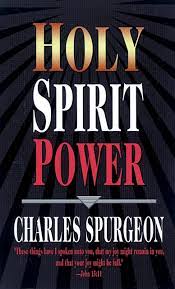
Because the HOLY SPIRIT is so important to Luke’s continuing account in Acts of the Apostles, before we proceed with Peter’s brief answer I would like to quote the powerful nineteenth century English preacher, Charles Spurgeon.
Please note Spurgeon’s brief outline about the Third Person of the Trinity.
One. Comforter
When Christ was on earth, He must have been the consolation of all those who were privileged to be His companions.
Spurgeon – Holy Spirit Power opening paragraph
This certainly would include Peter and the eleven now at his side on Pentecost – RH
In speaking of the Resurrection, from John 16 & 14, Spurgeon relates:
He would not leave those few poor sheep alone in the wilderness. He would not desert His children and leave them fatherless. Before He left, He gave soothing words of comfort.
Spurgeon then goes on to introduce the paraclete or comforter
Jesus had told them that the Father would give them ‘another comforter‘ [helper or advocate] to be with them forever.
Peter, our Pentecost preacher today, certainly felt this comfort once Jesus asked him if he loved Him AFTER the Lord once again appeared to them. Jesus commanded them that they should not depart from Jerusalem, but wait for the promise of the Father, with His Power to convict.
First, God the Holy Spirit is our very loving Comforter.
He delegates a portion of His power to His creatures, yet it is still His.(Quoting Psalm 19:4-5)
C.S. Spurgeon – Holy Spirit Power
Just take this in for a moment .. before we return to the crowds converted by Peter's Pentecost Sermon. - RH
Spurgeon goes on to explain three ways he will look at the Power of the Holy Spirit.
The outward and visible displays of it,
the inward and spiritual manifestations of it,
and the future and expected works of it.
Three: THE HOLY SPIRIT – THE GREAT TEACHER
We will not get there today as we observe the crowds of Pentecost, but the teaching of the Apostles will become immediately evident as the church grows throughout Acts.To READ HOLY SPIRIT POWER click here to order.
Repent!
“Men and brethren, what shall we do?”
Acts 2:37b NKJV
Peter replied, “Repent and be baptized, each of you, in the name of Jesus Christ for the forgiveness of your sins,
and you will receive the gift of the Holy Spirit.
For the promise is for you and for your children,
and for all who are far off, as many as the Lord our God will call.”
How does the anointed follower of Jesus Christ answer the unanswerable questions from the multitudes? Luke records not only the truly awesome events of Pentecost and bewilderment by the crowds, but also the Apostle Simon Peter’s amazing answer to thousands gathered in Jerusalem.
Previously: We witnessed the Holy Ghost in a crowded upper room.
(I spoke last time how we might more appropriately [from the KJV] view the Holy Ghost and cloven tongues like as of fire lighting on each one.)
One hundred together as one in prayer in the upper room in Jerusalem receive the Holy Spirit!
We now join the Twelve as they move on into the crowds on the busy streets of Jerusalem and multitudes in the Temple.
Acts of Perplexed Jerusalem Crowds on Pentecost
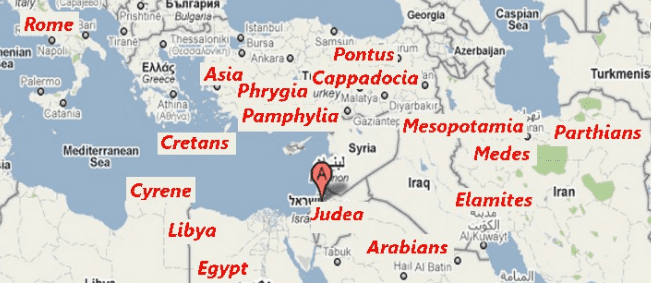
Now there were Jews residing in Jerusalem, devout men from every nation under heaven.
Acts of the Apostles 2:5 NASB
(Not so different from the crowds of a single Sunday of a 21st century Christmas or Easter festival, is it?)
NOTE on Population of Jerusalem [~80,000, possibly swelling above 100,000 during the three festival weeks]
- Jewish historian Josephus, who would know because he had lived there during the 60s AD, estimated the number of Pharisees alone to be 6,000 (Josephus, Antiquities of the Jews, 17.42) -* recommended source
Amazed and Astonished
Image an extended and formal debate between two devout religious officials (perhaps a Pharisee and and Sadducee) wondering how Simon Peter and these other lowly uneducated followers of Jesus from ‘up north’ could possibly speak to others in another language.
And they were all amazed and marvelled, saying one to another,
Behold, are not all these which speak Galilaeans?
Acts 2:7 KJV
Of course earlier Luke showed us debate with Jesus by perhaps some of the same ‘devout men’ who some attend these very public festivals just for the wine, prestige or public parties.
They were amazed (beside ones self to explain it, as I pointed out last time) and astonished G2296)].
This is the same reaction of Peter and others to the risen Christ, which Luke records in his first account.
And when He [Jesus] had said this, He showed them His hands and His feet. While they [the Apostles] still could not believe it because of their joy and astonishment G2296, He said to them, “Have you anything here to eat?”
Gospel of Luke 24:40-41 NASB20 – Strong’s G2296 – thaumazō
Luke describes the reaction of these men on Pentecost with this same adjective which John employs for an earlier debate of Jesus’ with Nicodemus about the same Holy Spirit which had anointed the Apostles this day.
“Do not be G2296 amazed G2296 that I said to you, ‘You must be born again.’
“The wind blows where it wishes, and you hear the sound of it, but you do not know where it is coming from and where it is going; so is everyone who has been born of the Spirit.”
“Truly, truly, I say to you, unless someone is born of water and the Spirit G4151, he cannot enter the kingdom of God. That which has been born of the flesh is flesh, and that which has been born of the Spirit G4151 is spirit G4151.
Gospel of John 3:5-6 – Jesus teaches Nicodemus on the Holy Spirit [G4151]
Debate about Peter & the Apostles
“Look, aren’t all these who are speaking Galileans?
—we hear them declaring the magnificent acts of God in our own tongues.”
“What does this mean?”
But others were jeering and saying, “They are full of sweet wine!”
Acts of the Apostles 2:13 NASB
14 But Peter, taking his stand with the other eleven [now including Mathias], raised his voice and declared to them:
“Men of Judea and all you who live in Jerusalem, know this, and pay attention to my words. For these people are not drunk, as you assume, since it is only the third hour of the day [that is, 9 o’clock in the morning]..
As Luke has already told us, the crowds include hundreds of ‘devout men from every nation under heaven.’
Certainly these religious leaders had been led to the Apostles by the sound of the Spirit. Although you may not recall the words of ‘this Galilean,’ these devout Jews will know the Scriptures Peter is about to preach.
..On the contrary, this is what was spoken through the prophet Joel:
Blow a trumpet in Zion, And sound an alarm on My holy mountain! Let all the inhabitants of the land tremble, For the day of the Lord is coming; Indeed, it is near, 2 A day of darkness and gloom, A day of clouds and thick darkness..
21 Do not fear, land; shout for joy and rejoice, For the Lord has done great things..
The fig tree and the vine have yielded in full. 23 So shout for joy, you sons of Zion, And rejoice in the Lord your God; For He has given you the early rain for your vindication..
28 It will come about after this That I will pour out My Spirit on all [flesh] mankind; And your sons and your daughters will prophesy, Your old men will have dreams, Your young men will see visions. 29 And even on the male and female servants I will pour out My Spirit in those days..
For on Mount Zion and in Jerusalem There will be those who escape, Just as the Lord has said, Even among the survivors whom the Lord calls.
The Prophesy of Joel 2:28-29, 32b *2:28 begins as v.3:1 in Hebrew
Acts 2:
17 ‘And it shall be in the last days,’ God says, ‘That I will pour out My Spirit on all mankind; And your sons and your daughters will prophesy, And your young men will see visions, And your old men will have dreams; 18 And even on My male and female servants I will pour out My Spirit in those days, And they will prophesy. 19 And I will display wonders in the sky above And signs on the earth below, Blood, fire, and vapor of smoke. 20 The sun will be turned into darkness And the moon into blood, Before the great and glorious day of the Lord comes. 21 And it shall be that everyone who calls on the name of the Lord will be saved.’
Peter’s Amazing Answer from Scripture
Jesus’ Apostle Simon Peter speaks to his fellow faithful Jews, many men gathered to hear from the place of this loud noise some explanation for this amazing sign.
Do you recall the interchange between Judeans near Jesus’ trial and Peter? The Apostle knows first hand how they associate Galileans (and Samaritans) as lesser Israelites of David’s line.
“Men of Israel, listen to these words:
Jesus the Nazarene, a Man attested[proven] to you by God[theos] with miracles [dynamis, power], and wonders[a prodigy, portent or omen] and signswhich God performed through Him in your midst, just as you yourselves know— this Man, delivered over [to enemies, or to the power, the will, of some one] by the predetermined plan and foreknowledge of God, you nailed to a cross by the hands of godless men and put Him to death.
The astounded men in the crowd must have wondered:
Do these men have this same Power [dynamis] which they have just heard?
Will this Disciple of Jesus now addressing so many continue with his opening indictment?
Yes, and Peter continues with yet another amazing witness of these historic events:
But God raised Him [the man attested, Jesus of Nazareth] from the dead, putting an end to the agony of death, since it was impossible for Him to be held in its power.
Acts of the Apostles 2:24 NASB
THIS SPEAKER [PETER] HAS JUST TOLD MEN WHO NAILED JESUS TO A CROSS JUST FIFTY DAYS AGO THAT THIS MAN [JESUS] COULD NOT BE HELD BY THE POWER OF DEATH!
Peter then returns to Scripture in order to present the Jews an understanding of the Lord and their Messiah, Jesus.
Son of David
Luke has already told those who have read in his Gospel account:
He shall be great, and shall be called the Son of the Highest: and the Lord God shall give unto him the throne of his father David: And he shall reign over the house of Jacob for ever; and of his kingdom there shall be no end.
Gospel of Luke 1:32-33 KJV
The Apostle Simon Peter begins here by addressing the house of Jacob by saying, “men of Israel.”
“For David says concerning Him:
‘I foresaw the LORD always before my face, For He is at my right hand, that I may not be shaken.
Protect me, God, for you are my refuge. I said to Adonai, “You are my Lord; I have nothing good outside of you.”
7 I bless Adonai, my counselor; at night my inmost being instructs me. 8 I always set Adonai before me; with him at my right hand, I can never be moved;
Certainly, the Apostle must have paused here..
Peter no doubt would have surveyed the eyes of those men in the crowd revealing the impact of the Spirit through these Scriptures upon their hearts.
Brothers
Peter, this lowly Galilean addressing multitudes of devout men (with their wives and families gathered beside them for this Jewish festival celebrated fifty days after Passover), now addresses these Judeans, Israelites and faithful pilgrims in Jerusalem endearingly as ‘brothers.’
ἀδελφός - Strong's G80 - adelphos
- From ἄλφα (G1) (as a connective particle) and delphus (the womb) - a brother (literally or figuratively) near or remote i.e. a fellow believer,united to another by the bond of affection
Don’t miss the personalness of the Apostle’s appeal to those convicted by the Spirit.
Men and brethren, let me freely speak unto you of the patriarch David, that he is both dead and buried, and his sepulchre is with us unto this day.
Since he was a prophet, he knew that God had sworn an oath to him to seat one of his descendants on his throne.
Seeing what was to come, he [David] spoke concerning the resurrection of the Messiah:
He [the Christ] was not abandoned in Hades, and his flesh did not experience decay.
Acts 2:30-31 CSB [also linked above with KJV & NASB]
Luke’s account here in the King James Version brings to mind the familiar genealogy from the opening of his Gospel.
“..that of the fruit of his loins, according to the flesh [that is: from David’s descendants], he [Yᵊhōvâ] would raise up Christ to sit on his [David’s] throne..”
The Apostle Peter reveals to the multitudes through Scripture they know well:
DAVID, King over a United Kingdom of Israel a thousand years ago — David who was also a PROPHET — predicted the resurrection of Israel’s Messiah.
Then Peter, with the eleven other Apostles who have also shown the crowds signs of speaking in their own native languages standing at his side, confirms their own personal witness to ALL:
We witnessed Jesus’ resurrection!
[Brethren, Peter has already addressed them]:
“It is this Jesus [iēsous] whom God [theos] raised up, a fact to which we are all witnesses.
Just picture what some men and women among the multitudes must have thought hearing this!
Peter has already restated David’s prophesy, in addition to quoting the prophet Joel. Now the Apostle proceeds to the logical conclusion:
Therefore, since He [Jesus] has been exalted at the right hand of God, and has received the promise of the Holy Spirit from the Father, He has poured out this which you both see and hear.
Acts of the Apostles 2:33 NASB
34 For it was not David who ascended into the heavens, but he himself says:
Peter quotes David to affirm his conclusion from PSALM 110:1
The Lord declared to my Lord, ‘Sit at my right hand until I make your enemies your footstool.‘
Therefore let all the house of Israel know for certain that God has made Him both Lord and Christ—this Jesus whom you crucified.”
Acts of the Apostles 2:36 NASB – Conclusion of Peter’s sermon
THIS IS THE END OF PETER’S SERMON.
“No it’s not,” you say.
"This can't be the end of Peter's sermon, because the Apostle has more to add."
While it is true that Luke adds an important interaction between Peter and someone from the crowd, allow me to ask you this:
Doesn’t your pastor END the words of his sermon without interchange or response from his church audience?
(We don’t hear Peter say, “Let us pray,” or “Amen.”
The crowds did not see Peter walk away from the pulpit as his praise band begins a song.)
NEXT:
Like some moments following contemporary sermons in the Spirit, worship continues in the hearts of some. The Apostle’s speech certainly is guided by Scripture, but primarily Peter preaches by the HOLY SPIRIT. So the question which follows from the crowd, also the work of the Spirit in the hearts of men, will bring Peter to continue with a powerful answer.
Next, we will hear Peter’s answer to pierced hearts.
Matthias fills a position of an Apostle from off the bench (so to speak) as a substitute for Judas who had betrayed Christ and then took his own life. This new Twelfth Apostle gets little mention as we could readily move on to some of the more miraculous events of Acts. (Luke mentions Matthias only twice in these verses.)
What I missed before Peter’s great preaching at Solomon’s Portico in the Temple was the Apostle’s taking up the mantle of leadership of the Church in an upper room in Jerusalem.
Peter Preaching in the Upper Room
After Ten Days Peter finally Acts: Shepherding Christ’s Flock
The Apostles & others have waited ten days after Jesus’ ascension.
And in those days Peter stood up in the midst of the disciples, and said, (the number of names together were about an hundred and twenty,)
Acts 1:15 KJV *Note: μαθητής – mathētēs translated as disciples in the KJV refers to learners of a teacher, not to be confused with Apostles; other versions translate as ἀδελφόςadelphos–generally translated as brethren (in Christ)
Why replace Judas?
After a hundred disciples of Jesus returned to Jerusalem and waited together, we can suppose that the Holy Spirit reveals to Simon Peter why Judas must be replaced by a twelfth Apostle.
“Brothers, the Scripture had to be fulfilled, which the Holy Spirit foretold by the mouth of David concerning Judas, who became a guide to those who arrested Jesus. For he was counted among us and received his share in this ministry.”
Acts of the Apostles 1:16-17 NASB – Simon Peter preaching to the hundred in Jerusalem
What had David said that applied to Judas now, a thousand years later?
Peter preaches by the same Holy Spirit who inspired David of what is written in the Psalms.
.. the Holy Spirit through the mouth of David foretold about Judas, who became a guide to those who arrested Jesus.17 For he was one of our number and shared in this ministry.”
18 Now this man acquired a field with his unrighteous wages. He fell headfirst, his body burst open and his intestines spilled out. 19 This became known to all the residents of Jerusalem, so that in their own language that field is called Hakeldama (that is, “Field of Blood”). 20 “For it is written in the Book of Psalms:
Let his dwelling become desolate; let no one live in it; and Let someone else take his position.
Recalling Judas’ betrayal in the upper room and in Gethsemane
In his first account Luke records Judas’ betrayal of Jesus nearly two months prior to Peter anointing his replacement shortly after Christ’s ascension into heaven.
Then entered Satan into Judas surnamed Iscariot, being of the number of the twelve..
“This cup, which is poured out for you, is the new covenant in My blood.
But behold, the hand of the one betraying Me is with Mine on the table. For indeed, the Son of Man is going as it has been determined; but woe to that man by whom He is betrayed!”
Gospel of Luke 22:21-22 – Jesus foretells His betrayal by Judas at the last supper
That fateful night two months past in Gethsemane
23 And they began to debate among themselves which one of them it was who was going to do this.
While he was still speaking, suddenly a mob came, and one of the Twelve named Judas was leading them. He came near Jesus to kiss him, but Jesus said to him, “Judas, are you betraying the Son of Man with a kiss?”
49 When those around him saw what was going to happen, they asked,
“Lord, should we strike with the sword?” Then one of them struck the high priest’s servant and cut off his right ear.
(We know that it was Peter who cut off the ear of Malchus.)
51 But Jesus responded, “No more of this!” And touching his ear, he healed him.
Preaching Scripture
Peter had learned well from Jesus the lessons of Scripture for three years.
During more than a month following Jesus’ crucifixion and resurrection the Lord certainly must have instructed His disciples of the great significance of events recorded in the Bible (their Old Testament or Old Covenant).
Luke records Jesus’ routine of teaching in Jerusalem, which Peter and the Apostles most certainly would have followed during these first days of the Church.
Now [days] during the day [Jesus] He was teaching in the temple, but [nights] at evening He would go out and spend the night on the [hill] mountain that is called [Olive Grove] Olivet.
And all the people would get up very early in the morning to come to Him in the temple to listen to Him.
Gospel of Luke 21:37-38 NASB [incl. footnotes]
Did you miss this during all the times you have heard the gut-wrenching drama of Christ’s Passion during the Lord’s last week in Jerusalem?
A Psalm of David. God of my praise, Do not be silent!
.. In return for my love they act as my accusers; But I am in prayer.
So they have [laid uponme] repaid me evil for good, And hatred for my love.
May his days be few; May another take his office.
Psalm 109:8 NASB – quoted by Peter in Acts 1:20
Peter connects David’s Psalm to Judas
Acts 1:
14 They all were continually united in prayer..
Now Peter by the Holy Spirit speaks of replacing the Apostolic office of Jesus’ betrayer.
21 “Therefore, from among the men who have accompanied us during the whole time the Lord Jesus went in and out among us— beginning from the baptism of John until the day he was taken up from us—from among these, it is necessary that one become a witness with us of his resurrection.”
YES, during the three years of Jesus’ earthly ministry MANY disciples followed the Lord, believed His teaching and witnessed His acts of miraculous signs only possible through the Lord God.
So they proposed two: Joseph, called Barsabbas, who was also known as Justus, and Matthias.
A helpful early church history linked below provides insight about casting lots used by the Apostles to choose Matthias over Joseph.
It was crucial to the remaining 11 Apostles that the number 12 Jesus had chosen be completed again. They chose as candidates two equally qualified disciples, prayed, cast lots and Matthias was chosen.
Sandra Sweeny Silver – EARLY CHURCH HISTORY—LIFE IN ANCIENT ROME & THE EARLY CHRISTIANS – CASTING LOTS IN THE BIBLE
24 And they prayed and said,
“You, Lord, who know the hearts of all people, show which one of these two You have chosen to [take the place of] occupy this ministry and apostleship from which Judas turned aside to go to his own place.”
And they [gave] drew lots for them, and the lot fell [upon]to Matthias; and he was added to the eleven apostles.
Acts of the Apostles 1:26 NASB – the selection of Matthias as a twelfth Apostle
Matthias
Μαθθίας
Matthias = “gift of God” -the apostle elected to fill the place of the traitor Judas [Acts 1:23, 26]
– apparently a shortened form of G3161; Matthias (i.e. Mattithjah), an Israelite:—Matthias.
Mattathias = “gift of Jehovah”
the son of Amos, in the genealogy of Christ
Mattathias was the son of Semei in the genealogy of Christ
LUKE records in his Gospel genealogy, beginning at 3:23
And Jesus himself began to be about thirty years of age, being (as was supposed) the son of Joseph, which was the son of Heli, which was the son of Matthat, which was the son of Levi.. which was the son of Mattathias, which was the son of Amos.. which was the son of Maath, which was the son of Mattathias, which was the son of Semei.. which was the son of Nathan, which was the son of David.. [ etc.. ] the son of Adam, which was the son of God.
Mattithiahoccurs in 8 verses in the KJV, always a son of the priestly line of the Levites.
Matthias – a post script
We do not read of Matthias again in Acts or the pastoral letters; but aren’t you wondering what awaited this important Apostolic ministry for this new twelfth Apostle?
Here is a reliable, little-spoken historical account (though not by Luke).
The Apostles in Jerusalem & all the world
About two thousand Christians, with Nicanor, one of the seven deacons, suffered martyrdom during the “persecution that arose about Stephen.”
God-willing, we will read more about Steven in Acts 7.
James the son of Zebedee was martyred about ten years later in A.D. 44.
As mentioned in my introduction to Acts, Luke had not yet recorded even his Gospel until about A.D. 60.
Philip thrown into prison [in Phrygia] , and afterwards crucified, A.D. 54.
The Apostle and Gospel-writer Matthew was slain with a halberd [a two-handed battle axe] in the city of Nadabah, [Ethiopia] A.D. 60.
At the age of ninety-four [James the Less] was beat and stoned by the Jews; and finally had his brains dashed out with a fuller’s club.
Matthias Of whom less is known than of most of the other disciples, was elected to fill the vacant place of Judas.
* Other traditions claim that Matthias was martyred in Cappadocia [modern day Turkey].
-- St. Jerome and the early Christian writers Clement of Alexandria and Eusebius of Caesarea attest that Matthias was among the 72 disciples paired off and dispatched by Jesus. - Source: Britannica
* OR Died c. AD 80
Jerusalem, Judaea or in Colchis (modern-day Georgia)
-- The tradition of the Greeks says that St. Matthias planted the faith about Cappadocia and on the coasts of the Caspian Sea, residing chiefly near the port Issus. Source: Wikipedia
NEXT: The Acts of Pentecost
To be continued...
Cookie Consent
We use cookies to improve your experience on our site. By using our site, you consent to cookies.
Used to monitor number of Google Analytics server requests
10 minutes
__utmb
Used to distinguish new sessions and visits. This cookie is set when the GA.js javascript library is loaded and there is no existing __utmb cookie. The cookie is updated every time data is sent to the Google Analytics server.
30 minutes after last activity
__utmc
Used only with old Urchin versions of Google Analytics and not with GA.js. Was used to distinguish between new sessions and visits at the end of a session.
End of session (browser)
__utmz
Contains information about the traffic source or campaign that directed user to the website. The cookie is set when the GA.js javascript is loaded and updated when data is sent to the Google Anaytics server
6 months after last activity
__utmv
Contains custom information set by the web developer via the _setCustomVar method in Google Analytics. This cookie is updated every time new data is sent to the Google Analytics server.
2 years after last activity
__utmx
Used to determine whether a user is included in an A / B or Multivariate test.
18 months
_ga
ID used to identify users
2 years
_gali
Used by Google Analytics to determine which links on a page are being clicked
30 seconds
_ga_
ID used to identify users
2 years
_gid
ID used to identify users for 24 hours after last activity
24 hours
_gat
Used to monitor number of Google Analytics server requests when using Google Tag Manager
1 minute
_gac_
Contains information related to marketing campaigns of the user. These are shared with Google AdWords / Google Ads when the Google Ads and Google Analytics accounts are linked together.
90 days
__utma
ID used to identify users and sessions
2 years after last activity
Marketing cookies are used to follow visitors to websites. The intention is to show ads that are relevant and engaging to the individual user.