Tag: Philadelphia

  • 7 Epistles of John with the same Revelation

    7 Epistles of John with the same Revelation

    ~ A.D. 95 – from Patmos:

    John, Pastor and Elder of the Church at Ephesus

    As we observed in our chronology of ACTS of the Apostles, the Disciple John was a young man when he followed Jesus.

    Now, the Apostle has outlived the other Eleven, Paul, beloved family and many other first generation Christians.

    The Elder John wrote the three short Epistles we are studying about ten years ago, but today we are looking ahead at John’s brief revelation to seven churches.

    I suppose you may not have thought of the introduction to 'The Revelation of Jesus Christ to John' as — SEVEN pointed epistles to 7 different churches. 

    ~ A.D. 80’s – 90’s – a Cultural context for JOHN’s 10 Epistles

    The Greco-Roman world at the close of the first century A.D. was in a state of cultural, philosophical, and religious ferment. Religious syncretism and inclusivism.. ‘the combination of various ideas and beliefs from different sources to form new or aberrant religions. This was the age of developing mystery religions, the age of the occult, the age of the proliferation of Gnostic sects.’

    The MacArthur New Testament Commentary 1-3 John

    Throughout Italy and the broader empire, new challenges arose: major earthquakes in Campania, famine and pestilence in Rome, and volcanic eruptions ranging from Mount Etna to the cataclysmic destruction of Pompeii and Herculaneum by Vesuvius in AD 79.

    The Julio-Claudian dynasty—embodied by Tiberius, Caligula, Claudius, and Nero—witnessed both grand construction projects (like the amphitheater at Alba Fucens) and notorious episodes of tyranny and scandal. .. After Nero’s fall in AD 68, civil war engulfed the empire until Vespasian founded the Flavian line, ushering in reconstruction efforts (such as the Colosseum) and culminating in the more stable governance of Nerva and Trajan by century’s end.

    source: RomanHistory.net

    an A.D. First Century culture of 7 Asian churches

    Do you remember from back in Acts of the Apostles how the Spirit, at first, had instructed Paul NOT to preach in Asia?

    Macedonia
    Acts on Mission to Macedonia

    And do you recall that Ephesus (in Asia) became a major city for Christian worship where later Paul had appointed Timothy as Pastor of the Ephesian Church?

    Paul preaching in Ephesus

    PLACE AND TIME OF WRITING.

    –The best authorities among the Fathers state that John was exiled under Domitian (IRENAEUS [Against Heresies, 5; 30]; CLEMENT OF ALEXANDRIA; EUSEBIUS [Ecclesiastical History, 3.20]). VICTORINUS says that he had to labor in the mines of Patmos. At Domitian’s death, A.D. 95, he returned to Ephesus under the Emperor Nerva. Probably it was immediately after his return that he wrote, under divine inspiration, the account of the visions vouchsafed to him in Patmos ( Rev 1:2, 9 ). However, Rev 10:4 seems to imply that he wrote the visions immediately after seeing them.

    source: Jamieson, Fausset & Brown
    Introduction to Revelation


    The Revelation of Jesus Christ

    which God gave Him

    The Disciple who knew the Lord best refers to GOD THE FATHER simply, as God.

    to show His servants

    that is, the saints or followers of JESUS, bond-servants redeemed by His blood on the Cross

    —things which must shortly take place.


    The Elder writes this same introduction to ALL seven churches who John has shepherded in the Way of Christ Jesus.

    What he means by ‘shortly‘ is much debated in the immediacy of what these beloved saints have endured through the end of this A.D. first century. — Or perhaps God intends this epistle of revelation more millennially for all saints of every age.

    Christ makes certain that Christians know the cost of faith until the unknown Day of His return.


    He made it known by sending his angel to his servant John, who testifies to everything he saw—that is, the word of God and the testimony of Jesus Christ.

    Revelation 1:1b-2 NIV


    The risen and ascended Lord Jesus Christ sends an apokalypsis via and angelic messenger to John on Patmos — and the Elder to these seven churches consequently, by his apostolic duty, sends out this same ‘disclosure of divine things formerly unknown’ and testifies to the truthfulness of what is to follow.

    It makes little difference if John had opportunity to send it from Patmos with a human messenger much in the way the Apostle Paul sent epistles to his churches OR if the Elder would have written it later upon John's return to Ephesus. 

    scroll with seven seals

    “Who is worthy to open the scroll and to break its seals?” – Question of the angel messenger in Revelation 5:2


    a Book Sealed within: Addressed to 7 mortal Elders

    What does John’s epistle enjoin each Elder to do?

    Set aside for a moment the imagery of the apocalypse with its angels, seven stars and seven candlesticks — the Elder John is FIRST to address issues of his own current church. 

    Most Christians know both exhortation and encouragement offered to the seven churches.

    Which ones speak to YOU with some urgency (and hopefully, perhaps, to any Elder of your local church? (So which church looks like yours?)

    Ἐφεσῖνος – Ephesus

    • “I know your works, your labor, and your endurance,
    • and that you cannot tolerate evil people.

    Of course, John knows all this personally.

    And does the Elder imply that the Ephesians will not be inclusive of those who insist on evil works opposed to Christ’s love?

    You have tested those who call themselves apostles and are not, and you have found them to be liars.

    Revelation 2:2 CSB

    And do your Elders test the theology and witness of your church leaders and members?


    And the pattern of this pointed epistle for each church now turns to exhortation and rebuke demanding repentance. 

    “But I have this against you:

    You have abandoned the love [agapē] you had at first.

    Look it up.. IF you don't quite remember what agape love is.

    “Remember then how far you have fallen;

    repent, and do the works you did at first.


    Do YOU? Do christians ever repent more than once (that time we claim to have come to Christ)?

    OR will He return to say, “I never knew you…?’


    “Yet you do have this: You hate the practices of the *Nicolaitans, which I also hate.

    *Revelation 2:6 CSB

    “Let anyone who has ears to hear listen to what the Spirit says to the churches.
    To the one who conquers,
    I will give the right to eat from the tree of life, which is in the paradise of God.

    Revelation of Jesus Christ to John 2:7 CSB

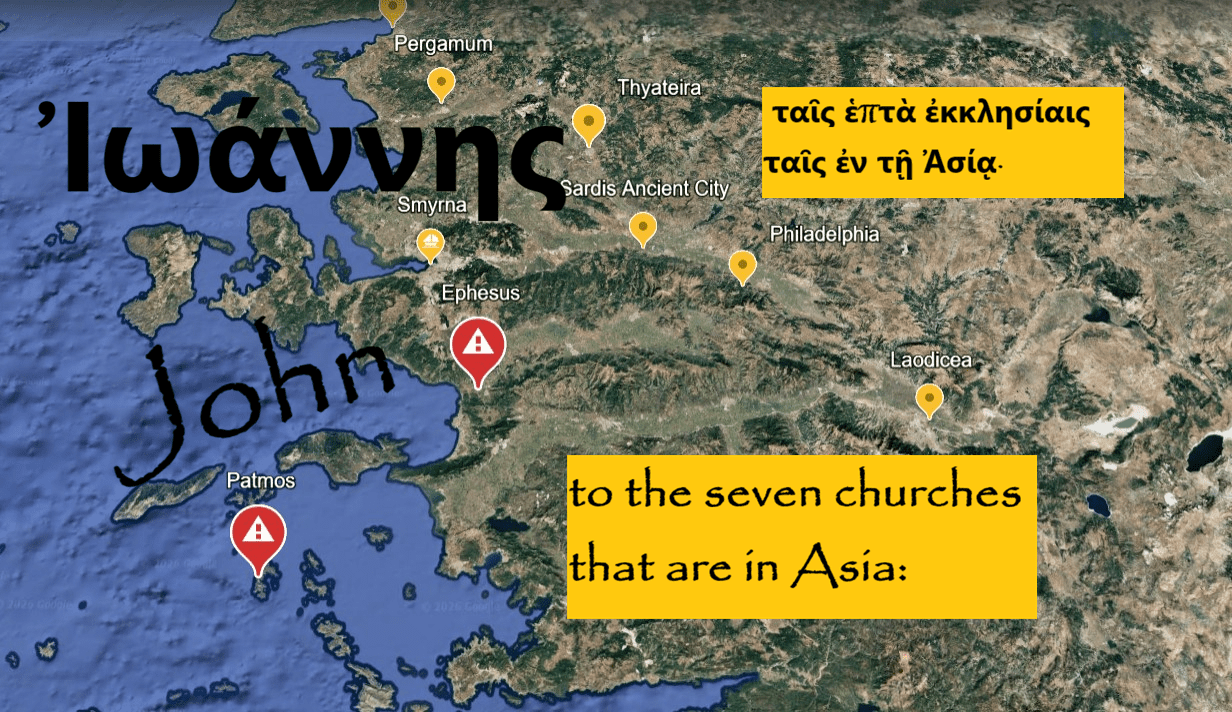
    John to the seven churches which are in Asia: map with cities pictured and the island of Patmos

    Σμύρνῃ – Smyrna

    • “I know your affliction and poverty,
    • but you are rich.
    • I know the slander of those who say they are Jews and are not, but are a synagogue of Satan.

    Do YOU know any who avoid the Name of Christ? Do some swear to be Jew or Christian while afflicting others? Who then, do they truly worship?

    “Don’t be afraid of what you are about to suffer.

    Does your prosperity preacher dare suggest suffering for the Lord Jesus Christ? OR REMIND of the Lord’s Judgment of all?

    The one who conquers will never be harmed by the second death.


    Πέργαμος – Pergamum

    “I know where you live ​— ​where Satan’s throne is.

    .. where Satan lives. [Another mention of the nearby Nicolaitans]

    But I have a few things against you.

    You have some there who hold to the teaching of Balaam, who taught Balak to place a stumbling block in front of the Israelites: to eat meat sacrificed to idols and to commit sexual immorality.

    Again, the common issue *even of this era is worship of idols and fornication. 

    In the same way, you also have those who hold to the teaching of the *Nicolaitans. So repent!

    Otherwise, I will come to you quickly and fight against them with the sword of my mouth.

    Revelation 2:15-16

    “Let anyone who has ears to hear listen to what the Spirit says to the churches.

    Doesn't this even sound like the preaching of JESUS? 
    painting of Hebrews in the wi
    I AM the Bread of Life

    To the one who conquers, I will give some of the hidden manna…

    Revelation 2:27b


    Θυάτειρα – Thyatira

    Just a REMINDER of Who Is speaking:

    Thus says the Son of God,

    the one whose eyes are like a fiery flame and whose feet are like fine bronze:

    Revelation of Jesus Christ to John 2:18b CSB

    • “I know your works ​— ​
    • your love, faithfulness, service, and endurance.
    • I know that your last works are greater than the first.
    Quite an encouragement and blessing to believers.

    “But I have this against you:

    This one thing of importance to the Lord Jesus Christ

    Jezebel

    You tolerate the woman Jezebel, who calls herself a prophetess and teaches and deceives my servants to commit sexual immorality and to eat meat sacrificed to idols. I gave her time to repent, but she does not want to repent of her sexual immorality.

    Revelation 2:20-21 CSB


    WHY is this issue of idolatry so important (in addition to God’s prohibition in the Ten Commandments of worshiping other gods)?

    Ἰεζάβελ – Jezebel – the symbolic name of a woman who pretended to be a prophetess, and who, addicted to antinomianism, claimed Christian liberty of eating things sacrificed to idols.

    Of Hebrew origin אִיזֶבֶל (H348) (used as a synonym of a termagant or false teacher):—Jezabel.

    אִיזֶבֶל

    Jezebel recalls the opposition to the LORD’s prophet Elijah.

    Jezebel = “Baal exalts” or “Baal is husband to” or “unchaste”

    queen of Israel, wife of Ahab, daughter of Ethbaal (King of Tyre)

    It’s a contest of serious consequence between the LORD God and the false gods, false prophetesses, false priestesses — brash and shameless sinners claiming sin as worship of their gods.

    This disaster happened because the people of Israel sinned against the LORD their God who had brought them out of the land of Egypt from the power of Pharaoh king of Egypt and because they worshiped other gods.

    They abandoned all the commands of the LORD their God. They made cast images for themselves, two calves, and an Asherah pole. They bowed in worship to all the stars in the sky and served Baal.

    2 Kings 17:7,16 CSB

    And it all goes back to Ahab and Jezebel in 1 Kings.

    Ahab also made an Asherah pole. Ahab did more to anger the LORD God of Israel than all the kings of Israel who were before him.


    Just one last application from Revelation, the mention of Jezebel, the Nicolaitans and (from a theological definition {above}) - antinomianism.

    Antinomianism is the belief or teaching that since believers are saved by grace through faith, there is no further obligation to follow any moral law or command.

    .. At its core, antinomianism proposes that under the New Covenant, Christians are completely exempt from all moral guidelines because divine grace supersedes any need for abiding by commandments.

    source: Biblehub.com


    John to the seven churches which are in Asia: map with cities pictured and the island of Patmos

    Σάρδεις – Sardis

    I know your works; you have a reputation for being alive, but you are dead.

    Revelation 3:1b CSB

    • “Be alert
    • and strengthen [guard] what remains, which is about to die,
    • for I have not found your works complete before my God.
    • “Remember, then, what you have received and heard;
    • keep it, and repent.
    • If you are not alert, I will come like a thief, and you have no idea at what hour I will come upon you.

    “But you have a few people in Sardis who have not defiled their clothes, and they will walk with me in white, because they are worthy. In the same way, the one who conquers will be dressed in white clothes, and I will never erase his name from the book of life but will acknowledge his name before my Father and before his angels.

    Revelation 3:4-5

    And the Lord Jesus again seals His warning to the Sardinian church calling on the MANY to follow the example of the FEW.

    “Let anyone who has ears to hear listen to what the Spirit says to the churches.

    Revelation 3:5 CSB


    Φιλαδέλφεια – To the Church in Philadelphia

    Permit me first to remind you that simply as the name, Christian, witnesses the Name of Christ; Philadelphia or Philedelphos φιλάδελφος witnesses [From φίλος (G5384) and ἀδελφός (G80)]as a FRIEND and BROTHER.


    “I know your works.

    Look, I have placed before you an open door that no one can close because you have but little power; yet you have kept my word and have not denied my name.

    Quite a compliment of Christian LOVE of these saintly brothers and sisters in Christ.

    “Note this: I will make those from the synagogue of Satan, who claim to be Jews and are not, but are lying ​— ​I will make them come and bow down at your feet, and they will know that I have loved you.

    A.D. first century followers of the Messiah Jesus considered themselves to be true Jews, who have now been redeemed. And the love they hold in Christ will include Romans (like much of the population of this city of Philadelphia) and Hellenists, Greeks or gentiles as they worship God in truth side by side.

    “Because you have kept my command to endure, I will also keep you from the hour of testing that is going to come on the whole world to test those who live on the earth.

    Revelation 3:10 CSB


    Λαοδίκεια – Laodicea

    And to the angel of the church of the Laodiceans write,

    ‘These things says the Amen, the Faithful and True Witness, the Beginning of the creation of God:

    the Revelation of Jesus Christ to John 3:14 NKJV


    an urgent CAUTION, perhaps, for many a 21st century Common Era christian church claiming Jesus in some lesser way than in Truth.

    “I know your works, that you are neither cold nor hot. I could wish you were cold or hot.

    Revelation 3:15 NKJV

    “So then, because you are lukewarm,

    and neither cold nor hot,

    I will vomit you out of My mouth.

    Laodicea: Lukewarm Prosperity

    • Banking hub, black-wool trade, renowned medical school with eye powder.
    • Water arrived by aqueduct, lukewarm by the time it reached town.
    • After the AD 60 quake, the city rebuilt itself without Rome’s help—boastful self-sufficiency reflected in the church.

    Source: BibleHub.com commentary


    Because you say…

    “I am rich

    and have acquired great wealth,

    and need nothing,”

    but do not realize that you are wretched, pitiful, poor, blind, and naked,

    take my advice

    and buy gold from me refined by fire so you can become rich!

    Buy from me white clothing so you can be clothed and your shameful nakedness will not be exposed,

    and buy eye salve to put on your eyes so you can see!

    Revelation 3:17-18 New English Translation


    Do you know of a Common Era Church like this — so in need of taking this advice from the risen and returning Christ Jesus ?


    LISTEN! Hear His Voice. Open the door of your lukewarm heart. Allow the Lord to give you manna and living water of eternal life.

    Sit on His Throne with Him.. just as He too conquered and sat down with His Father on His throne.

    “Let anyone who has ears to hear listen to what the Spirit says to the churches.”

    the Revelation of Jesus Christ to John 3:22 CSB


    Next: INTRO — 3 Letters (10 yrs earlier) from the Apostle John

  • Hebrews 13 -Remain in Philadelphia

    13:1 ἡ φιλαδελφία μενέτω [menō philadelphia menō]

    Philadelphia?

    ‘Wait,’ you say. Philadelphia – stay in Philadelphia?

    If your familiarity of the New Testament extends beyond the Pennsylvania ‘city of brotherly love’ in the U.S., you may recall the importance of one of the seven churches mentioned in Revelation. Not that Philadelphia either.

    The author of Hebrews has nearly concluded his letter, but we need to address an application of his purpose. By doing so we must first take a look at love as we often misrepresent it in the English language.

    A lesson in love

    C.S. Lewis wrote an important book addressing the translation issues from Greek to English called, “The Four Loves.” (Link to study guide.) For our lesson here I will outline the four Greek words which translate as “love.”

    1. eros – romantic love (which receives much worldly attention)
    2. storge – love for family and affectionate love
    3. agape spiritual love
    4. philia – friendship

    Understand that the Hellenistic or Greek culture was common to Jerusalem, Rome and the world in between. So to hear the word ‘love‘ in Hebrews and other letters of the New Testament and the Gospels as a Greek-speaking believer of the first century church, ask yourself ‘which of the four loves?’

    philia love

    The writer of Hebrews here uses this ‘philia’ love when he writes:

    Let love of the brethren continue.

    Hebrews 13:1 NASB

    Paul urges this same philia love of friendship in Romans 12:10-11.

    Be devoted to one another in brotherly love; give preference to one another in honor..

    Consider any urging of ‘brotherly love’ or ‘love for the brethren’ as φιλαδελφία translated to english as: philadelphia.

    agape love

    Earlier in Hebrews 6 we also encountered agape spiritual love.

    For God is not unjust so as to forget your work and the love which you have shown toward His name, in having ministered and in still ministering to the saints.

    Hebrews 6:10 NASB

    The author reinforces a call to this same spiritual love in Hebrews 10:24

    .. and let us consider how to stimulate one another to love and good deeds..

    Yet these loves overlap even in a Greek understanding of love. Occasionally one type of love illustrates a desired characteristic of another.

    Jesus uses a tense of agape love for His closest friends and Disciples in a command specific to them, yet applicable to all believers.

    αὕτη ἐστὶν ἡ ἐντολὴ ἡ ἐμή ἵνα ἀγαπᾶτε ἀλλήλους καθὼς ἠγάπησα ὑμᾶς

    “This is My commandment, that you love [agapaō] one another, just as I have loved [agapaō] you.

    John 15:12 Greek, NASB

    Could any command of our Lord hold more importance?

    In Christ spiritual brothers become family

    This spiritual love secured by our Lord Christ Jesus, of persons requires us to welcome, to entertain, to be fond of, to love dearly our brothers and sisters bound by our faith as His church.

    The author of Hebrews therefore encourages us that by this very love in Christ, we are different from everyone else.

    Of course our storge love for family and philia friendships rise to a higher good as well. And love’s action, ἀγάπη agapē, ofter translated ‘charity‘ derives from this grace-filled love of our spiritual relationship with God.

    Philadelphia: Remain in the Lord’s place of brotherly love, which witnesses our Lord’s own affection for the brethren (fellow-believers). Its adjective implies kindhearted.

    Hebrews 13:

    • 2 Don’t neglect to show hospitality,
    • 3 Remember those in prison..
    • the mistreated…
    • “as though you suffered with them.”
    • Honor marriage (pointing to eros as God intended).
    • Be satisfied with what you have…

    Once again the writer quotes scripture:

    I will never leave you or abandon you.

    Hebrews 13:5B, quoting Deuteronomy 31:6

    7 Remember your leaders who have spoken God’s word to you. As you carefully observe the outcome of their lives, imitate their faith.

    Jesus Christ is the same yesterday, today, and forever.

    Don’t be led astray by various kinds of strange teachings; for it is good for the heart to be established by grace…

    Hebrews 13:8-9a

    Our Altar in the Enduring City

    10 We have an altar from which those who worship at the tabernacle do not have a right to eat.

    Even Moses was unable to enter when the glory of the LORD filled the tabernacle, for it is the holy place where God accepts the sacrifice of man.

    The author of Hebrews illustrates that the blood is brought into the most holy place by the high priest as a sin offering is not a complete sacrifice. He make a point to show us the fate of the sacrificed bodies. 11 For the bodies of those animals… [from which the blood of the sin offering was sacrificed] are burned outside the camp.

    Abel Grimmer [Public domain]
    The Road to Calvary

    Therefore, Jesus also suffered outside the gate, so that he might sanctify the people by his own blood.

    Hebrews 13:12 CSB

    Go to Christ outside the camp

    A works-driven Judaism, catholicism or easy christianity draw us to the victory procession of the king entering the city. Crowds will follow any easy path to the high hill of victorious faith.

    Jesus falls carrying Cross out of Jerusalem to Golgotha

    Yet those same expectant masses who laid palms before Jesus chastised a bloodied and beaten Son of Man as He was lead away from the city to the hill of Golgotha.

    Isaiah tells us: He bore the reproach for our sin. To this end, by our humble worship we must also take up His Cross to follow Jesus.

    The author of Hebrews therefore leads us to worship our Perfect High Priest following His path of reproach for our sake. His earlier mention of this reproach was in Hebrews 11.

    Let us therefore go forth to him outside of the camp, bearing his reproach.

    Hebrews 13:13 HNV

    14 We do not have enduring city here…

    True then of Jerusalem and more so true now of our own 21st century city of destruction. Our call to the path from the city therefore:

    … we seek the one to come.

    in conclusion

    Heaven is not found on the heights of our successes in faith, but on the humbling path of scorn where Christ bore our sin and death.

    We have a new High Priest of a New Covenant with God, the Father of all.

    Therefore, through him let us continually offer up to God a sacrifice of praise, that is, the fruit of lips that confess his name.

    Hebrews 13:15 CSB

    17 Obey your leaders and submit to them, since they keep watch over your souls as those who will give an account, so that they can do this with joy and not with grief, for that would be unprofitable for you.

    With this final caution the author concludes his letter to the Hebrews, having only to request prayers and leaving words of his blessing.

    Letter to the Hebrews: To be concluded...
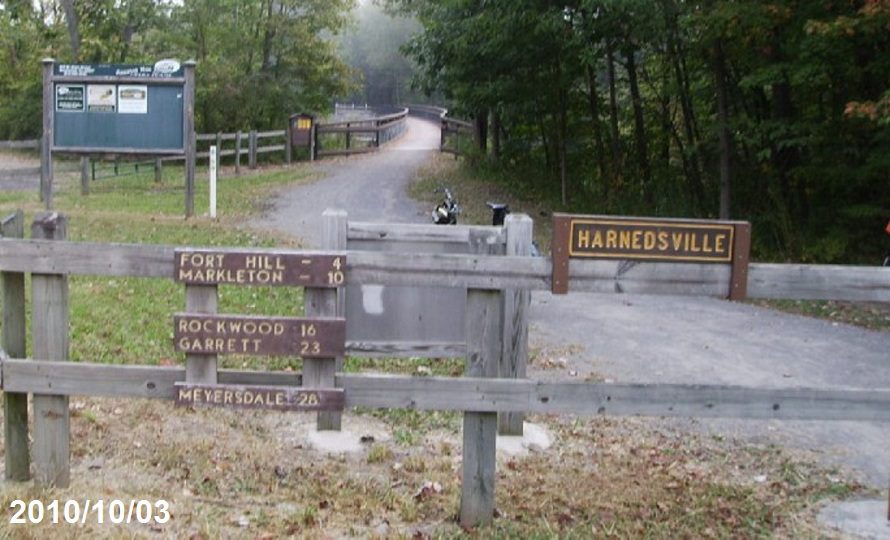
  • Harnedsville – Some Pennsylvania History (c.1763-1783)

    Harnedsville – Some Pennsylvania History (c.1763-1783)

    PROLOGUE: My last “blog” post about my personal history was about Cortland Ohio. It featured my hometown and my Grandfather, William Alba Harned.

    My father was born in Conneaut Lake, Pennsylvania. Both of his grandfathers had farms there and as a young boy I visited western Pennsylvania frequently. For now we will skip the generation of my dad, William E. Harned, who recently celebrated his 90th birthday, to take a look back further into some more general history.

    Without boring you with generations of the Harned family tree or names that go back to an Edward Harned, who left Sandwich England for an English colony of Massachusetts, or stringing my connecting generations through New Jersey and other parts of Pennsylvania; I want to share a (rather long) excerpt of context of Pennsylvania history, all from one source. I trust you American history buffs will enjoy some of this.

    Link below to full article on Somerset Co. PA, location of Harnedsville PA 15424

    HARNED family – Some Pennsylvania History –Excerpt.

    We pick up the story of William Penn’s English lands about 250 years ago. I have highlighted first references to each year to help us follow the timeline of American History.

    Bouquet had met and defeated the Indians at Bushy Run, August 5, 6, 1763, thereby shattering Pontiac’s dream of redeeming the wilderness for the Red Man.

    CHAPTER IX – No Trespassing

    From a military point of view the lands west of the Alleghenies to the Ohio were now cleared of both French and Indians, and therefore subject to the seeds of English culture. A civilian, viewing the grounds from another angle, saw a hotbed of cross purposes. There were the hunter, the trader, the land speculator, the pioneer settler who based his land claims upon squatter rights, and the Indians.

    In 1767 there had been an extension of the Mason and Dixon line which showed that most of these citizens lived within the bounds of Pennsylvania, and a number in the future Somerset County. Sensing inevitable clashes among these people because of their different interests, John Penn, Lieutenant Governor of Pennsylvania, attempted to avert trouble by advising the Assembly to pass a law to remove the people now settled in these parts, and to prevent others from settling in this area of the province.

    With the exception of the strip of land now known as Allegheny, Northampton, Southampton, Fairhope, Larimer, and Greenville Townships, the remaining sections of Somerset County were included in this forbidden territory. Ostensibly the order was to prevent fresh clashes with the Indians from whom this land was not yet purchased.

    Accordingly John Penn appointed the Reverend John Steele of the Presbyterian Church at Carlisle, John Allison, Christopher Lemes, and James Potter to make known and explain the law to the settlers. Leaving on March 2nd, 1768, they traveled by way of Fort Cumberland, and the Braddock Road to the Western settlements.

    The following autumn, November 5, 1768, the Penns made another treaty with the Indians, called the Treaty of Fort Stanwix, in which all the forbidden lands were purchased from the Red Men for the sum of ten thousand pounds.

    After acquiring the Indian title the Penns immediately offered this land for sale for five pounds sterling per one hundred acres, and one penny an acre per annum quit rent. Just who was the first person to receive the first warrant in what is now Somerset County will probably never be known, but there is one warrant in Elk Lick Township that bears the date of April 12, 1769, or just nine days after the opening of the land office.

    CHAPTER X – The Promised Land

    Twenty-five years before the Reverend John Steele was commissioned to remove the settlers from this territory, an entry in an old diary discloses a scene along the Juniata River of a young man and his wife who are determined to “go on The Western Ride to the land of the Turkey Track.”– “they crossed over the river with many calls back and forth of sad farewells, and so off into the woods to the west-running waters.”–“Says he wishes to be reborn again, and so they go to the promised land.”

    More than ten thousand men, including the armies of Washington, Braddock, Forbes and Bouquet, crossed and re-crossed the promised land of Somerset County before there was recorded officially the name of one permanent settler.

    Most of this land was marked, “Indian Territory” on the maps and ledgers of the Penns; therefore anyone living here was, according to the provincial authorities, out of bounds, off the record and disinherited. But to neglect to enter a name on a docket in no wise affected the men and women who were clearing the land, building cabins, and reaping the golden ears from their patches of squaw corn.

    But when the time arrived, April 3, 1769 at 10 o’clock A. M., City of Philadelphia, for the sale of land and the collection of quit rents by the Penns, a survey and inventory of their flocks became a matter of prime importance. The disinherited automatically became bona fide citizens; subject to the benevolent governing powers of the Penns, and taxes.

    CHAPTER XI – Home to the Mountains

    The lure of far away places has always tugged at the heartstrings of people in every land; particularly when their pastures are not so lush. Having heard of the rich mountain valleys that lay among the great folds of the Appalachians, a group of people living along the mosquito infested flats of Essex and Morris counties in New Jersey decided to seek new homes in the virgin wilderness of the Penns’ domain.

    In the spring of 1770 a little band of these discontented settlers loaded their worldly goods upon the backs of their oxen, and started toward new homes in the western mountains.

    Following the general course of Braddock’s Road to the Negro Mountains, they swung into the narrow vale of White’s Creek and thence north to the Valley of the Laurel Hill Creek. Arriving here about the first of May they pitched their tents, after which the “men folks” went forth to select a portion of land on which to build a home for himself and his family. By mutual understanding among themselves each one was to be limited to such quantity of land as he could walk around in a single day. In all there were about eighteen or twenty families. Tradition gives us the names: Robert Colborn, David King, Oliver Drake, William Rush, Andrew Ream, Reuben Skinner, John Mitchell, John Hyatt, William Tannehill, James Moon, Edward Harned, David Woodmancy, John Copp, John McNair, Joseph Lanning, William Brooke, Jacob Strahn, Obadiah Reed, and William Lanning.

    With the Turkeyfoot settlers as their nearest neighbors these families flourished like the green bay tree; establishing permanent landmarks which are now known as the Jersey Settlement, Jersey Church, Draketown, Drake’s Mill and King’s Mill (two of the first grist mills in Somerset County) Harnedsville, forts and block houses which formed the nuclei of the present towns of Ursina and Confluence.

    Apple orchards, cleared lands, and military and civil records are fitting monuments for the spirits of these brave pioneers.

    Signs and symbols, carved in the rocks by the hands of our ancestors, are uncertain accounts of the lives they led. The most expert archaeologists disagree as to their exact meanings.

    Written words bind the past to the present as no other medium can. Unfortunately the early settlers of Somerset County were spare to the point of parsimony in their use of the quill and inkpot.

    Harmon Husband, riding horse back into the Glades in 1771 was farther removed from the Atlantic settlements than the sons of Penn were from the powers beyond the sea. In common with the hunters and a few settlers of the Glades, Husband now belonged to that small band of pioneers who had snapped the last tie that bound them to the traditions of the ages-in short he belonged to the disinherited.

    Before coming to the Glades Husband had spent his early boyhood days in Chester County, Pennsylvania and Cecil County, Maryland. As a young man he went to the province of North Carolina, where he gained property, position, and influence. In the role of a reformer he was instrumental in marshalling the forces of the common people in that province. He called them the Regulators or Sons of Liberty.

    The pivotal issue was taxes.

    Tryon, the provincial governor of North Carolina, was well versed in the well known, universal, and timeless game of subtraction and division; that is, taxing his subjects to the utmost to maintain himself and his small group of satellites in royal style. But Tryon made the fatal mistake, as many have before and since, of over-adjusting the thumbscrews of taxation. The result was rebellion, climaxed by the Battle of Alamance-the first battle of the American Revolution which was fought May 16, 1771. At the sound of the first clash of battle, Harmon Husband, the leader of the Sons of Liberty, jumped on his horse and fled.

    In fairness to Husband, who was a Quaker, indoctrinated with principles which would not allow him to fight, he had the courage of his convictions, and when forced to display these inner truths, there was no show of hypocrisy.

    There is a monument at Hillsboro, North Carolina to twelve of Harmon Husband’s compatriots who were hanged by the neck until they were dead by the British Governor on June 19, 1771, or about the same time that Husband was being reborn and rechristened in the cool shade of a Somerset County maple grove.

    CHAPTER XV – Revolution

    South of the line that forms the lower boundaries of Addison, Elklick, Greenville, and Southampton townships it is conceded that the Battle of Alamance was the first battle of the American Revolution with Harmon Husband as the leader of organized resistance to the British Crown. North of the Mason and Dixon line the poet tells us that it was at Concord where the “shot heard round the world” was first fired on the 19th of April, 1775.

    Both have ample proof for their opinions, while all agree that frontier Americans held high the torch of Liberty, and with their squirrel rifles, defended that light to their death.

    The pioneers of Somerset County (called Bedford County at the time) were no exceptions. Under the command of Captain Richard Brown, with James Francis Moore as first lieutenant, men from the region of the Turkeyfoot, Cox’s Creek Glades, Stony Creek Glades, and along the Forbes Road shouldered their flintlocks and joined Washington’s forces. Few returned.

    The account they gave of themselves is a saga in itself.

    On the home front there was far more excitement than in the year of 1763 when Pontiac let loose his savage wrath. The simple reason for this was that there were many more settlers here during Revolutionary days, and the battle lines were drawn on both sides of the mountains. The ablest fighters had emptied the buck horn racks of the best rifles, and had marched eastward to meet the Red Coats, leaving the older men and boys with worn and rattling flintlocks to guard their cabins and families against Indian raids from the west.

    With the British holding the western military forts it was their strategy to arm the Indians with long rifles, scalping knives, and fire water, and send them to the frontier settlements with murderous intent. The Indians, aided by a few renegade whites, such as the Girtys, cut a staggering red swath through the mountain clearings.

    Express riders, the spearhead of civilian defense, galloping from the Forbes Road to the Cox’s Creek Glades and Brothers Valley shouted to the panic stricken settlers:

    “James Wells from Jenner Fort shot by the Indians! Flee for your lives !” (Autumn of 1776)

    “The Indians have attacked Fort Stony Creek! One of our men killed !” (November 27, 1777)

    “Five people killed by the Indians over against the mountains!” (Shade Township, November, 1777)

    Harmon Husband removed his family to Fort Cumberland, himself returning to his farms near the close of the war to find (March 1783) that the Somerset settlement had not been invaded. By the spring of 1784 nearly all the settlers had returned.

    CHAPTER XVI

    Rum and Rebellion

    The final draft of a peace treaty between England and America was signed on September 3, 1783, leaving the swaggering young Republic to face the cynicism of the adult nations of the world.

    Growing pains of the infant empire were mistaken by the Old World for more serious maladies.

    The Big Three who held the bottle of Soothing Syrup for the wriggling young America were George Washington as President, Alexander Hamilton as Secretary of the Treasurer, and Thomas Jefferson as Secretary of State.

    Hamilton believed in a strong central power that would command the dignity and respect of the “common herd.” Jefferson had ideas of his own. Faced with a $77,000,000 war debt, Hamilton conceived the idea of placing a small tax on all spiritous liquors.

    At the time there were, according to estimates, 5000 distilleries in Pennsylvania with at least 24 within the present bounds of Somerset County.

    Now the idea of government officers entering private homes, measuring the products of the stills and collecting taxes for the same was not, according to the principles of the mountain settlers, among the ideals they had fought for. There was also the spectre of a swarm of these “revenuers” with their hands in the public coffers.

    The reactions of the mountain folk to these measures were mass meetings of protest, and some rather rough handling of Hamilton’s agents.

    CHAPTER XVII – Peace Comes to the Frontier

    The Old West was gone. The frontier that had been the Stony Creek Glades was pushed back to the Ohio and the Mississippi. The log cabin, the long rifle, the axe and the plow took the place of the bark huts and the stone hatchets of the Shawnees and the Mingos. Jehovah watched over the smoking chimneys of the clearings in the forests of the Alleghenies and the Laurel Hills, while Manitou shrieked in vain protest when the winter winds whistled between the black teeth of the spiked stockades.

    The settler’s keen axe was biting deeper and deeper into the bush. Log cabins mushroomed overnight, clustering together, and taking names like Berlin, Somerset, Meyersdale, and Stoystown.

    Whether the war-whoop sounded or not, the result was the same. Fearing to return to their clearings, many of their crops rotted on the vine, promising lean fare for the coming winter.

    Sickness and death have always dogged the footsteps of even the most hardy pioneers. Because no disciple of Hippocrates had come, or remained in the wilderness of Somerset County to aid and comfort the afflicted, each family resorted to healing powers at hand. Every cabin had its herb garden, or lacking that they stripped the bark from the wild cherry, the slippery elm and the sassafras to brew health restoring potions.

    In the days before the little red school house in Somerset County children were brought up in the way that they should go, without specialists to guide or perplex them in the rough hewn paths of learning. Boys were taught early the use of the Dutch scythe, the broad axe, and the flintlock. In the matter of letters few mastered the fine art of the three R’s.

    Those who did were introduced to them by the way of well thumbed Bibles.

    Girls were taught the tunes of the rhythmic whir of the spinning wheels and the intricate steps of the hand loom. One of the first attempts to bring regimented “book larnin’” into settlements of Somerset County was in the year of 1777. James Kennedy, one of Harmon Husband’s indentured servants, who was a poor hand at grubbing and picking brush, was chosen to lead, guide and direct the lives of the little children of the Somerset Settlement. The young schoolmaster, after surveying and questioning his home spun class for a few minutes dismissed school with the admonition, “Och! but you are set of young haythens.”

    Law and order were maintained in the clearings by adhering to the simple and age old verities that have served as cornerstones for civilized societies in all times. Without sheriff or justice, the thief and the liar were humiliated by public condemnation until the culprit sought peace of mind and body in some distant settlement where his sins could not find him. In the matter of more personal offenses against honor and virtue, the score was usually settled by other members of the families involved, in rough and tumble fights which in many cases developed into ear chewing and eye gouging matches.

    The vitriol of female wagging tongues was neutralized by the simple and effective device agreed upon by the more rigid pillars of the settlements. When the gossips appeared in their doorways, they listened with the usual absorbing feminine inquisitiveness while the mush bubbled in the pot, but discounted every dripping word as child’s chatter. In short the gossip was granted a license to talk, and even the “news” of an impending Indian raid caused not one stitch to be dropped by the knowing housewives. The spinning wheel, hand loom, and the backs of ‘coon and deer were sources of material for dress. The hunter’s frock, a knee-length fringed coat made of home spun cloth or buck skin was universally worn by the men. This garment was fitted with a belt upon which hung the tomahawk and scalping knife. Lapping over in the front it could be used for a pouch in which to carry provisions in the form of dried venison, salt pork and bread. Coon skin caps, buck skin shirts, and leather stockings were further protection against sleet and snow.

    Moccasins served as footgear. These were made of a single piece of deer skin with a gathering seam along the top of the foot, and another from the bottom of the heel, and tied about the ankle with thongs of deer skin. In cold weather they were stuffed with deer hair or dry leaves. During rainy weather and slushy seasons this gear was looked upon as “a decent way of going barefooted.”

    Among the various religious setttlements of the county their several faiths dictated their mode of dress.

    Moving on to this day, while touching area history about 100 years later:

    Harnedsville UMC Church

    The Harnedsville Church is located in the village of Harnedsville, just south of Confluence, Pa, in Somerset County.  The mailing address is: 1643 Listonburg Rd, Confluence, Pa 15424.

    Harnedsville Evangelical Congregation started about 1870, in a log school house at Walker’s Mill.  The first preacher was Rev. George White, a circuit rider from Preston Co., WV.

    In 1910, a new church was built in the village of Harnedsville on land acquired from Thomas and Elizabeth Bird.  It was dedicated as the “Memorial United Evangelical Church”.   It is the church in which we still worship.  In 1946, the Evangelical Church merged with the Church of United Brethren in Christ to form The Evangelical United Brethren Church.  In 1968, the Methodist Church and the Evangelical United Brethren Church united, and became the United Methodist Church, of which we are members today.

    Sunday morning worship is 9AM, followed by Sunday
    School at 10AM.

    Directions: From Somerset, take Rt. 281 south to
    Confluence, Pa.  Turn left on Rt. 523 and drive 2 miles.
    Church is on right.

    Pennsylvania is an interesting state with even more interesting history.  Before you visit Harnedsville, consider a visit to Gettysburg or the old home of American government in Philadelphia to learn much more.

    P.S IF you were following the Revolutionary War timeline and would like just another bit of PA history, about this time of year in 1777 our new government was running for their lives.

    Things began looking grim for Philadelphia, the old capital city, in September 1777.

    British forces under General William Howe had been advancing north from the Chesapeake Bay in an effort to capture the revolutionary capital, and American forces led by George Washington had moved south of Philadelphia to intercept the invading force. On September 11, Washington’s men clashed with Howe’s troops in the Battle of Brandywine.

    The battle was a catastrophe for the Continental Army.  Howe outmaneuvered Washington, and the rebellious colonists had little choice but to retreat

    On September 26, 1777, the British waltzed unopposed into the City of Brotherly Love.

    The delegates packed up their gear and hoofed it 60 miles west of Philly to Lancaster. On September 27, 1777, just one day after the British strolled into Philadelphia, the Continental Congress met in Lancaster’s county courthouse, a building that had been constructed in the town square in 1737.

    Just like that, Lancaster became the third capital of the fledgling nation. (Baltimore had also briefly served as the capital between December 20, 1776 and February 27, 1777.) The Continental Congress got some work done that day, including electing Benjamin Franklin as commissioner to negotiate a treaty with France, but the delegates didn’t have much time to get comfortable.

    ON THE ROAD AGAIN

    Even a 60-mile buffer from the British forces in Philadelphia seemed a bit thin given the easy march the red coats had just made into the old capital, so after one day in Lancaster, the Continental Congress again packed its bags. This time the delegates headed to York, Penn., which offered another 20 miles of cushion from the British. Plus, York was nestled on the western side of the Susquehanna River, which made it easier to defend from potential British encroachment.

    The Second Continental Congress had a longer stay in York. The delegates met in York’s courthouse from September 30, 1777, all the way through June 27, 1778, at which time the congress moved back to Philadelphia.

    Lancaster wasn’t the only unexpected capital in the country’s early days—Princeton, Annapolis, and Trenton all had stints of their own under the Articles of Confederation—but its time at the top was certainly the shortest. Today we tip our caps towards Pennsylvania in honor of the 236th anniversary of Lancaster’s brief moment in the sun.  Read the full text here: