Tag: Pontius Pilate

  • The Apostles Creed 4 JESUS Crucified and Buried

    The Apostles Creed 4 JESUS Crucified and Buried

    The Apostles’ Creed — foundational to our Apostolic Christian faith
    Followers of Christ must always expect an attack against Scripture. Church doctrine is a line in the sand. - How will a leader or council of leaders choose what the Church will teach?
    I BELIEVE or WE BELIEVE IN:

    We believe Jesus Christ was crucified, died, and was buried.

    Here’s a brief outline of the fundamental objects of our faith found in The Creed:

    1. God
    2. Jesus Christ
    3. the Holy Spirit
      • and the Virgin Mary
    4. Jesus was crucified
      • and was buried
    5. more…

    source: apostles-creed.org


    The early church taught what is basically in the Apostles creed

    It was not till heresies and divisions in the church that any creeds were established.

    source:

    The Apostles’ Creed

    Our outline above used for this SERIES taken from the Old Roman Creed (vide ante) from which the Apostles’ Creed was adapted and possibly in use before the mid-2nd century.


    The Apostles’ Creed and other affirmations of faith were adopted corporately by the Church to refute permeating heresies plaguing believers since the time of the Apostles.

    Roger@TalkofJesus.com
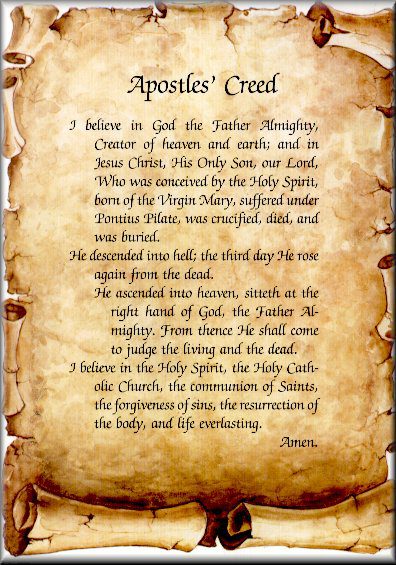

    The Apostles Creed

    I believe:

    Jesus Christ suffered and died…


    Do some not believe, though the historical evidence of the facts overwhelmingly support the Gospel accounts?

    YES, because the Spirit of God has not revealed to them the significance of the Messiah Jesus, the Son of God SUFFERING or His role of sacrifice and redemption as the “Son of Man.”

    As Scripture states:

    GOD IS ONE IN ESSENCE,

    and as the Gospel reveals,

    THREE IN PERSON.

    More on Trinity from R.C. Sproul


    The apostate, heretic and pagan alike create a god, goddess or false prophet of their own liking — an idol to follow into the abyss of sin’s punishment — in deference to the One God and Lord Jesus Christ.

    Roger@TalkofJesus.com

    New Testimony of John (witness of Yeshua):

    Gospel of John 1:10-12 Hebrew Names Version

    From his fullness we all received grace upon grace. For the law was given through Moshe.

    Grace and truth came through Yeshua the Messiah.

    No one has seen God at any time.

    The one and only Son, who is in the bosom of the Father, he has declared him.

    Gospel of John 1:16-18 HNV


    suffered under Pontius Pilate

    Pilate therefore entered again into the Praetorium, called Yeshua, and said to him,

    “Are you the King of the Yehudim?”

    Yeshua answered him, “Do you say this by yourself, or did others tell you about me?”

    Pilate answered, “I’m not a Yehudi, am I? Your own nation and the chief Kohanim delivered you to me. What have you done?”

    Yeshua answered, “My kingdom is not of this world. If my kingdom were of this world, then my servants would fight, that I wouldn’t be delivered to the Yehudim. But now my kingdom is not from here.”

    Pilate therefore said to him, “Are you a king then?”

    Yeshua answered, “You say that I am a king. For this reason I have been born, and for this reason I have come into the world, that I should testify to the truth. Everyone who is of the truth listens to my voice.”

    “I AM the way, the truth, and the life…”

    Pilate said to him, “What is truth?”

    Gospel of John 18:33-38a HNV


    Is this not the first question asked by those who question the truth of Scripture and the Lord Jesus Christ?

    Therefore, WE will pick and choose what we will believe from the Bible.


    Pilate said to them,

    “Shall I crucify your King?”

    “Hail, King of the Yehudim!”
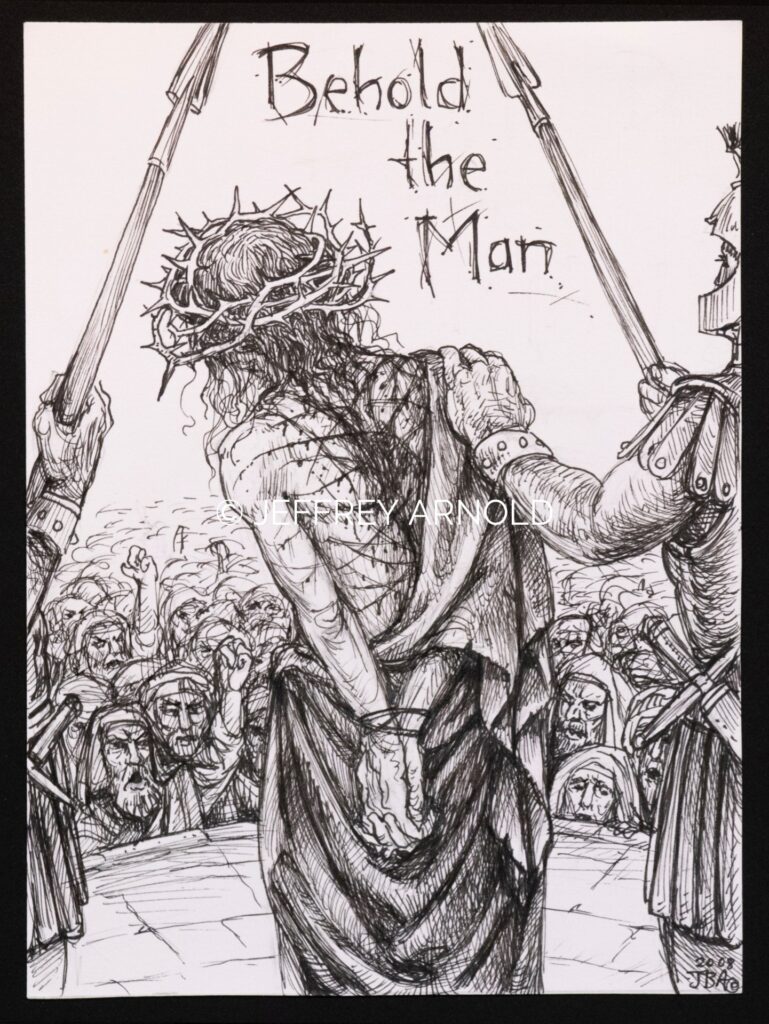
    Don’t you know that I have power to release you, and have power to crucify you?”

    Yeshua answered,

    “You would have no power at all against me, unless it were given to you from above. Therefore he who delivered me to you has greater sin.”

    Gospel of John 19: excerpts Hebrew Names Version


    The Christ of God, of course, refers to the one of the Twelve who had betrayed JESUS, because He was not the King who would follow the whims of religious nationalism. (Judea would not have JESUS to lead them to expel Rome.)

    was crucified
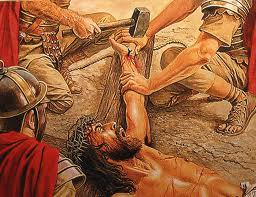
    Jesus nailed to the Cross

    ..Then the soldiers, when they had crucified Yeshua, took his garments and made four parts, to every soldier a part; and also the coat.
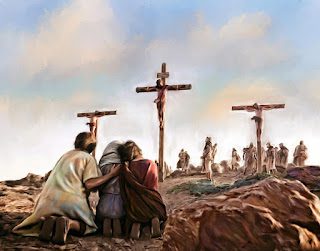
    But there were standing by the cross of Yeshua his mother, and his mother’s sister, Miryam the wife of Klofah, and Miryam from Magdala…

    John 19:30b HNV


    So they took Yeshua’s body, and bound it in linen cloths with the spices, as the custom of the Yehudim is to bury…
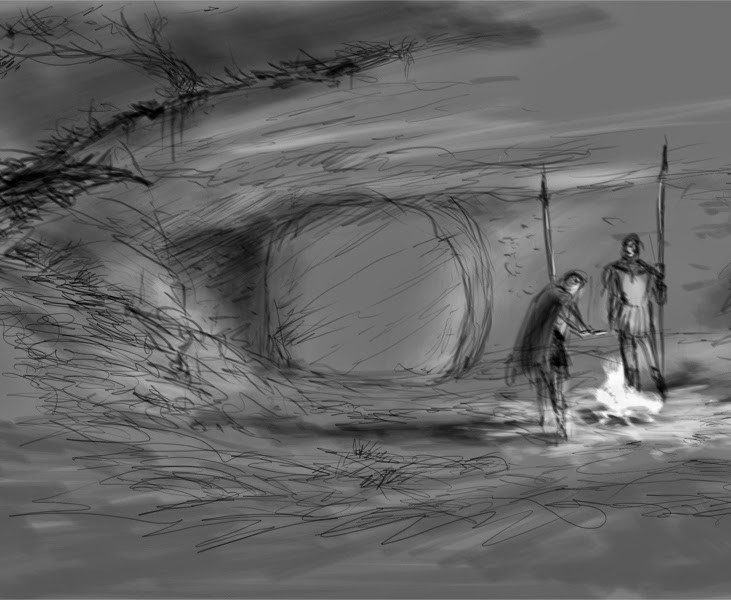
    two Roman soldiers standing by fire at night by Jesus' tomb

    Then because of the Yehudim’ Preparation Day (for the tomb was near at hand) they laid Yeshua there.

    Gospel of John 19:Hebrew Names Version


    Talk of JESUS . com

    The Son of Man — born of the virgin Mary some thirty years before — the Son of God who the angel told would overshadow her and she would bear Him — DEAD! gruesomely crucified and nailed to and hung from a Roman cross!

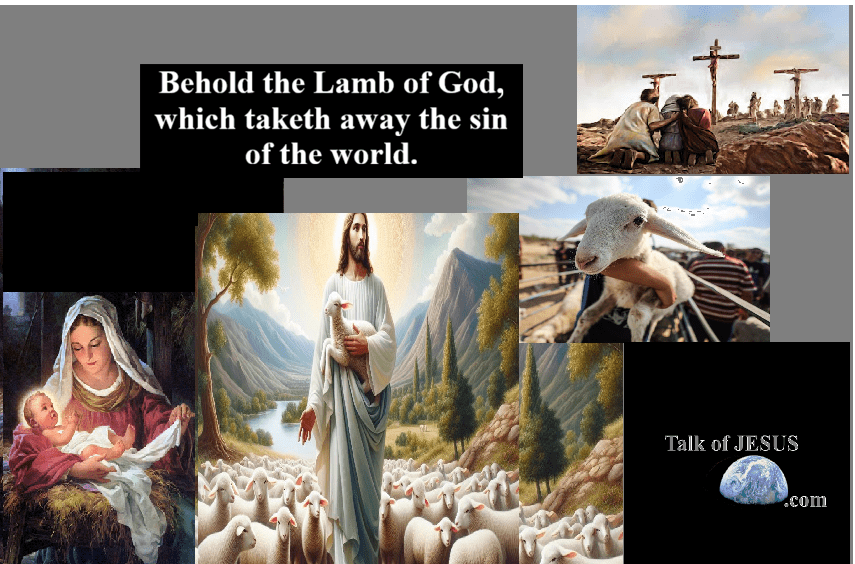
    Behold the Lamb of God, which taketh away the sin of the world. - Jesus in a manger and the lamb of sacrifice on a cross

    next – in the Apostles’ Creed

    an ANSWER

    after three days in the tomb of JESUS…
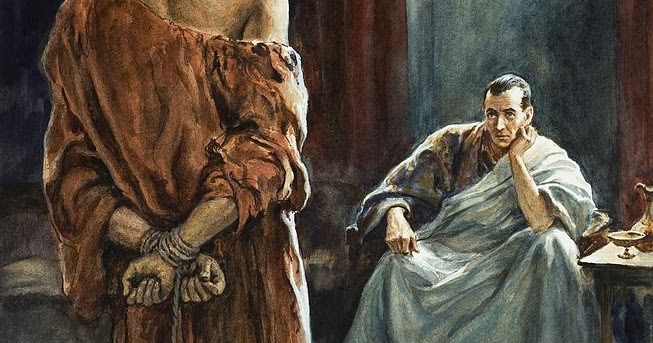
  • Are You a King?

    Are You a King?

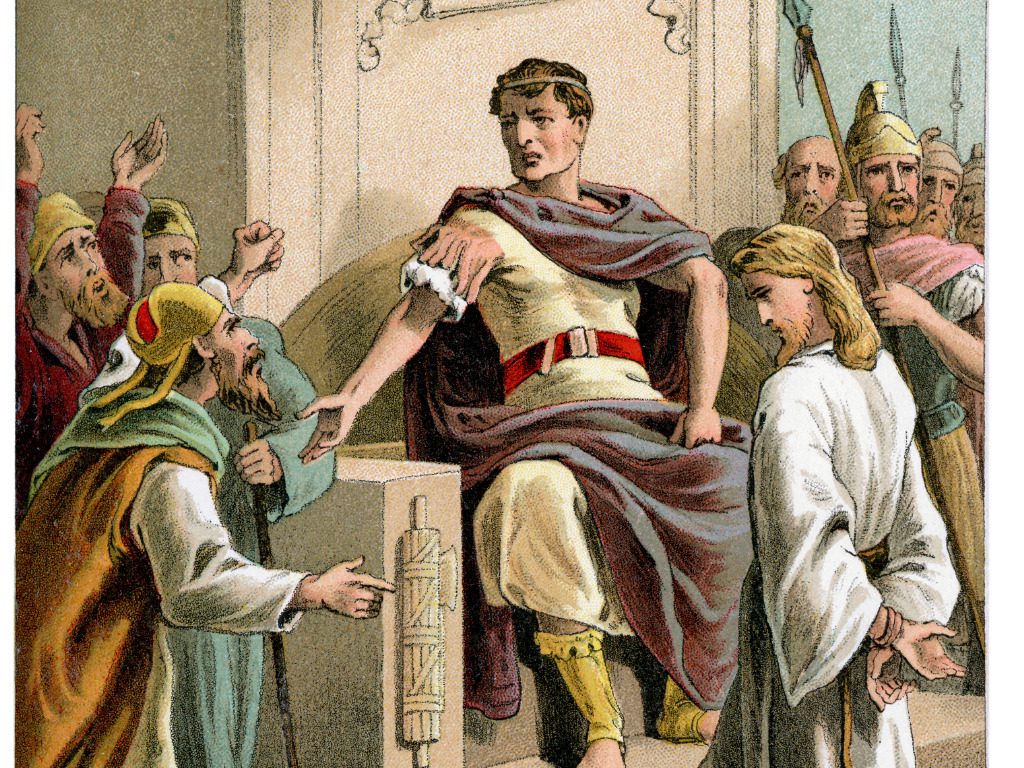
    Therefore Pilate entered again into the Praetorium, and summoned Jesus and said to Him,

    “Are You the King of the Jews?”

    John 18:33 NASB

    The Politically Charged Question

    Pilate interrogates Jesus by beginning privately with a loaded question.

    As Governor AND presiding judge (in chambers), the Prefect questions the defendant already declared guilty by the Jews, local leaders who have no authority in this Roman court of Judea.

    Pilate’s questions (to which he must have had prepared standard answers to usual responses) went to motive.

    • “What is your authority here?”
    • “Are you a threat to true authority, which as Governor I represent?”

    The Gospels do not record these words, but the timing and context of Jesus’ trial suggests to the Governor that he recognizes a political hot potato in dealing with this popular Rabbi during the religious festival of the Jews in Jerusalem.

    For further understanding of Pontius Pilate look back to: 
    1st century Rome – an awkward embrace of RELIGION & politics

    John 18:

    Very early that morning:

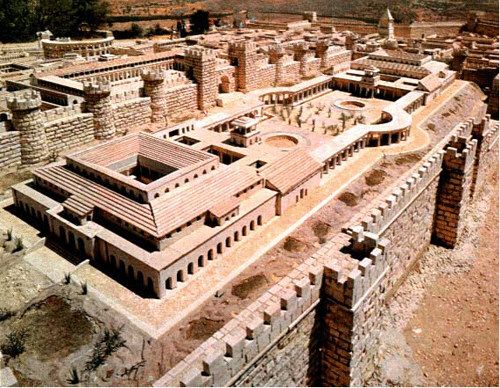
    praetorium in Jerusalem
    • As the Jewish officials brought Jesus to the exterior of the Praetorium Pilate came out to them.
    • .. and they themselves did not enter into the Praetorium so that they would not be defiled, but might eat the Passover.

    29 Therefore Pilate went out to them and said, “What accusation do you bring against this Man?”

    They answered and said to him, “If this Man were not an evildoer, we would not have delivered Him to you.”

    31 So Pilate said to them, “Take Him yourselves, and judge Him according to your law.”

    The Jews said to him, “We are not permitted to put anyone to death..”

    Sentenced to death by accusation

    We already know of the deceptive stealth of the Temple officials, ceasing Jesus at night then bringing the Messiah of Israel to trial before them.

    The Jews really had no authority in Judea and regardless of their predetermined verdict of guilt and sentence of death, Pilate dismisses their case. But now the politics come into play.

    These religious emissaries want to execute the man opposed to their religious positions of power, the Man who had ridden victorious into town on a donkey just a few days before, Jesus of Nazareth (a town not even in Pilate’s Judea).

    Although we seldom consider the passage of time within a single verse or two of scripture, consider this possibility in the scene about to take place:

    • Certainly the Jews with their prisoner Jesus on the outside and Pilate with his advisors inside the Praetorium must ponder what to do next.
    • Since Pilate is in charge of Jerusalem and responsible to Rome for any potential trouble, he makes the first move in trying to keep peace between the politics and religion of Jerusalem.

    Questions with political consequences

    33 Therefore Pilate entered again into the Praetorium, and summoned Jesus and said to Him…

    Although the trial of Jesus takes place like all Roman trials in the public square, Pilate begins his questioning of this prisoner of the Jews in private.

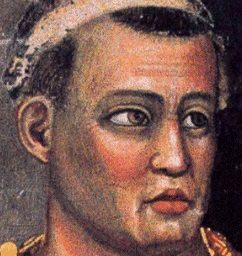
    painting of pontius pilate

    “Are You the King of the Jews?”

    Are you the King?

    Questions with political consequences are best asked first in private. Leaders must know the politically correct answer before asking it in public.

    Remember Jesus’ accusers were not present because they would not defile themselves by their self-righteous rule of separation from this gentile Governor responsible for every civic event in Jerusalem. The Jews needed to maintain their white-washed public image before their followers.

    • Pilate summoned Jesus to him.
    • As a result of his summons the Jews had to release Jesus into the governor’s custody.

    βασιλεύς

    What is the root meaning of Pilate’s question to Jesus?

    βασιλεύς basileús, bas-il-yooce’; probably from G939 (through the notion of a foundation of power); a sovereign (abstractly, relatively, or figuratively):—king.

    • leader of the people, prince, commander, lord of the land, king

    What are you, Jesus?

    (It’s a fair question — to which the Governor would have had a standard reply.

    Imagine some of these pre-prepared political answers of Pilate.)

    • We have no kings here. You are not a king of Egypt or even Herod who was once king in Jerusalem. Kings do not matter here.
    • Our king resides in Rome and I am his governor. What I say comes from our king: Tiberius Caesar.
    • Are you a king? It does not matter. Tiberius Caesar is king.

    Rather than being led into a conversation about who He is not, Jesus asks the Governor a question.

    34 Jesus answered,

    “Are you saying this on your own initiative, or did others tell you about Me?”

    • Is this really your question
    • or did someone tell you that I am a King?

    The Governor immediately reminds the accused that in fact he, Pilate, is Roman (and Rome governs Jerusalem).

    Pilate answered, “I am not a Jew, am I?

    Your own nation and the chief priests delivered You to me;

    what have You done?”

    John 18:38 NASB

    Pilate’s response confirms indictment by the chief priests, but the judge’s question, ‘What have you done?” is opportunity for the defendant to appeal His ill-gotten verdict.

    Israel’s Messiah Jesus answers the Governor’s original question about His Authority.

    My Kingdom – βασιλεία

    Jesus answered, “My kingdom is not of this world.

    John 18:36a

    The Accused makes no claim to Jerusalem or to Judea or any Syrian territory governed by Pilate.

    Rather Jesus claims an authority of the gods (in Pilate’s understanding). In this case:

    ‘royal power, kingship, dominion, rule, not to be confused with an actual kingdom but rather the right or authority to rule over a kingdom.’source: blueletterbible.org

    Jesus continues His assurance to Pilate that He is no threat to Rome as other kings and threatening rebels fight to gain influence in places like Jerusalem.

    “… If My kingdom were of this world, then My servants would be fighting so that I would not be handed over to the Jews;

    but as it is, My kingdom is not of this realm.”

    What Realm?

    • “..but as it is, My kingdom is not of this realm.” – John 18:36c NASB
    • “..but now is my kingdom not from hence.” – John 18:36c KJV
    • “..But as it is, my kingdom is not from here.” – John 18:36c CSB

    A King must have a country, a realm to rule here and now. Jesus Christ makes no such claim.

    The Lord Jesus when brought before Pilate confirms, ‘my kingdom is not from here.”

    ἐντεῦθεν

    Outline of Biblical Usage

    1. from this place, hence
    2. on the one side and on the other, on each side

    Luke records an incident from earlier in Jesus ministry describing it with the same Greek word.

    Just at that time some Pharisees approached, saying to Him, “Go away, leave here, G1782 for Herod wants to kill You.” – Luke 13:31

    Herod, of course, is a pawn not only of Jerusalem’s Jewish politics but also of Rome. Jesus continued at that time to prophesy the events of these three days:

    And He [Jesus] said to them [Pharisees who secretly followed Jesus],

    “Go and tell that fox [Herod],

    ‘Behold, I cast out demons and perform cures today and tomorrow, and the third day I reach My goal.’

    “Nevertheless I must journey on today and tomorrow and the next day; for it cannot be that a prophet would perish outside of Jerusalem.

    Luke 13:32-33 NASB

    οὐκοῦν, adverb, not therefore

    This is subtle, as well as a function of speech; but don’t miss it.

    Several translations of the original Greek from this passage read differently in attempts to convey the argument here of Jesus’ judge Pilate.

    37 Therefore Pilate said to Him, “So You are a king?”

    (You are a king, but from where {if not here}?)

    • .. but it is better to write οὐκοῦν, so that Pilate, arguing from the words of Christ, asks, not without irony, art thou not a king then? or in any case, thou art a king, art thou not? cf. Winer’s Grammar, 512 (477).
    • and since a speaker often introduces in this way his own opinion, the particle is used affirmatively, therefore, then, the force of the negative disappearing. Hence, the saying of Pilate οὐκοῦν βασιλεύς εἰ σύ must be taken affirmatively: – Source: Strong’s

    To this end was I born

    Jesus answered, Thou sayest that I am a king. To this end was I born, and for this cause came I into the world, that I should bear witness unto the truth. Every one that is of the truth heareth my voice.

    John 18:37b KJV

    In answer to Pilate’s restatement of his own question, “Art thou a king then?” Jesus clearly states His purpose to which He was born as Son of Man and Son of David, the Christ of Hebrew Scripture.

    John began his Gospel (Good News) of Jesus Christ stating this same purpose. It really has nothing to do with anything kinglike, as the Jews expected of their Messiah that He would be like King David or King Solomon.

    In the beginning was the Word, and the Word was with God, and the Word was God.

    And the Word became flesh, and dwelt among us, and we saw His glory, glory as of the only begotten from the Father, full of grace and truth.

    John 1:1,14 NASB

    Jesus proclaims privately to Pontius Pilate:

    “I was born for this, and I have come into the world for this: to testify to the truth… CSB

    Pilate is about to ask Jesus the question a Judge must ask himself honestly before concluding a trial, but first Christ continues with purpose for all:

    “… Everyone who is of the truth listens to my voice.”

    the words of Jesus Christ to Pontius Pilate – John 18:37c CSB

    Do you with ears to hear listen to the voice of Christ Jesus?

    To be continued...
    Page TWO - Please click Page 2 below for the questions.

    Pages: 1 2

  • Kings, Governors, Politicians & Priests 2– Pontius Pilate

    Kings, Governors, Politicians & Priests 2– Pontius Pilate

    Τίνα κατηγορίαν φέρετε κατὰ τοῦ ἀνθρώπου τούτου

    “Tis katēgoria pherō kata ho anthrōpos hoytos?

    John 18:29 – question of Pilate to the Jews who brought Jesus before him

    What accusation do you bring against this Man?”

    Pilate’s question to those who brought Jesus before him is most appropriate for any judge of a man brought to law before the court.

    Previously we discussed in Kings, Governors, Politicians & Priests – Power in the Palaces of Justice the political nature of the accusations of Jerusalem’s religious officials. We also addressed why the Jewish prosecutors brought their Messiah to the Roman Prefect, Pontius Pilate.

    Then the Jewish leaders took Jesus from Caiaphas to the palace of the Roman governor. By now it was early morning, and to avoid ceremonial uncleanness they did not enter the palace, because they wanted to be able to eat the Passover.

    John 18:28 NIV

    John 18:

    29 Therefore Pilate went out to them and said, “What accusation do you bring against this Man?”

    30 They answered and said to him, “If this Man were not an evildoer, we would not have delivered Him to you.”

    Did these Jewish religious prosecutors answer Pilate’s question – what charge against this man?

    The Jewish officials make no specific charge before the judge of this court, the Governor Pilate. They indict Jesus as ‘an evildoer.’

    31 So Pilate said to them, “Take Him yourselves, and judge Him according to your law.”

    In effect, the Roman Governor of all the province of Judea acting as High Court Judge of Jerusalem tells them, ‘Case dismissed.’

    Politics & Religion

    If you read too quickly through the trial transcript (as we often do Scripture) you may miss more of the motivation and underpinnings of politics and religion in Jerusalem.

    • Pilate (Governor and Judge) dismisses the case of the Jews against Jesus.
    • The Prosecutors (Jewish officials) appeal his judgment immediately.
    We'll return to the Praetorium of Pilate,
    but first the questions of politics.

    Who is Pontius Pilate?

    Pontius Pilate (Latin: Pontius Pīlātus [ˈpɔntɪ.ʊs piːˈlaːtʊs]; Ancient Greek: Πόντιος Πιλάτος, Póntios Pilátos) was the fifth governor of the Roman province of Judaea, serving under Emperor Tiberius from 26/27 to 36/37 AD.

    Source: Wikipedia
    • First, Pilate is Roman in every context of culture.

    • Second, Pilate is a politician.

    He was appointed by Roman leaders as Prefect for this challenging eastern extreme of the Empire. His ten year appointment means that Pilate has full understanding of Jerusalem’s politics of religion prior to the Jews bringing Jesus to trial.

    It may be helpful to think of the Roman Prefect Pilate, governing from Herod’s elegant palace during every large Jewish festival, as a governor replacing the former kings – a sort of remote emperor of Rome.

    He commands nearly 3000 troops, which Pilate can order at will to control Jerusalem’s crowds and zealous pilgrims. Jesus’ trial for Pilate falls only in the jurisdiction of keeping the pax Romana peace for Rome in Jerusalem.

    To understand Pilate, Rome’s Governor, you first must understand the politics & religion of Rome.

    anno Domini is Medieval Latin and means “in the year of the Lord”

    Rome – 1st c. Anno Domini

    We know the connection of Caesar Augustus to the birth {in approximately 6-4 BC} of Jesus Christ.

    In those days Caesar Augustus issued a decree that a census should be taken of the entire Roman world.

    Luke 2:1 NIV

    But understand the politics of Caesar throughout the Empire over time and gain insight into Pilate’s politics in this trial of Jesus {in approximately AD 30-33} far-removed from Rome in distant Judea.

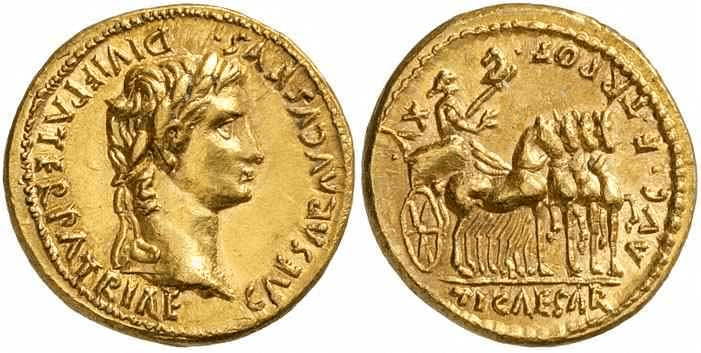
    Coin of Caesar Augustus

    Caesar

    Καῖσαρ, Καίσαρος , Caesar (properly, the surname of Julius Caesar, which being adopted by Octavianus Augustus and his successors afterward became an appellative, and was appropriated by the Roman emperors as a part of their title)

    • Tiberius Caesar Augustus was the second Roman emperor, reigning from AD 14 to 37 (during the time of Jesus’ trial). He succeeded his stepfather, the Roman emperor Augustus. – source: Wikipedia
    • Tiberius’s father, also named Tiberius Claudius Nero, a high priest and magistrate, was a former fleet captain for Julius Caesar. – source: Britannica.com
      • Don’t miss this: he was a Roman soldier commanding a fleet AND a judge AND a high priest; that is military, governing and religious authority
    • Emperor (Tiberius Caesar Augustus), ‘one of the greatest Roman generals’ appointed Pontius Pīlātus [ˈpɔntɪ.ʊs piːˈlaːtʊs] governor of the Roman province of Judea in AD 26/27 {a few years prior to Jesus’ trial for which he is best known}.
    More about the politics & religions of Rome to come…
    Page TWO - Please click Page 2 below for the questions.

    We’ll return to the Pilate’s trial of Jesus Christ, but I would like to provide a few more resources about the politics and religions of the Roman Empire before we do.

    To be continued...

    Pages: 1 2