Tag: prophets

  • Conquered and the Conquerers

    Conquered and the Conquerers

    Jesus, Son of Man, comes among us with a perspective of history of another dimension we can scarcely comprehend: time.

    I am the Alpha and the Omega, the beginning and the end.

    Before Abraham was, I AM.

    Remarkable statements! A perspective of history which can only be viewed outside of our dimension of time.

    Never-the-less, let us view some of the maps of the nations (gentiles) over the times preceding the incarnation of the Son of Man.
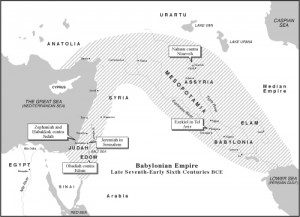
    Babalonian Empire Israel has fallen. God has pronounced judgment on Israel for her unfaithfulness. God sends his Prophets to unfaithful Judah (her sister of whoredom) and to the gentile nations as well.

    Judah is small. Assyria, Babylonia, Mesopotamia, Syria and Egypt are large and powerful, opposing each other with God giving victory to varied enemies of Judah in the times of the Prophets and the times of His silence before a newer map at a later time.
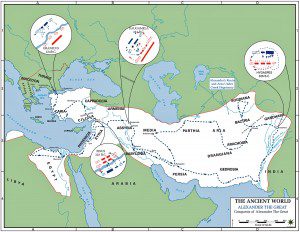
    alexander_the_great_conquestsIn the fourth century B.C. comes another conqueror from the west: Alexander the Great. He defeats the eastern empires and spreads Greek culture throughout the Mediterranean. The map again differs and the language and culture from the time after Alexander’s death is called Hellenism. Greek becomes the common language of the empire, including Jerusalem and the former areas of defeated Israel and fallen Judah (now called Phoenicia). Don’t think of it as small Greece, islands of the Mediterranean, but Empire Greece, as in Asia (or most of what we now call Asia) as far as India in the East.

    Now, much nearer the time of Jesus, 62 B.c.- 14 A.D., we read of the Incarnate Son of God in Luke 2. (No doubt all are familiar with the story, yet few are familiar with the map.)

    The Birth of Jesus Christ

    2 In those days a decree went out from Caesar Augustus that all the world should be registered. 2 This was the first registration when Quirinius was governor of Syria. 3 And all went to be registered, each to his own town. 4 And Joseph also went up from Galilee, from the town of Nazareth, to Judea, to the city of David, which is called Bethlehem, because he was of the house and lineage of David, 5 to be registered with Mary, his betrothed, who was with child.
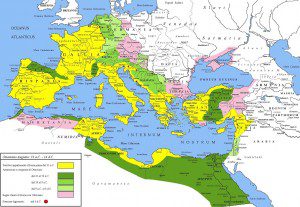
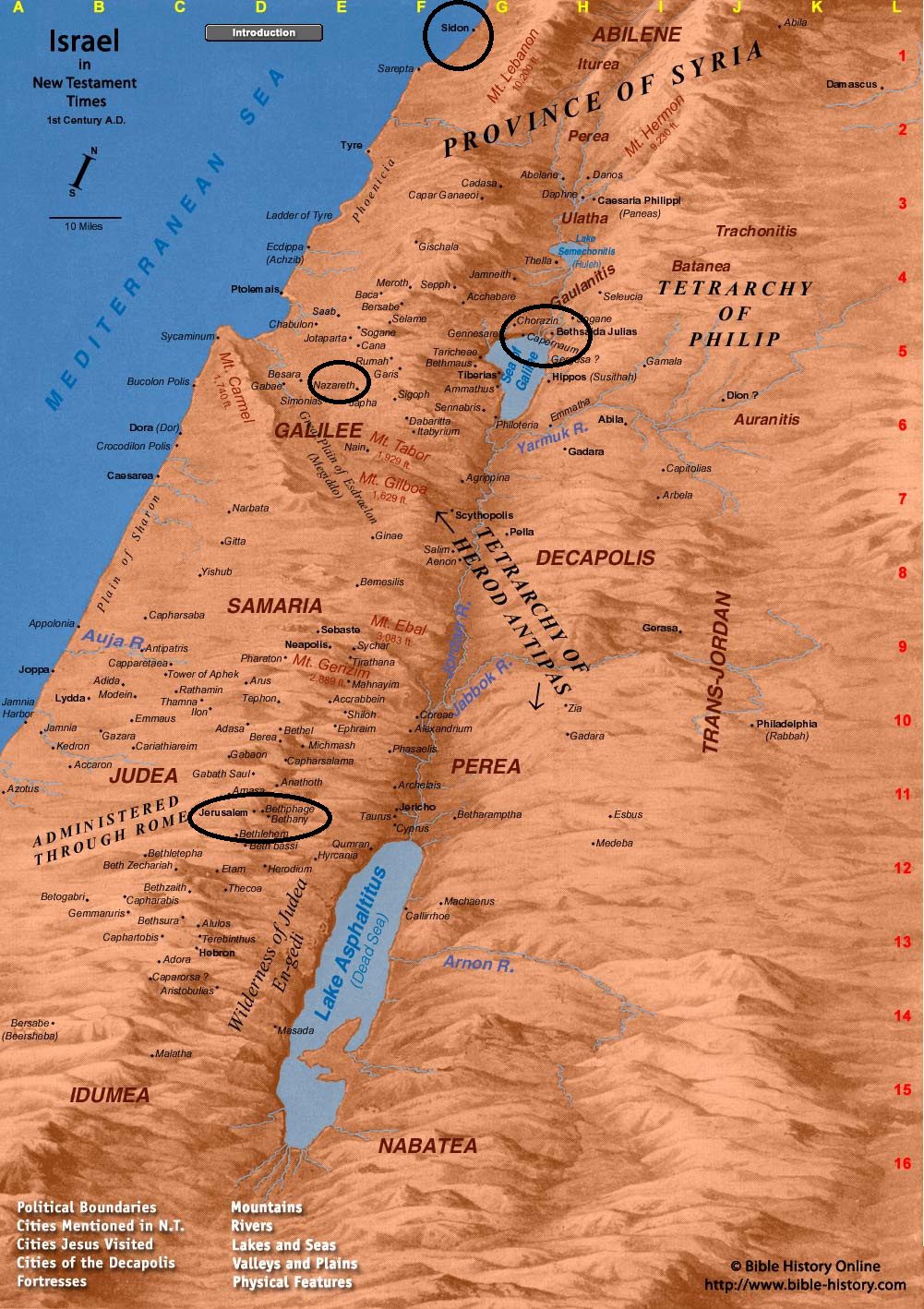
    Augusto_Roman empireAgain in our timeline under Rome, again we must view the map not as a place of Israel or Judah. Rome conquered Jerusalem, Tyre and Sidon (of Syria), Nazareth and all the rest. The map is of Rome and every town in every land is a crossroads that leads to Rome.

    Judea is nothing more than a minor province in a key expansion of Rome, extending south from Tyre and Damascus beyond Jerusalem. The military control of Rome over the conquered provinces involves an infusion of Roman military control and government and taxes, along with the sharing of a common culture of Hellenistic roots in the Greek language and culture.

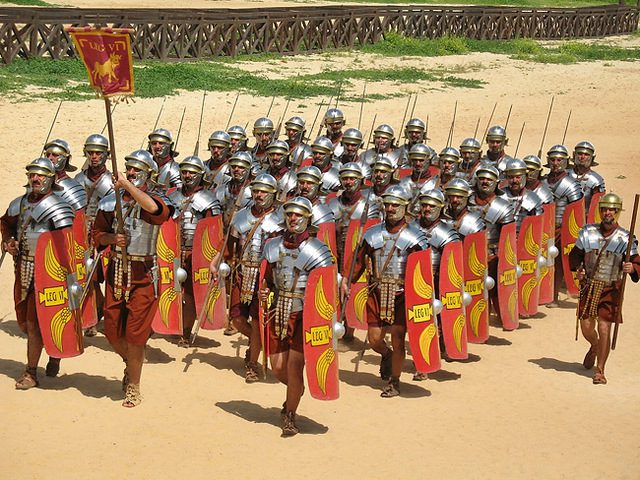
    The power of Rome is not its politics or religion, but it’s army. The success of Rome is due, in part, to the integration of a common language (Greek) and culture with the local customs and religions and trade (including taxes to pay the army, administrative costs of Rome). Pay your taxes and keep your local customs.

    The religions of the gentiles of Rome, the gentiles of Greece, and the gentiles of the conquering Babylonians, and other conquering nations like Assyria and Egypt have one thing in common: many gods. The “god of the current time” is often the current ruler, a Pharaoh, a Caesar or worshiped human king.  The Asians worship idols. The Greeks and Romans worship idols. Only the Jews have One God and no idols.

    This same Caesar Augustus of Luke 2 had (for political reasons) declared himself a god. Later, the local Jewish politicians seek to draw Jesus into this controversial debate.

    Want to start a controversy among lovers of Greek mythology (yes, myths as origins of various gods and the ways they serve man)? Just ask how many. Answer? Thousands!

    And Rome cared more for her power and politics than culture. However Rome’s idols and gods also explained which gods served man in which ways. How many?  Again, a countless number of gods to serve the Roman citizen and the slaves of Roman rule.

    Another fact of Roman life overlooked is that the population of Rome had many slaves  It was the culture, discipline organization and administration of the Roman army that best modeled any success of Rome. A conquered people in the days of Jesus, like in the days of the Prophets, could be taken away from their cities and towns and homes to any foreign town or province and sold as slaves. The Roman army used this as leverage to have local leaders do as they wanted under a local administration of Rome.

    Into this environment comes the family of the Herod’s who chose their sides with the right Roman generals and were rewarded for their efforts.

    (Why all this background? NEXT we continue with Jesus’ early encounters with Romans in His travels…)


  • Who Welcomes His Ministry? – 2

    Who Welcomes His Ministry? – 2

    Returning now to the Gospel of Luke, we look back from Jesus’ move to His fast-growing early ministry in Capernaum on the Sea of Galilee to His hometown of Nazareth and the event of His departure.

    Luke 4

    English Standard Version (ESV)

    15 And he taught in their synagogues, being glorified by all.

    22 And all spoke well of him and marveled at the gracious words that were coming from his mouth. And they said, “Is not this Joseph’s son?” 23 And he said to them, “Doubtless you will quote to me this proverb, ‘Physician, heal yourself.’

    What we have heard you did at Capernaum, do here in your hometown as well.”

    24 And he said, “Truly, I say to you, no prophet is acceptable in his hometown.

    Let us pause here to speak of an earlier Prophet of the Old Testament (approx. 850-870 B.C.): Elijah.

    1 Kings 16:

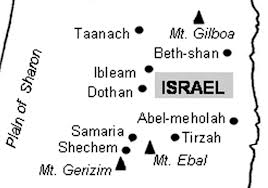
    old israel n kingdom map21 Then the people of Israel were divided into two parts. Half of the people followed Tibni the son of Ginath, to make him king, and half followed Omri. 22 But the people who followed Omri overcame the people who followed Tibni the son of Ginath. So Tibni died, and Omri became king. 23 In the thirty-first year of Asa king of Judah, Omri began to reign over Israel, and he reigned for twelve years; six years he reigned in Tirzah. 24 He bought the hill of Samaria from Shemer for two talents of silver, and he fortified the hill and called the name of the city that he built Samaria, after the name of Shemer, the owner of the hill.

    25 Omri did what was evil in the sight of the Lord, and did more evil than all who were before him…

    NOTE the proximity of this area in the two maps between this area of divided Israel and the beginning ministry of Jesus in Nazareth.

    Ahab Reigns in Israel

    29 In the thirty-eighth year of Asa king of Judah, Ahab the son of Omri began to reign over Israel, and Ahab the son of Omri reigned over Israel in Samaria twenty-two years. 30 And Ahab the son of Omri did evil in the sight of the Lord, more than all who were before him.

    (It’s an ongoing theme in scripture: ‘And __ did evil in the sight of the Lord.’

    Against this the Prophets called all to repentance. 

    Elijah Predicts a Drought

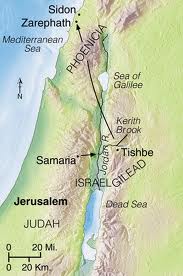
    elijah map17 Now Elijah the Tishbite, of Tishbe in Gilead, said to Ahab, “As the Lord, the God of Israel, lives,before whom I stand, there shall be neither dew nor rain these years, except by my word.” 2 And the word of the Lord came to him: 3 “Depart from here and turn eastward and hide yourself by the brook Cherith, which is east of the Jordan.

    7 And after a while the brook dried up, because there was no rain in the land.

    The Widow of Zarephath

    8 Then the word of the Lord came to him, 9 “Arise, go to Zarephath, which belongs to Sidon, and dwell there. Behold, I have commanded a widow there to feed you.” 10 So he arose and went to Zarephath. And when he came to the gate of the city, behold, a widow was there gathering sticks. And he called to her and said, “Bring me a little water in a vessel, that I may drink.” 11 And as she was going to bring it, he called to her and said, “Bring me a morsel of bread in your hand.” 12 And she said, “As the Lord your God lives, I have nothing baked, only a handful of flour in a jar and a little oil in a jug. And now I am gathering a couple of sticks that I may go in and prepare it for myself and my son, that we may eat it and die.” 13 And Elijah said to her, “Do not fear; go and do as you have said.

    Returning now to Nazareth and Jesus’ mention of this Prophet after His hometown asked for miracles:

    Luke 4

    24 And he said, “Truly, I say to you, no prophet is acceptable in his hometown. 25 But in truth, I tell you, there were many widows in Israel in the days of Elijah, when the heavens were shut up three years and six months, and a great famine came over all the land, 26 and Elijah was sent to none of them but only to Zarephath, in the land of Sidon, to a woman who was a widow.


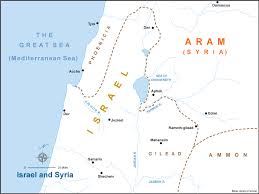
    divided israel and syriaAnd of successor to  Elijah, the Prophet Elisha, Jesus said:

    27 And there were many lepers in Israel in the time of the prophet Elisha, and none of them was cleansed, but only Naaman the Syrian.”

    Yes, Jesus is preaching an active and insistent call to the people of Nazareth: REPENT!

    And Luke continues to tell us how well Jesus’ call to his own best known and most beloved neighbors responded to His call to repent:

    28 When they heard these things, all in the synagogue were filled with wrath.

    Angry at the hometown Messiah? (Think of the tourist possibilities… Well, maybe in a few centuries we can whitewash the truth of Jesus reception in Nazareth.)

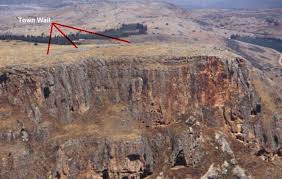
    29 And they rose up and drove him out of the town and brought him to the brow of the hill on which their town was built, so that they could throw him down the cliff.

    old nazareth wall above cliff30 But passing through their midst, he went away.
    What people would welcome the ministry of one of their own by seeking to kill him?

    Does Jesus’ ministry and call to repent not meet with the same reception in our own town in these last days?


  • Who Welcomes His Ministry?

    Who Welcomes His Ministry?

    Luke 4:

    Jesus Begins His Ministry

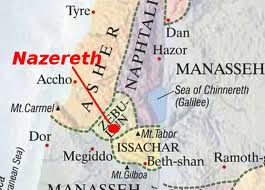
    nazareth zabulon map14 And Jesus returned in the power of the Spirit to Galilee, and a report about him went out through all the surrounding country. 15 And he taught in their synagogues, being glorified by all.

    Jesus Rejected at Nazareth

    16 And he came to Nazareth, where he had been brought up.

    Generally, Doctor Luke provides us with great detail of proof from eye witness accounts of Jesus and the Acts of the Apostles; however in this chronological glance at the beginning of Jesus’ three-year ministry on earth after being led into the wilderness by the Holy Spirit a look through the eyes of the Apostle Matthew is more helpful.

    Matthew 4

    English Standard Version (ESV)

    Jesus Begins His Ministry

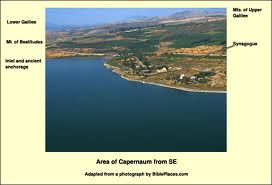
    capernaum from se12 Now when he heard that John had been arrested, he withdrew into Galilee. 13 And leaving Nazareth he went and lived in Capernaum by the sea, in the territory of Zebulun and Naphtali…

    Jesus of Nazareth, as He was known, then moved to and lived in Capernaum by the sea of Galilee.

    17 From that time Jesus began to preach, saying, “Repent, for the kingdom of heaven is at hand.”

    Let us speak to the vocation and mission of the Prophet for a moment.

    To begin, God appoints Prophets, generally separate of the Priestly office and official leadership of God’s own people. Prior to John the Baptist, the Prophet spoke and wrote to and of the fallen Nations: Israel, Judah and the gentile nations who God used to humble and punish His own people into repentance.

    Isaiah was probably an aristocrat with influence of kings. He lived about 700 years before Christ.

    Jeremiah and Daniel ( both about 600 B.C.) were both young when God used them as prophets to their own people and both older as God used them to show His glory to the rulers of conquering gentile nations. Ezekiel is also an exile around the same time.

    These men are not in charge; yet all, through the voice and power of God, call men to repentance.

    Amos is just a farmer and a shepherd in Judah (about 800 B.C.) who God uses to announce the fall of the northern Kingdom Israel. Micah was just a countryman in Israel who lived near the Philistine border about this same time.

    Hosea gets his marriage advice from God who instructs him to marry a whore, as His people have become. Jonah did not even want to be God’s Prophet and ran away (though God pursued and saved him.) We know almost nothing about the Prophet Joel.

    Although Zechariah and Haggai were connected to the office of Priest, it was at a time after repentance during the rebuilding of the Temple by Ezra and Nehemiah (about 500 B.C.). Malachi warns of too casual of an attitude toward worship of God (about 460-430 B.C.).

    The Second Temple is destroyed.  God keeps silent for over 400 years – 20 generations!

    Herod the Great, by alliance with gentile Rome, builds yet another Temple in captured Jerusalem.

    Along comes John the Baptist telling another Herod, Pharisees, Sadducees, Scribes, Temple authorities and the people everywhere: REPENT!

    He dresses and acts like a madman and lives in the wilderness; but the people believe and follow John. He baptizes and witnesses that Jesus of Nazareth is the one on whom the Spirit of God descends. He IS the Promised One.

    Now Jesus, who they all knew since boyhood, a man raised as a carpenter moves away from His hometown. He travels a few miles, moving His belongings to a little inland fishing village, Capernaum. And what was Jesus’ first message to his new hometown?

    Matthew 4:17 From that time Jesus began to preach, saying, “Repent, for the kingdom of heaven is at hand.”

    Jesus left His mother and brothers and family, their carpenter business and comes to a fishing village. Jesus doesn’t look like the wild Prophet John. He is gentle. He looks like his new neighbors. He dresses like them. He eats with them. And Jesus worships with them.

    Why would Jesus have that same crazy message for these new neighbors and new friends as He had for his family back home in Nazareth? Repent, you of Capernaum (also known as Chorazin). Repent Bethsaida (a neighboring fishing town on Chinnereth (the Sea of Galilee.)

    Jesus calls His Disciples to leave their fishing businesses to follow Him. They do. And among them another local resident, resented by almost every working man: Mathew Levi, a tax collector, who continues his narrative Gospel:

    Jesus Ministers to Great Crowds

    23 And he went throughout all Galilee, teaching in their synagogues and proclaiming the gospel of the kingdom and healing every disease and every affliction among the people. 24 So his fame spread throughout all Syria, and they brought him all the sick, those afflicted with various diseases and pains, those oppressed by demons, epileptics, and paralytics, and he healed them. 25 And great crowds followed him from Galilee and the Decapolis, and from Jerusalem and Judea, and from beyond the Jordan.

    We, too, focus on these wonderful miracles witnessed by many and refuted by none. We look to follow this Jesus;He IS the same Jesus who comes to us, as did John the Baptist, saying: Repent!

    To be continued…