Tag: Psalms

  • A River of Redemption Flowing from Eden – to Goshen

    Pulled from the Torrent, a Redeemer Forgotten

    Perhaps you recall that the name Moses or מֹשֶׁה Môsheh means drawn; from drawing out (of the water), i.e. rescued. He is revered as a rescuer of Israel, but how did Moses get to Egypt in the first place? As a baby fleeing harm in a wicker sarcophagus, Moses was plucked from certain death in the waters of a river in Goshen.

    Psalm 18:

    16 He reached down from on high
    and took hold of me;
    he pulled me out of deep water.
    17 He rescued me from my powerful enemy
    and from those who hated me,
    for they were too strong for me.
    18 They confronted me in the day of my calamity,
    but the Lord was my support.
    19 He brought me out to a spacious place;
    he rescued me because he delighted in me.


    Pharaoh’s daughter then brought Moses into the house of the King of Egypt where he was raised in the best of privileged circumstances. She takes him from a wicker ark closed over him by his Hebrew mother and draws the child from the water into her saving arms. 

    Exodus 2:

    5 Pharaoh’s daughter went down to bathe at the Nile while her servant girls walked along the riverbank. She saw the basket among the reeds, sent her slave girl, took it, 6 opened it, and saw him, the child—and there he was, a little boy, crying. She felt sorry for him and said, “This is one of the Hebrew boys.”

    She most certainly would have known her father’s command:

    Pharaoh then commanded all his people: “You must throw every son born to the Hebrews into the Nile, but let every daughter live.” – Exodus 1:22


    2:10 When the child grew older, she [Moses’ mother, hired as a mid-wife] brought him to Pharaoh’s daughter, and he became her son. She named him Moses, “Because,” she said, “I drew him out of the water.”

    Migrant Tribes in the Lands of Others

    Perhaps you have not thought of it: peoples or tribes are homeless families looking for a place to live.

    The Hebrews were one such people; yet the Lord God is their ever-living חֲיָא Patriarch, even more so than Moses or Abraham. Ever since Abraham they raised sheep, migrated to lands where they could sustain life and became merchants trading with citizens and travelers in lands to which the Lord would lead.

    Recall that the persecution of the Hebrews in the time of Moses was consequence of envy of their prosperity by the rulers of the land.

    Exodus 1:

    8 A new king… said to his people, “Look, the Israelite people are more numerous and powerful than we are. 10 Come, let’s deal shrewdly with them; otherwise they will multiply further, and when war breaks out, they will join our enemies, fight against us, and leave the country.”

    11 So the Egyptians assigned taskmasters over the Israelites to oppress them with forced labor. They built Pithom and Rameses as supply cities for Pharaoh.

    In the first hall of the Temple of Rameses II

    Egypt’s and Israel’s Forgotten Redeemer

    Genesis 46:

    The words of Zaphnathpaaneah:

    “I will go up and inform Pharaoh, telling him, ‘My brothers and my father’s family, who were in the land of Canaan, have come to me.

    32 The men are shepherds; they also raise livestock. They have brought their flocks and herds and all that they have.’

    33 When Pharaoh addresses you and asks, ‘What is your occupation?’ 34 you are to say, ‘Your servants, both we and our fathers, have raised livestock from our youth until now.’

    Then you will be allowed to settle in the land of Goshen, since all shepherds are detestable to Egyptians.”

    All about Goshen

    Goshen & Ramses

    To be continued… 

  • That you may have Certainty – 5 – A King of the Jews

    That you may have Certainty – 5 – A King of the Jews

    King of the Jews

    Herodian coin from Judea with palm branch (right) and wreath (left), 34 AD.

    And Pilate asked him, “Are you the King of the Jews?” And he answered him, “You have said so.” – Luke 23:3

    They had remembered  hearing the indictment of this gentile governor 

    while hiding their faces from his Roman judgment seat. Although complicit in Jesus’ prosecution, an illegitimate half-jew Herodian sat powerless while Roman troops ruled the streets of Jerusalem.

    While Jesus was not the kind of Messiah King they had expected, He did acknowledge the title bestowed by Jews accusing Jesus of treason against Judah and Rome.

    Most amazingly, Jesus has now appeared to these disciples after His resurrection! He continues to appear to hundreds of disciples; here and there, even in the locked rooms of Jerusalem.

    Herod’s rule as tetrarch of Galilee and Peraea, holds no authority over Judea, ruled by Marcus Pontius Pilatus, Roman prefect (governor) under the emperor Tiberius.
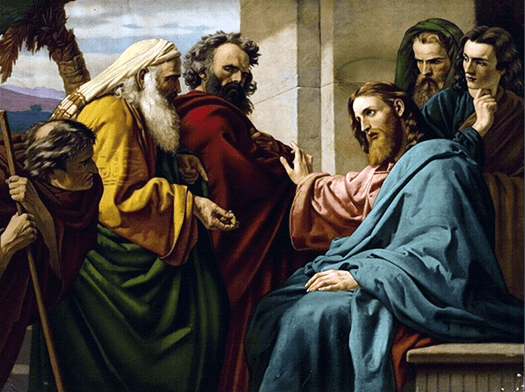
    Captive Israel, now named Judea, Samaria, Galilee and Perea had no king, only legions of Rome. Most  people lamented for the days of their strong kings, David and Solomon. Occasionally some rebelled against Rome, led by misguided ambitious young lions in hope of glory.

    Judge or King?

    From the day Israel crossed the Jordan its people encountered many kings of surrounding kingdoms. The Hebrew people had followed the Lord, but judges would become unable to rule this stiff-necked and proud people.

    1 Samuel 7:

    15 Samuel judged Israel all the days of his life. 16 And he went on a circuit year by year to Bethel, Gilgal, and Mizpah. And he judged Israel in all these places. 17 Then he would return to Ramah, for his home was there, and there also he judged Israel. And he built there an altar to the Lord.

    1 Samuel 8:

    “… Now appoint for us a king to judge us like all the nations.”

    More than a thousand years before Pilate judged Judea, here marks the beginning of kings of the Jews.  Samuel was no more inclined to accept a king of the Jews than the Roman governor Pilate.

    6 But the thing displeased Samuel when they said, “Give us a king to judge us.” And Samuel prayed to the Lord. 7 And the Lord said to Samuel,

    “Obey the voice of the people in all that they say to you, for they have not rejected you, but they have rejected me from being king over them.

    8 According to all the deeds that they have done, from the day I brought them up out of Egypt even to this day, forsaking me and serving other gods, so they are also doing to you. 9 Now then, obey their voice; only you shall solemnly warn them and show them the ways of the king who shall reign over them.”

    A King to rule over Israel

    A risen Christ Jesus must have reminded disciples of the Lord’s anointing of their kings. Its truth had not been as their traditions recalled, but rather a concession to the desires of their forefathers.

    1 Samuel 9:

    … “Behold, there is a man of God in this city, and he is a man who is held in honor; all that he says comes true. So now let us go there. Perhaps he can tell us the way we should go.” …

    5 Now the day before Saul came, the Lord had revealed to Samuel: 16 “Tomorrow about this time I will send to you a man from the land of Benjamin, and you shall anoint him to be prince over my people Israel. He shall save my people from the hand of the Philistines. For I have seen my people, because their cry has come to me.” 17 When Samuel saw Saul, the Lord told him, “Here is the man of whom I spoke to you! He it is who shall restrain my people.”

    A Humble King and Triumphant Return

    What was it worshipers near Jerusalem had sung while laying palm branches before Jesus?

    “As for me, I have set my King
    on Zion, my holy hill.” 

    I will tell of the decree:
    The LORD said to me, “You are my Son;
    today I have begotten you.

    Ask of me, and I will make the nations your heritage,
    and the ends of the earth your possession.

    You shall break them with a rod of iron
    and dash them in pieces like a potter’s vessel.”

    Psalm 2:6-9


    It had been a week of anointing for the King of the Jews.

    The Cross had not been the anticipated breaking of Israel’s oppressors, but the Lord’s embracing forgiveness for mankind.

    And now with a resurrection begins the ascent to His Kingdom of righteousness and everlasting reign. Jesus certainly must have repeated stories of the kings and predictions of the Prophets. For the Gospels retell those very scriptures.

    His disciples hear their beloved friend, the risen Messiah, tell why He had to be crucified on a cross and sacrificed for our sins.


    Zechariah 9:9

    Rejoice greatly, O daughter of Zion!
    Shout aloud, O daughter of Jerusalem!
    Behold, your king is coming to you;
    righteous and having salvation is he,
    humble and mounted on a donkey,
    on a colt, the foal of a donkey.


    Come, Lord Jesus. 


    To be continued…


  • Your Mistake – You Don’t Know the Power of God

    Your Mistake – You Don’t Know the Power of God

    Jesus replied, “Your mistake is that you don’t know the Scriptures, and you don’t know the power of God.

    Matthew 22:29 NLT

    The Power of God

    Psalm 68:

    God shall arise, his enemies shall be scattered;
    and those who hate him shall flee before him!
    2 As smoke is driven away, so you shall drive them away;
    as wax melts before fire,
    so the wicked shall perish before God!
    3 But the righteous shall be glad;
    they shall exult before God;
    they shall be jubilant with joy!

    18 You ascended on high,
    leading a host of captives in your train
    and receiving gifts among men,
    even among the rebellious, that the Lord God may dwell there.

    19 Blessed be the Lord,
    who daily bears us up;
    God is our salvation. Selah

    28 Summon your power, O God,
    the power, O God, by which you have worked for us…

    34 Ascribe power to God,
    whose majesty is over Israel,
    and whose power is in the skies.

    35 Awesome is God from his sanctuary;
    the God of Israel—

    he is the one who gives power and strength to his people.
    Blessed be God!


    Who is in Control?

    Political and religious bickering such as is common in every age postures man against man and promotes idea against ideal. Jesus encountered such controversies as part of everyday life and ministry, yet refused to become entangled in issues of authority.

    The hidden question beneath numerous inquiries to Jesus from religious officials of every belief was, ‘do you see why we are right and that you are wrong?’

    Their assumption of the Son of Man was that Jesus would have taken control (like they would have seized power) IF He IS the Son of God.

    Yet God did not sacrifice his only Son for power of control, but for forgiveness of sins.

    When do powerful leaders look upwards to the Lord in humility?

    Where was the humility of Jerusalem’s religious leaders in the presence of their Messiah Incarnate? They continued to cling to what little control Rome would allow. To relinquish power to Jesus would mean giving up authority of their position. 

    Perhaps the best illustration of the questions of authority of the Lord Jesus Christ from officials in control of the people takes place in their first dialogue after clearing the Temple.

     MATTHEW 21:

    Quotes & Events:

    “Hosanna to the Son of David! Blessed is he who comes in the name of the Lord! Hosanna in the highest!”

    Jesus, surrounded and worshiped by crowds, rides into Jerusalem on a donkey. (Christians celebrate this occasion as Palm Sunday.) He drove out all who were buying and selling from the temple of God.

    “It is written, ‘My house shall be called a house of prayer,’ but you make it a den of robbers.”

    He healed the blind and the lame in the courtyards of the temple. Crowds continued to praise Jesus, while the established religious authorities continue to question their witness to miracles.

    … they were indignant, 16 and they said to him, “Do you hear what these are saying?”

    “Yes; have you never read, “‘Out of the mouth of infants and nursing babies you have prepared praise’?”

    Jesus left for Bethany, home of Lazarus whom He had raised from the dead! He returned the next morning and crowds continued to follow and Praise the Lord.

    Do you suppose the multitudes praising Jesus in Jerusalem included those who had witnessed the resurrection of Lazareth in Bethany?

    Yes! Of course. 

    Resurrection – Only by the Power of God

    John 12:

    Six days before the Passover, Jesus therefore came to Bethany, where Lazarus was, whom Jesus had raised from the dead…

    9 When the large crowd of the Jews learned that Jesus was there, they came, not only on account of him but also to see Lazarus, whom he had raised from the dead.

    10 So the chief priests made plans to put Lazarus to death as well, 11 because on account of him many of the Jews were going away and believing in Jesus.

    12 The next day the large crowd that had come to the feast heard that Jesus was coming to Jerusalem. 13 So they took branches of palm trees and went out to meet him, crying out, “Hosanna! Blessed is he who comes in the name of the Lord, even the King of Israel!”


    To be continued…

    By What Authority? – Leaders, Law, Scriptures, God