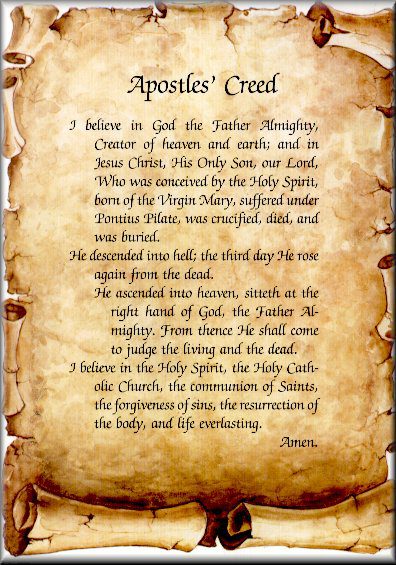
The Apostles’ Creed — foundational to our Apostolic Christian faith
I BELIEVE or WE BELIEVE IN:
The Apostles’ Creed
We believe JESUS will JUDGE the living and the dead.
The Quick and the Dead
Death becomes a more serious matter IF WE consider an inevitable after-life of our lifeless flesh and blood and in a prepared place of our created soul.
This failing flesh, weakening sinews, crumbling of bones, flow through our heart and quickness of brain will not endure…
nor will the very breath of our brief mortal life.
And yet.. this created soul will remain…
What then?
Redemption OR Judgment?
Structure of Christian CREEDS
Here’s a brief outline of the fundamental objects of our faith found in The Creed:
God
Jesus Christ
the Holy Spirit
and the Virgin Mary
Jesus was crucified
and was buried
He rose from the dead
He ascended to heaven
Siteth at the right hand of the Father (ye olde English)
Whence He cometh to judge the living and the dead
more…
source: apostles-creed.org
We believe Jesus will judge the living and the dead
During His incarnation as the Son of Man and prior to His crucifixion Jesus had confessed:
The Apostle Paul helps us with this look at the judgment of the quick and the dead:
And if Christ be in you, the body is dead because of sin; but the Spirit is life because of righteousness. But if the Spirit of him that raised up Jesus from the dead dwell in you,
he that raised up Christ from the dead shall also quicken your mortal bodies by his Spirit that dwelleth in you.
We know it and recognize the the Apostles borrow this from the Gospel of what Christ has taught during His incarnation.
from the Greek [ζωοποιέω] it more specifically means:
to produce alive, begat or bear living young
to cause to live, make alive, give life
and as Jesus used it in a parable pointing to death:
of seeds quickened into life, i.e. germinating, springing up, growing
For as the Father raiseth up the dead, and quickeneth them; even so the Son quickeneth whom he will.
Gospel of John 5:21 KJV
Think of the implication of this to a mortal like us as we look toward the dust.
An the Lord Jesus assures the faithful:
It is the spirit that quickeneth; the flesh profiteth nothing:
and you believers with ears to hear, listen to this:
the words that I speak unto you, they are spirit, and they are life.
Gospel of John 6:63 KJV – the word of Jesus, the son of Man and Son of God
from Christ to the Apostles to Christian Creeds
The Apostle Paul writes to the church in Ephesus — a worldly cosmopolitan city with the temple of the Greek goddess Artemis (the goddess Diana of the Romans) — in about AD 60, quoting the Prophets:
“Awake, you who sleep, Arise from the dead, And Christ will give you light.”
See then that you walk circumspectly, not as fools but as wise, redeeming the time, because the days are evil.
Ephesisans 5:14b-16 NKJV
And the risen Christ speaks a warning against turning back from sins and heresies leading to hell, which had seduced many of the Ephesian ‘christians‘:
“Remember therefore from where you have fallen; repent and do the first works, or else I will come to you quickly and remove your lampstand from its place—unless you repent.
Revelation of Jesus Christ to John 2:5 NKJV
Their great falling from grace in Ephesus having taken place in the AD 90’s, a mere three decades after the Apostle Paul had pastored their church.
The historical record of the Church beyond the first century AD points to both firm doctrine and similar falling away from Christ.
Augustine of Hippo on the Apostles’ Creed
Born: AD 354, Augustine lived an early 'willfully, decadent, pagan life' in Carthage, even taking a mistress who bore him a bastard son.
Source: The Confessions of St. Augustine, Rosalie DeRosset – intro
In Carthage, Augustine’s knowledge.. he admits, made him, “swollen up with vanity” (Bk 3, chap. 6). — probably made him prey for the Manichean religion. The chief characteristic of this sect was Gnosticism, an extreme dualism that claimed evil and good as equal.
ibid. pp 13-14
In just four centuries heresies had encompassed and seeped into the churches. Later after after St. Augustine and the fall of Rome, considerable idolatry and various heresies would invade the Catholic Church and later after Luther, the Protestant Church.
READ what Augustine later taught about THE APOSTLES’ CREED:
“Thence He shall come to judge the quick and dead.”
The quick, who shall be alive and remain;
the dead, who shall have gone before.
It may also be understood thus: The living, the just; the dead, the unjust.
For He judges both, rendering unto each his own.
To the just He will say in the judgment, “Come, ye blessed of My Father, receive the kingdom prepared for you from the beginning of the world.” For this prepare yourselves, for these things hope, for this live, and so live, for this believe, for this be baptized, that it may be said to you, “Come ye blessed of My Father, receive the kingdom prepared for you from the foundation of the world.”
To them on the left hand, what?
“Go into everlasting fire prepared for the devil and his angels.”
Thus will they be judged by Christ, the quick and the dead.
We have spoken of Christ’s first nativity, which is without time;
spoken of the other in the fullness of time,
Christ’s nativity of the Virgin; spoken of the passion of Christ; spoken of the coming of Christ to judgment.
The whole is spoken, that was to be spoken of Christ, God’s Only Son, our Lord. But not yet is the Trinity perfect.
Used to monitor number of Google Analytics server requests
10 minutes
__utmb
Used to distinguish new sessions and visits. This cookie is set when the GA.js javascript library is loaded and there is no existing __utmb cookie. The cookie is updated every time data is sent to the Google Analytics server.
30 minutes after last activity
__utmc
Used only with old Urchin versions of Google Analytics and not with GA.js. Was used to distinguish between new sessions and visits at the end of a session.
End of session (browser)
__utmz
Contains information about the traffic source or campaign that directed user to the website. The cookie is set when the GA.js javascript is loaded and updated when data is sent to the Google Anaytics server
6 months after last activity
__utmv
Contains custom information set by the web developer via the _setCustomVar method in Google Analytics. This cookie is updated every time new data is sent to the Google Analytics server.
2 years after last activity
__utmx
Used to determine whether a user is included in an A / B or Multivariate test.
18 months
_ga
ID used to identify users
2 years
_gali
Used by Google Analytics to determine which links on a page are being clicked
30 seconds
_ga_
ID used to identify users
2 years
_gid
ID used to identify users for 24 hours after last activity
24 hours
_gat
Used to monitor number of Google Analytics server requests when using Google Tag Manager
1 minute
_gac_
Contains information related to marketing campaigns of the user. These are shared with Google AdWords / Google Ads when the Google Ads and Google Analytics accounts are linked together.