“I am the resurrection and the life. Whoever believes in me, though he die, yet shall he live, 26 and everyone who lives and believes in me shall never die. Do you believe this?”
The Word Became Flesh
John 1 (ESV)
1 In the beginning was the Word, and the Word was with God, and the Word was God. 2 He was in the beginning with God. 3 All things were made through him, and without him was not any thing made that was made. 4 In him was life, and the life was the light of men. 5 The light shines in the darkness, and the darkness has not overcome it.
Genesis 1:
In the beginning, God created the heavens and the earth. 2 The earth was without form and void, and darkness was over the face of the deep. And the Spirit of God was hovering over the face of the waters.
26 Then God said, “Let us make man in our image, after our likeness.
Genesis 2: 7 then the Lord God formed the man of dust from the ground and breathed into his nostrils the breath of life, and the man became a living creature.
9b The tree of life was in the midst of the garden, and the tree of the knowledge of good and evil.
16 And the Lord God commanded the man, saying, “You may surely eat of every tree of the garden, 17 but of the tree of the knowledge of good and evil you shall not eat, for in the day that you eat of it you shall surely die.”
Genesis 3:
22 Then the Lord God said, “Behold, the man has become like one of us in knowing good and evil. Now, lest he reach out his hand and take also of the tree of life and eat, and live forever—” 23 therefore the Lord God sent him out from the garden of Eden to work the ground from which he was taken.
Genesis 5:5 Thus all the days that Adam lived were 930 years, and he died.
+
If there is one time in our mind we really would like to question the indisputable inerrancy of the Bible it is probably a quote of the devil’s question in the garden:
He said to the woman, “Did God actually say…?” – Genesis 3:1b
Follow Satan’s deceiving question with whatever evil your mind may conceive, but the premise is false answer of Satan.
4 But the serpent said to the woman, “You will not surely die…
Walk up to Eve or Adam and ask either of them if what Satan has assured them as enticement to sin is true?
Yes, every one of us knows that we will surely die! Therefore, what is our hope? (And I remind us now that the Bible is God’s guaranteed word.)
God IS, the LORD exists before time and measurement of creation; God IS, the LORD remains after the time of creation can no longer be measured. This is unfathomable to our limited created mind (which now has the knowledge of good and evil). This is why we must believe by faith.
Have you ever considered how different our world would be without sin? Have you ever dared to think what it would be like to NEVER die, while living in a Paradise of God’s love?
Consider the resurrection by faith: that the LORD who created all things, the LORD who created each particle of your flesh and bones, your brain and body, your heart and soul; that the LORD who made you can make you eternal!
We can be raised from the dead to a life God intended! Praise our Lord Jesus Christ!
Evidence of Christ’s resurrection is well-documented, yet still not believed by those not saved from death by their own sin and disobedience. They do not want to believe God. By their own will many will not bow down to any, even God the LORD!
Evidence of the resurrection, which some of the Jews did not believe, is presented in scripture even before the Cross of Christ Jesus. Some always refuse to obey God in spite of the evidence of scripture.
Is faith by evidence of scripture so far beyond the evidence seen only by your eyes which can deceive?
By Faith
Hebrews 11 English Standard Version (ESV)
Now faith is the assurance of things hoped for, the conviction of things not seen.
By faith Enoch was taken up so that he should not see death, and he was not found, because God had taken him.
By faith Noah, being warned by God concerning events as yet unseen, in reverent fear constructed an ark for the saving of his household. By this he condemned the world and became an heir of the righteousness that comes by faith.
By faith Abraham obeyed when he was called to go out to a place that he was to receive as an inheritance. And he went out, not knowing where he was going.
Do you believe in the resurrection of Jesus Christ by faith, when you know ‘you will surly die’?
18 And she said to Elijah, “What have you against me, O man of God? You have come to me to bring my sin to remembrance and to cause the death of my son!”
+
Is that what you think of Easter? Is that what you think of all the hope of the empty tomb of Jesus? Where is your faith?
+
20 And he cried to the Lord, “O Lord my God, have you brought calamity even upon the widow with whom I sojourn, by killing her son?”
21 Then he stretched himself upon the child three times and cried to the Lord, “O Lord my God, let this child’s life come into him again.” 22 And the Lord listened to the voice of Elijah. And the life of the child came into him again, and he revived.
23 And Elijah took the child and brought him down from the upper chamber into the house and delivered him to his mother. And Elijah said, “See, your son lives.”
Indeed, the Son lives! He IS resurrected from the dead.
Ezekiel 37:
The hand of the Lord was upon me, and he brought me out in the Spirit of the Lord and set me down in the middle of the valley; it was full of bones.2 And he led me around among them, and behold, there were very many on the surface of the valley, and behold, they were very dry. 3 And he said to me,“Son of man, can these bones live?”
What do you think: When you run to the place where the body should be, do you have faith in the resurrection?
5 Thus says the Lord God to these bones: Behold, I will cause breath [It is the same word as in the beginning, Gen. 1:2] to enter you, and you shall live.
6 And I will lay sinews upon you, and will cause flesh to come upon you, and cover you with skin, and put breath in you, and you shall live, and you shall know that I am the Lord.”
7 So I prophesied as I was commanded. And as I prophesied, there was a sound, and behold, a rattling, and the bones came together, bone to its bone.8 And I looked, and behold, there were sinews on them, and flesh had come upon them, and skin had covered them. But there was no breath in them.
+
Is that what you say of the body that has died?
“There is no breath in them. They are dry bones forever.”
The Prophet Ezekiel is witnessing creation of a man by the Spirit of God! – resurrection from the bones of men who have died!
It was a battle for Jerusalem where faithful men died defending the Holy City of the LORD. Faithful fallen followers of God, who wept over Jerusalem, the city that kills the prophets and stones those who are sent to it!
+
Thus says the Lord God: Come from the four winds, O breath, and breathe on these slain, that they may live.”
10 So I prophesied as he commanded me, and the breath came into them, and they lived and stood on their feet, an exceedingly great army.
+
Resurrection at the command of the Living GOD! Men dead, given life from the dust of our bones!
Do you hearken to the upward call of the Voice of the Living One?
Resurrection! Do you believe this?
This is 600 years before Christ Jesus. This is the same time even Jews persecuted their own Prophets. This is the time of Jeremiah who they threw into a pit to die. This is a time when Daniel would interpret handwriting on the walls for Kings who had destroyed Jerusalem in 607 BC; a time when the faithful were led as captives into Babylon, as before Moses had led Israel from the slavery Egypt.
It is the LORD who brings floods on all of the earth. It is the LORD who parts the sea before the Hebrews to pass over. It is the LORD who commands spirit into the lifeless body, which lies in the tomb of hopelessness.
Jesus Raises a Widow’s Son
Luke 7:
11 Soon afterward he went to a town called Nain, and his disciples and a great crowd went with him. 12 As he drew near to the gate of the town, behold, a man who had died was being carried out, the only son of his mother, and she was a widow, and a considerable crowd from the town was with her.
13 And when the Lord saw her, he had compassion on her and said to her, “Do not weep.” 14 Then he came up and touched the bier, and the bearers stood still. And he said, “Young man, I say to you, arise.”
15 And the dead man sat up and began to speak, and Jesus gave him to his mother.
16 Fear seized them all, and they glorified God, saying, “A great prophet has arisen among us!” and“God has visited his people!” 17 And this report about him spread through the whole of Judea and all the surrounding country.
+
I have sat through memorials for my mother and for my wife…
They lay in the grave without sinew to embrace me in the flesh; lifeless rest, without spirit to have compassion on me… Is there hope for these?
Yes! I say. In Christ they live. By their faith, their bones will hearken to the upward call of Jesus, when at last He will return once more on the clouds of Heaven… and then the Judgment.
Even with evidence of the Prophets and witness of Jesus, the Son of Man raising a boy from the coffin and giving him back to his mother: many refused to believe. Yet the work of the resurrection is never finished until Jesus says, “It is finished.”
The Death of Lazarus
Now a certain man was ill, Lazarus of Bethany, the village of Mary and her sister Martha… 5 Now Jesus loved [agapaō] Martha and her sister and Lazarus…
8 The disciples said to him, “Rabbi, the Jews were just now seeking to stone you, and are you going there again?” …
14 Then Jesus told them plainly, “Lazarus has died, 15 and for your sake I am glad that I was not there, so that you may believe. But let us go to him.” 16 So Thomas, called the Twin, said to his fellow disciples, “Let us also go, that we may die with him.”
+
Not a lot of faith here from a disciple who knew Jesus raised the boy at Nain from the dead. Fear and doubt: how easily we forget our faith in the Lord when our flesh is at stake. We are just like him though; for we would want to put our hands in the wounds of the nails.
We pray for Jesus to heal the inevitable sickness leading to death of a loved one, when their true sickness is the sin of our souls.
17 Now when Jesus came, he found that Lazarus had already been in the tomb four days. 18 Bethany was near Jerusalem, about two miles off, 19 and many of the Jews had come to Martha and Mary to console them concerning their brother…
21 Martha said to Jesus, “Lord, if you had been here, my brother would not have died. 22 But even now I know that whatever you ask from God, God will give you.”
23 Jesus said to her, “Your brother will rise again.”
24 Martha said to him, “I know that he will rise again in the resurrection on the last day.”
25 Jesus said to her, “I am the resurrection and the life. Whoever believes in me, though he die, yet shall he live, 26 and everyone who lives and believes in me shall never die. Do you believe this?”
27 She said to him, “Yes, Lord; I believe that you are the Christ, the Son of God,who is coming into the world.”
… 32 Now when Mary came to where Jesus was and saw him, she fell at his feet, saying to him, “Lord, if you had been here, my brother would not have died.”
… 38 Then Jesus, deeply moved again, came to the tomb. It was a cave, and a stone lay against it. 39 Jesus said, “Take away the stone.”
… “Lazarus, come out.”
44 The man who had died came out, his hands and feet bound with linen strips, and his face wrapped with a cloth.
Jesus said to them, “Unbind him, and let him go.”
The Plot to Kill Jesus
45 Many of the Jews therefore, who had come with Mary and had seen what he did, believed in him, 46 but some of them went to the Pharisees and told them what Jesus had done.
47 So the chief priests and the Pharisees gathered the council and said, “What are we to do? For this man performs many signs. 48 If we let him go on like this, everyone will believe in him, and the Romans will come and take away both our place and our nation.”
+
Jesus Christ is not the only one to ride into Jerusalem in triumph. The Table of Sacrifice for the Temple is prepared. The proof of the resurrection, even in the person of Lazarus, is evidence!
“Blessed is He who comes in the Name of the LORD,” shout some.
Then when it is time for the Sacrifice, many flee. Many betray the Lord to hold onto their comfortable sins. They shout, “Crucify Him! Crucify Him.“
Like a Lamb he is led to the slaughter, scourged for the punishment of our sins, and nailed to a tree with the curse of our unrighteousness.
“Crucify Him! Crucify Him,” we witness by the fruit of our quick run from the Cross after we worship most Sundays. Yet He loves us so much.
Christ died for our sins.
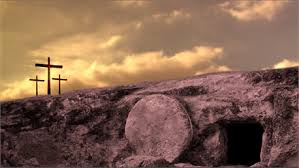
For the Tomb will be empty…
And so will be yours…
The Savior returns.
+
Do you believe this?
+