Tag: roman

  • The Gospel: Witnessed by the Romans

    The Gospel: Witnessed by the Romans

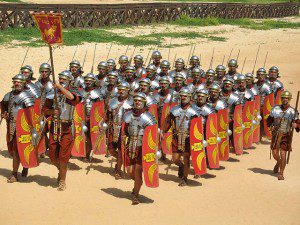
    Roman squad

    Acts 10 At Caesarea there was a man named Cornelius, a centurion of what was known as the Italian Cohort, 2 a devout man who feared God with all his household, gave alms generously to the people, and prayed continually to God.

    Don’t miss this: Caesarea is the administrative capital and military outpost of the Roman Empire by which Rome ruled, taxed and maintained civil order in Judea and Idumea.

    Cornelius is a centurion – a Roman soldier, part of the Italian Cohort sent across the Great Sea (Mediterranean) to maintain the claim of Rome in these foreign colonies; much as the Spanish, English and other empires have done in more recent centuries.

    We recognize that Jesus was Messiah to the Jews and preached to Jewish converts from other nations. We recognize that Jesus also taught in other areas – gentile towns – clearly with little or no connection to Judea or long-ago destroyed Israel.

    We may have missed (until the missionary journeys of Paul) that Romans, as occupying residents of the Land of Promise, were witness to the Gospel.

    Acts 10:3 About the ninth hour of the day he saw clearly in a vision an angel of God come in and say to him, “Cornelius.” 4 And he stared at him in terror and said, “What is it, Lord?”

    And he said to him, “Your prayers and your alms have ascended as a memorial before God. 5 And now send men to Joppa and bring one Simon who is called Peter. 6 He is lodging with one Simon, a tanner, whose house is by the sea.” 7 When the angel who spoke to him had departed, he called two of his servants and a devout soldier from among those who attended him, 8 and having related everything to them, he sent them to Joppa.

     How does it happen that a Roman is witness to the Gospel of Jesus Christ?

    Again, it’s just like you or me at work: we probably didn’t see that ‘Roman’ right there beside us (doing their own job) as we were witness to all of the truth of our faith.

    Let’s focus on some Romans (other than Pontius Pilate) at the spectacle of the Crucifixion of Christ Jesus on the Cross in Jerusalem some months earlier than this scene with Cornelius.

    Luke 23: Then the whole company of them arose and brought him before Pilate. 2 And they began to accuse him, saying, “We found this man misleading our nation and forbidding us to give tribute to Caesar, and saying that he himself is Christ, a king.” 3 And Pilate asked him, “Are you the King of the Jews?” And he answered him, “You have said so.”

    Were there Roman Centurions present in this scene with the potential for an uprising against Roman authority? Or course; many Roman soldiers.

    20 Pilate addressed them once more, desiring to release Jesus, 21 but they kept shouting, “Crucify, crucify him!” 22 A third time he said to them, “Why, what evil has he done? I have found in him no guilt deserving death. I will therefore punish and release him.” 23 But they were urgent, demanding with loud cries that he should be crucified. And their voices prevailed. 24 So Pilate decided that their demand should be granted. 25 He released the man who had been thrown into prison for insurrection and murder, for whom they asked, but he delivered Jesus over to their will.

    Were Roman Centurions present? Yes, and the crowd is growing even more unruly. They continue to do as ordered (even though the Roman ruler of the occupied territory has declared this man ‘innocent.’) How can he do that? Yet orders are orders.

    27 And there followed him a great multitude of the people and of women who were mourning and lamenting for him. 28 But turning to them Jesus said, “Daughters of Jerusalem, do not weep for me, but weep for yourselves and for your children.

    A military escort for the condemned criminals through the crowds of Jerusalem? SOP – (Standard Operating Procedure).

    33 And when they came to the place that is called The Skull, there they crucified him, and the criminals, one on his right and one on his left. 34 And Jesus said, “Father, forgive them, for they know not what they do.”

    The soldiers cast lots to see who would win his clothes. (A rather macabre occupation of time for executioners to be distracted from the cries of dying men.)

    44 It was now about the sixth hour, and there was darkness over the whole land until the ninth hour, 45 while the sun’s light failed.

    A foreboding storm covers the scene of the skull of death (as it was known). Are the Roman Legions fearful?

    Would you be fearful? … Probably.

     46 Then Jesus, calling out with a loud voice, said, “Father, into your hands I commit my spirit!”

    And having said this he breathed his last.

    47 Now when the centurion saw what had taken place, he praised God, saying, “Certainly this man was innocent!”

    48 And all the crowds that had assembled for this spectacle, when they saw what had taken place, returned home beating their breasts.

    What who you (as the Centurion) think of the witness of this spectacle?

    Just one more additional thought (which I mentioned in an earlier writing about the Sermon on the Mount):

    Do you think that Jesus (or anyone) could gather 5000 people or 4000 people or multitudes together to witness His teaching and witness His miracles and witness the truth of His daily life without Roman Centurians also being present?

    Not likely.

    We witness the gospel to any the Lord also sends to the places we live, work, play, travel and worship.

    What is your witness of the Gospel to the Romans guarding over you (who you rarely notice)?
     

  • Who Is It?

    Who Is It?

    A knock at the door:

    What is your first thought?

    ‘Who is it?’ your mind rapidly asks. “Who is it?’ your voice may even inquire loudly?

    Perhaps you know who to expect and will just open the door to welcome your guest. Or in a more hostile environment you might even ask, ‘Friend or foe?’

    The door stands as the remaining barrier between you and the unseen ‘friend or foe,’ the known guest or unknown visitor who has come to meet you face to face in the place where you live.

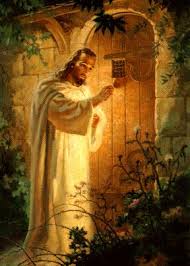
     “Behold, I stand at the door and knock,” invites the painting which does grace the walls of many homes and houses of worship.

    The friendly guest is none other than the Lord, Jesus.

    I have heard a sermon or two using the illustration of Jesus at the door – some based on the actual scripture; other messages from the pulpit using the picture to illustrate other applications of other scriptures.

    (Personally, I had forgotten for a moment the source of this scene.) The author, through the Spirit, is not an unexpected guest to the Apostle. The context, perhaps a bit unexpected for this tranquil scene, is the Revelation of Jesus Christ to John.

    The revelation of Jesus Christ, which God gave him to show to his servants the things that must soon take place. He made it known by sending his angel to his servant John…

    3 Blessed is the one who reads aloud the words of this prophecy, and blessed are those who hear, and who keep what is written in it, for the time is near.

    Greeting to the Seven Churches

    4 John to the seven churches that are in Asia:

    Grace to you and peace from him who is and who was and who is to come, and from the seven spirits who are before his throne, 5 and from Jesus Christ the faithful witness, the firstborn of the dead, and the ruler of kings on earth.

    To him who loves us and has freed us from our sins by his blood 6 and made us a kingdom, priests to his God and Father, to him be glory and dominion forever and ever. Amen.

    7 Behold, he is coming with the clouds, and every eye will see him, even those who pierced him, and all tribes of the earth will wail on account of him. Even so. Amen.

    8 “I am the Alpha and the Omega,” says the Lord God, “who is and who was and who is to come, the Almighty.”


    The Apostle John then describes his vision and prophesy from the Risen Christ Jesus and continues with Christ’s word to each of seven churches.

    STOP. Do not be deceived for an instant that this Revelation of Christ Jesus does not apply to you and me (even though addressed to ‘seven churches of Asia’ in the first century).

    We are the church – the churches of Christ Jesus in this day.  The Revelation is timely to Christ’s Church worldwide (catholic, universal, orthodox, protestant, Greek, Roman, etc.): ALL who are true Christians, faithful to our One Lord, who IS faithful and true.

    Behold, it is Christ who knocks at the door.

    Look! See the Word of scripture. Listen to the Voice of Jesus.

    What is your answer to His word to each of the seven churches? [See Revelation 2-3]

    To the Church in Laodicea

    [He has kept this Revelation until last for the seven churches.]

    14 “And to the angel of the church in Laodicea write: ‘The words of the Amen, the faithful and true witness, the beginning of God’s creation.

    15 “‘I know your works: you are neither cold nor hot.

    Is Jesus (at the door of your heart) a friend?

    OR is Jesus, the Amen and final Judge of all souls, a foe?

     “I know your works,” says the Lord.

    He knows our love. (OR He knows our lack of love.)

    He knows our faith or lack of faith.

    He knows our service for Him or our lack of fruit for His Kingdom.

    Imagine that our risen Lord Jesus comes to your door and confronts you with this:

    Would that you were either cold or hot!

    16 So, because you are lukewarm, and neither hot nor cold,

    I will spit you out of my mouth.


     To be continued…


  • Relationship with a Roman

    Relationship with a Roman


    capernaum map

    Luke 7:1 After he had finished all his sayings in the hearing of the people, he entered Capernaum.

    Jesus has just taught the crowds who were amazed at His teaching (probably under the watchful Roman eyes of their area squad of the Legion).

    Jesus taught His own people with such sayings as:

    • Love your enemies, do good to those who hate you.
    • Be merciful, even as your Father is merciful.
    • The good person out of the good treasure of his heart produces good.
    • “Why do you call me ‘Lord, Lord,’ and not do what I tell you?

    The multitudes followed Jesus from place to place (under watchful Roman eyes, along with ears to hear the true motives of this Jewish teacher who taught in the synagogues of the towns and on the distant hillsides) … waiting to see what their promised Messiah would do. (The Roman authorities and Jewish authorities wanted to know that as well.)

    Jesus has told the crowds, “For no good tree bears bad fruit, nor again does a bad tree bear good fruit, 44 for each tree is known by its own fruit.”

    What is the fruit of Jesus’ ministry? For most of the crowds just watch. Many bear no good fruit.

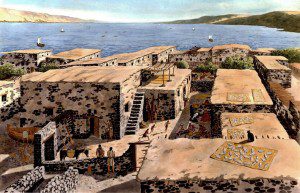
    balage_capernaumJesus returns to his new home, followed by the crowds of onlookers.
    2 Now a centurion had a servant who was sick and at the point of death, who was highly valued by him. 3 When the centurion heard about Jesus, he sent to him elders of the Jews, asking him to come and heal his servant.

    This Roman soldier had a servant, possibly a captured slave from their many battles of the Roman campaign and rule of the region (perhaps even a zealous Jew). We know that the culture of the City of Rome required many slaves (25% of the population). This person (slave or servant) was valuable to the Roman Centurion (a General in charge of many men, in addition to his own servants).

    Propriety and protocol require communication at the proper levels of leadership to approach a common Jew like Jesus; therefore the centurion sends another servant to communicate with the servant of a Jewish elder about dealing with this common Rabbi of the hillsides about possibly helping him in a personal matter of his gentile (Roman) household.

    The Elders themselves (highly esteemed and with the authority of Jewish leadership of their fellow Jews like Jesus) come to the Rabbi Jesus and ask Him a favor. No faithful Jew would refuse such a request directly from an Elder.

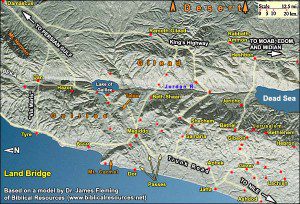
    land-bridge-600_24 And when they came to Jesus, they pleaded with him earnestly, saying, “He (this gentile, Roman centurion) is worthy to have you do this for him, 5 for he loves our nation, and he is the one who built us our synagogue.”

    So the Jews then begin a short journey toward the Roman encampment nearby, but not in Capernaum.

    6 And Jesus went with them. When he was not far from the house, the centurion sent friends, saying to him, “Lord, do not trouble yourself, for I am not worthy to have you come under my roof. 7 Therefore I did not presume to come to you. But say the word, and let my servant be healed.

     Fruit of His teaching! AND from a Roman gentile.

    8 For I too am a man set under authority, with soldiers under me: and I say to one, ‘Go,’ and he goes; and to another, ‘Come,’ and he comes; and to my servant, ‘Do this,’ and he does it.”

    And Jesus had just asked on the hillsides:

    “Why do you call me ‘Lord, Lord,’ and not do what I tell you?”

    Beloved believer, you who this day claim Christ by calling yourself a christian; do you hear now Jesus’ teaching to faithful followers of God?

    It is a further lesson for the ears of skeptical Jews and their local Elders:

     9 When Jesus heard these things, he marveled at him, and turning to the crowd that followed him, said, “I tell you, not even in Israel have I found such faith.” 

    And later report would come back to Capernaum from the gentile Roman camp of this miracle that did not even require the touch or near presence of Jesus:

    10 And when those who had been sent returned to the house, they found the servant well.

     Adoption and mercy for gentiles like most of us. Jesus IS Lord of all.

    We cry out to Christ, “Lord, Lord.”

    Do you have the faith of this centurion?

    Is He your Lord?