he who believes in me, though he die, yet shall he live, and whoever lives and believes in me shall never die.
Do you believe this?”
Gospel of John 11:25-26 RSV
The Son of God Who rose from the dead after being sacrificed on a cross for those who believe until His coming again, authoritively ANSWERED the timeless questions of mortal men, women and curious children of WHAT HAPPENS WHEN WE DIE?
Many men have pondered this relative relationship between the timeless Creator of all things with mortal men made in his image.
Before Christ
Job 3:
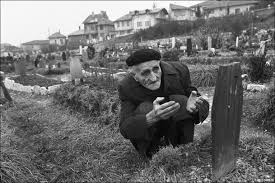
of the grave
“There the wicked cease from raging, And there the weary of strength are at rest. “The prisoners are at ease together; They do not hear the voice of the taskmaster. “The small and the great are there, And the slave is free from his master.
“Why is light given to him who is troubled, And life to the bitter of soul, Who long for death, but there is none, And dig for it more than for hidden treasures, Who are glad with joy, And rejoice when they find the grave?
“But regarding the resurrection of the dead, have you not read that which was spoken to you by God, saying, ‘I am the God of Abraham, and the God of Isaac, and the God of Jacob?’ He is not the God of the dead but of the living.” (Matt 22:31-32 NAS)
“And inasmuch as it is appointed for men to die once and after this comes judgment, so Christ also, having been offered once to bear the sins of many, shall appear a second time for salvation without reference to sin, to those who eagerly await Him.” (Heb 9:27-28 NAS)
The body dies — returns to the dust from which God created mankind. And the soul — not just the breath of life,brain or your lifeless heart where blood flows no more — your soul and mine will return to its place in the light of THE LORD or judged — separated from Christ and God — to the place of darkness and punishment.
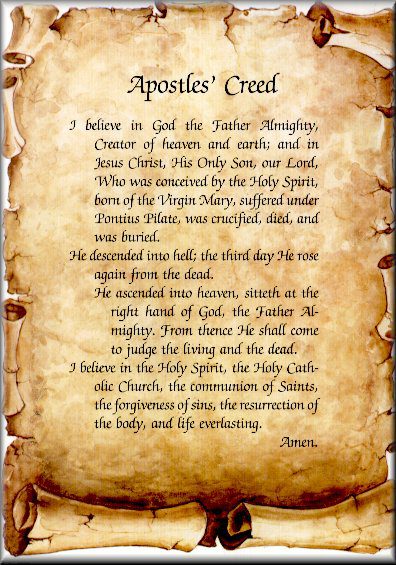
The Apostle Paul, whose Scriptures anchor the Apostles’ Creed, explains resurrection more thoroughly in his first epistle to the Saints in Corinth:
But if it is preached that Christ has been raised from the dead, how can some of you say that there is no resurrection of the dead?
If there is no resurrection of the dead, then not even Christ has been raised. And if Christ has not been raised, our preaching is useless and so is your faith… If only for this life we have hope in Christ, we are of all people most to be pitied.
The Apostle addresses issues of unbelief in the Church, as well as growing heresies about Jesus Christ, His body and His Spirit.
But Christ has indeed been raised from the dead, the firstfruits of those who have fallen asleep…
For as in Adam all die, so in Christ all will be made alive...
The body that is sown is perishable, it is raised imperishable;
it is sown in dishonor, it is raised in glory;
it is sown in weakness, it is raised in power;
it is sown a natural body, it is raised a spiritual body…
Listen, I tell you a mystery: We will not all sleep, but we will all be changed— in a flash, in the twinkling of an eye, at the last trumpet. For the trumpet will sound, the dead will be raised imperishable, and we will be changed.
Then quoting and answering the Prophets Isaiah and Hosea, Paul writes:
“Death has been swallowed up in victory.”
“Where, O death, is your victory?
Where, O death, is your sting?”
1 Corinthians 15 excerpts continued
But thanks be to God! He gives us the victory through our Lord Jesus Christ.
Then I saw an angel coming down from heaven, having the key of the abyss and a great chain in his hand…
Then I saw thrones, and they sat on them, and judgment was given to them.
And I saw the souls of those who had been beheaded because of their witness of Jesus and because of the word of God..
And they came to life and reigned with Christ for a thousand years.
The rest of the dead did not come to life until the thousand years were finished. This is the first resurrection.
Blessed and holy is the one who has a part in the first resurrection. Over these the second death has no authority, but they will be priests of God and of Christ and will reign with Him for a thousand years.
.. And the devil who deceived them was thrown into the lake of fire and brimstone, where the beast and the false prophet are also, and they will be tormented day and night forever and ever.
Then I saw the dead, the great and the small, standing before the throne, and books were opened…
Then death and Hades were thrown into the lake of fire. This is the second death, the lake of fire.
And if anyone’s name was not found written in the book of life, he was thrown into the lake of fire.
“Truly, truly, I say to you, he who believes has eternal life. “I am the bread of life.
Note that communion here is the fellowship of the saints whick follows learning the teaching or doctrine of the Apostles.
AND that Communion (as we call it) is a corporate breaking of the bread [klasis artos], a symbolic remembrance of Christ’s broken body.
They devoted themselves to
(from the CSB) (and in addition to;)
the apostles’ teaching,
to the fellowship (communion of the saints),
to the breaking of bread,
and to prayer.
ALL these together, as Christ’s local church, to keep them holy and separate from the sin and surrounding sinners of whom they once embraced.
κοινωνία koinōnía, koy-nohn-ee’-ah; from G2844; partnership, i.e. (literally) participation, or (social) intercourse, or (pecuniary) benefaction (giving to the benefit of the church):—(to) communicate(-ation), communion, (contri-)distribution, fellowship.
After the Hebrews had abandoned the Law of Moses and their priest Ezra reads it to the people.
.. the children of Israel were assembled with fasting, and with sackclothes, and earth upon them.
repentant prayer
.. And the seed of Israel separated themselves from all strangers,
sanctification or holiness apart from the sin of their former life
and stood and confessed their sins, and the iniquities of their fathers.
Confession to God precedes asking for forgiveness.
But they and our fathers dealt proudly, and hardened their necks, and hearkened not to thy commandments,
And refused to obey, neither were mindful of thy wonders that thou didst among them; but hardened their necks, and in their rebellion appointed a captain to return to their bondage:
but thou art a God ready to pardon, gracious and merciful, slow to anger, and of great kindness, and forsookest them not.
Nehamiah 9:16-17 KJV
the remission of sins,
Admittedly 'remission from the Creed is a little 'King James' in its sound. But recognize the New Testament application with which you may be able to relate from a familiar prayer and Scripture.
Forgive us our debts
(Which comes from this OT application of the Law)
“At the end of every seven years you shall grant a remission of debts.
מִקֵּץ שֶׁבַע־שָׁנִים תַּעֲשֶׂה שְׁמִטָּה׃
Deuteronomy 18:1 LSB
‘And forgive us our debts, as we also have forgiven our debtors.
Gospel of Matthew 6:12 LSB
“For if you forgive others for their transgressions,
your heavenly Father will also forgive you.
“But if you do not forgive others,
then your Father will not forgive your transgressions.
Matthew 6:14-15 LSB – the teaching of Jesus, the Son of Man, to followers
the concept of “wages,” which implies a payment or consequence that is earned. In the biblical context,
sin refers to any action, thought, or attitude that falls short of God’s holiness and commands.
Death here is both physical and spiritual, indicating separation from God.
Theologically, this underscores the seriousness of sin and its inevitable outcome without divine intervention.
Contrasting with the earned wages of sin, the “gift of God” emphasizes grace, which is unmerited favor. Eternal life is not something humans can earn; it is a gift freely given by God.
It is only through Jesus Christ, His death, and resurrection, that believers receive this gift. Jesus is seen as the fulfillment of Old Testament types and prophecies, such as the Passover Lamb (Exodus 12) and the Suffering Servant (Isaiah 53).
Citizens of Greek City-States claimed freedom and justice..
(although like everywhere else, Greek democracy did not apply to its slaves.)
Socrates drank the hemlock of justice weighed by his opponents of classic philosophy.
And, of course, Alexander the Great Macedonian claiming all Greece and the world had different ideas of law to make the world Greek again.
(“There’s nothing new under the sun,” stated Solomon, King over much of the same empire nearly a thousand years before Alexander.)
Roman Law
In today’s setting of Acts of the Apostles it’s important for us to remember that in Jerusalem – Judean LAW (it isn’t even fully JEWISH LAW applicable in other Roman Provicences (or States by contemporary comparison) – as administered by the Sanhedron separate of the Roman Governor, a minor appointed Proconsul accountable to the Emporor.
This jurisdictional oversight – similar to that when Pontius Pilate tried to pass the political hot potato of the King of the Jews back and forth to Herod or the Jewish leaders of Jerusalem – is little different when just a few years later Paul retuns to Jerusalem to face JUSTICE redefined in various venues.
Jews demanding JUSTICE
The Apostle of Jesus sent to the Gentiles (Greeks) has just returned home.
After his witness to the Jews (in Hebrew) of being sent by Jesus (who had been crucified) on the road to Damascus) AND being sent to the Gentiles — (this had been 20 years ago, back in A.D. 37) — once again, Paul proclaims Christ risen!
The adjitated jewish crowd was about to stone him, just as when he himself had witnessed the execution of Stephen.
“Is it lawful for you to flog a man who is a Roman citizen and uncondemned?”
When the centurion heard this, he went to the tribune..
Acts of the Apostles 22:25b-26a ESV
There he's done it!
Paul initiates a whole chain-of-events triggering the chain-of-command in Roman oversight and justice.
But on the next day, desiring to know the real reason why he was being accused by the Jews, he [the Tribune in charge of the Centurians] unbound him and commanded the chief priests and all the council to meet, and he brought Paul down and set him before them.
Acts 22:30 ESV
This JEWISH council — about seventy leading men, SUMMONED to apprear before the ROMAN Tribune and his COURT of Roman justice in Jerusalem — are NOT in charge of the proceedings.
Acts 23:
And looking intently at the council, Paul said, “Brothers, I have lived my life before God in all good conscience up to this day.”
Remember: Although the courtroom is that of the Jews, Paul — the DEFENDENT — faces them as his PROSECUTOR (not his judge).
And the high priest Ananias commanded those who stood by him to strike him on the mouth.
“God is going to strike you, you whitewashed wall!
Are you sitting to judge me according to the law, and yet contrary to the law you order me to be struck?”
Some savvy oral arguments take place (as is common in court). Paul seeks to divide the jury of his accusers:
“.. It is with respect to the hope and the resurrection of the dead that I am on trial.”
It worked. One of his fellow Pharisees stands in his defense,
“We find nothing wrong in this man.
What if a spirit or an angel spoke to him?”
The dissension (between the two parties of the Pharisees and Sadducees)became violent.
Now the Jews of this local lower court — to which the rules of the Pax Romana defer — sound more like a lynch mob than a place of justice AND (let’s not forget) Paulos is a ROMAN CITIZEN.
And as a great dissension was developing, because the commander was afraid Paul would be torn to pieces by them, he ordered the troops to go down and take him away from them by force, and bring him into the barracks.
Acts 23:10 LSB
Conspiracy against Christ and His Apostle
The world will often witness an unexplainable boldness in a certain saint of God is seemingly insurmountable circumstances. (This had happened with the Apostle time and time again during his ten-plus years of travel among the gentiles and Greeks.)
The night before his highly anticipated public trial in Jerusalem the Apostle of Christ Jesus again received supernatural instruction.
But on that very night, the Lord stood at his side and said,
“Take courage; for as you have solemnly borne witness to My cause at Jerusalem, so you must bear witness at Rome also.”
Acts 23:11 LSB
Imagine — the Lord Jesus Christ, who had been crucified twenty-seven years ago — the same risen Lord who had appeared in a vision of great glory twenty years ago — stands beside the Apostle and now sends him to Rome!
So of course, Paul is emboldened when he is brought to trial before the Roman court the next day.
Meanwhile, more than forty of the jews made a plot to murder Paul (outside of the jurisdiction of the Roman authorities).
They went to the chief priests and elders and said,
“We have strictly bound ourselves by an oath to taste no food till we have killed Paul. Now therefore you, along with the council, give notice to the tribune to bring him down to you, as though you were going to determine his case more exactly. And we are ready to kill him before he comes near.”
The Plot Thickens
Paul’s jewish nephew hears of the plot of these forty men, so the young man heads to the Roman fortress to try to warn Paul.
Paulos — the Roman citizen held in protective custody after the big hubbub of the jewish crowds — instructs his guards to go to the man in charge.
Paul called one of the centurions and said,
“Take this young man to the tribune, for he has something to tell him.”
Acts 23:17 ESV
The tribune [Claudius Lysias] took him by the hand, and going aside asked him privately, “What is it that you have to tell me?”
Note the gentleness of this tribune, Claudius Lysias - a man in charge of the centurions of Antonia Fortress as he seeks to get to the truth of the matter.
The young son of Paul’s sister responds:
“The Jews have agreed to ask you to bring Paul down to the council tomorrow, as though they were going to inquire somewhat more closely about him.
But do not be persuaded by them, for more than forty of their men are lying in ambush for him, who have bound themselves by an oath neither to eat nor drink till they have killed him. And now they are ready, waiting for your consent.”
Acs 23:21b-22 ESV
“Tell no one that you have informed me of these things.”
An Imposed Authority of Roman Justice
“Get ready two hundred soldiers, with seventy horsemen and two hundred spearmen to go as far as Caesarea at the third hour of the night.[9 pm]
Caesarea – (Caesar’s Palace in Judea
Also provide mounts for Paul to ride and bring him safely to Felix the governor.”
This military escort of a Roman citizen Paulos is most unlike the handling of Jesus the king of the Jews sent to the Pontius Pilate, governor of that time, (who happened to be in Jeruslem rather than Caesarea).
Official Orders sent with Paul
“Claudius Lysias,
to his Excellency the governor Felix,
greetings.
This man was seized by the Jews and was about to be killed by them when I came upon them with the soldiers and rescued him, having learned that he was a Roman citizen. And desiring to know the charge for which they were accusing him, I brought him down to their council. And desiring to know the charge for which they were accusing him, I brought him down to their council. And when it was disclosed to me that there would be a plot against the man, I sent him to you at once, ordering his accusers also to state before you what they have against him.”
Acts 23:26-30 ESV
You might call this 'the official COURT record.'
Of course — ALL follow orders and the next scene with, with Roman effeciency, take place in Caesarea.
Marcus Antonius Felix
Antonius Felix, served as the Roman procurator of Judea from ~AD 52-58. He was appointed by the Emperor Claudius and was known for his harsh and often corrupt administration. Felix was a freedman of Claudius' mother, Antonia. - source: BibleHub
When they had come to Caesarea and delivered the letter to the governor, they presented Paul also before him.
The Governor inquires about jurisdiction – that is, in effect – Am I the appropriate judge of this case?
And when he learned that he [Paulos] was from Cilicia, he said, “I will give you a hearing when your accusers arrive.” And he [Antonius Felix] commanded him [the Centurian in charge of Paul’s escort] to be guarded in Herod’s praetorium [there in Caesarea].
Acts of the Apostles 23:35 ESV [with names of prepositions]
Used to monitor number of Google Analytics server requests
10 minutes
__utmb
Used to distinguish new sessions and visits. This cookie is set when the GA.js javascript library is loaded and there is no existing __utmb cookie. The cookie is updated every time data is sent to the Google Analytics server.
30 minutes after last activity
__utmc
Used only with old Urchin versions of Google Analytics and not with GA.js. Was used to distinguish between new sessions and visits at the end of a session.
End of session (browser)
__utmz
Contains information about the traffic source or campaign that directed user to the website. The cookie is set when the GA.js javascript is loaded and updated when data is sent to the Google Anaytics server
6 months after last activity
__utmv
Contains custom information set by the web developer via the _setCustomVar method in Google Analytics. This cookie is updated every time new data is sent to the Google Analytics server.
2 years after last activity
__utmx
Used to determine whether a user is included in an A / B or Multivariate test.
18 months
_ga
ID used to identify users
2 years
_gali
Used by Google Analytics to determine which links on a page are being clicked
30 seconds
_ga_
ID used to identify users
2 years
_gid
ID used to identify users for 24 hours after last activity
24 hours
_gat
Used to monitor number of Google Analytics server requests when using Google Tag Manager
1 minute
_gac_
Contains information related to marketing campaigns of the user. These are shared with Google AdWords / Google Ads when the Google Ads and Google Analytics accounts are linked together.