
Tag: Scripture

Scripture is the word commonly used for the Written Word of the Old Testament or Hebrew Bible.

TalkofJESUS.com would like to hear from you via your comments and questions on a NEW Series of brief posts in A.D. 2022.

Short Takes on Scripture – Tell us your thoughts about this brief quote from the Bible.

Sola Scriptura ! written on a blackboard (Latin for ''only scripture'
ONLY Scripture

talkofjesus.com share scripture

  • Your Mistake – You don’t know the Scriptures

    Jesus replied, “Your mistake is that you don’t know the Scriptures, and you don’t know the power of God.

    Matthew 22:29 NLT

    כְּתָב – a writing, document, edict

    Scriptures, the written word of God

    First, let’s understand scripture. It’s written down, recorded, a message of importance with authority; but scripture is much more than that.

    • a written edict
      • of royal enactment
      • of divine authority
    http://slideplayer.com/slide/4487529/

    We forget the igniting spark of the Reformation just five centuries ago. The printing press fanned the flame of scripture now available to ordinary saints of the church.

    In the early church, the time of Jesus and before Christ, Scriptures were hand-written on individual sheets or rolls of parchment. Faithful Scribes meticulously recorded every jot and tittle on individual scrolls. Worshipers relied on leaders of the faith for the truth of the Bible recorded through the generations and millenia.

    I remind us: no cell phones, no internet, no television, no radio, no media producers and analysts of pronouncements by authorities. Just authoritarian leadership with men who wrote down important words to be shared with the people. Scriptures for worship and written announcements for a king or emperor’s  emissaries to send out to all the land.

    Jesus spoke with such authority and sent out the Twelve as emissaries to proclaim the Gospel to Israel. Israel was a captive land ruled by a king dependant on Rome. Jesus’s authority, proclaimed throughout these Roman provinces, not only resonated with the common people, but challenged the very limited authority of Jewish officials in Jerusalem.

    Sadducees Ask About the Resurrection

    23 The same day Sadducees came to him, who say that there is no resurrection, and they asked him a question…

    Let’s examine the role of the Sadducees who have been part of the crowds in various places and among those with no ears to hear. Look for these religious unbelievers in the multitudes. 

    Matthew 5-7

    The Sermon on the Mount

    Seeing the crowds, he went up on the mountain, and when he sat down, his disciples came to him…

    Crowds of men, women and children came to hear Jesus from distant and nearby towns. Most could not read, although a few local religious authorities always seemed to show up in the crowds. Jesus’ listeners had heard very little of the scriptures in their weekly gatherings and seasonal festivals of the church. 

    Is it so different today among the ‘literate’ of the church illiterate in the Scriptures?

    Many of us know and some can quote the beatitudes (or blessings) Jesus spoke. Jesus’ encouraging proverbs lift our hearts. But let’s listen further.

    17 “Do not think that I have come to abolish the Law or the Prophets; I have not come to abolish them but to fulfill them… 20 For I tell you, unless your righteousness exceeds that of the scribes and Pharisees, you will never enter the kingdom of heaven…

    (We will see how Jesus addresses the mistakes of the Pharisees later.)

    Israel just before Jesus

    So you think we have controversy today?

    The undercurrent of politics between conservative and liberal, republican and democrat, communist and  theist in the 21st century pales by comparison to Roman rule of 1st century Israel.

    Every religious encounter with Jesus comes from a different perspective.

    Before the empire, Rome once had a king and then a republic in 509 BC until about 29 BC. 

    A glance at a map from 90 BC,  just a little more than a century before Christ, shows a Hellenistic (Greek) Hasmonean State.  It would be like us thinking back to about 1890.

    The Romans had invaded Greece, Macedonia and many other countries. It would be only a few more years until the fall of Jerusalem and massive political and religious changes.

    The Sadducees were a political party consisting mainly of high priests and aristocrats of Jerusalem, who had only been around since about 150 B.C. Their claim to priestly authority came through Zadok and Aaron, but their line was by no means continuous back to those generations.

    They were aristocrats and fancily-dressed priests. Even though they claimed only literal scripture and no validity to any oral Torah, their party had wholeheartedly embraced hellenism as comprise of retaining influence with their greek captors. Jesus may have easily pointed to Sadducees in the crowd by telling any parable against the rich. 

    Once again, it may be helpful to think back on the history of each of these perspectives of the time of Jesus in parallel to looking back the same number of years in the 21st century. In Jesus’ time, Sadducees would only have a history comparable of us looking back to around the 1830’s.

    Just before Christ

    Suppose you sit among the multitudes listening to Jesus on a hillside or by the seashore. The year, about AD 30. A few of the old men will remember well the stories of their fathers about 63 B.C.

    In our current context we would look back only to 1925 A.D. My father had been born. One of my grandfathers was twenty-five years old and I remember his stories about World War I.

    This is how recent the memory of the crowds listening to Jesus would have remembered the fall of Jerusalem in 63 B.C.

    The Roman general Gnaeus Pompeius Magnus, Pompey the Great, conquered Jerusalem, entered and defiled the Holy of Holies. 

    Just four years later Pompey would enter into an alliance with Julius Caesar. who would be assassinated on the Ides of March (March 15), 44 BC. by Gaius Cassius Longinus, Decimus Junius Brutus, and Marcus Junius Brutus, ironically next to the Theatre of Pompey.

    In contemporary terms we only need to think back as far as March 15, 1944, near the end of WWII.

    Controversies of the Jews

    Then they understood that he did not tell them to beware of the leaven of bread, but of the teaching of the Pharisees and Sadducees –Matthew 16:12

    Hellenistic Period (332-141 BCE)

    Sadducees embraced Hellenism (Greek culture) but argued for the strict religious obligations of Levitical priesthood. Priests have authority over the people according to Hebrew scripture, not the Septigent

    The Torah gave this aristocratic class the authority of Law. Sadducees also argued that the resurrection did not exist.

    They opposed any Authority of Jesus as King or Son of God and argued against the Pharisees; for after all they were just common people. Unlike the Sadducees, the multitudes with ears to hear Jesus were, for the most part, just like you and me.


    To be continued…

  • Death’s Melancholy: Resurrection’s Rapture

    Death’s Melancholy: Resurrection’s Rapture

    “Then beginning with the scriptures of Moses and from all the prophets he uncovered the things concerning himself.” – the good news of Luke 24:27

    Scripture taught along a road from Jerusalem

    One of the the most remarkable verses in scripture comes to us from witnesses on a road to Emmaus from Jerusalem. Though less notable than much scripture, two followers of the crucified Christ learn scripture from him. We quickly learn the personal witness of Cleopas and one other follower who encounter the risen Lord in person! Jesus, as we might expect, picks up in teaching scripture just as the Lord had done for three years.

    Describing the Scene

    Matthew Henry [1662-1714], scriptural commentator from Wales U.K., describes the scene with much compassion for those who had just endured the traumatic events in Jerusalem.

    Our Lord Jesus went gloriously down to death, in spite of the malice of his enemies, who did all they could to make his death ignominious; but he rose again more gloriously, of which we have an account in this chapter; and the proofs and evidences of Christ’s resurrection are more fully related by this evangelist than they were by Matthew and Mark.

    One of these two disciples was Cleopas or Alpheus, said by the ancients to be the brother of Joseph, Christ’s supposed father; who the other was is not certain..

    They went to a village called Emmaus, which is reckoned to be about two hours’ walk from Jerusalem; it is here said to be about sixty furlongs, seven measured miles..

    Henry describes these two former followers of Jesus of Nazareth:

    They were sad; it appeared to a stranger that they were so. They had lost their dear Master, and were, in their own apprehensions, quite disappointed in their expectations from him. They had given up the cause, and knew not what course to take to retrieve it.

    Isn’t this how death of one we love and admire generally comes upon us?  Listen more to Henry’s account:

    Note, Christ’s disciples are often sad and sorrowful even when they have reason to rejoice, but through the weakness of their faith they cannot take the comfort that is offered to them. Being sad, they had communications one with another concerning Christ…

    Weep with them who weep

    Henry continues: Giving vent to the grief may perhaps give ease to the grieved; and by talking it over we may talk ourselves or our friends may talk us into a better frame.

    “Joint mourners should be mutual comforters; comforts sometimes come best from such.”
    Matthew Henry on the mourning of the Disciples after Jesus’ death.

    Though Christ had now entered into his state of exaltation, yet he continued tender of his disciples, and concerned for their comfort. He speaks as one troubled to see their melancholy.. Note, Our Lord Jesus takes notice of the sorrow and sadness of his disciples, and is afflicted in their afflictions.

    Christ has hereby taught us, [1.] To be conversable. Christ here fell into discourse with two grave serious persons, though he was a stranger to them and they knew him not, and they readily embraced him. It does not become Christians to be morose and shy, but to take pleasure in good society.

    [2.] We are hereby taught to be compassionate. When we see our friends in sorrow and sadness, we should, like Christ here, take cognizance of their grief, and give them the best counsel and comfort we can: Weep with them that weep.

    Luke 24:13-35 excerpts

    [You may want to take time here to read Luke 24 or additional verses.]

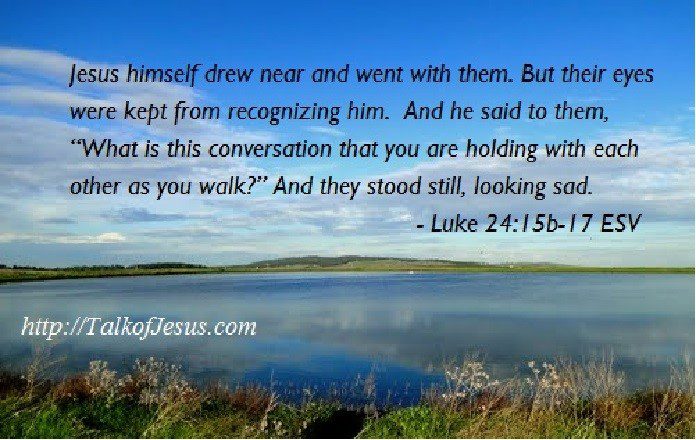
    15 While they were talking and discussing together, Jesus himself drew near and went with them. 16 But their eyes were kept from recognizing him. 17 And he said to them, “What is this conversation that you are holding with each other as you walk?” And they stood still, looking sad.

    Conversation along a road to Emmaus

    NOTE: The conversational style of their witness presumes who speaks, yet who says anything other than Jesus does not really matter.

    Cleopas: “Are you the only visitor to Jerusalem who does not know the things that have happened there in these days?”

    The unrecognized man now walking with them:  “What things?”

    Cleopas (most likely): “Concerning Jesus of Nazareth, a man who was a prophet mighty in deed and word before God and all the people, and how our chief priests and rulers delivered him up to be condemned to death, and crucified him.  But we had hoped that he was the one to redeem Israel.

    The other disciple: Yes, and besides all this, it is now the third day since these things happened. Moreover, some women of our company amazed us. They were at the tomb early in the morning, and when they did not find his body, they came back saying that they had even seen a vision of angels, who said that he was alive.

    Cleopas (perhaps): Some of those who were with us went to the tomb and found it just as the women had said, but him they did not see.

    The unrecognized, risen, Son of Man: “O foolish ones, and slow of heart to believe all that the prophets have spoken! Was it not necessary that the Christ should suffer these things and enter into his glory?”


    Reaction to the Risen Christ!

    Can you image their reaction and sudden recognition of their witness of the Risen Christ?

    From this point forward, their journey would be transformed. Sorrow lifts toward rapturous joy! Jesus once more walks with those He loves. The Lord begins teaching more scriptures from the books of Moses. He unwraps so many verses from the scriptures written about Him by the Prophets.

    Jesus’ words from Isaiah and other Prophets we have just read must have pierced the hearts of these two disciples. For He spoke of His life as predicted by scripture and explained why the Lord’s crucifixion for our sins had to take place.

    What a glorious walk to Emmaus after having left Jerusalem dejected and directionless.

    Conclusion to conversation at journey’s end

    28 So they drew near to the village to which they were going. He acted as if he were going farther..

    Cleopas:  “Stay with us, for it is toward evening and the day is now far spent.”

    ,, So he went in to stay with them. 30 When he was at table with them, he took the bread,,

    Jesus (familiar words of blessing, to this effect):

    ‘This is my body which is given for you…

    He broke it and gave it to both disciples…

    31 And their eyes were opened, and they recognized him.

    And he vanished from their sight!

    The other disciple (in mutual amazement) to Cleopas:  “Did not our hearts burn within us while he talked to us on the road, while he opened to us the Scriptures?”

    33 And they rose that same hour and returned to Jerusalem.

    Yes, even though it was toward evening, these two disciples who had just encountered Jesus immediately returned. They had just completed a seven mile walk, yet would return under the cover of darkness for about a three hour journey and ascent back into the Roman-guarded city of Jerusalem.

    35 Then they told what had happened on the road, and how he was known to them in the breaking of the bread.

    Melancholy or Joy?

    What describes your mortal life? Does the inevitability of death (and yes, judgment) cause you grief?

    Christians speak of a rapture, really an overflowing indescribable joy in one sense.

    The Gospel of the sacrifice and resurrection of Jesus is filled with joy.
    “for those who believe.
    Yet you must believe in Jesus and receive the Holy Spirit.”

    Scripture also prophesies a rapture of these last days as certainly as death destroys the flesh. Judgment of all, in Christ or against Christ (the only two choices). Resurrection lifts up the soul and the Lord creates a new and indestructible sinless body! Only by the purification of the Blood of Christ Jesus… only through Christ.

    The Bible speaks of a new Jerusalem, a new heaven and a new earth! An eternal place in the Presence of the LORD where:

    “..there shall be no more death, neither sorrow, nor crying, neither shall there be any more pain: for the former things are passed away. – The Revelation of Jesus Christ to John: 21:4 KJV

    Who do you choose?

    Do you stand alone, justifying your sins by your own good works? After having done so little for the Lord, as we all may rightfully be convicted, are you facing death’s melancholy?

    Or in Christ Jesus, the incarnate son of man, born to a virgin, died for our sins as Perfect Sacrifice on a cross – in Christ the LORD, One with the Father and One with the Holy Spirit, will you embrace the resurrection’s rapture? It is the Good News, the great joy, the glad tidings of Easter for those who bow down to the LORD.

    “He IS the Lord of love. Jesus IS. Worship the Lord our God, who loves you so much as to endure the Cross.” tweet=”Amen. Happy Easter. Joy and eternal life is ours in Christ Jesus.

  • Fully Trained – 8

    Fully Trained – 8

    A disciple is not above his teacher, but everyone when he is fully trained will be like his teacher.

    Why do you see the speck that is in your brother’s eye, but do not notice the log that is in your own eye?

    – Luke 6:40-41

    The gospel of Luke carefully records truth from eyewitness accounts of numerous historical citizens of the first century.

    The following is a fictional representation, part one of the conclusion to seven previous episodes of eyewitness by one of Jesus’ first disciples.

    As I have said, when we came among the first disciples of Jesus and followed our Lord to Capernaum, into the hills of Galilee and eventually on His teaching journeys though Samaria and Judea, I knew with all of my heart that He IS the Messiah of God.

    Yet it took us many years of difficult witness to understand the many sayings of Jesus to the crowds. Although we understood His words, we had doubts of how we might apply our Lord’s teaching to our daily lives.

    Luke 6:27 “But I say to you who hear, Love your enemies, do good to those who hate you, 28 bless those who curse you, pray for those who abuse you.

    For all those years even after Jesus’ resurrection it seemed like everyone was an enemy of the Messiah Jesus. They made it most difficult for us to love them even a little. All I could see was that the difficulty our former friends and neighbors had put us through had probably caused my wife to lose our baby. They nearly starved us to death, had it not been for the generosity of some of our new friends, followers of Christ – total strangers.

    30 Give to everyone who begs from you, and from one who takes away your goods do not demand them back.

    Jesus’ sayings to us (back when we were His early disciples) were difficult for us. We could in no way be like our Teacher, as our Lord would command us.

    36 Be merciful, even as your Father is merciful. 37 “Judge not, and you will not be judged; condemn not, and you will not be condemned; forgive, and you will be forgiven; 38 give, and it will be given to you.

    Jesus was our teacher, our rabbi. We followed Him at first by faith, before we had certainty that Jesus IS the Messiah of God – the Christ – the Promised One.

    Teachers or rabbis taught; disciples of these wise rabbis followed and sought to be like these highly trained teachers.

    A friend of ours, a brother in the Lord, later gave us a better insight of our position as new followers of Jesus, a look in the mirror of our own immaturity we could not have understood at the time. In fact, he later included it in a letter to the church:

    For though by this time you ought to be teachers, you need someone to teach you again the basic principles of the oracles of God. – Hebrews 5:12

    Jesus was teaching us a basic principle in one of His shortest parables. (A parable was a common way for rabbis to tell a story to illustrate a point.) We thought it was funny at the time, but we came to learn the truth of it. For we were disciples who would have led many a teacher astray. We were nothing like Jesus.

    39 He also told them a parable: “Can a blind man lead a blind man? Will they not both fall into a pit?

    It was a great picture. Was Jesus speaking of other rabbis who were misleading us?

    He then challenged us, though we didn’t know it at the time. Jesus said we must become more than just disciples – more than just followers of some teaching.

    40 A disciple is not above his teacher, but everyone when he is fully trained will be like his teacher.

    I’m still not fully trained, but after all these years I have finally become more like our teacher than like a blind follower.

    How about you? Who do you follow blindly? (See what I mean?)

    To be continued