Tag: series

  • For you will always have the poor – 2

    For you will always have the poor – 2

    “For the poor you have with you always, but Me you do not have always.” – John 12:1 NKJV

    This remark of Jesus cuts right to the quick, does it not? A sense of urgency here: the Son of Man is about to depart from the company of those the Lord came to save.

    An earlier story (in the home of Lazarus)

    Once again, I ask us to examine the 5 W’s of the gospel accounts.

    In the first part of this series we examined the gospel of Mark.

    We established some facts:

    1. It took place on Tuesday, two days prior to the Passover.
    2. It took place in Bethany, in the home of Simon the Leper.
    3. An unnamed woman came in and broke an alabaster flask, anointing Jesus’ head.
    4. There were some who said to themselves indignantly, “Why was the ointment wasted like that?” [Once more, ‘to themselves.’]
    5. Jesus praises the unnamed woman.

    Read carefully a similar, earlier incident from the gospel of John:

    John 12:

    Six days before the Passover, Jesus therefore came to Bethany, where Lazarus was, whom Jesus had raised from the dead.


    Again, earlier – six days before the Passover, not two. And as we mentioned the Passover that year was a Thursday; therefore, most likely on the evening of the Sabbath, Friday, not the following Tuesday after Jesus’ triumphal entry into Jerusalem.


    Jesus therefore came to Bethany, where Lazarus was, for a final Sabbath meal with his dear friends.

    2 So they gave a dinner for him there. Martha served, and Lazarus was one of those reclining with him at table.


    Once again, we are in Bethany, but with all certainty Lazarus is hosting the meal with Jesus as honored guest in his own home (not one of another resident of Bethany who will host them all just four days later). Martha, Mary, Lazarus and Judas Iscariot are all named in addition to Jesus.


    3 Mary therefore took a pound of expensive ointment made from pure nard, and anointed the feet of Jesus and wiped his feet with her hair. The house was filled with the fragrance of the perfume.


    Some new detail

    In addition to naming Lazarus, Mary and Martha, we now learn that Mary anointed the feet of Jesus and wiped his feet with her hair. It is the act of a servant, an act of humility. Furthermore, we learn from the Apostle John, who wrote this account and knew the disciples well, that Judas complains about the value of the pure nard. It is Judas who suggests to all the value that could be uses for the poor; yet John reveals Judas’ motive in mentioning the poor, that Judas steals cash from this treasury of the disciples.


    4 But Judas Iscariot, one of his disciples (he who was about to betray him), said, 5 “Why was this ointment not sold for three hundred denarii and given to the poor?” 6 He said this, not because he cared about the poor, but because he was a thief, and having charge of the moneybag he used to help himself to what was put into it.

    7 Jesus said, “Leave her alone, so that she may keep it for the day of my burial. 8 For the poor you always have with you, but you do not always have me.”


    Jesus, of course, ignores the false suggestion that Judas and the disciples can sell Mary’s expensive ointment for a profit to ‘help the poor.’ Jesus defends Mary’s generous and kind act of worship.

    I ask us, though: aren’t you and I just like Judas in that way?

    Don’t we so often accuse the generous act of another in a way to imply that we could be better stewards of their gift to the Lord?


    Jesus’ last Sabbath before the Sacrifice

    Exodus 16:26  שֵׁשֶׁת יָמִים תִּלְקְטֻהוּ וּבַיֹּום הַשְּׁבִיעִי שַׁבָּת לֹא יִֽהְיֶה־בֹּֽו׃

    It is now Saturday, the Sabbath.


    9 When the large crowd of the Jews learned that Jesus was there, they came, not only on account of him but also to see Lazarus, whom he had raised from the dead.

    10 So the chief priests made plans to put Lazarus to death as well, 11 because on account of him many of the Jews were going away and believing in Jesus.

    The Triumphal Entry

    12 The next day the large crowd that had come to the feast heard that Jesus was coming to Jerusalem. 13 So they took branches of palm trees and went out to meet him, crying out, “Hosanna! Blessed is he who comes in the name of the Lord, even the King of Israel!”


    Jesus, the Twelve and some followers had traveled one final journey from Galilee to Jerusalem, via Bethany. In preparation for the time at hand, they rest in the home of their risen friend, Lazarus.

    Do you remember what Jesus had assured Mary after Lazarus had been in the grave four days?

    (This was not the first resurrection Jesus caused, but it was the most recent.)

    John 11:

    25 Jesus said to her, [ctt title=”“I am the resurrection and the life. Whoever believes in me, though he die, yet shall he live, and everyone who lives and believes in me shall never die.” tweet=”Do you believe this? – John 11:25-26 ESV” coverup=”Q4g8Y”]

    Do you believe this?”

    27 She said to him, “Yes, Lord; I believe that you are the Christ, the Son of God, who is coming into the world.”


    No words speak more of the life of one who believes than these:

    To be continued…


  • For you will always have the poor

    For you will always have the poor

    Why mention the poor?

    Once again, Jesus makes what appears to be an offhand remark about the poor. Jesus often criticized the leaders of Temple and Pharisees for their treatment of the poor; doesn’t this remark catch you off guard?

    It would be easy enough to lose the context of Jesus’ apparent ambivalence toward the poor in the rush of events surrounding Passover week. Jesus’ final entry into Jerusalem has many seemingly more important things going on than what to us would first appear to be a slip of the tongue (sort of like cursing the fig tree).  Yet like in our previous series you may find some subtleties worthy of note that impact more than just the poor.

    The Gospel Quotes:

    Prior to examining Jesus’ point of the comment, which we will do later in this series, let’s begin quotes from the view points of three different gospel writers.

    Mark 14:7

    For you always have the poor with you, and whenever you want, you can do good for them.

    Matthew 26:7

    For you always have the poor with you, but you will not always have me.

    John 12:8

    For the poor you always have with you, but you do not always have me.”

    The 5 W’s

    Now to discover the context we must examine all three stories asking:

    Who, what, where, when and why?

    You will find some variation in the three Gospel stories and some similarities. We begin today with Mark’s gospel.


    Mark 14:

    It was now two days before the Passover and the Feast of Unleavened Bread. And the chief priests and the scribes were seeking how to arrest him by stealth and kill him, 2 for they said, “Not during the feast, lest there be an uproar from the people.”


    We have the ‘when:’ two days before the Passover, which in this particular year with the Passover on a Thursday, was Tuesday.


    3 And while he was at Bethany in the house of Simon the leper, as he was reclining at table, a woman came with an alabaster flask of ointment of pure nard, very costly, and she broke the flask and poured it over his head.

    4 There were some who said to themselves indignantly, “Why was the ointment wasted like that? 5 For this ointment could have been sold for more than three hundred denarii and given to the poor.” And they scolded her. 6 But Jesus said, “Leave her alone. Why do you trouble her? She has done a beautiful thing to me. 7 For you always have the poor with you, and whenever you want, you can do good for them. But you will not always have me. 8 She has done what she could; she has anointed my body beforehand for burial. 9 And truly, I say to you, wherever the gospel is proclaimed in the whole world, what she has done will be told in memory of her.”


    Where? In the house of Simon the Leper, in Bethany, near Jerusalem.

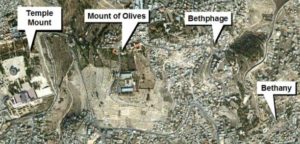
    Bethany is today el ‘Azareyeh (“the place of Lazarus”- the L being displaced to form the article).

    Who is present? Jesus, of course; Simon, host of the meal (who Jesus had likely healed from leprosy; ‘some,’ likely the Twelve and others; and an unidentified woman who enters Simon’s home.

    What happens? She pours out some very expensive oil on Jesus, an act of great humility and worship.

    (More about her and her gracious act later.)


    To be continued…


  • for it was not the season for figs – 8

    for it was not the season for figs – 8

    The Fig Tree Languishes

    In this concluding part of our 8-part series we draw our conclusions of why JESUS on his way to Jerusalem cursed the fig tree.

    [circa 835 BC]

    The Prophet Joel:

    1:3 Tell your children of it,
    and let your children tell their children,
    and their children to another generation…


    Generations recall what has been before.

    Sin is always the downfall of the Lord’s chosen nation. 

    Surely scripture speaks contemporarily to those with ears to hear.


    1:12 The vine dries up;
    the fig tree languishes.
    Pomegranate, palm, and apple,
    all the trees of the field are dried up,
    and gladness dries up
    from the children of man.


    ~A.D. 30

    Yesterday they shouted, ‘Hosanna!’

    Eight centuries after Joel and other prophets warned Judah to repent, Jesus of Nazareth entered Jerusalem triumphantly. Even the children shouted praises and the crowds witness miracles.

    Jesus then returned to nearby Bethany for the night.

    A connection of Bethany to figs

    Bethany was home to Lazarus, where some in the Jerusalem crowds had known that Jesus had raised him from the dead! Much is expected for this day. 

    An unripe fig? photo of BethanyBethany "house, place of unripe figs" is a village located on the E slope of Mt. Olivet, about one and one-half miles from J
    Bethany “place of unripe fig tree near to Jerusalem

    Bethany “house, place of unripe figs” is a village located on the E slope of Mt. Olivet, about one and one-half miles from Jerusalem.

    It was called also the house of misery on account of its lonely situation and the invalids who congregated there.’ Source

    Matthew 21:

    18 In the morning, as he was returning to the city, he became hungry.

    'It lies on the eastern slope of the Mount of Olives, fully a mile beyond the summit. Bethany has been commonly explained "house of dates," but it more probably signifies "house of misery." 

    19 And seeing a fig tree by the wayside, he went to it and found nothing on it but only leaves. And he said to it, “May no fruit ever come from you again!”

    Gospel of Matthew 21:19

    And the fig tree withered at once.


    Once a withered fig, Jerusalem will wither once more

    Israel and Judah had been destroyed.

    Jerusalem’s walls and Temple are rebuilt after many years, first by Ezra then built back bigger and better by Herod the Great.

    Rome, like other nations, has again captured a chosen people; sons of Abraham, sons of David.

    A King rides up to the gates triumphantly and crowds praise Jesus.

    Now the Lord returns to Jerusalem and curses a fig tree.

    Do these jews praising Jesus know their scripture

    Of course they do.


    “Nearly every 1st century jew knew the word of God better than most jews or christians in these last days with abundant access to unread Bibles.”


    32:46 וַיֹּאמֶר אֲלֵהֶם שִׂימוּ לְבַבְכֶם לְכָל־הַדְּבָרִים אֲשֶׁר אָנֹכִי מֵעִיד בָּכֶם הַיֹּום אֲשֶׁר תְּצַוֻּם אֶת־בְּנֵיכֶם לִשְׁמֹר לַעֲשֹׂות אֶת־כָּל־דִּבְרֵי הַתֹּורָה הַזֹּֽאת׃

    and he said to them, “Place in your heart all the words with which I am warning you today, which you shall command your sons to be careful to do, even all the words of this law.

    Deuteronomy 32:46

    Deuteronomy 8:

    6 So you shall keep the commandments of the Lord your God by walking in his ways and by fearing him. 7 For the Lord your God is bringing you into a good land, a land of brooks of water, of fountains and springs, flowing out in the valleys and hills,

    8 a land of wheat and barley, of vines and fig trees and pomegranates, a land of olive trees and honey, 9 a land in which you will eat bread without scarcity, in which you will lack nothing, a land whose stones are iron, and out of whose hills you can dig copper.

    10 And you shall eat and be full, and you shall bless the Lord your God for the good land he has given you.”


    Have we forgotten the lesson of the fig tree?

    Just in case you have missed the Prologue and Scripture bringing us to this conclusion: GO BACK to the PROLOGUE HERE

    Even as we have forgotten the Lord in our daily lives, Jesus the Messiah has found no fruit of repentance in Israel — in our nation

    — perhaps rarely in our churches — and even in the landscapes and homes of this 21st century christian life.

    The Lord found no desire of God’s chosen people to turn back to true worship of the Lord.

    God our Father sent the Son to us in the flesh to become a Sacrifice for our sins.

    Jesus neared the completion of His time with us on His created earth as Son of Man and then set his face toward Jerusalem and CURSED the fig tree.

    ‘Cursed be anyone who does not confirm the words of this law by doing them.’ And all the people shall say, ‘Amen.’”

    Deuteronomy 27:26

    It was not the season for figs, but a time for sacrifice.

    silhouette of Jesus on Cross in front of sunset
    “As Moses lifted up the serpent in the wilderness, even so must the Son of Man be lifted up – John 3:13

    Matthew 21:

    20 When the disciples saw it, they marveled, saying,

    “How did the fig tree wither at once?”

    21 And Jesus answered them, “Truly, I say to you, if you have faith and do not doubt, you will not only do what has been done to the fig tree, but even if you say to this mountain, ‘Be taken up and thrown into the sea,’ it will happen. 22 And whatever you ask in prayer, you will receive, if you have faith.”


    What season is your faith?

    + Do you worship the Lord?

    + Would a King entering your town recognize your fruit?


    Forgive me, Lord. Help me in my unbelief, for I have not asked you to take up the evil on this mountain of my mortal life and cast it into the sea.

    Jesus IS Lord. He will return to reign forever and ever. 

    Amen.