Tag: ships

  • Transporting Paul – Citizen Prisoner of Caesar- Acts 27

    Transporting Paul – Citizen Prisoner of Caesar- Acts 27

    The Apostle Paul, a Jew among Jews commissioned by Christ to go into all the world of the gentiles — after taking the Gospel to the Greeks since A.D. 47 — is now a prisoner sent to Rome.

    In the year of our Lord 59:

    Roman Prisoners (Chattel of Caesar)

    Make no mistake about it: ROME rules the world! Their ships have captured it since the days of Julius Caesar and although Judea claims a King, Jerusalem is no exception to Rome’s rule.

    Paul – a citizen under Roman rule

    In Paul’s lifetime thus far Caesar Augustus had been Emperor when he was a boy in Cilicia;Tiberius during his years studying under Gamaliel in Jerusalem and when Jesus was crucified and up until the day Christ appeared to Saul near Damascus.

    Paul had begun preaching the Gospel to the gentiles near the end of the reign of Caligua, who had declared himself a god in A.D. 37.

    The Emperor Claudius had made Judea a province of Rome after the death of Herod Agrippa I in A.D. 44, ruling the empire during many martyrdoms of several saints and some Apostle’s during the time of Paul’s missionary journeys.
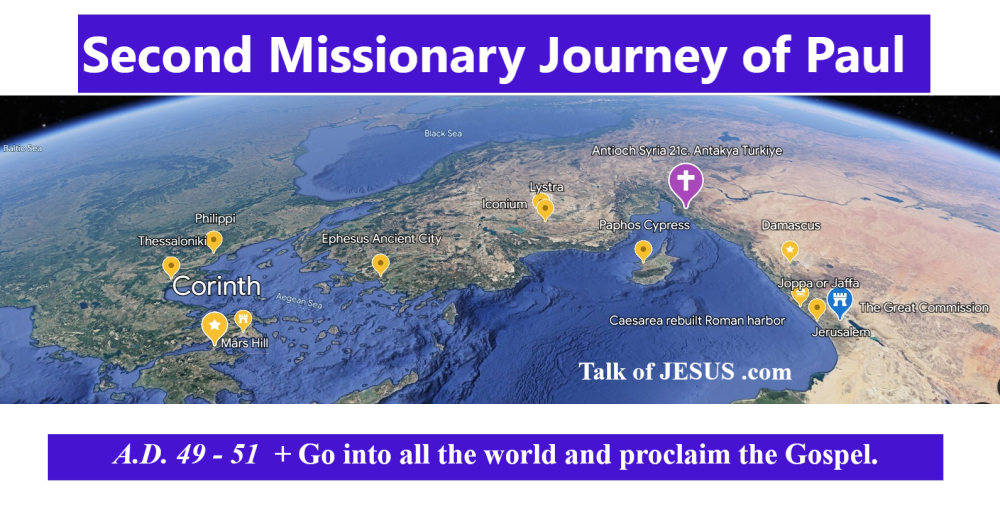
    But on taking leave of them he said, “I will return to you if God wills,” and he set sail from Ephesus. Conclusion of the second missionary journey of Paul from Acts 18
    and he set sail from Ephesus.

    In the civil administration, many measures demonstrate Claudius’s enlightened policy. He improved in detail the judicial system, and, in his dealings with the provinces, he favoured a moderate extension of Roman citizenship by individual and collective grants..

    .. during a period of troubles Claudius expelled the Jews from Rome for a short time; Christians may have been involved. Elsewhere he confirmed existing Jewish rights and privileges, and in Alexandria he tried to protect the Jews without provoking Egyptian nationalism.

    Source: Britannica

    Claudius had ruled Rome and the world up until just five years ago, but Paul’s appeal is to a new Caesar.
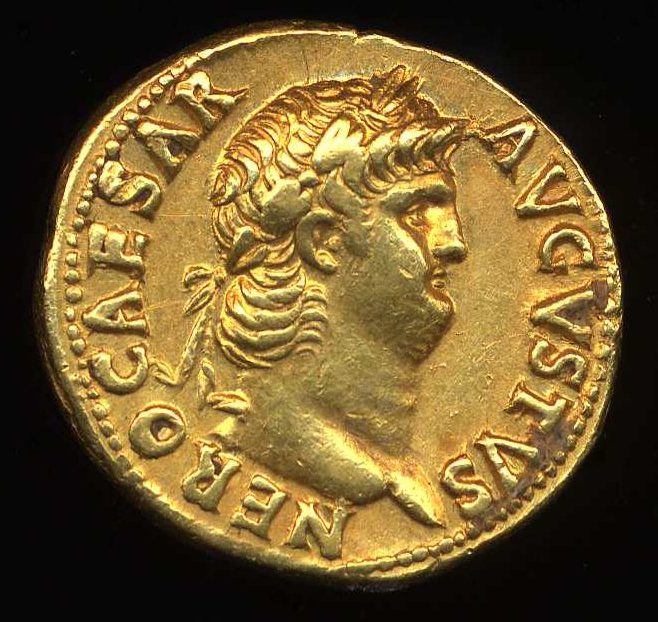
    Roman Coin with profile of Nero Caesar Augustus

    Nero Claudius Caesar Augustus Germanicus

    Up to the year 59, Nero’s biographers cite only acts of generosity and clemency on his account. His government forbade contests in the circus involving bloodshed, banned capital punishment, reduced taxes, and accorded permission to slaves to bring civil complaints against unjust masters.

    Source: Britannica

    The Apostle Paul is about 54 years old now. He is a Roman citizen of Tarsus, Cilicia who would have been set free by the Roman Governor (with approval of the Judean King) had the Apostle not earlier appealed to Caesar — the 22 year old Nero now ruling Rome under his mother’s tutelage.

    Acts 27:

    Now when it was decided that we would sail for Italy, they proceeded to deliver Paul and some other prisoners to a centurion of the Augustan cohort named Julius.

    And getting aboard an Adramyttian ship, which was about to sail to the regions along the coast of Asia, we set sail accompanied by Aristarchus, a Macedonian of Thessalonica.
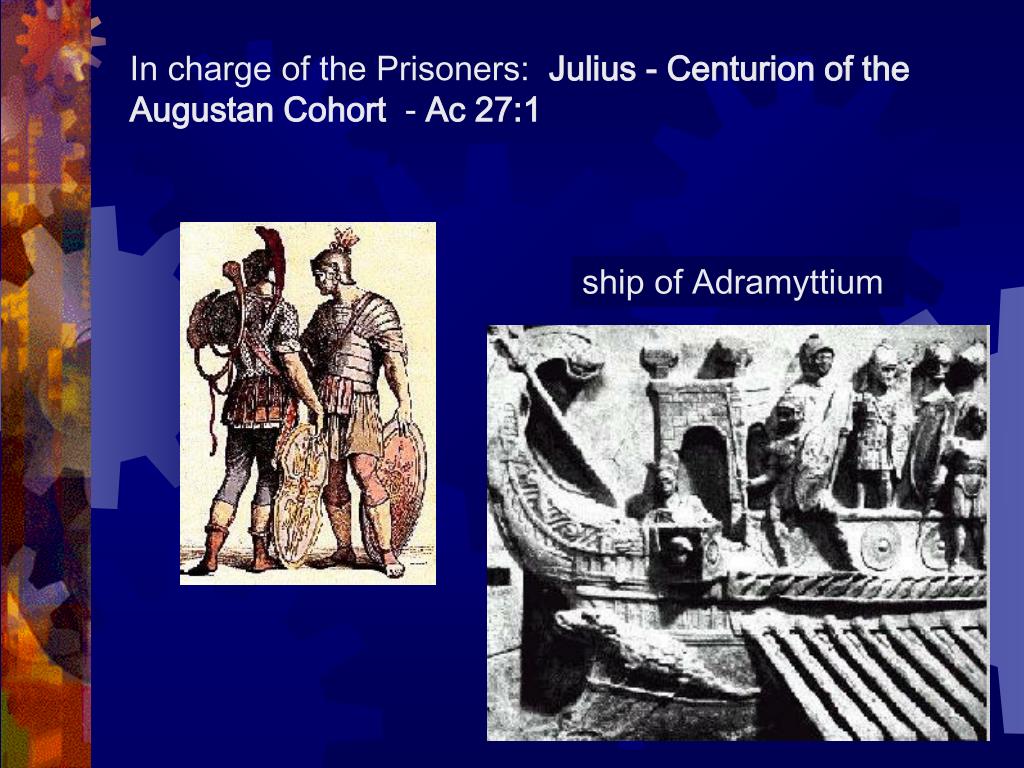
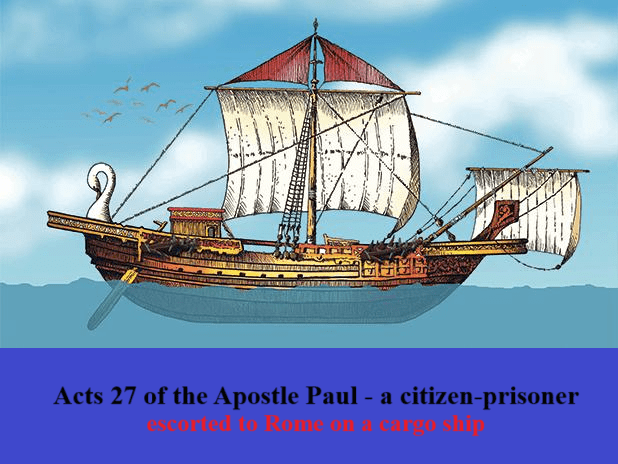
    Acts 27:1 prisoners of Roman Centurion Julius include the Apostle Paul
    Doctor Luke, the historian recording the Acts of the Apostles, tells us a few details of Paul's journey to Rome as a prisoner. 

    We will proceed on this 2200 mile [3500 km] voyage taking into account the perspective of Iulius [Julius], Paul’s Roman Centurio Augustus’ responsible for all prisoners of Caesar Nero.


    The Writ of Porcius Festus

    Before sailing to Rome, the Centurion representative of Caesar —Julius would have been given an official writ of Paul’s court proceedings and judgment.

    Porteus Festus may have given written instructions and verbal administrative recommendations as the current Governor of Judea transferring this prisoner Paul into the direct jurisdiction of Nero.

    Julius probably would not have known that Paul had been rescued from the Jews two years ago by Judea’s former governor. Antonius Felix, you may remember, had left Paul in prison in Caesarea for two years after another Centurion had rescued the Apostle from an assassination plot of the Jews.

    Paul is a Jew (as one might expect of a resident of Judea). But the Governor would want this Centurion Julius to know that his prisoner being sent to Nero is a Roman citizen acquited of the Jewish charges.

    BUT, Paul had appealed to Caesar and could not be released until the Emperor agreed to hear or dismiss Paul’s case.


    Roman roads and shipping routes
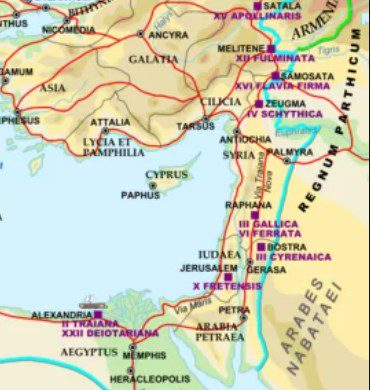
    The Centurion Julius would have to plan a route to Rome to deliver his cargo — Paul, a prisoner and Roman citizen. Caesarea Maritime is a port and administrative center of Rome’s eastern army. Like any port ships arrive and depart with cargo and supplies for Rome’s army. Some smaller ships sailed from port to port on what you might call ‘the milk run’ delivering essentials for further transport inland along the extensive Roman roads.

    Julius gained passage on such a ship that sailed along the coast, first with a stop in nearby Sidon, with a terminus destination of Myra.
    Stop One of a long Voyage
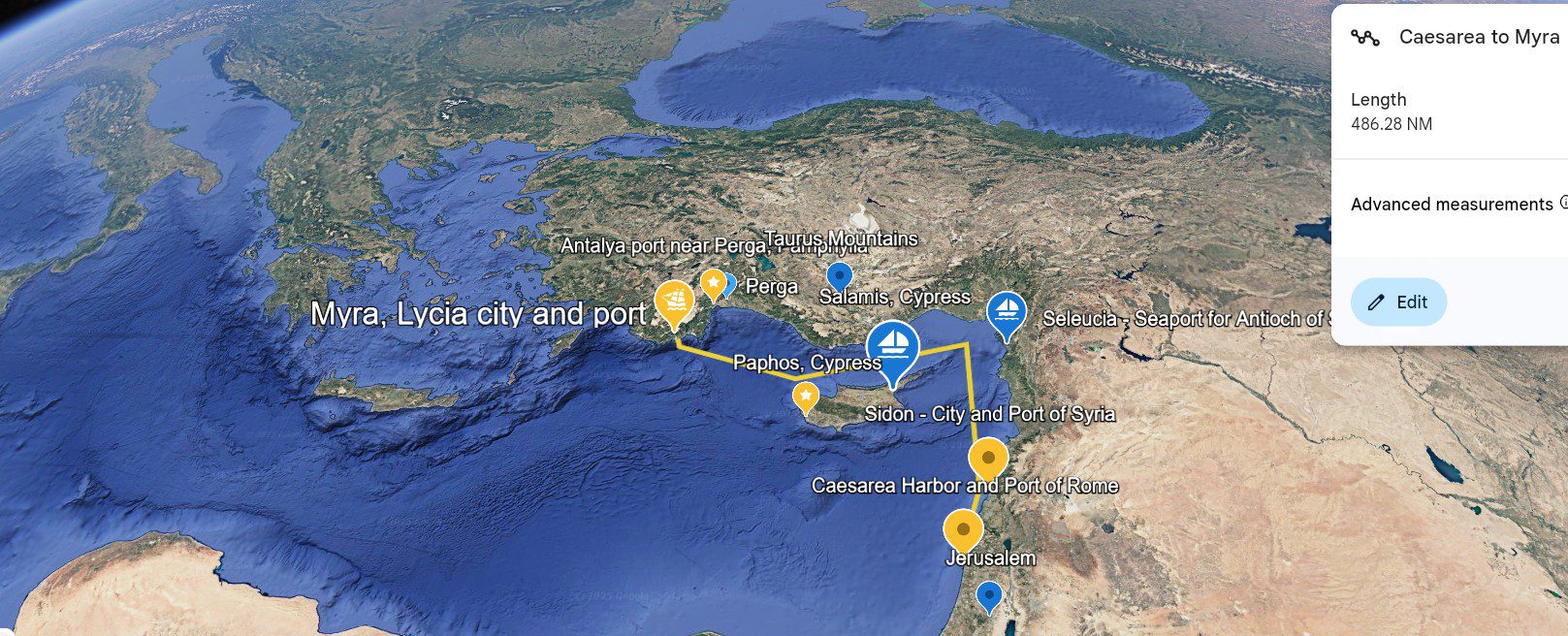
    Voyage of Paul's first ship as a prisoner of Rome
    486 Nautical Miles [~ 900 KM or 660 Miles]

    .. aboard an Adramyttian ship, which was about to sail to the regions along the coast of Asia, we set sail..

    The next day we put in at Sidon,

    and Julius treated Paul with consideration and allowed him to go to his friends and receive care.
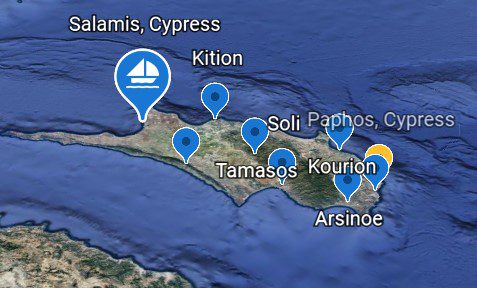
    Cypress cities Acts 13

    And from there we set sail [leeward] and sailed under the shelter of Cyprus [to the south of us] because the winds were against us.

    And when we had sailed through the sea along the coast of Cilicia and Pamphylia, we landed at Myra in Lycia.
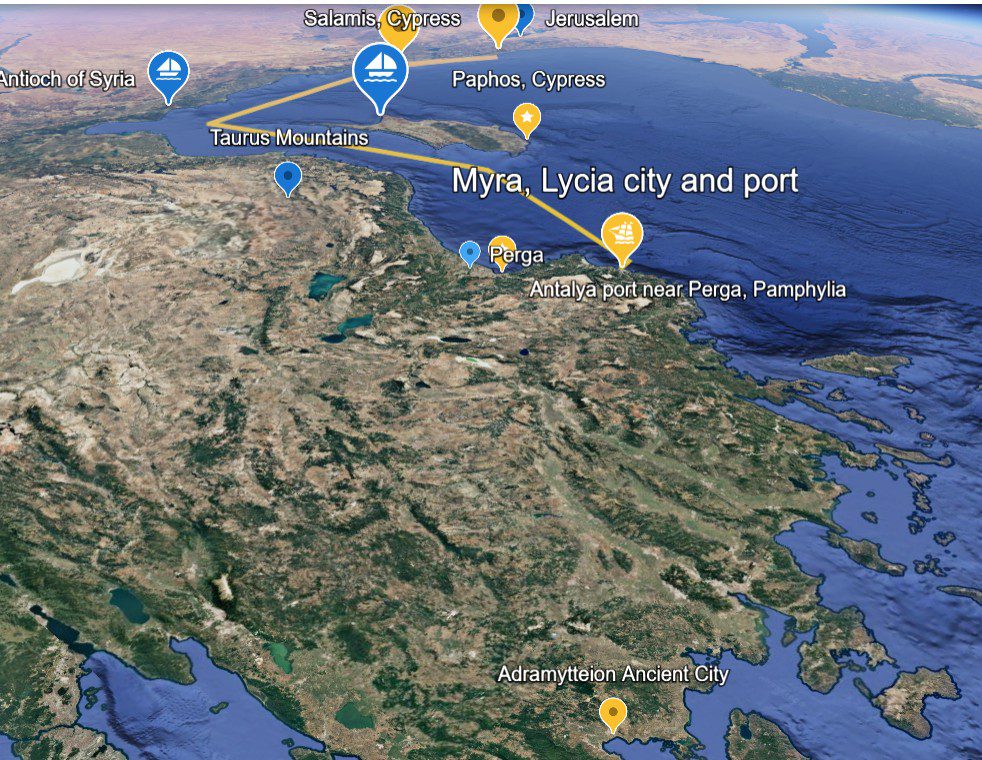

    Finding a bigger ship in Myra

    The Centurion Julius, probably knowing not only the Mediterranean ports and Roman administrators but also which ships sail further to Rome, will book passage on a larger ship capable of sailing into deeper waters to continue their long voyage.

    To be continued... 
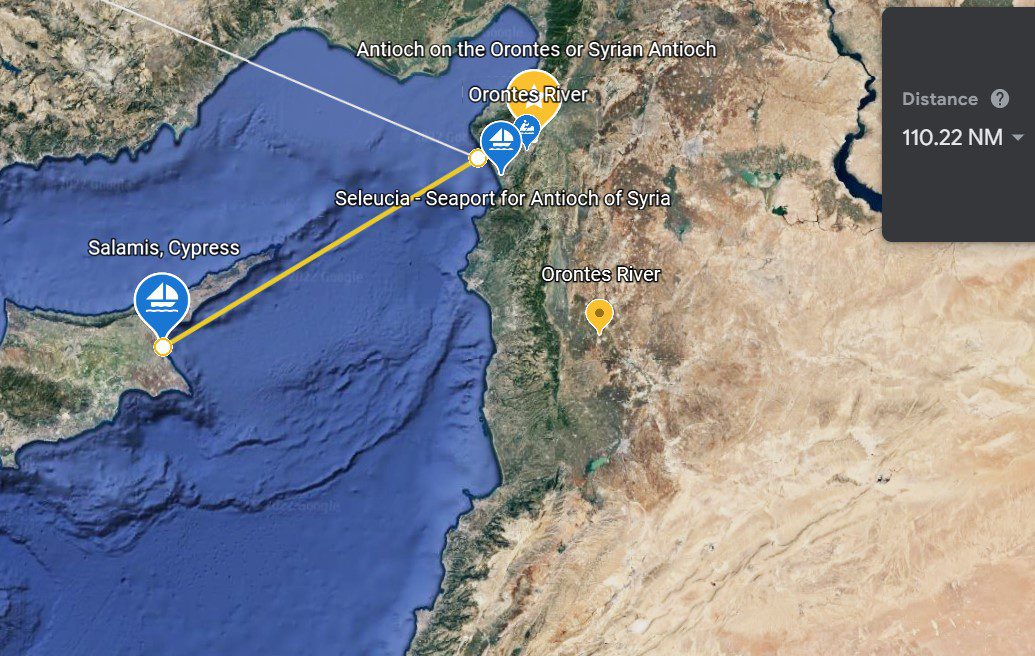
  • Acts 13.4 Sailing to Salamis Cypress

    Acts 13.4 Sailing to Salamis Cypress

    Sailing from Antioch to Cypress

    Acts of the Apostles 13:

    4 So, being sent out by the Holy Spirit, they went down to Seleucia and from there they sailed to Cyprus.

    A.D. 47

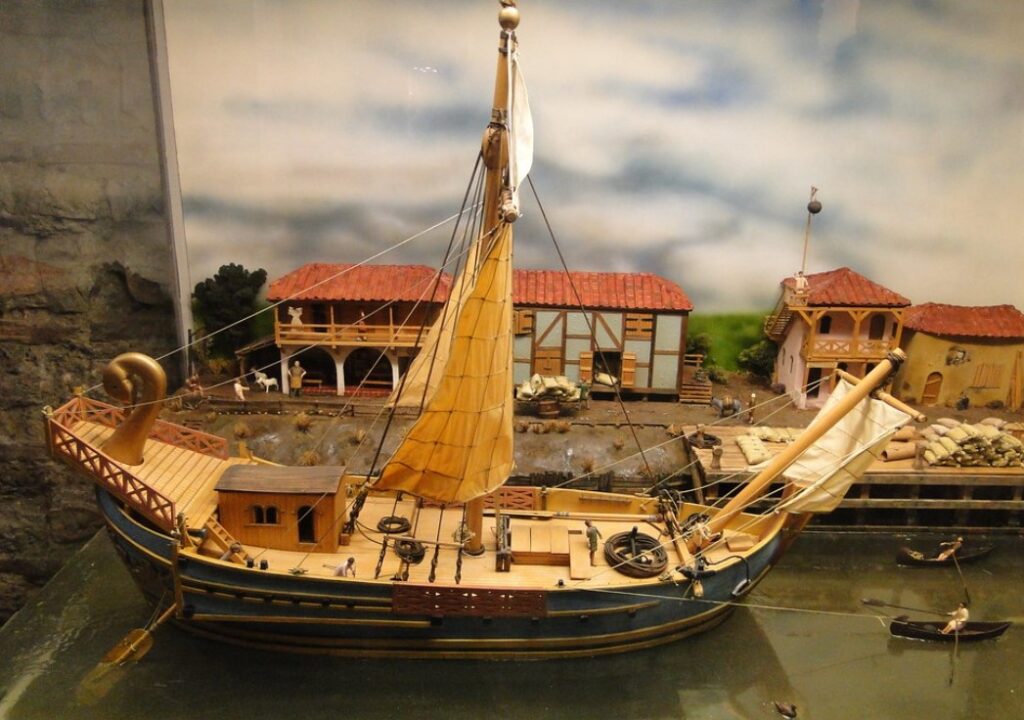
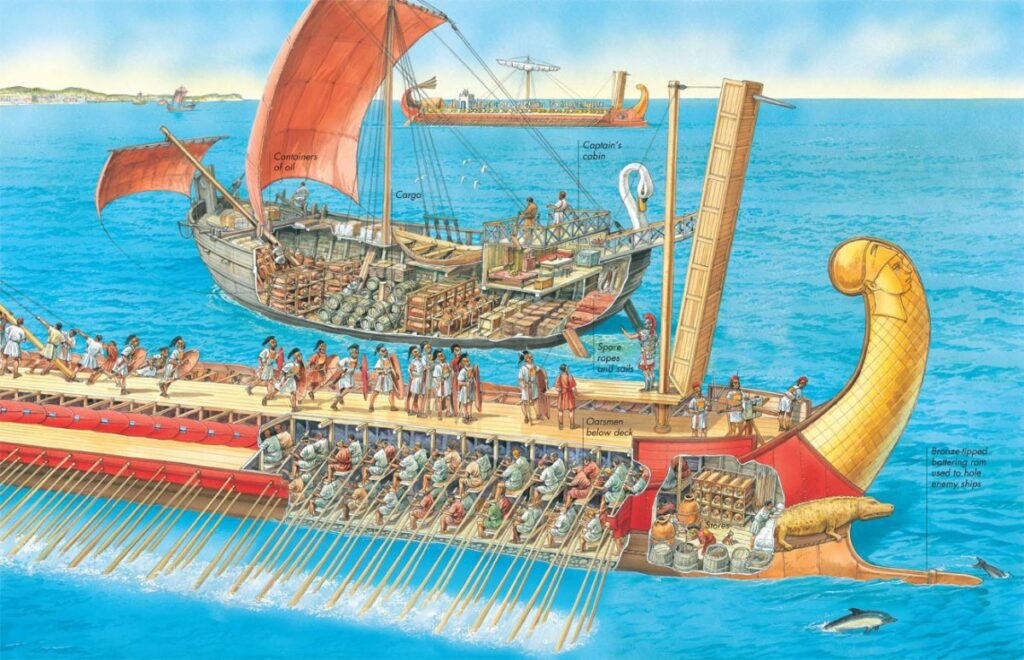
    A Roman merchant ship sails from Seleucia

    Photo source

    Sailing Journeys in the Roman Empire

    I don’t know about you, but I didn’t really know very much about sailing around in the Mediterranean in the first century A.D. And when I read later in Acts about wintering in some ort or about ship wrecks I had no idea what that was all about.

    So here is a little I’ve learned about Paul’s journeys by ship in the first century Mediterranean Sea.


    How did the ancient Romans travel?

    [Like Paul and Barnabas]

    • There were no passenger ships per say in first century Rome. No luxury cruise lines or anything similar.
    • People willing to travel by ship had to board a merchant ship.
    • They would first have to find a ship, it could be almost any kind of ship and then they would have to get the captain’s approval. The price would also be negotiated with the captain.
    • Most of the times passengers would bring their own food supplies, covers, mattresses, even a tent and sleep on deck!
    • Sometimes there would be hundreds of people on the deck.
    • There were no restaurants or any of the luxuries of today’s ships but passengers could use the ship’s facilities to cook their meals. People would often play games, gamble, read or just drink wine.

    OR perhaps a fellow passenger might ask two men like Paul and Barnabas,

    “What brings you to Cypress?”

    VITA ROMAE

    .. Romans were not traditionally seafaring people. They were mostly land-based people who learned to build military and merchant ships from the people that they conquered. Sailing the seas was often considered un-Roman.

    Romans had very few warships [BUT]

    Rome managed to defeat the world’s most powerful navy to become the dominant naval power in the Mediterranean or as the Romans called it Mare Nostrum (“our sea”).

    Sailing the Roman Sea

    Another function of Roman military ships was to patrol the Mediterranean sea and to sometimes escort merchant ships.

    • Most ships had a cargo capacity of 100 to 150 tons
    • The largest ships, with a capacity of 600 tons, were 150 ft (46m) long.
    • Merchant ships mainly used mainly wind power. They had from one to three masts with large square sails and a small triangular sail called the supparum at the bow.
    • They also had oarsmen (usually slaves). [Roman military ships used free Roman soldiers on the oars.]

    The time of travel along the many shipping lanes could vary widely. Roman ships would usually ply the waters of the Mediterranean at average speeds of 4 or 5 knots.

    VITAE ROME

    Salamis, Cypress

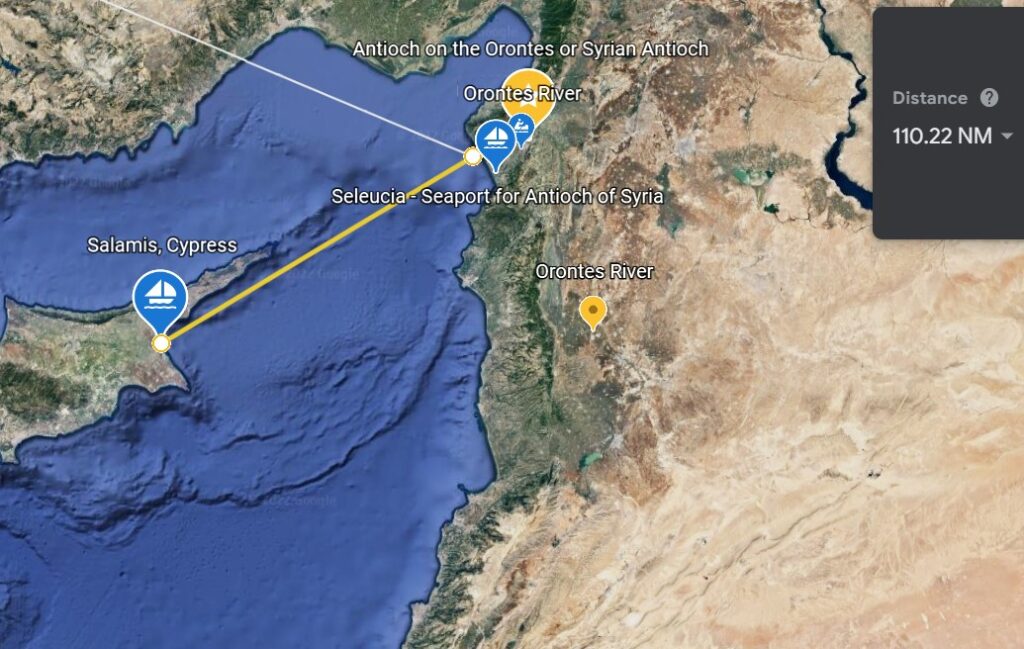
    Seleucia Syria (1st c) to Salamis Cypress

    IF we do the math, allowing for the additional time in Seleucia while the cargo is loaded on their ship.. waiting in the boarding line where the captain’s representative makes certain all passengers have paid their fare.. boarding time… casting off WHEN the tide and winds seem right…

    once weighing anchor, navigating the ship with new weight in the hold carefully out of the harbor…

    AT 4-5 knots per hour (eventually) & depending on prevailing winds..

    for perhaps 20-25 hours.. at least overnight (for this short voyage_) and timing of the tides and navigating Salamis…

    [Don't you just love all that waiting before departure and docking even on a short journey?]
    

    IF you would like to catch up to the LATEST post from our SERIES from ACTS of the Apostles CLICK HERE


    So Joseph, you say you were born here?

    See Acts 4:36

    A Levite.

    And you brought Saul here from Tarsus? (I’ve been there.)

    What’s this ‘Good News’ you are bringing here?


    One additional passenger

    DO YOU RECALL:

    Five years earlier in Jerusalem [~AD 42}: Peter amazingly appears at the gate of John Mark’s home after being freed from Herod’s prison by an angel.

    Peter goes to the home of Mary mother of Mark

    AFTER Herod Agrippa died [A.D. 44]:

    Barnabas and Saul returned to Jerusalem, fulfilling their ministry, taking along with them John, who was also called Mark. – Acts of the Apostles 12:25

    NOW, nearly three years later [~A.D.47]:

    Seleucia Syria (1st c) to Salamis Cypress

    FIRST PORT of the FIRST Missionary Journey – Salamis

    • It possessed a good harbor and was the most populous and flourishing town of Cyprus
    • in the Hellenic and Roman periods, carrying on a vigorous trade with the ports of Cilicia and Syria.
    • Its population was mixed, consisting of Greek and Phoenician elements.
      • The former, however, gave its tone and color to the city, and the chief cult and temple were those of Salaminian Zeus.
    • There they preached the gospel in the “synagogues of the Jews” (Acts 13:5);
      • the phrase is worth noting as pointing to the existence of several synagogues and thus of a large Jewish community in Salamis.
      • Of work among the Gentiles we hear nothing,
      • nor is any indication given either of the duration of the apostles’ visit or of the success of their mission;
      • but it would seem that after a short stay they proceeded “through the whole island”

    And when they reached Salamis, they began to proclaim the word of God in the synagogues of the Jews, and they also had John as their helper.

    Acts of the Apostles Paul & Barnabas 13:5 on Cypress

    WE see here just a brief first stop of Apostles sent out by the Holy Spirit with the Gospel, which Paul and Joseph of Cypress proclaim in the synagogue of Salamis to fellow Jews who have not yet heard the Good News of Jesus, the Christ promised by the Lord God.

    With them, a servant helper, John Mark, who observingly will record his first Gospel published about ten years later [in the A.D. 50’s].


    ACTS of the Apostles 13 on Cypress
    
    TO BE CONTINUED...
    
    Seleucia Syria (1st c) to Salamis Cypress

    Talk of JESUS . com

    Comment on Scripture – Share the Gospel