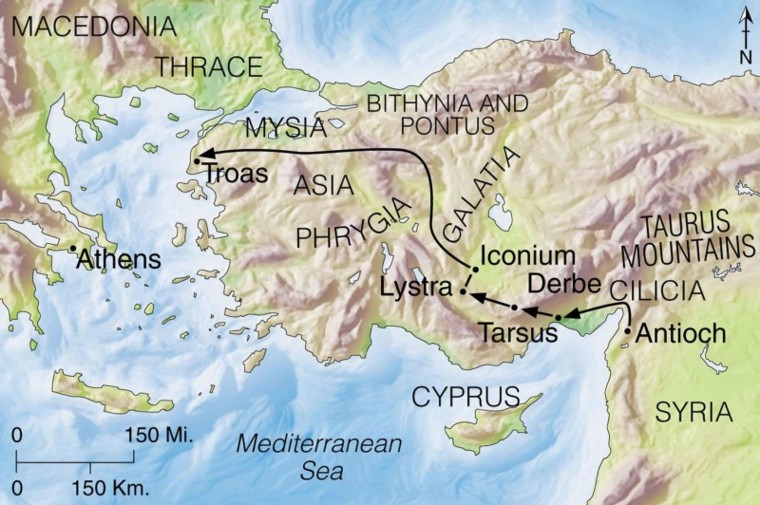
1st c. Roman region of Asia lies between PHRYGIA to the S & MYSIA to the N
Last time we mentioned the beginning of their land journey, but these few verses provide no account of which towns or how long these men stayed in this part of the central plain beyond Lystra, Derbe and Iconium before sailing to Europe from Troas.
7 And when they had come up to Mysia, they attempted to go into Bithynia, but the Spirit of Jesus did not allow them.
8 So, passing by Mysia, they went down to Troas.
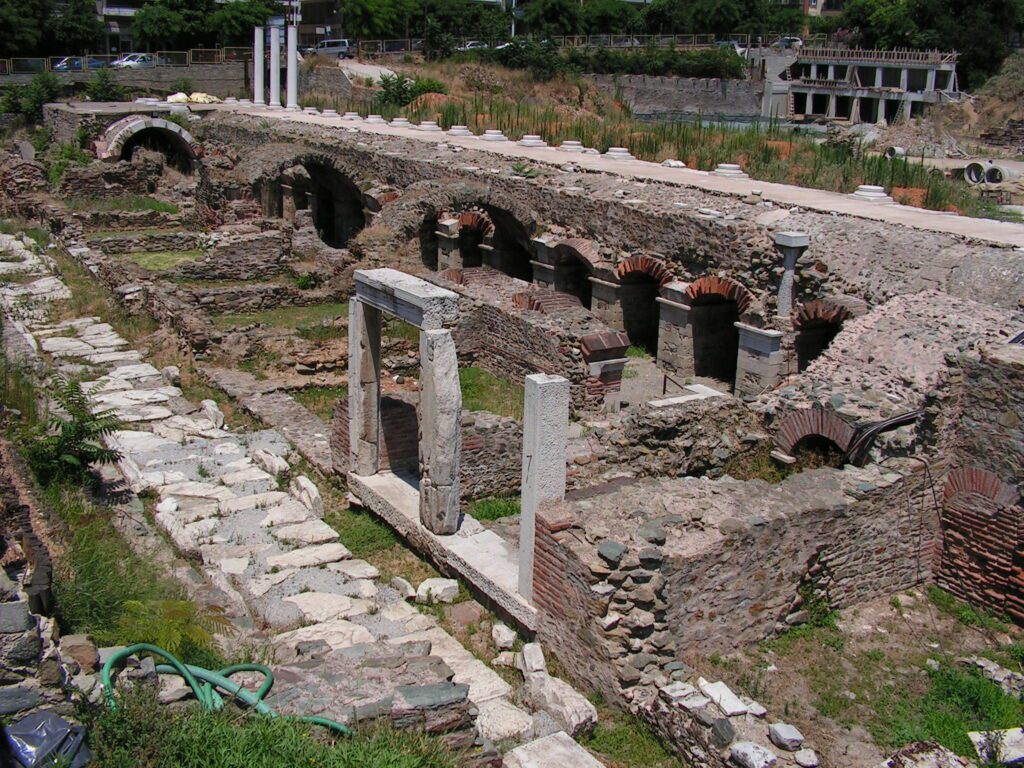
Troas, Asia Minor
the leading of the Spirit
You may have thought that Paul, Silas and Timothy had wandered from town to town in the mountains aimlessly proclaiming the Gospel wherever they happened on a town or small city. NOT SO.
Here is how 21st century Christians (having to know every reason for every act of any 1st c. apostle of Jesus) will often trip over the mysterious leading of the Spirit.
And just a reminder from the Greek that an apostle is a delegate, messenger, one sent forth with orders, especially orders from the triune God.
WHY did Paul, Silas and Timothy end up in Troas (perhaps ready to sail back to Antioch or to Cypress once more where Paul could meet up with Barnabas and John Mark)?
How is it that Paul did NOT choose a land route to Europe to begin proclaiming the Gospel to all the world?
Luke tells us:
ACTS 16:6 ..having been forbidden by the Holy Spirit to speak the word in Asia.
ACTS 16:7 ..but the Spirit of Jesus did not allow them.
τὸ πνεῦμα Ἰησοῦ – ho pneuma – the Spirit – (SAME WORD)
definition in part G4151 i.e. a simple essence, devoid of all or at least all grosser matter, and possessed of the power of knowing, desiring, deciding, and acting
CHRISTIAN, do YOU obey the ALL-KNOWING and ETERNAL power of the risen JESUS?
Do you allow the HOLY SPIRIT to direct YOU in directions GOD plans so different from the paths YOU would take?
PAUL not only has encountered the risen JESUS some years back when Christ REDIRECTED this apostle to the gentiles in an entirely different direction,
but Saul of Tarsus AND ALL of these apostles were “sent out” by the HOLY SPIRIT, as well as from their local Church back in Antioch.
The Lord Jesus continues to order his 21st c. disciples of the church into unknown, even mysterious places — into a world unfamiliar to their former witness of God.
Taking the Gospel into a Greco-Roman world
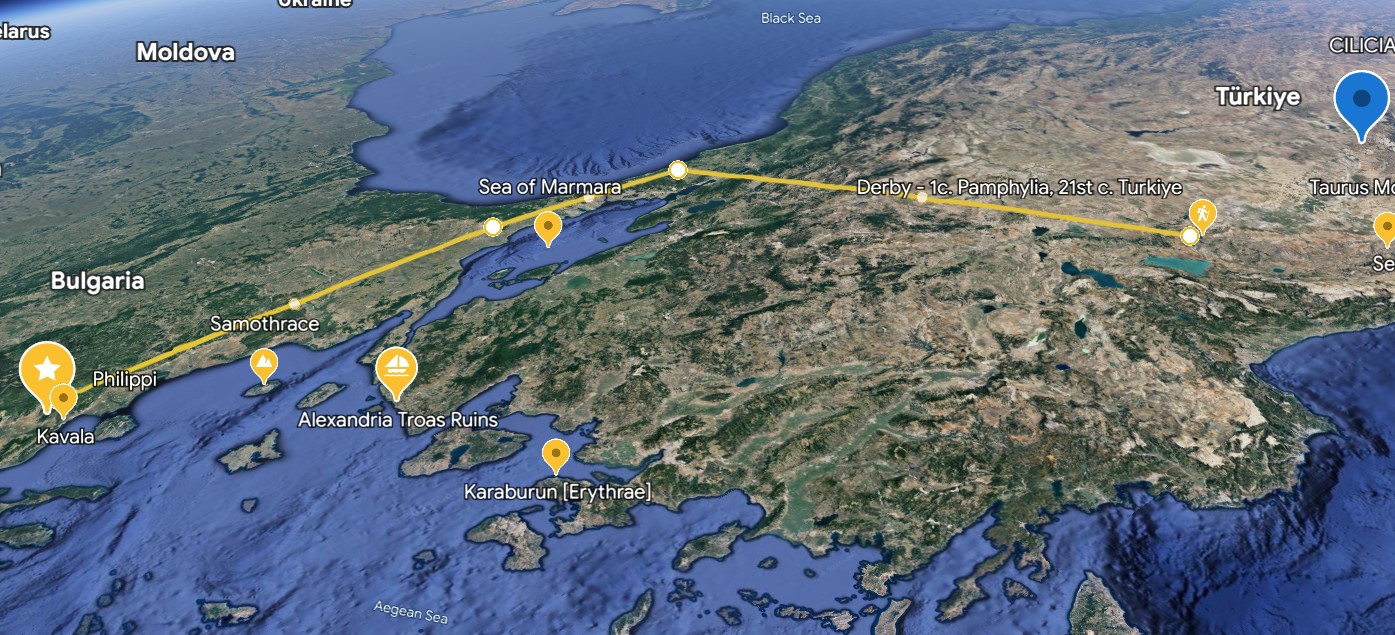
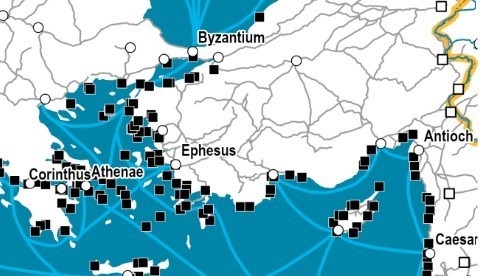
Roman roads & routes of the Aegean Sea later in AD 125
The Lord Jesus continues to order his disciples of the church into unknown, even mysterious places — into a world unfamiliar to their former witness of God.
The increasing presence of Rome in so many strategic ports of the Aegean in Paul’s day dominated all travel in and between the major cities of Eurasia.
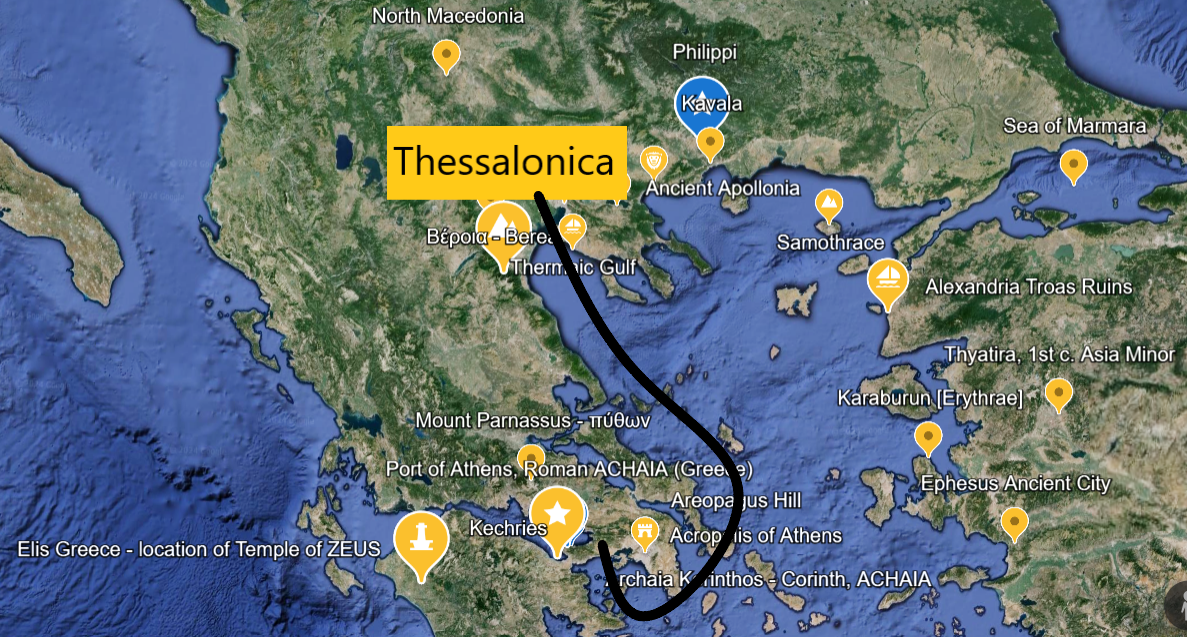
The Apostles might have sailed back to Antioch from the Roman-occupied towered town and port of Troas. Yet by the command of the Spirit they took the commercial ferry routes toward Philippi near the north-western shore of the Aegean – a leading Greek city in Europe.
A vision in Troas
ACTS 16:9
And a vision appeared to Paul in the night: a man of Macedonia was standing there, urging him and saying,
“Come over to Macedonia and help us.”
What will Silas and Timothy think of this sudden change of tickets for an entirely different journey ahead?
And when he had seen the vision, immediately we sought to go on into Macedonia, concluding that God had called us to preach the gospel to them.
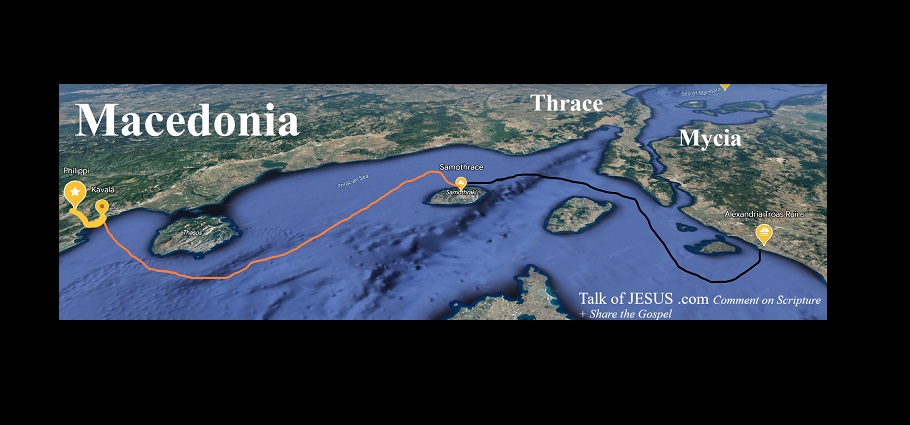
Troas to Neapolis, Philippi, Macedonia
Sailing from Troas to Neapolis
11 So, setting sail from Troas, we made a direct voyage to Samothrace,
and the following day to Neapolis,
You'll have difficulty finding 'Nea polis' on a map because it's Greek for "new city." Even on Cypress Paul had been to Nea Paphos, built after an earthquake had destroyed much of Paphos.
Nowadays the city's nickname is "the cyan city" (Η γαλάζια πόλη) and the symbol of the municipality of Kavala is the head of goddess Parthenos, the patron goddess of ancient Neapolis, as depicted in the coinage of the ancient Greek city. - source: Wikipedia
12 and from there to Philippi, which is a leading city of the district of Macedonia and a Roman colony. We remained in this city some days.
and after he had explained everything to them, he sent them to Joppa. –ACTS 10:8
What’s for lunch? – a scene in Joppa
Some quoted text from NASB20 + CLICK Below to read ALL of Acts 10 in:
1550 Stephanus New Testament; Easy-to-Read English Version; Conferenza Episcopale Italiana; Russian Synodal Version
.. Peter went up on the housetop about [noon] the sixth hour to pray. But he became hungry and wanted to eat; but while they were making preparations, he fell into a trance..
Has that ever happened to you?
You’re hungry.. but you doze off while the sounds and aromas of lunch or dinner fill you with dreams rather than the action of coming to the table to eat.
CLICK trance ABOVE for full definition of ἔκστασις [ek'-stas-is]
an alienation of mind
He saw something coming down through the open sky. It looked like a big sheet being lowered to the ground by its four corners. In it were all kinds of animals, reptiles, and birds. 13 Then a voice said to him,
“Get up, Peter; kill anything here and eat it.”
“By no means, Lord, for I have never eaten anything [common or profane] unholy and unclean.”
15 But the voice said to him again,
“God has made these things pure. Don’t say they are unfit to eat.”
16 This happened three times. Then the whole thing was taken back up into heaven. Peter wondered what this vision meant.
A Roman Soldier with two men at the gate
.. behold, the men who had been sent by Cornelius had asked directions to Simon’s house, and they appeared at the gate; and calling out, they were asking whether Simon, who was also called Peter, was staying there.
ACTS of the Apostles 10:17b-18 NASB20
From the roof of the home of Simon the tanner (where the gate would be clearly visible) as the Apostle emerges from his trance he hears these men.
19 While Peter was still thinking about the vision, the Spiritsaid to him,
“Behold, three men are looking for you.
“Arise therefore, go down and go with them, doubting nothing; for I have sent them.”
Simon Peter, the Apostle forgiven by the risen Christ for his own doubt just beyond the gate of Jesus’ trial, must certainly wonder what the Lord has in store for him by sending these UN-jewish Roman guests to him. Yet obediently, Peter descends from his noon-time prayers and roof-top trance to meet these Romans at Simon’s door.
“Behold, I am the one you are looking for; what is the reason for which you have come?”
22 The men said, “A holy angel told Cornelius to invite you to his house. He is an army officer. He is a good man, one who worships God, and all the Jewish people respect him. The angel told him to invite you to his house so that he can listen to what you have to say.”
Roman house guests in Jewish Joppa
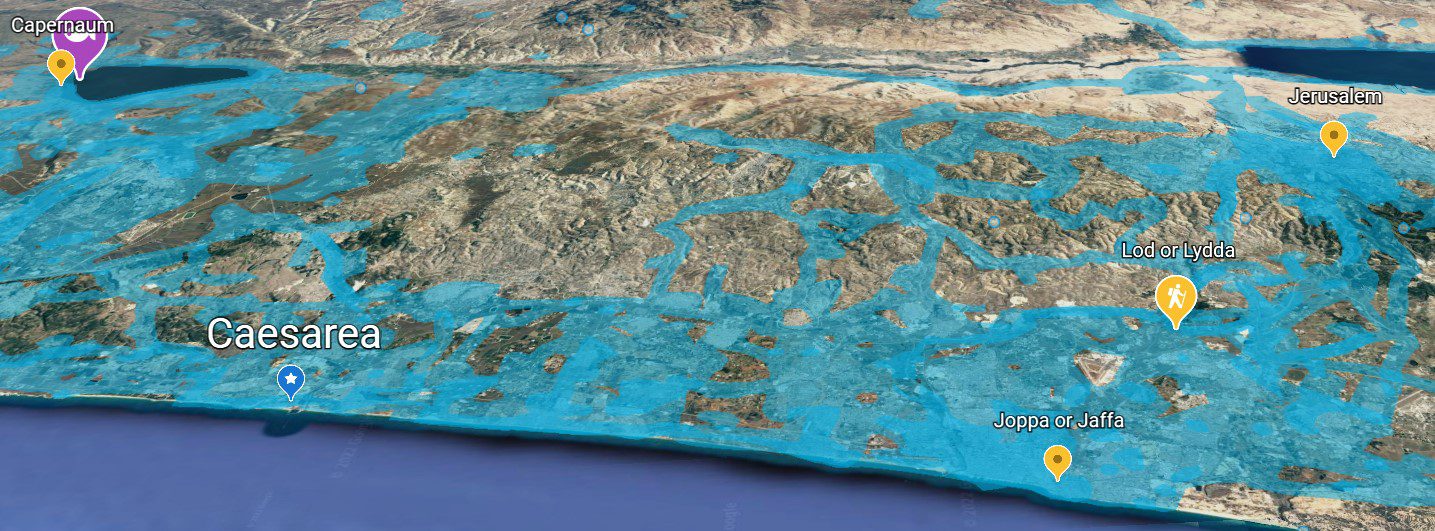
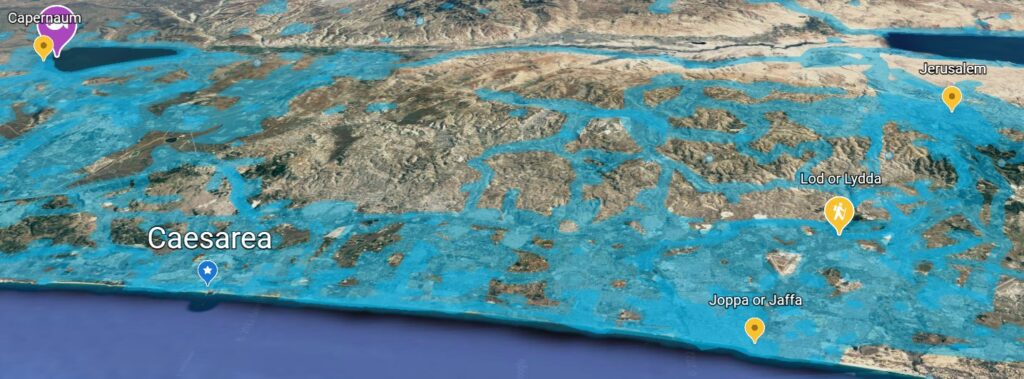
The Apostle Philip, of course, has already preached the Gospel in Caesarea. But these Romans from their own capital city up the coast have not come to our jewish port of Joppa from him.
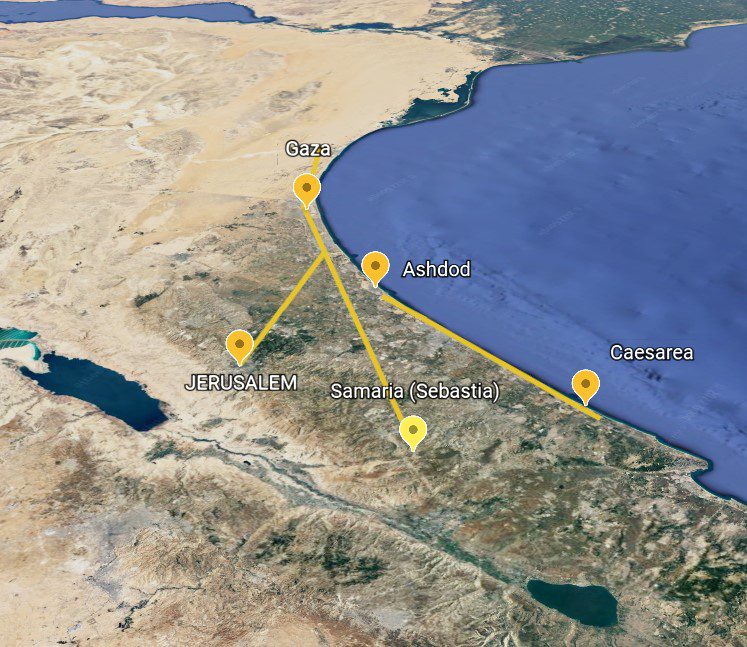
ACTS 8: .. the Spirit of the Lord snatched Philip away.. 40 But Philip found himself at Azotus and as he passed through he kept preaching the gospel to all the cities, until he came to Caesarea.
Their journey between these two coastal ports takes most of a day on foot [~10-14 hours]. The ~60 km [~40 mile] trip by Cornelius' men from the early hours of the morning by have been by chariot.
These Romans have arrived around lunch time.
23 Peter asked the men to come in and stay for the night.
Lunch, Evening meal, Prayer together, conversation between these Romans and Peter and Simon.
And then, no doubt, an early prayer and breakfast for all..
Now on the next day he got ready and went away with them, and some of the brothers from Joppa accompanied him.
On the following day he entered Caesarea…
The Gospel Mission of Peter to Romans at Caesarea —
Luke 3:1 Now in the fifteenth year of the reign of Tiberius Caesar, when Pontius Pilate was governor of Judea, and Herod [Antipas] was tetrarch of Galilee and his brother Philip was tetrarch of the region of Ituraea and Trachonitis ..
(No, not that Philip, whose wife Herodias his brother Herod Antipas took as his own wife.)
Jesus chose Twelve Apostles at the beginning His ministry in Galilee. The Apostle Philip was one of the Twelve.
Philip has been an Apostle for about five years now.
The year c. A.D. 32 or 33.
(But it’s not that Philip, either. Don’t get confused like I did.)
When Simon Peter healed a lame man and spoke at Solomon’s Portico just two years ago, Philip would have observed the entire miracle. (Actually, two men named Philip may have been present.)
As the church grew rapidly, the twelve summoned the multitude of the disciples, asking them to choose seven men of good reputation, full of the Holy Spirit and wisdom to lead in ministering to the Church: Steven, Philip and five others.
(Yes, this other brother Philip, a leading deacon of the Church, second in the list of seven, is known as Philip the Evangelist.)
So now after Stephen’s trial, the Church in Jerusalem faces imminent persecution.
Philip heads back north through the mountains of Judea, traveling one of their usual routes to Galilee through Samaria.
Samaria was destroyed by Alexander the Great in 331 BCE, and again by the Hasmonean king John Hyrcanus in 108 B.C. The city was rebuilt by Herod the Great between the years 30–27 B.C. According to Josephus, Herod expanded and renovated the city, bringing in 6,000 new inhabitants, and renamed it “Sebastia” in the emperor’s honor (translating the Latin epithet Augustus to Greek Sebastos, “venerable”). – Source: Wikipedia
We will return to Luke's chronology shortly, but lets begin with a parallel timeline from his account of events in *Sebastia from the perspective of its people.
The ‘not so good’ *Samaritan
..there was a certain man called Simon, who previously practiced sorcery [μαγεύω] in the city and astonished the people of *Samaria, claiming that he was someone great, to whom they all gave heed, from the least to the greatest, saying, “This man is the great power of God.”
the name given by the Babylonians (Chaldeans), Medes, Persians, and others, to the wise men, teachers, priests, physicians, astrologers, seers, interpreters of dreams, augers, soothsayers, sorcerers etc.
the oriental wise men (astrologers) who, having discovered by the rising of a remarkable star that the Messiah had just been born, came to Jerusalem to worship him
a false prophet and sorcerer
Luke had begun his account with Philip's departure from Jerusalem following the execution of Stephen.
Philip went down to the city of Samaria and began proclaiming the [Messiah] Christ to them.
Philip leaves for *Samaria fully aware its reputation. He's been there before and passed through the town many times. And Jesus had illustrated general Jewish thought about this city and these northern tribes in the Parable of the Good Samaritan.
Miracles and Signs by Philip
6 And the multitudes with one accord heeded the things spoken by Philip, hearing and seeing the miracles which he did. For unclean spirits, crying with a loud voice, came out of many who were possessed;
Philip, along with the Apostles and many other disciples following the Lord had witnessed Jesus’ power to command evil spirits. Peter healed a lame manin Jerusalem, just one of several Apostolic signs of power. Now we learn of Philip’s miracles by the power of the Holy Spirit.
and many who were paralyzed and lame were healed.
ACTS (of the Apostle philip) 8:7b – NKJV
GOOD vs. EVIL!
Scripture records several contests similar to Philip’s opposition. Some of these contests between God (good) and evil have taken place on this very mountain where Philip encounters Simon Magus.
False prophets and idolaters deceive others by spirits (i.e. demons, devils, angels) from all that is evil.
Our 21st century Christian minds easily dismiss powers we cannot explain.
Do you really believe in such powers of the spiritual realms?
Acts reveals the Power of the HolySpirit [πνεῦμα].
“You men who are stiff-necked and uncircumcised in heart and ears are always resisting the Holy SpiritG4151; you are doing just as your fathers did. – Acts 7:51
But he, being full of the Holy SpiritG4151, looked intently into heaven and saw the glory of God, and Jesus standing at the right hand of God – Acts 7:55
They went on stoning Stephen as he called on the Lord and said, “Lord Jesus, receive my spirit G4151!” – Acts 7:59
The HOLY SPIRIT of the ONE GOD, WHO IS One with God the Father and the One begotten Son Christ Jesus, works for good in the hearts and lives of sinful men and women like us once we turn to Jesus as our Lord and Savior.
Acts of the Apostles is a first century account of a continuing battle between Good and Evil.
The Good News (Gospel) of the Lord’s death and resurrection is that JESUS will win this war.
Simon Covets Philip’s Power
Of course this power is not from Philip, but from the Holy Spirit.
11 They [the Samaritans] were attentive to him {Simon] because he had amazed them with his sorceries for a long time. But when they believed Philip, as he proclaimed the good news about the kingdom of God and the name of Jesus Christ, both men and women were baptized.
13 Even Simon himself believed. And after he was baptized, he followed Philip everywhere and was amazed as he observed the signs and great miracles that were being performed.
Philip’s signs are more powerful than the power of Simon Magus, who the Samaritans called, ‘the great power of God!’
Was Simon’s baptism a complete turning from evil and a permanent cleansing?
Did Simon receive the Holy Spirit
(even as Ananias and Saphira had claimed, yet sought to deceive the Holy Spirit and other believers)?
Luke tell us: 16 ‘They had only been baptized in the name of the Lord Jesus.
Baptism alone does not make you any more faithful to Jesus than Ananias and Saphira OR Judas.
Philip continues teaching of new believers in Samaria with great success.
Meanwhile, back in Jerusalem..
14 When the apostles who were at Jerusalem heard that Samaria had received the word of God, they sent Peter and John to them.
Why Peter and John?
About eight days after these sayings, He took along Peter, John, and James, and went up on the mountain to pray.
Peter, James and John know the Person of Jesus more intimately than the other nine Apostles.
These three comprised an inner-circle of leadership for the Lord Jesus.
The Twelve in turn lead other disciples (hundreds of them at times), so that now these Apostles lead a growing Church.
The Lord Jesus Christ ascended into heaven! (At the conclusion of Luke’s Gospel and opening of ACTS of the Apostles, leadership passes to them.)
Simon Peter leads this inner circle of the Apostles, all of the Twelve (including Mathias), Jerusalem’s seven deacons (including Stephen and Philip); and NOW [c. A.D. 33] many disciples of Jesus beyond Jerusalem as they, ‘Go into all the world and proclaim the Gospel.’
Peter and John join Philip in Samaria
ACTS 8:15 After they went down there, they prayed for them so that the Samaritans might receive the Holy Spirit because he had not yet come down on any of them..
Then Peter and John laid their hands on them, and they received the Holy Spirit.
Apparently Simon is not of one accord with these new believers in Samaria. So the magician has missed out on the blessings of the Holy Spirit;
But the powerful always covet more power.
18 And when Simon saw that through the laying on of the apostles’ hands the Holy Spirit was given, he offered them money, saying,
“Give me this power also, that anyone on whom I lay hands may receive the Holy Spirit.”
If Simon’s story had ended here
Would you recognize this false prophet, a teacher with power?
Do you realize that such a man must bow down to the LORD God or face judgment with eternal consequence?
Does Scripture not warn us how to handle such sheep in the designer clothing of wolves?
ACTS of the First Century Church
Stephen had just called out such false leaders in Jerusalem! For two years now the Apostles have demonstrated signs from God to Jerusalem’s leaders. Revenge and persecution fill its political streets.
These leaders of the Great City of religion misused Scripture. AND false accusation meant to silence opposition to the Truth of the Gospel, resulted in their false leadership condemning Stephen to death!
The Lord Jesus Christ had warned of others to come. Simon Magnus could have been one of the first.
“And many false prophets will rise up and mislead many people.
YOU want such power, right? To make a lame man stand? Heal someone’s cancer? Help someone paralyzed with pain to get up and walk once more? Even to save a young man or woman from death? (Stephen was just thirty years old)
So did Simon, who like so many just offered to pay Peter for such POWER.
“Give me also this ability so that everyone on whom I lay my hands may receive the Holy Spirit.”
ACTS 8:19 NIV – Simon’s request to Peter
PETER would have none of it.
20 But Peter replied,
“May your money be destroyed with you for thinking God’s gift can be bought! You can have no part in this, for your heart is not right with God.
23 for I can see that you are full of bitter jealousy and are held captive by sin.”
24 “Pray to the Lord for me,” Simon exclaimed, “that these terrible things you’ve said won’t happen to me!”
Returning to the scene of the crimes against Christ and His Church:
25 After testifying and preaching the word of the Lord in Samaria, Peter and John returned to Jerusalem. And they stopped in many Samaritan villages along the way to preach the Good News.
ACTS of Philip (the Deacon Evangelist): TO BE CONTINUED...
Cookie Consent
We use cookies to improve your experience on our site. By using our site, you consent to cookies.
Used to monitor number of Google Analytics server requests
10 minutes
__utmb
Used to distinguish new sessions and visits. This cookie is set when the GA.js javascript library is loaded and there is no existing __utmb cookie. The cookie is updated every time data is sent to the Google Analytics server.
30 minutes after last activity
__utmc
Used only with old Urchin versions of Google Analytics and not with GA.js. Was used to distinguish between new sessions and visits at the end of a session.
End of session (browser)
__utmz
Contains information about the traffic source or campaign that directed user to the website. The cookie is set when the GA.js javascript is loaded and updated when data is sent to the Google Anaytics server
6 months after last activity
__utmv
Contains custom information set by the web developer via the _setCustomVar method in Google Analytics. This cookie is updated every time new data is sent to the Google Analytics server.
2 years after last activity
__utmx
Used to determine whether a user is included in an A / B or Multivariate test.
18 months
_ga
ID used to identify users
2 years
_gali
Used by Google Analytics to determine which links on a page are being clicked
30 seconds
_ga_
ID used to identify users
2 years
_gid
ID used to identify users for 24 hours after last activity
24 hours
_gat
Used to monitor number of Google Analytics server requests when using Google Tag Manager
1 minute
_gac_
Contains information related to marketing campaigns of the user. These are shared with Google AdWords / Google Ads when the Google Ads and Google Analytics accounts are linked together.
90 days
__utma
ID used to identify users and sessions
2 years after last activity
Marketing cookies are used to follow visitors to websites. The intention is to show ads that are relevant and engaging to the individual user.