The Apostles’ Creed — foundational to our Apostolic Christian faith
I believe in the Holy Church
Seems simple enough. What is the Holy Church?
And doesn’t the Apostles’ Creed say, “The holy catholic Church?”
Yes, but through the centuries and vast political change, the Church has progressed and divided in thought even over these basic Apostolic teachings.
Let’s return to our simplistic outline of the original Roman Creed, our more informal approach of the first three centuries AD.
“The Old Roman Creed”
- I believe in God almighty [Ruf. the Father almighty]
- And in Jesus Christ, his only Son, our Lord
- Who was born of the Holy Spirit and the Virgin Mary
- Who was crucified under Pontius Pilate and was buried
- And on the third day rose from the dead
- Who ascended into heaven
- Siteth at the right hand of the Father
- Whence He cometh to judge the living and the dead
- The Holy Ghost
- The Holy Church
- The remission of sins
- The resurrection of the flesh
- The Life everlasting.
The early church taught what is basically in the Apostles creed…
It was not till heresies and divisions in the church that any creeds were established.
Good News outlasting a fallen world
Most of us give little thought to ancient history and political failings as they affect the lives of so many so long ago. Few consider these ancient interactions between religion, philosophy and the outcomes impacting the Church.
However I believe you may find some helpful insights into the Creeds of the Church with just a few facts (and limited study of such political events from ancient Roman history).
Some Dates and culture of note:
- ~ AD (anno Domini, Latin for in the year of our Lord) 30 – Jesus Christ crucified (4), rose from the dead (5) and ascended into heaven (6).
- (#’s listed above from the Roman Creed)
- ~ AD 44 – the first Apostle martyred – James, son of Zebedee
- ~ AD 70 – Romans destroy Jerusalem and the Temple
- ~ AD 90’s the last surviving Apostle John dies on the island of Patmos
- Greek is the universal language of the Early Church, including in Rome.
- ~ AD 117 the Roman Empire reaches its largest and thereafter, Rome’s influence begins to fail to govern effectively.
- AD 284 the Emperor divides the Empire into East and West for administrative purposes and to a large extent the Church will do the same.
A divided Roman Empire leads to a divided Church
- AD 312 – TWO Roman Emperors (Maxentius, who lost, and Constantine I, who won) meet in battle.
- AD 313 – Constantine converts to Christianity, moves the Empire’s capital west and re-names the New Roman Capital, Constantinople (modern Istanbul, Turkie).
- AD 325 – The Nicene Creed (Nicene being near the religious leaders in Constantinople).
- AD 340 – The Apostles’ Creed, the text is similar to a Baptismal Creed already in use in Rome as early in the 2nd and 3rd century.
- AD 410 Rome itself is sacked
- and as you probably know,
- AD 476 Fall of the entire Roman Empire
MORE: of later Church divisions leading to the Protestant Reformation from an earlier SERIES on TalkofJESUS.com
Here is a bit about the printing press, Bibles for common folk to read, St. Augustine and of course that troublesome German priest, Martin Luthur.
The Apostles’ Creed
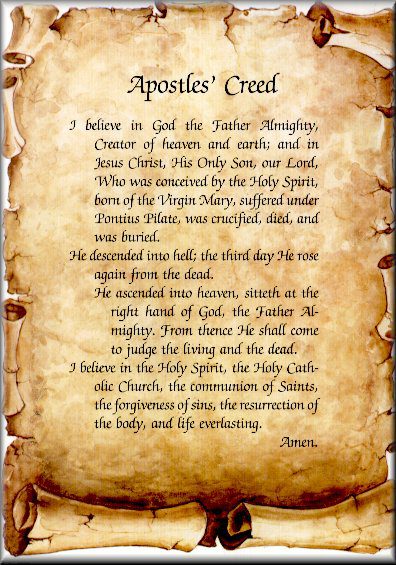
I believe in the Holy Catholic Church
Without getting weighed down in controversies, let’s take a look at what this means to the CHURCH.
- to: The Holy Church
- to: the holy catholic Church
What we have in common here (between the Roman Creed and the Apostles’ Creed) is the CHURCH.
WHAT IS IT?
Church
In fact, Christ is its founder.
“And I also say to you that you are Peter, and upon this rock I will build My church;
Gospel of Matthew 16:18 LSB
and the gates of Hades will not overpower it.
- ekklēsia in the New Testament Greek.
- ecclesia in Latin from the Vulgate
Peter later writes two epistles (a Greek word meaning, letter) to the churches. From our recent series:
The Apostle (or Saint, if your must) but really Peter acts as a Bishop overseeing many churches) writes:
To those who are elect exiles of the Dispersion in Pontus, Galatia, Cappadocia, Asia, and Bithynia, according to the foreknowledge of God the Father, in the sanctification of the Spirit, for obedience to Jesus Christ and for sprinkling with his blood:
This points toward a Holy and separated group of Christians – persecuted Christians – and any of these saints of the churches deserving of honor for the example they lived in Christ.
Holy, holy
Capitalization: semantics, really. Little if any effect on meaning.
The Apostle Paul, a mater of language (Greek, as well as Hebrew) clarifies this even more in his first epistle to the Corinthians.
Paul, called as an apostle of Jesus Christ by the will of God, and Sosthenes our brother,
To the church of God which is at Corinth, to those who have been sanctified in Christ Jesus, saints by calling, with all who in every place call on the name of our Lord Jesus Christ, their Lord and ours:
1 Corinthians 1:1-2 NASB
Paul humbly introduces himself noting the he is CALLED AS AN APOSTLE OF JESUS CHRIST. He’s no SAINT – with a CAPITAL S – speaking down to the saints- SMALL ‘s’ who must listen to the Apostle.
And of course no saint would have ever addressed him as , Saint Paul, Apostle Paul, Arch-Bishop Paul, your most-reverend Apostleness or any other inappropriate greeting. He is their loving brother and father in the faith.
Paul’s theological guidance to the church – every church – every believer and saint is confirming that they have been SANCTIFIED in Christ Jesus. This is what makes all Christians saints.
- hagiazō
- to render or acknowledge, or to be venerable or hallow
- to separate from profane things and dedicate to God
- to purify
Paul uses a verb which speaks to the holiness of those sanctified in the blood of Christ shed for us on the Cross.
- hagios
- most holy thing, a saint
Of course the Apostles describe Christ followers, sanctified in His Blood sacrificed for sinners, as saints — HOLY ONES
It did not take long for the Apostle Peter to get to this KEY point in his first epistle either AND quoting the holy scripture of Moses AND referring to Christ:
.. but like the Holy One who called you, be holy yourselves also in all your conduct;
because it is written,
“YOU SHALL BE HOLY, FOR I AM HOLY.”
1:Peter 1:15-16 LSB
catholic
So remember that the purpose of agreement on the Church (or churches)confessing or saying the same Creed is to say the WE all are alike in that WE BELIEVE these same things.
AND ALSO what WE believe and confess separates us from those who do NOT follow Christ. Therefore we are sanctified or purified by Christ.
IT IS A UNIVERSAL or CATHOLIC confession and affirmation that binds us as CHRIST followers … or saints of His Church.
NOT Peter’s church. NOT Paul’s church. Not that of some holy mother or fatherly Saint of the past…
We are part of Christ’s Holy Church, made Holy by Him.
WE believe in the Holy Catholic Church
Christ’s Church
Although WE do not accept every accusation of heresy or claim of special authority outside of the Holy written word of God and Jesus Christ.
I suppose, beloved fellow saint, that you too have an opinion on this.
(That's why the Church fathers emphasized these few important words in The Apostles' Creed.)

Why not COMMENT with your thoughts on the Holy Catholic Church at the end of this post, if you will?
Talk of JESUS . com
Comment on Scripture – Share the Gospel
Leave a Reply