Category: Epistles – Is his letter to our church?

Epistle of Paul to the Romans 1 - the Apostles sends a church letter to Rome and the local saints of area churches
Epistle of Paul to the Romans

Epistles ἐπιστολή or Letters

I charge you by the Lord that this epistle be read to all the holy brethren.

Paul’s First Letter to the Thessalonians 

Don’t  miss our recent FEATURED SERIES

JUNE 2024 – 2025 —

1 CORINTHIANS 

———————————————————-

Letters – Is he writing to me?
The short answer: YES.

In their epistles or 1st century church letters the Apostles and other men sent out by Jesus build up the saints [small – ‘s’] or members of local first century churches.

A Disciple or other witness of JESUS would write it. Messengers then delivered these church letters to many isolated worshipers.

Followers of Jesus Christ receive these letters as a major encouragement to their personal faith. Then leaders read them to worshipers of their church.

Although the Epistles 0r Letters to the Church were originally written to churches of the first century,

Romans through Jude will seem like letters to your 21st century church.

  • What do Peter, Paul, John and others tell us we must do?
  • Is he talking about an issue in your 21st c. church as well?
  • How does the writer’s advice, warning, or encouragement to the 1st c. believers apply to you as well
  • Is the writer of this letter talking about something you need to address in your 21st century ‘christian’ life?

Contemporary Application of the Letters (Epistles)

Most New Testament writers take on specific issues confronting faithful followers of Jesus Christ. These same issues continue to confront believers until the Lord’s coming again in these last days.

Certainly Christ our Lord will come again to those God has chosen for eternal life.

Believers currently suffer more than most of you who know Christ in your local church can imagine.

In other lands Christians continue to suffer by the hand of the ungodly.
Go into all the world

A 21st century Common Era church can see and hear nearly any atrocity of man or artificial imagination of sinful man’s mind, yet ‘christians‘ dare not speak of any absolute truth of the Lord God or talk of JESUS CHRIST.

Will YOU comment on Scripture and share the Gospel?

I invite you to read the inspired word of Scripture written in these LETTERS TO THE CHURCH.

YES, He IS writing to YOU.

Beloved brother or sister in Christ Jesus,

Will you read this ‘CHURCH LETTER’ and talk of JESUS through your comment, sharing and email to me about this ‘Letter to you?”

Roger@talkofJesus.com

  • And Now the News – Just the Facts

    And Now the News – Just the Facts

    Moreover — and as a matter of fact, the Apostle continues — here are the facts of the Gospel of the resurrection and Christ once more (for your logical Greek reasoning).


    Letters & NEWS

    As we have read in the Apostle’s first epistle to the Corinthian saints, letters are personal and recall a connection of love between Paul and those in Corinth.

    I give thanks to my God always for you because of the grace of God that was given you in Christ Jesus, that in every way you were enriched in him in all speech and all knowledge— even as the testimony about Christ was confirmed among you—

    .. I appeal to you, brothers, by the name of our Lord Jesus Christ, that all of you agree..

    1 Corinthians 1:4-10a excerpt ESV

    The Apostle states his obstacles common to the Corinthians — a diverse church in every way — at the outset of his epistle:

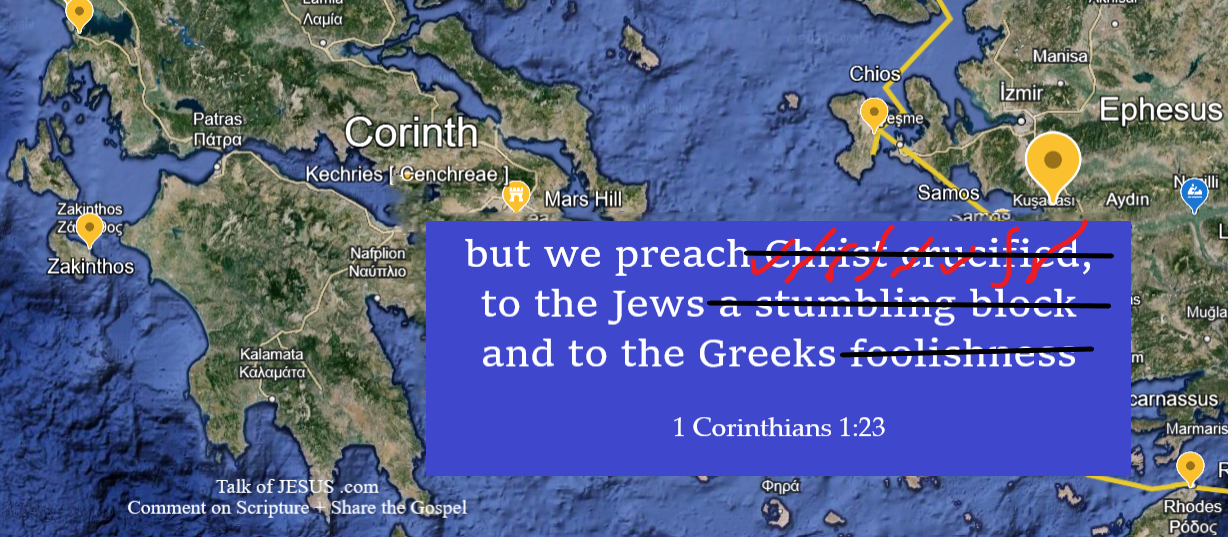
    For Jews demand signs and Greeks seek wisdom,

    but we preach Christ crucified, a stumbling block to Jews and folly to Gentiles

    Paul’s first letter to the Corinthians 1:22-23 ESV

    And the Apostle establishes his own authority in Christ — the head of the Church who died for sinners.

    Though I am free of obligation to anyone, I make myself a slave to everyone, to win as many as possible. To the Jews I became like a Jew, to win the Jews.

    1 Corinthians 9:19-20a ESV

    Yet Paul’s pathos and personal connection to the Corinthians appeals to all who love the Lord — Jew and Greek and Romans who worship as saints of one Church — this one in first century Corinth.


    The Parthenon in Athens a place to honor and worship all the gods
    The Parthenon

    Logic

    Recall from our previous look at Paul’s personal letter that even though a remnant of Jews live in Corinth (and the smaller ancient city of Athens), the culture of his audience is Greek.

    (Even the Romans mimicked worship of the Greek gods and goddesses.) 
    Tethys - titan goddess - a grandmother of the goddess Ephyra - namesake of Corinth
    In Greek mythology, Tethys was Consort of Oceanus, father of the river gods and goddesses including a Greek goddess who founded Corinth named Ephyra.

    What’s missing for Greek worshippers?

    The connections between credibility and impact.

    • How can worshippers of myths — a myriad of made-up gods and goddesses — purport LOGIC as truth?

    In fact, the FACTS of logic built on false premises do not add up.

    This is Paul’s cultural challenge — and ours.

    Paul’s personal letter to the Corinthian saints (church).

    The Apostle’s connection of logic to his Greek audience is agape (love).

    “IF I have not love (charity) [agape], I am nothing.

    1 Corinthians 13:2

    As for the difference of Paul’s beliefs in God:

    Now I would remind you, brothers, of the gospel I preached to you, which you received, in which you stand..

    1 Corinthians 15:1 ESV

    Before we list Paul’s FACTS for believers, let’s examine this Greek culture of logic in the light of truth cast upon the temples of many mythical gods and goddesses of Corinth.

    Truths revealed to our minds

    The following quoted in part from WARRANTED CHRISTIAN BELIEF PP290-294

    What more is there to faith than belief?

    What distinguishes the Christian believer from the demons?

    ——

    “You believe that God is one; you do well. Even the demons believe—and shudder!

    Epistle of James to the Church 2:19 ESV

    They believe these things, but hate them;

    and they also hate God.

    WARRANTED CHRISTIAN BELIEF P.291

    Is it not so?

    Hasn’t this hatred of God also been your experience at simply the mention of Jesus Christ?


    Perhaps they also hope against hope that these things aren’t really so..

    in a self-deceived way..

    the problem here is not merely cognitive..

    but.. Promethean..

    ibid.

    Cultural ‘science‘ of Promethean Logic

    Prometheus statue in NYC Rockefeller Center

    COVID-masked Prometheus statue at Rockefeller Center NYC, US as seen on the News

    Prometheus, in Greek religion, one of the Titans, the supreme trickster, and a god of fire. His intellectual side was emphasized by the apparent meaning of his name, Forethinker. In common belief he developed into a master craftsman, and in this connection he was associated with fire and the creation of mortals.

    Source: Britannica

    WE must think to the AD 55 Corinthian culture, as well as our own Common Era challenges of preaching the Good News of Jesus Christ, in these ‘Promethean‘ terms of logic —scientific facts of the world masked as NEWS.

    Roger@TalkofJesus.com

    The demons, no doubt, are theists and also believe of God that he exists; because they do not trust and love God and do not make his purposes their own.

    ibid. p.294

    Heretics — those who hate God — contend against Christ.


    Gospel Good News

    NOW, after stating that everything must be done in order, the Apostle Paul begins with the facts of the resurrection. AND note that he presents these FACTS as ‘of first importance.’

    Facts:

    For what I received I passed on to you as of first importance:

    1 Corinthians 15:3

    that Christ died for our sins..

     ὅτι Χριστὸς ἀπέθανεν ὑπὲρ τῶν ἁμαρτιῶν 
    Christ (christos) -- not simply JESUS or Lord or some other designation of His Person or earthly position.

    The Apostle Paul makes “CHRIST” christos — central to his FACTS to the Corinthians, using this Messianic designation (in Greek) over sixty times in this epistle.

    AND Paul’s protos point reminds us that CHRIST DIED FOR OUR SINS

    (the Person of Jesus) Christ ἀποθνῄσκω died [apothnēskō] (as all men and women do)

    -- AN INDISPUTABLE FACT --

    Then Christ’s apostle to the gentiles reminds:

    ὑπὲρ τῶν ἁμαρτιῶν

    hyper egō hamartia

    for our sins 

    Christ’s apostle continues logically with a REASON (remember, these are Greeks seeking wisdom in this) for this indisputable fact that Jesus died on a Cross (some twenty years before this).

    And in his logical support of why Christ – the Messiah of the Jews – would do this, the Apostle cites God’s Holy written word:

    “.. according to the Scriptures [γραφή – graphē].


    AND logically following his FACT of Christ’s death Paul adds:

    that he was buried,

    that he was raised on the third day

    in accordance with the Scriptures,

    1 Corinthians 15:4 ESV

    Not such a big deal that Jesus was buried (although many criminals hung on Roman crosses were left as carrion for the carnivorous).

    It is the RESURRECTION of Christ which always ignites the Promethean detractors of truth.

    AND again Paul adds: “in accordance with the Scriptures.”

    NOW Paul logically follows-up from presenting his facts to the truthful testimony of eye witnesses.

    ὁράω – HE appeared:

    1. to Cephas (Peter)
    2. the Twelve (Jesus’ Disciples)
    3. Then he appeared to more than five hundred brothers at one time, most of whom are still alive, though some have fallen asleep.
    4. to James (Jesus’ half-brother)
    5. then to all the apostles.
    6. the Apostle Paul

    Last of all, as to one untimely born, he appeared also to me. For I am the least of the apostles, unworthy to be called an apostle, because I persecuted the church of God.

    1 Corinthians 15:8-9 ESV

    We Preached + you believed the facts

    In the Apostle’s ‘reminder’ written to the believing saints of the church in Corinth, Paul begins with just the facts — provides witnesses — and now preaches once more what many had proclaimed in person.

    But by the grace of God I am what I am, and his grace toward me was not in vain.

    On the contrary, I worked harder than any of them, though it was not I, but the grace of God that is with me.

    Whether then it was I or they, so we preach and so you believed.

    Paul’s first epistle to the Corinthians 15:10-11 ESV

    SINCE ~AD 33 — and for all these years of our Lord since — MANY WITNESSES of One Lord — have Preached and Proclaimed

    Jesus Christ crucified for our sins, buried, and raised from the dead — appearing, in fact, to many witnesses.

    and (when we preached)

    — you believed!


    But the Apostle is NOT FINISHED with this all-important proclamation of the Good FACTS of the Resurrection.

    NEXT, Paul will continue with the certainty of the resurrection of the dead.. and you must consider what this will mean to your own faith and mortal life.

    Talk of JESUS . com

    Comment on Scripture – Share the Gospel


  • Propriety in Worship of the Church – 1 Corinthians 14

    Propriety in Worship of the Church – 1 Corinthians 14

    Paul wanted his churches to exhibit a modesty and propriety recognized by the surrounding culture, especially in worship.

    (1 Corinthians 14)

    THE BAKER ILLUSTRATED BIBLE COMMENTARY P.1303

    An Overview of Paul’s Epistle

    Most outlines of Paul’s first letter to the Corinthians include what we are about to read next under a smaller heading of ‘spiritual gifts’ or ‘the gifts of tongues and prophesy’ as part of a larger section of the epistle — as a conclusion of the previous chapters.

    Remember that like our letters to anyone it had no chapters.

    Without returning to my original introduction to 1 Corinthians, I would like to point to these larger points of Paul’s letter here:

    1 Corinthians
    • Response to their questions [chaps. 7-16]
    • Recommendation of others & closing

    One of the central cultural issues of propriety and order the Apostle has addressed in response to several Corinthian questions is that of the role of women.

    Within the Apostle’s response to the Corinthian elders some of these issues include:

    * Immorality in the Church (5:1–6:20)

    These issues applied to men certainly affect all women. 
    • But actually, I wrote you not to associate with anyone who claims to be a brother or sister and is sexually immoral or greedy, an idolater or verbally abusive, a drunkard or a swindler. Do not even eat with such a person.
      • 1 Cor 5:2
    • Flee sexual immorality! Every other sin a person commits is outside the body, but the person who is sexually immoral sins against his own body.
      • 1 Cor 6:18

    Marriage in the Church (7:1–40)

    • 3 A husband should fulfill his marital duty to his wife, and likewise a wife to her husband.
    • 10 To the married I give this command — not I, but the Lord — a wife is not to leave her husband.

    Liberty in the Church (8:1–11:1)

    This section ends with Paul's personal example: 

    Imitate me, as I also imitate Christ.

    AND — (as introduction to our current larger section of his epistle) — the Apostle continues by encouraging those who have done so.

    Worship in the Church (11:2–14:40)

    Now I praise you because you remember me in everything and hold fast to the traditions just as I delivered them to you.

    3 But I want you to know that Christ is the head of every man, and the man is the head of the woman, and God is the head of Christ.

    – 1 Corinthians 11:2-3 CSB

    Intro to Apostolic instructions about Head Coverings

    • Roles of Men and Women in the Church (11:2–16)
    • The Lord’s Supper (11:17–34)
    • Spiritual Gifts (12:1–14:40)


    The Context of Worship – A.D. 55 or 2025 CE

    As you can see, the Apostle has introduced this smaller section of his letter about spiritual gifts in the context of worship

    AND that he has already addressed some of the roles of men and of women who worship the Lord Jesus Christ as the Apostle has ‘delivered‘the traditions’ to them.


    What is propriety?

    • for a first century Corinthian
    • or (for example) a 21st c. Cincinnatian
    Lady with blue and gilt garment, fan and sun hat, from Tanagra - 4c. BC

    This photo next to the BAKER commentary for 1 Corinthians 14 got my attention to focus back on

    the propriety and modesty of a classic Corinthian woman. 

    Propriety – conformity in socially acceptable conduct and speech, appropriateness, fear of offending against conventional rules of behavior especially between the sexes.

    source

    In light of this, consider propriety from the earlier BAKER quote.

    At Corinth he [Paul] was particularly concerned about women’s reputation. For women modest draped clothing with a head covering was common. (see 1 Corinthians 11:2-16),

    as seen here in a sculpture from 300 BC (Tanagra, Greece)

    ibid.


    Here is more background on the culture of Corinth named for a goddess descended from the Greek Titans [also pictured on our cover to this post].

    In Greek mythology, Tethys was Consort of Oceanus, father of the river gods and goddesses including a Greek goddess who founded Corinth named Ephyra.

    The Greeks and Romans honored many gods and goddesses of culture and worshipped these with some order and propriety, while worship of others included temple prostitutes, so much debauchery and excess witnessed in festive celebrations.

    (Sound familiar, 21st c. christian?)

    Yet the modesty of a proper woman is important to the Corinthians, both men and women, thus the Apostle’s insistence on the propriety of head-coverings in worship of the church.


    What’s allowed in proprietary worship of God?

    1 Corinthians 14:

    Concerning Prophesy and Tongues

    Pursue love and desire spiritual gifts, and especially that you may prophesy.

    .. The person who prophesies is greater than the person who speaks in tongues, unless he interprets so that the church may be built up.

    .. — since you are zealous for spiritual gifts, seek to excel in building up the church.

    13Therefore the person who speaks in a tongue should pray that he can interpret.


    Who’s in charge?

    Using several references from Paul's letters to the Corinthians in "DIVINE PROVIDENCE," STEPHEN CHARNOCK [pub. AD 1680, updated 2022] provides us with a helpful overview of the Apostle's thinking: 

    The edification of the church is the great end that we are commanded to work toward:

    Stephen Charnock – DIVINE PROVIDENCE, p.146

    Since you are eager for manifestations of the Spirit, strive to excel in building up the church.”

    1 Cor, 14:13 – ibid.


    Then, under the heading 'The Gifts and Common Grace of Bad Men and Women' Charnock addresses Paul's order of propriety mentioned in this and other epistles. 

    God is the giver of gifts, Christ is the governor of those gifts, and all is for your sake.

    ibid.

    I find this particularly helpful.

    Think of it:

    God the Father (or because of their Oneness in substance, God the Father, Son and Holy Spirit) — who created ALL things —

    charges CHRIST (Jesus, the Person of the Son of Man and Son of God) — THE CORNERSTONE of the Church — as its governor

    with perfect distribution of the gifts to the church — gifts that GOD has given to the church for the LORD’s divine purpose for the sake of those chosen before creation to worship him .


    Now think of Jesus' parable of the wheat and the tares for this next one: 

    There are some husks that come up among men and women, and God uses them to shelter the church in common works, and he [GOD] restrains these men and women through the knowledge of Christ.

    God gives gifts to them out of love for his church, not out of love for them.

    DIVINE PROVIDENCE, P.147

    Get a grip on this: it’s not about YOU — God’s love is about HIS CHURCH.

    REMEMBER, what the Apostle has just written?

    • IF I [do any of so many things]
    • BUT have NOT [agape {love}]
    • I am nothing
    • and I gain nothing.

    Dearly beloved,

    Do you take this bond of your church to have and to hold..?


    OR is our desire to try out relationships of LOVE 

    to try out church es

    — NOT having or holding  any commitment to Christ Jesus  and His body the Church?


    What then, brothers?

    We realize that this is not a politically correct question in this common era (and some English translations soften it), but Paul uses the Greek word ἀδελφός - adelphos - a masculine noun for brethren. 

    What then, brothers? When you come together, each one has a hymn, a lesson, a revelation, a tongue, or an interpretation.

    Let all things be done for building up.

    1 Corinthians 14:26 ESV

    The Apostle, under Christ, under God addresses the men of the church — not the women saints of Corinth — as was proper in Corinthian culture.

    The Apostle has addressed:

    • quarreling among you, my brothers. (1:11)
    • But I, brothers, could not address you as spiritual people, but as people of the flesh, as infants in Christ. (3:1)
    • But now I am writing to you not to associate with anyone who bears the name of brother if he is guilty of.. [a long list of sins] (5:11)

    Brothers, do not be children in your thinking. Be infants in evil, but in your thinking be mature.

    1 Corinthians 14:20 ESV

    Order and Propriety

    Each of you (brothers).. (not the sisters.. and not ONLY the pastor in charge under Christ).

    What then is it, brothers? When you may come together, each has a psalm, has a teaching, has a revelation, has a tongue, has an interpretation.

    Let all things be done for edification.

    1 Corinthians 14:26 Berean Literal Bible – [more study]

    • Tongues?
      • two or three at most
      • in turn &
      • must have interpretation
    • Prophets?
      • two or three
      • others weigh in on what is said
      • IF a personal revelation is made to one present, the man receiving it must remain silent.
      • all may profit by learn and be encouraged by (this kind of) prophesy
      • prophets are subordinate [hypotassōto] to each other

    Now do not be offended by Paul's next orderly instruction for worship — for it uses the same Greek word [hypotassō] — for the Corinthian women of propriety and modesty expected in worship. 

    For God is not a God of confusion but of peace.

    As in all the churches of the saints, the women should keep silent in the churches.

    For they are not permitted to speak, but should be in submission , as the Law also says.

    1 Corinthians 14:33-34 ESV

    Note that the Apostle — who has been addressing order and propriety in worship throughout his epistle to the saints of Corinth — also speaks to ALL the CHURCHES [ekklēsia] of the SAINTS [hagios].


    ARE YOU, beloved 21st century worshipers of the Lord Jesus Christ, not also His saints?

    and we have believed,
    and have come to know, that you are the Holy One [hagios] of God.”

    Gospel of John 6:69 ESV – Simon Peter to the Lord Jesus

    Yes, the women of Corinth and of your 21st century church could be of the Holy Ones - saints - of God; so don't be offended by what the Apostle Paul next instructs the saints by the Spirit - even if God formed you as a woman. 

    If there is anything they desire to learn, let them ask their husbands at home. For it is shameful for a woman to speak in church.

    1 Corinthians 14:35 ESV

    Paul then proceeds to instruct ‘the brothers’ in those issues the apostle has already addressed, prophesies and spiritual gifts (essentially reiterating ‘listen to me about these things).

    And the Apostle Paul’s conclusion to this large section of his letter to the Corinthian saints

    who are of course free from the Law (as servants of God, Christ and each other) —

    But let all things be done properly and with order.

    1 Corinthians 14:40 BLB


    And since Paul's epistle (like any letter) lacks chapters, what does the Apostle NEXT remind the Corinthians -- the saints of Christ's Church? 

    About THE RESURRECTION.

    Comment on Scripture – Share the Gospel

  • To have and to hold Christian Love

    To have and to hold Christian Love

    Dearly beloved, Paul writes earlier – a greeting of agape love NOT inappropriate for a marriage, but the Apostle’s intent in this section addresses spiritual gifts and love of the CHURCH specifically.

    we have the mind of Christ.

    1 Corinthians 2:16 KJV

    ἔχω – echō

    • to have, i.e. to hold
    • to have i.e. own, possess

    So think of it this way:

    WE (referring to the Church) hold the mind of Christ. And WE possess the mind of Christ as HIS body, the Church.

    AND, of course, don't miss this application to our vows of Christian marriage as well, (not to mention our relationship to a dearly beloved local church family). 
    Do our marriage vows model a Common Era witness of christianity to an uncommitted world? 

    to HAVE and to HOLD

    used of those joined to any one by the bonds of natural blood or marriage or friendship or duty or law etc., of attendance or companionship

    Strong’s G2192 – echō

    Dearly beloved,

    Do you take this bond of your church (etc.) to:

    have and to hold?


    OR do WE just want to try out relationships of LOVE and church es — NOT having or holding any commitment to Christ Jesus and His body the Church?


    But because of sexual immoralities, each man is to have G2192 his own wife, and each woman is to have G2192 her own husband.

    Paul has already pointed the Corinthians to a higher standard.

    Yet HERE the Apostle continues to apply this love to the body of the CHURCH.

    So what is this agape LOVE?

    The Lord Jesus had warned those who would follow:

    And because iniquity shall abound, the love G26 of many shall wax cold.

    Matthew 24:12 KJV

    The Apostle had opened this section by listing what agape LOVE is NOT.

    Love’s clear contrasts in the love of believers

    Paul now proceeds to list a few of the insufficient adjectives which describe the love of God in Christ Jesus - both what LOVE is and what agape LOVE is NOT. 

    Love Charity


    1 Corinthians 13:4
    • is patient
      • long-spirited
      • forbearing
      • suffereth long
      • is long-suffering,
    • is kind
      • gentle
      • gracious
      • benevolent
      • desires to do good to others
    • does not envy
    • does not boast
      • brag
      • vaunt itself
      • employ rhetorical embellishments in extolling one’s self excessively
    • is not proud.

    1 Corinthians 13:5

    • Doth not behave itself unseemly
      • behave rudely
      • act unbecomingly
      • dishonor others
      • is not disrespectful
      • or inconsiderate.
    • It is not self-seeking
      • seeketh not her own
      • himself, herself, itself, themselves
    • is not easily provoked
      • irritable
      • resentful
      • angered
      • gets annoyed
      • aroused to anger
    • thinketh no evil
      • does not keep an account of a wrong suffered
      • no record of being wronged
      • love that forgives and forgets

    1 Corinthians 13:6

    it does not rejoice at wrongdoing,

    but rejoices with the truth.

    1 Corinthians 13:6 ESV

    • ἀδικία – wrongdoing
      • injustice, of a judge
      • unrighteousness of heart and life
      • a deed violating law and justice, act of unrighteousness

    The Greek word for “truth” is “aletheia,” which signifies not only factual accuracy but also sincerity and integrity.

    In the biblical narrative, truth is often associated with God’s character and His revelation to humanity.

    John 14:6

    source: BibleHub Study Bible

    Agape rejoices with the truth;


    It bears all things, believes all things, hopes all things, endures all things.

    1 Corinthians 13:7 BSB

    • It always protects,
      • always trusts,
      • always hopes,
      • always perseveres.
    • Love never gives up,
      • never loses faith,
      • is always hopeful,
      • and endures through every circumstance.

    ἀγάπη agapē never fails,

    1 Corinthians 13:8a

    And again, the Apostle's list and concern is for spiritual gifts.

    BUT..

    Paul continues, 
    • As for prophecies,
      • they will pass away;
    • as for tongues,
      • they will cease;
    • as for knowledge,
      • it will pass away.
    • 9 For we know in part
    • and we prophesy in part,
    • 10 but when the perfect comes,
      • the partial will pass away.

    1 Corinthians 13:8b-10 ESV

    And let's not forget, the Apostle's instruction to the Corinthians is to contrast these to our agape love in Christ as His body the Church. 

    Now Paul, their teacher for a year and a half concludes his settling of their differences by essentially telling the Corinthian saints to:

    Grow up!

    When I was a child, I spoke as a child, I understood as a child, I thought as a child;

    but

    when I became a man, I put away childish things.

    1 Corinthians 13:11 NKJV

    Have YOU, dearly beloved, 21st century saint?

    For now we see in a mirror, dimly, but then face to face.

    Now I know in part,

    but then I shall know just as I also am known.

    1 Corinthians 13:12 NKJV

    TalkofJesus.com post [2 min.] from September 11, 2013


    and now abide

    νυνὶ δὲ μένει

    menō – not to depart

    • to continue to be present
    • to be held, kept, continually

    to remain as one, not to become another or different

    These are just a few of the meanings when the Apostle pleas with his beloved church to have and to hold Christ -- the love of God for saints chosen to abide in the love of the Lord. 

    What Paul writes here sounds like a benediction — a closing thought. But is not since the Apostle has more to say about spiritual gifts.

    And now abide faith, hope, love, these three; but the greatest of these is love [ἀγάπη agapē].

    1 Corinthians 13:13 NKJV


    NEXT: (with an interruption for Lent 2025 CE) in chapter 14 the Apostle Paul will conclude this section of his epistle on order in worship and spiritual gifts.

    Comment on Scripture – Share the Gospel