Tag: apostle

  • 2 Peter 1 – Know Christ’s Divine Nature

    2 Peter 1 – Know Christ’s Divine Nature

    Jesus Christ Lord God with cross

    Does Christ wield divine authority in your life?

    Second Epistle of Simeon Peter 1:

    ..seeing that His divine power has granted to us everything pertaining to life and godliness, through the full knowledge of Him who called us by His own glory and excellence.

    For by these He has granted to us His precious and magnificent promises, so that by them you may become partakers of the divine nature, having escaped the corruption that is in the world by lust.

    2 Peter 1:3-4 Legacy Standard Bible


    Do you know God and Christ?

    The Apostle Simeon Peter Cephas , Simon Peter — wants you to know the Divine nature of God [theos] and Jesus Christ [Christos].

    ..to you in the full knowledge of God and of Jesus our Lord;

    2 Peter 1:2b

    And most essentially these of the Divine nature [physis] above all knowledge (or full knowledge), rather than partial knowledge [gnōsis] of man — even a righteous man or one with wisdom — corrupted [phthora] by our own sinful nature.

    Note that by the unseen inspiration of the Holy Spirit in this scripture, the Apostle Peter in the opening of his second epistle had immediately claimed the authority of:

    ..  the righteousness of our God and Savior, Jesus Christ:

    .. the full knowledge of God and of Jesus our Lord;


    So to continue from when we introduced Peter in our introduction, the Apostle now writes to the church a second time so that all may be assured of their calling.

    our mutually possessive God and Savior

    How we long to belong to someone whom we love!

    A creature of fragile frame in God's image dare not approach the Almighty.
    --

    Yet in JESUS, God touched man in a personal Way
    — in Christ a new covenantal relationship for which we yearn endlessly,

    forged in the love of God and our Lord.

    So Simon Peter, the Rock to whom Jesus looked to now build the church, assures believers and followers of The Way:


    And because of his glory and excellence, he has given us great and precious promises.

    These are the promises that enable you to share his divine nature and escape the world’s corruption caused by human desires.

    In view of all this, make every effort to respond to God’s promises..

    The more you grow like this, the more productive and useful you will be in your knowledge of our Lord Jesus Christ.

    2 Peter 1:4-5a,8 NLT

    But those who fail..
    The restored Apostle who had denied Jesus three times before Christ's sacrifice on the Cross cautions those who claim Jesus, yet fail in repentance:

    But those who fail to develop in this way are shortsighted or blind, forgetting that they have been cleansed from their old sins.

    2 Peter 1 9 NLT


    Some in Adam have not seen the guarded gate of Eden reopened by Christ — God’s new election of saints called to return to the tree of life, mercifully clothed in righteousness through the perfect Sacrifice of our Savior and Lord.

    Apostolic Faith Defined through Peter’s Second Epistle

    The Apostle Peter — clearly in the Authority of our God and Savior Jesus Christ, here in his second epistle of Holy Scripture — commands discernment by the body of Christ – all pastors and every holy saint of the church called to grow in our faith.


    You have no doubt noticed that I have briefly skipped the answer Simon Peter provides to HOW our sanctification grows our faith.

    Peter’s progression in this list will help your personal discernment which the Apostle of Christ commands of those who love Jesus our Lord.

    7 Affections of Sanctification

    Growing Apostolic Faith Through Seeds of Holiness

    Before we look at the list, let’s glance at some terms of faith considering the connection made by the Apostle Simon Peter.

    Sanctification: Is Separation to the Service of God

    Psa 4:32Cr 6:17

    Torrey’s New Topical Textbook

    IF Christians are sanctified to God through the Lord Christ Jesus, THEN, Peter tells us, those saints will grow in the same holiness, rejecting the sin of our former self.


    The Apostle has already addressed sanctification. In fact, Simon Peter opens his first epistle to the saints with this bold greeting and claim in Christ:

    Elect according to the foreknowledge of God the Father, through sanctification of the Spirit, unto obedience and sprinkling of the blood of Jesus Christ..

    1 Peter 1:2a KJV

    Therefore the Apostle lists a general,

    HOW TO ‘ grow or mature in your faith

    for the saints of God.


    And again,

    By these he has given us very great and precious promises, so that through them you may share in the divine nature, escaping the corruption that is in the world because of evil desire.

    2 Peter 1:4 CSB

    For this very reason, make every effort to supplement your faith with goodness..

    add to your faith virtue,
    to virtue knowledge,
    to knowledge self-control,
    to self-control perseverance,
    to perseverance godliness,
    to godliness brotherly kindness,
    and to brotherly kindness
    love.

    2 Peter 1:5b-7 NKJV

    No single translation of these few verses seems sufficient in conveying the full-depth of the Apostle’s advice. Therefore let us take a few moments to allow the cleansing of Peter’s description to open our blind eyes.

    ADD these to your faith:

    Adjectives of Affective Faith:

    1. aretē
    2. gnōsis
    3. egkrateia
    4. hypomonē
    5. eusebeia
    6. philadelphia
    7. agapē

    Peter describes how we may diligently apply our new desires in Christ to our faith. You may have even memorized one English translation of these descriptions from the Apostle’s directive; however you may find insight into the richness of Peter’s list from adjectives in other translations.

    Remember: these all translate from Peter's written Greek - common to all of the first century Roman Empire.

    Adjectives beginning with KJV:
    VIRTUE

    moral excellence, goodness, worthiness

    KNOWLEDGE

    (insight, understanding)

    TEMPERANCE

    self-control,

    PATIENCE

    perseverance, patient endurance, steadfastness

    GODLINESS

    piety

    BROTHERLY KINDNESS

     brotherly affection, mutual affection, brotherly love

    CHARITY

    love, love for everyone, unselfish love, charity,  love itself

    source: BlueLetterBible.org – Bibles


    Neither Useless nor Unfruitful

    These affections are all good things. But more importantly to the Apostle’s evidence to ALL, all are Christian.

    For if you possess these qualities in increasing measure, they will keep you from being ineffective and unproductive in your knowledge of our Lord Jesus Christ. But whoever does not have them is nearsighted and blind, forgetting that they have been cleansed from their past sins.

    2 Peter 1:8*9 NIV

    SO then, how must you act, justified sinner?

    Wherefore, the rather, brethren, (KJV)

    Peter leaves no doubt in the expected actions of believers.

    The Apostle addresses the brothers (as is customary in leadership — who teach their wives with the authority and compassion of Christ and will raise their children in the authority of God and Christ and Scripture).

    He opened his epistle leaving no question as to his apostolic authority in the Divine POWER of God — theios dynamis [v.3] — and Peter confirms Christ’s confirmation to we who are now elect in Him to become participants in Jesus’ Divine NATURE — theios physis [v.4].

    (After all, IF we are no longer like the unsaved sinners who we once were, then our Christ-like fruit of the Spirit will show His hope of eternal life in us.)

    Therefore, brothers, be all the more diligent to confirm your calling and election, for if you practice these qualities you will never fall.

    For in this way there will be richly provided for you an entrance into the eternal kingdom of our Lord and Savior Jesus Christ.

    2 Peter 1:10-11 ESV

    Divinity and Trinity

    I would like to make a side-point concerning authority here which Simon Peter is about to address more fully as we proceed next time.

    First (as I just mentioned from varied English translations), Paul addresses the men of the church as was done in Greek, Roman and Jewish culture. In AD first century culture men, women and deities interacted in an order of hierarchy. Some men over others, some women over others, children under the authority of their mother or a servant woman under her authority — even Greek and Roman deities held unseen authority over men and women in designated areas of their lives and creation.

    As the Apostle has placed himself in this line of authority as both a doulos of DEITY — so Simon Peter also claims his delagated authority from ALMIGHTY GOD in the Person of GOD’s only Son Christ Jesus.

    The APOSTLE claims this obedience not to him personally, but as the personal slave of God sent to the world with the Gospel.

    The church cannot claim Christ while turning against GOD’s own commands.

    Peter’s Apostolic Gospel applies to ALL men and to ALL women who claim to be Christians.

    No claim of God while denying the written word of God in Scripture and instruction of an Apostle is true. Any christian claim of JESUS contrary to the Apostolic witness will not make a pastor, elder or bishop or any mortal man or woman a true Christian.

    Even JESUS, the Son of God, submitted to the will of the Father in everything and He promises to send the Holy Spirit as a counselor to those elected to eternal life in the New Covenant.

    We cannot take time today to again address the Trinity.

    Am I numbered among God’s elect?

    R.C. Sproul reminds readers that Peter’s first epistle was addressed to the elect and notes that his second epistle with this important teaching, ‘drips theology.’

    So speaking of these affections we have just reviewed [2 Peter 1:5-7] Sproul writes:

    Yet he wants believers to be even more diligent about something else. There is an even greater priority, and that is the doctrine of election—not in the abstract but in respect to your own person.

    The most important question you need answered in your lifetime is this: am I numbered among the elect?

    ibid. p.195


    Consider the question in the mirror of God’s truth. Do YOU have the fruit of the Spirit shown in elected saints who turn to CHRIST?


    Any who lack such humble witness of Jesus to which Peter points in this epistle may be heretics — ravenous wolves, clothed in some other gospel of an anti-Christ.

    NEXT: The Will of a departing Apostle


    Talk of JESUS . com

    Comment on Scripture – Share the Gospel


  • Your Communions in Church and in Christ

    Your Communions in Church and in Christ

    Communions, gatherings, worship services, church services — call them whatever you like. But the Apostle Paul provides some pointed correction for the church as we continue in 1 Corinthians 11.

    Communion – Sharing in the Lord’s Supper

    What’s the Apostle Paul saying to the Church?

    It’s an Exhortation

    Pretty strait-forward

    Paul addresses these communions (as the idolatrous feasts of Corinth he has already addressed) presenting a clear choice for godly saints of the Church at Corinth.

    v.17 In the following instructions I have no praise to offer, because your gatherings do more harm than good. – BSB


    for the Church

    Would you like to hear Paul's introduction in another way? 

    1 Corinthians 11:18

    • For first of all, when you come together as a church, I hear that there are divisions among you, and in part I believe it. – NKJV
    • In the first place, I hear that when you come together as a church, there are divisions among you, and to some extent I believe it. – NIV
    • For first of all, when you come together in the assembly, I hear that divisions exist among you, and I partly believe it. – HNV

    This is simply Paul’s FIRST POINT following the Apostle’s exhortation about sanctified living AND following his FIRST POINT about ROLES in Christian Worship within this section of his Epistle ordering Christ’s instructions for worship.

    The Apostle Paul specifically points to times when we assemble [or come together] συνέρχομαι – synerchomai as a CHURCH ἐκκλησίᾳ – ekklēsia.

    Many of you know this Greek word for church. 

    LOOK at its definition
    (nothing specifically yet about communion here. But read on.)

    The Apostle then continues in his outline for Christian gatherings.

    Sharing in the Lord’s Supper ( 11:17⁠–⁠34 )

    church supper

    An exhortation for social and festive meals in the church community

    Now then, when you come together, it is not the Lord’s Supper you eat.

    21 For as you eat, each of you goes ahead without sharing his meal. While one remains hungry, another gets drunk.

    22 Don’t you have your own homes in which to eat and drink? Or do you despise the church of God and humiliate those who have nothing?

    What can I say to you? Shall I praise you for this?

    No, I will not!


    The Apostle’s transition into this section had been:

    Be ye followers of me, even as I also am of Christ.1 Cor 11:1 KJV


    Paul's focus:

    Our communions other than Holy Communion

    For there must be also heresies among you,

    that they which are approved may be made manifest among you.

    1 Corinthians 11:19 KJV

    * In the first major schism of the Church in the A.D. 11th century the Roman Church divided from the Orthodox Church. See the Timeline in the link above.

    Common Era christians dare not mention such things as HERESY, lest we offend some unbeliever in our gathering or sharing in breaking bread with us at an occasional community evangelism feast. 

    We prefer a gentler approach of translations of αἵρεσις - hairesis like: factions or divisions or differences.

    11:20 συνερχομένων οὖν ὑμῶν ἐπὶ τὸ αὐτὸ οὐκ ἔστιν κυριακὸν δεῖπνον φαγεῖν

    When ye come together therefore into one place, this is not to eat the Lord’s supper.

    First Epistle of Paul to the Corinthians 11:20 KJV

    Does the Apostle then instruct the Church NOT to share in Holy Communion?

    NO, certainly not.

    Only not to participate in such a community meal alongside unbelievers (EVEN ‘at church’ ), including those who are not in Christ in this Holy Sacrifice of Communion as worship.


    The Lord’s Supper

    You may want to READ some of the Gospel including these Holy Scriptures, but I urge you for now to remain focused on the Apostle’s INSTRUCTION specifically to saints of the Church at Corinth (in ~ A.D. 55).

    Gospel cross-references to the Lord’s Supper

    King James Version


    a HOLY Communion in Christ celebrated by the Body of Christ

    Holy Communion the Bread and Cup of salvation in Christ  for the body of Christ the Church

    For I have received of the Lord that which also I delivered unto you..

    1 Corinthians 11:23a KJV

    Paul here reiterates from the Gospel accounts that which the Apostle had already instructed in person.


    .. That the Lord Jesus the same night in which he was betrayed took bread:

    And when he had given thanks, he brake it, and said, Take, eat:

    this is my body, which is broken for you:

    this do in remembrance of me.

    After the same manner also he took the cup,

    when he had supped, saying,

    This cup is the new testament in my blood:

    this do ye, as oft as ye drink it,

    in remembrance of me.

    First Epistle of Paul to the Corinthians 11:23-25 King James Version

    An Apostolic Application

    Once again, Paul has already WRITTEN:

    • NOT to eat Food Sacrificed to Idols AND taught lessons of the Jews’ exodus from Egypt concerning their idolatry.

    For as often as you eat this bread and drink the cup, you proclaim the Lord’s death until he comes.

    1 Corinthians 11:26 ESV

    The Apostle had reminded the saints of Corinth earlier in his letter of both his authority and humility in Christ confirming:

    • I have applied these things to myself [THEREFORE] learn from us not to go beyond what is written.
    • Paul’s instruction consequently will require the saints of Corinth:

    Let a person examine himself, then, and so eat of the bread and drink of the cup.

    1 Corinthians 11:28 ESV


    27 Therefore, whoever eats the bread or drinks the cup of the Lord in an unworthy manner will be guilty of sinning against the body and blood of the Lord. – BSB

    Commentary – Study Bible [below]

    • The term “unworthy manner” suggests a lack of reverence or self-examination
    • The “bread” and “cup” symbolize the body and blood of Christ, and partaking in them requires a heart of humility and repentance.
    • To be “guilty of sinning” implies a serious offense, akin to profaning something holy.

    For he that eateth and drinketh unworthily, eateth and drinketh damnation to himself, not discerning the Lord’s body.

    First Epistle of Paul to the Corinthians 11:29 King James Version

    If we would judge ourselves
    The Apostle offers a few additional reasons to examine ourselves before these communions with the world and the Holy Communion of the saints of our local church. 
    • That is why many among you are weak and sick,
    • and a number of you have fallen asleep.
    • Now if we judged ourselves properly, we would not come under judgment.
    • But when we are judged by the Lord, we are being disciplined so that we will not be condemned with the world.

    In conclusion, Paul reiterates about their divisions over their communions.

    ἐκδέχομαι – ekdechomai 

    33 Wherefore, my brethren, when ye come together to eat,

    tarry one for another.

    translates the King James

    1. to receive, accept
    2. to look for, expect, wait for, await: ἀλλήλους ἐκδέχεσθε wait for one another, namely, until each shall have received his food, 1 Corinthians 11:33, cf.

    PAUL closes this section of his letter about divisions stating that he has more to say about other issues later in person.

    “.. And when I come, I will give instructions about the remaining matters.


    Judge for yourself

    English translation: pictures Table Man Wine Mug Food Food Religion Text added to photo What's wrong with you Communions?

    Comment on Scripture – Share the Gospel

  • Am I not free? Religion 1 Corinthians 9

    Am I not free? Religion 1 Corinthians 9

    Am I not free? Am I not an apostle? Have I not seen Jesus our Lord? Are you not my work in the Lord?

    1 Corinthians 9:1 New Heart English Bible

    Freedom and Religion

    Eric Kress outlines two main points of application from the previous chapter of 1 Corinthians 8:

    Paul’s 4 questions intertwined in context and application

    Paul’s four-fold point (in the Apostle’s letter without chapter and verse) begins:

    οὐκ εἰμὶ ἐλεύθερος 

    ‘Not am I free?’ literally begins the Greek text.

    OR the King James begins:

    οὐκ εἰμὶ ἐλεύθερος

    ‘Am I not an apostle?’

    1 Corinthians 9:1 Bibles


    We won’t want to miss that the Apostle’s pivotal questions follow his concern regarding the idolatry of Corinth and communion between the saints of the Corinthian church with the revelers of the city.

    Freedom of religion

    Suppose for a moment that most every Sunday you go to some local church with an identifiable ‘christianNAME like:

    • such and such FREE church or
    • Our evangelical denomination brand church
    • City name Christian church
    • Korinthian cathedral and parish?

    Won’t most of the people who know you in town also know that:

    • you claim to be a saint,
      • part of you so-named christian church
    • worshiping some god JESUS
    • preached by some Apostle Paul

    • AND in this church occasionally inviting YOU
      • (of another sect celebrating other gods)
      • to go gather in community with these worshipers of One JESUS Christ their Lord?

    Shouldn’t these Corinthian christians come join our religious feasts and live the life of revelry and worship we do with our gods?

    Why should they?

    As we have learned previously in Paul’s letter, his question is not so much:

    • where the Corinthian saints go join in the community as much as
    • how they exercise their freedom publically as witnesses of Jesus Christ our Lord.

    To the Jews and by the Law food sacrificed to idols would seem to be the unlawful offence against the Lord God. (The Messiah Jesus [Yeshua] after all was hailed as the King of the Jews.)

    Community feasts and festivals were, after all, organized by Jews (a small minority in the city), Roman citizens, Hellenists or perhaps adherents of some other foreign religion.


    In a Common Era context, (perhaps Orthodox or Latin Catholic) religious communions and idolic festivals resemble that of the larger communities of like A.D. first century Roman Corinth.

    Authority of an Apostle

    4 Have we no right to eat and to drink?

    5 Have we no right to take along a wife who is a believer, even as the rest of the apostles, and the brothers of the Lord, and Cephas?

    8 Do I say these things according to human authority?

    Or does not the Law also say the same thing?

    Paul then quotes the Law of Moses. 

    And without getting into technical reasons why, the more authoritative KJV begins with Paul's apostleship. It then proceeds to freedom. And ALL of Paul's four questions lead us to his authority in personal witness of the risen Christ and the Apostle's ultimate authority over those gathered as the saints of the Corinthian church.

    Paul’s Deuteronomic illustration of the muzzled ox begs the question:

    .. Is God merely concerned about oxen?

    Or is He speaking altogether for our sake?

    Yes, for our sake it was written, because the plowman ought to plow in hope, and the thresher to thresh in hope of sharing the crops.

    If we sowed spiritual things in you, is it too much if we reap material things from you?

    1 Corinthians 9:11 LSB [context vs. 9-14]

    Paul’s Humble Witness of Christ

    If others share this authority over you, do we not more?

    Nevertheless, we did not use this authority, but we endure all things so that we will cause no hindrance to the gospel of Christ.

    1 Corinthians 9:12

    NO MAN IS FREE OF AUTHORITY.

    Paul points out that he and Barnabas, as apostles of the risen Jesus Christ, do NOT impose their true authority over the church for their own gain.

    Apostles of the Lord all take on the humility of Jesus for Christ’s sake.

    And Paul points out that community leaders who do have authority over feasts, festivals and cities must not see these ‘CHRISTIANS‘ as a hindrance to Christ — a Korinthian christian who becomes a stumbling block to true faith.


    14 So also the Lord directed those who proclaim the gospel to get their living from the gospel… For woe is me if I do not proclaim the gospel.

    The Religion of Paul’s saints

    Many of Paul's questions are rhetorical, designed to make us think through the logic connecting theology and religion,

    our knowledge of God with our witness of faith.

    Everyone practices religion. A Korinthian will get up early, stretch their mind and muscles, breathe in the life-giving air of mother self — and then go worship her at some celebration of community occasion of feasts in the name of some god of their passions.

    The Apostle knew the religion of Roman sailors and Corinthian guides to the temples of debauchery! So he cautions the saints of Corinth to abstain from such religion in all cases for the sake of Christ.

    Religion defined and maligned

    Men will write for religion, fight for It, die for it; anything but live for it.

    W. Cotton Commentary on James 1:26-27

    • I make myself a slave to everyone – 1 Cor 9:19b
    • To the Jews I became like a Jew v.20
    • To the weak I became weak -v.22

    Those who consider themselves religious and yet do not keep a tight rein on their tongues deceive themselves, and their religion is worthless.

    James 1:26 NIV

    Even James writes warnings against hypocrisy; not against the Jews but the Hellenists of every town.

    And like James, the Apostle Paul cautions the saints of Corinth against getting caught up in an inclusiveness of the local religious practices of other religions.

    Adherents of Christian religion are NOT free to practice any anti-Christ religion in order to win someone to Biblical freedom of religion.


    Why is religion most maligned in the name of freedom by preachers from other churches freely claiming Christ?

    Roger@talkofJesus.com

    I urge you, brothers and sisters, saints of our Lord and Saviour Jesus Christ, to drill down into thoughtful application of the definition of religion below. - RH 

    Strong’s G2356 – thrēskeia – feminine noun, From a derivative of θρησκός (G2357), adjective, from θροέω (G2360), verb

    θρησκεία – Religion, Worshipping –

    • religious worship
      • esp. external, that which consists of ceremonies
        • religious discipline, religion

    Strong’s G2357 – thrēskos adjective, (Probably from the base of θροέω (G2360): to cry aloud, make a noise by outcry

    religious (apparently from τρέω to tremble; hence, properly, trembling, fearful

    fearing or worshipping God

    to tremble, trembling, fearful


    Religious fear and worship such as this appears throughout the Bible.  (Today however we will not examine several religious encounters with the LORD from Old Testament.) 

    An Apostle claiming Corinthian saints for Christ

    Returning to Paul's first letter to the Corinthians: 

    Paul the Servant to All

    19 Though I am free of obligation to anyone, I make myself a slave to everyone, to win as many as possible.

    Imagine that! -- an Apostle and witness of the risen Christ Jesus -- a man with complete religious authority over the church, especially those saints who belong to Christ in places like Corinth to whom the Apostle writes his epistle. 

    23 I do all this for the sake of the gospel, so that I may share in its blessings.

    Paul has already stated clearly:

    For Christ did not send me to baptize, but to proclaim the gospel, not in wisdom of word, so that the cross of Christ will not be made empty.

    1 Corinthians 1:17 LSB

    In the opening of his epistle Paul continues:

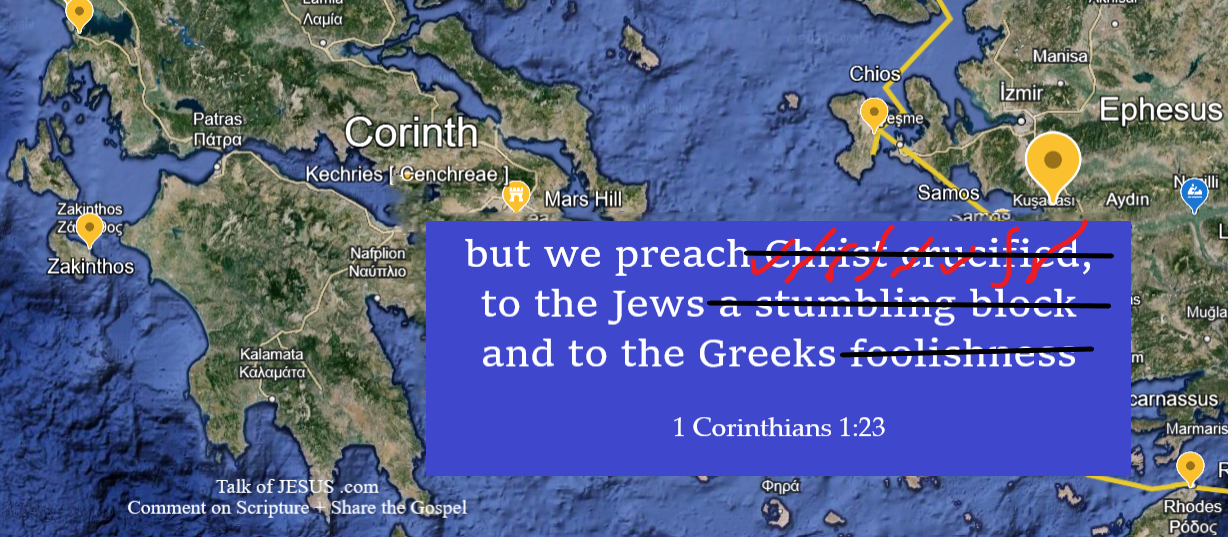
    For the word of the cross is foolishness to those who are perishing, but to us who are being saved, it is the power of God.

    Consider that many who CLAIM "FREEDOM OF religion" truly argue for FREEDOM FROM RELIGION, which, of course, is "foolishness," since ALL men and women are religious about certain religious routines of   life and mortal limbs of dust. 

    .. you would not have many fathers, for in Christ Jesus I became your father through the gospel.

    Therefore I exhort you, be imitators of me.

    1 Corinthians 4:15b-16 LSB

    The Apostle claims the loyal saints of the Corinthian church for himself as their personal, loving father of the faith in Jesus Christ.

    If others share this authority over you, do we not more?

    Nevertheless, we did not use this authority, but we endure all things so that we will cause no hindrance to the gospel of Christ.

    1 Corinthians 9:12 LSB

    Are YOU a Korinthian falling down in your faith?

    What is your city of Corinth, with its festivals so licentious that that they call you Korinthian for your sins — what is the life here in Corinth like?

    And where does a saint of Christ Jesus fit into the milieu of these gods and your festivals?

    HOW WILL YOU ever reach the glory of the Lord Jesus Christ when the Lord calls to Himself all of His saints?


    Do you not know that in a race all the runners run, but only one receives the prize?

    Run in such a way as to take the prize.

    Everyone who competes in the games trains with strict discipline.

    They do it for a crown that is perishable, but we do it for a crown that is imperishable.

    The Apostle, father of the Corinthian saints once again makes an example of his own religion and faith:

    Therefore I do not run aimlessly;

    I do not fight like I am beating the air.

    27 No, I discipline my body

    and make it my slave,

    so that after I have preached to others,

    (And here is Paul's warning of our own witness to our community, neighbors, friends and family..) 

    I myself will not be disqualified.

    1 Corinthians 9:24-27 Berean Standard Bible


    And NEXT, the Apostle to the Gentiles will once again warn the Jews who have come to Christ AND again the local Greeks of the Corinthian Church.


    Comment on Scripture – Share the Gospel