Tag: Caesarea

  • Justice deferred in a Political Theatre of Law

    Justice deferred in a Political Theatre of Law

    We suppose Law to be a tool of Justice

    Citizens of Greek City-States claimed freedom and justice..

    (although like everywhere else, Greek democracy did not apply to its slaves.)

    Socrates drank the hemlock of justice weighed by his opponents of classic philosophy.

    And, of course, Alexander the Great Macedonian claiming all Greece and the world had different ideas of law to make the world Greek again.

    (“There’s nothing new under the sun,” stated Solomon, King over much of the same empire nearly a thousand years before Alexander.)
    Justina Roman goddess pictured "LAW in the Roman theatre of JUSTICE

    Roman Law

    In today’s setting of Acts of the Apostles it’s important for us to remember that in Jerusalem – Judean LAW (it isn’t even fully JEWISH LAW applicable in other Roman Provicences (or States by contemporary comparison) – as administered by the Sanhedron separate of the Roman Governor, a minor appointed Proconsul accountable to the Emporor.

    This jurisdictional oversight – similar to that when Pontius Pilate tried to pass the political hot potato of the King of the Jews back and forth to Herod or the Jewish leaders of Jerusalem – is little different when just a few years later Paul retuns to Jerusalem to face JUSTICE redefined in various venues.

    Jews demanding JUSTICE

    The Apostle of Jesus sent to the Gentiles (Greeks) has just returned home.

    After his witness to the Jews (in Hebrew) of being sent by Jesus (who had been crucified) on the road to Damascus) AND being sent to the Gentiles — (this had been 20 years ago, back in A.D. 37) — once again, Paul proclaims Christ risen!

    The adjitated jewish crowd was about to stone him, just as when he himself had witnessed the execution of Stephen.

    “Is it lawful for you to flog a man who is a Roman citizen and uncondemned?”

    When the centurion heard this, he went to the tribune..

    Acts of the Apostles 22:25b-26a ESV

    There he's done it! 

    Paul initiates a whole chain-of-events triggering the chain-of-command in Roman oversight and justice.

    But on the next day, desiring to know the real reason why he was being accused by the Jews, he [the Tribune in charge of the Centurians] unbound him and commanded the chief priests and all the council to meet, and he brought Paul down and set him before them.

    Acts 22:30 ESV

    This JEWISH council — about seventy leading men, SUMMONED to apprear before the ROMAN Tribune and his COURT of Roman justice in Jerusalem — are NOT in charge of the proceedings. 

    Acts 23:

    And looking intently at the council, Paul said, “Brothers, I have lived my life before God in all good conscience up to this day.”

    Remember: Although the courtroom is that of the Jews, Paul — the DEFENDENT — faces them as his PROSECUTOR (not his judge).

    And the high priest Ananias commanded those who stood by him to strike him on the mouth.

    “God is going to strike you, you whitewashed wall!

    Are you sitting to judge me according to the law, and yet contrary to the law you order me to be struck?”

    Some savvy oral arguments take place (as is common in court). Paul seeks to divide the jury of his accusers:

    “.. It is with respect to the hope and the resurrection of the dead that I am on trial.”

    It worked. One of his fellow Pharisees stands in his defense,

    “We find nothing wrong in this man.

    What if a spirit or an angel spoke to him?”

    The dissension (between the two parties of the Pharisees and Sadducees)became violent.

    Now the Jews of this local lower court — to which the rules of the Pax Romana defer — sound more like a lynch mob than a place of justice AND (let’s not forget) Paulos is a ROMAN CITIZEN.


    And as a great dissension was developing, because the commander was afraid Paul would be torn to pieces by them, he ordered the troops to go down and take him away from them by force, and bring him into the barracks.

    Acts 23:10 LSB

    Conspiracy against Christ and His Apostle

    The world will often witness an unexplainable boldness in a certain saint of God is seemingly insurmountable circumstances. (This had happened with the Apostle time and time again during his ten-plus years of travel among the gentiles and Greeks.)

    The night before his highly anticipated public trial in Jerusalem the Apostle of Christ Jesus again received supernatural instruction.

    But on that very night, the Lord stood at his side and said,

    “Take courage; for as you have solemnly borne witness to My cause at Jerusalem, so you must bear witness at Rome also.”

    Acts 23:11 LSB

    Imagine — the Lord Jesus Christ, who had been crucified twenty-seven years ago —  the same risen Lord who had appeared in a vision of great glory twenty years ago —  stands beside the Apostle and now sends him to Rome!

    So of course, Paul is emboldened when he is brought to trial before the Roman court the next day.

    Meanwhile, more than forty of the jews made a plot to murder Paul (outside of the jurisdiction of the Roman authorities).

    They went to the chief priests and elders and said,

    “We have strictly bound ourselves by an oath to taste no food till we have killed Paul. Now therefore you, along with the council, give notice to the tribune to bring him down to you, as though you were going to determine his case more exactly. And we are ready to kill him before he comes near.”


    The Plot Thickens
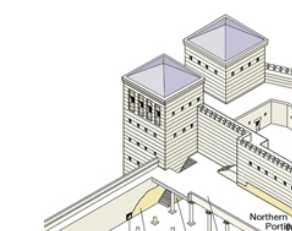
    steps from Antonia Fortress to roofs of Temple porticos

    Paul’s jewish nephew hears of the plot of these forty men, so the young man heads to the Roman fortress to try to warn Paul.

    Paulos —  the Roman citizen held in protective custody after the big hubbub of the jewish crowds —  instructs his guards to go to the man in charge.

    Paul called one of the centurions and said,

    “Take this young man to the tribune, for he has something to tell him.”

    Acts 23:17 ESV

    The tribune [Claudius Lysias] took him by the hand, and going aside asked him privately, “What is it that you have to tell me?”

    Note the gentleness of this tribune, Claudius Lysias - a man in charge of the centurions of Antonia Fortress as he seeks to get to the truth of the matter. 

    The young son of Paul’s sister responds:

    “The Jews have agreed to ask you to bring Paul down to the council tomorrow, as though they were going to inquire somewhat more closely about him.

    But do not be persuaded by them, for more than forty of their men are lying in ambush for him, who have bound themselves by an oath neither to eat nor drink till they have killed him. And now they are ready, waiting for your consent.”

    Acs 23:21b-22 ESV

    “Tell no one that you have informed me of these things.”


    An Imposed Authority of Roman Justice

    “Get ready two hundred soldiers, with seventy horsemen and two hundred spearmen to go as far as Caesarea at the third hour of the night.[9 pm]

    Caesarea! a model of Roman incursion into all the world of the Mediterranean - a key port for Romans, a city where Cornelius, Philip, Peter, Paul and others brought the gospel
    Caesarea – (Caesar’s Palace in Judea

    Also provide mounts for Paul to ride and bring him safely to Felix the governor.”

    This military escort of a Roman citizen Paulos is most unlike the handling of Jesus the king of the Jews sent to the Pontius Pilate, governor of that time, (who happened to be in Jeruslem rather than Caesarea). 

    Official Orders sent with Paul

    “Claudius Lysias,

    to his Excellency the governor Felix,

    greetings.

    This man was seized by the Jews and was about to be killed by them when I came upon them with the soldiers and rescued him, having learned that he was a Roman citizen. And desiring to know the charge for which they were accusing him, I brought him down to their council. And desiring to know the charge for which they were accusing him, I brought him down to their council. And when it was disclosed to me that there would be a plot against the man, I sent him to you at once, ordering his accusers also to state before you what they have against him.”

    Acts 23:26-30 ESV

    You might call this 'the official COURT record.' 

    Of course —  ALL follow orders and the next scene with, with Roman effeciency, take place in Caesarea.

    Marcus Antonius Felix

    Antonius Felix, served as the Roman procurator of Judea from ~AD 52-58. He was appointed by the Emperor Claudius and was known for his harsh and often corrupt administration. Felix was a freedman of Claudius' mother, Antonia. - source: BibleHub 

    When they had come to Caesarea and delivered the letter to the governor, they presented Paul also before him.

    The Governor inquires about jurisdiction – that is, in effect – Am I the appropriate judge of this case?

    And when he learned that he [Paulos] was from Cilicia, he said, “I will give you a hearing when your accusers arrive.” And he [Antonius Felix] commanded him [the Centurian in charge of Paul’s escort] to be guarded in Herod’s praetorium [there in Caesarea].

    Acts of the Apostles 23:35 ESV [with names of prepositions]

    Justice – a Case to be continued


    Talk of JESUS . com

    Comment on Scripture – Share the Gospel
  • Returning to seven servants in the Spirit

    Returning to seven servants in the Spirit

    Acts of the Apostles 21:

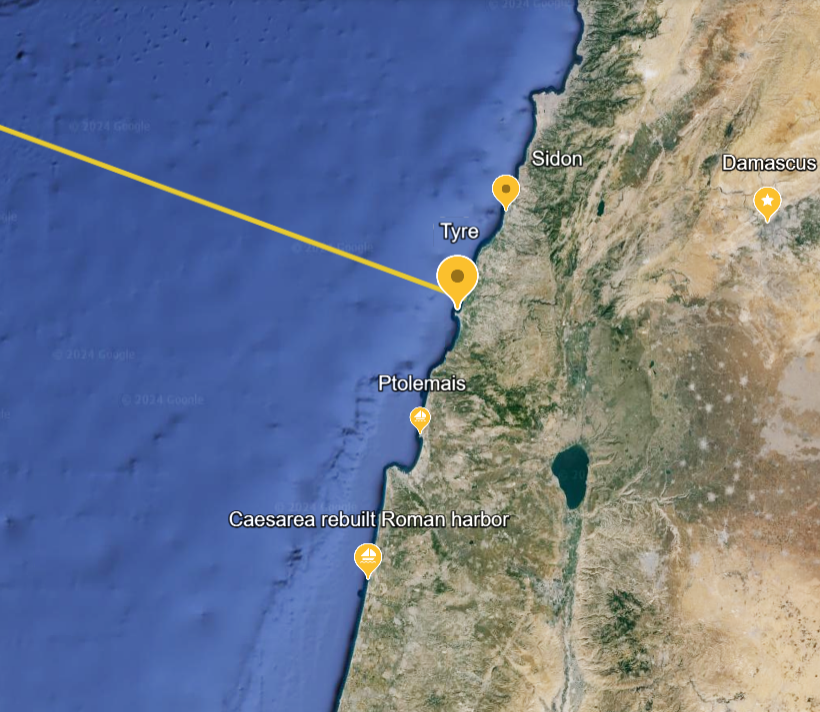
    7 We continued our voyage from Tyre and landed at Ptolemais, where we greeted the brothers and sisters and stayed with them for a day.

    8 Leaving the next day, we reached Caesarea and stayed at the house of Philip the evangelist, one of the Seven.

    Google earth view of eastern Mediterranean ports near Tyre

    Returning to the Church in order to serve

    Paul had first embarked on three missions TEN YEARS AGO from Antioch, with Jerusalem being little more than a stop on his way back to Syria along the roads of a distant mission skirting Galatia once more and bypassing Asia Minor to sail the Aegean to Macedonian and Greek cities.

    ~ AD 57

    His FIVE YEAR THIRD MISSION now complete, the Apostle to the Gentiles now returns to Jerusalem.

    Although the Lord Jesus Himself had taught in Tyre and Sidon (and also presumably the great Maccabean port of Ptolemais between them) Paul now lands in Caesarea, Herod’s great Hasmonaean port named for the Emperors they served.

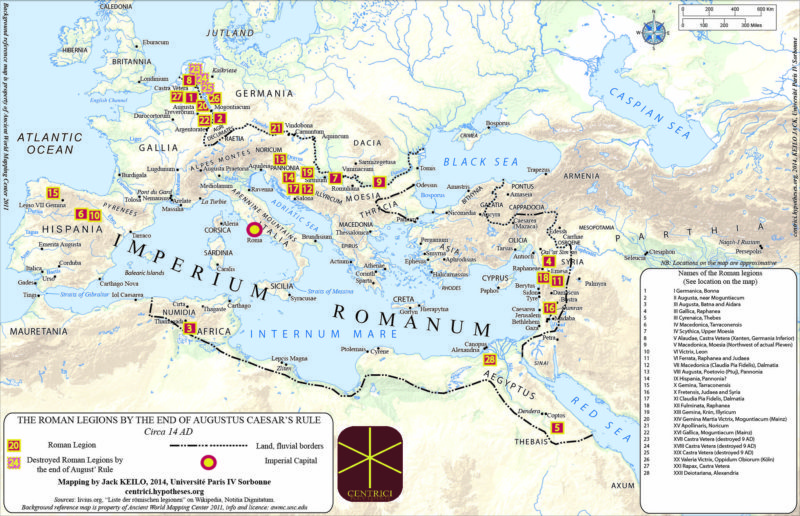
    map of Roman Empire - Augustus organization of Legions
    1st c. Roman Cities

    ROME ruled with a westward wave that had included all of the Aegean by the time its dual citizen, Saul of Tarsus, had preached the Gospel of Jesus Christ to much of Syria and Hellenist cities of a former Macedonian Empire.

    ~ A.D. 40 – a Judean history Before Christ

    NOTE: Earlier in ACTS of the APOSTLES 12 I may have slighted the historical significance of this coastal area in our transition between ACTS of the Apostle Peter and the ACTS and missions of the Apostle Paul.

    Now that Paul is returning home in the year of our Lord 57, let’s take a brief look at another map in the minds of Paul and historical context of Judeans born about the time of Christ Jesus.

    ~ AD 37

    Saul had encountered the risen Christ along a road to Damascus. At the same time the Apostle Peter had taken the Gospel to Samaria and even to the gentiles.

    And Saul [Paul], who had been received the the Apostles, then fled to Tarsus from Caesarea. – Acts 9:26-30

    Paul is returning to brothers and sisters in Christ in Caesarea all these years later.

    Dr. Luke, who knew a gentile history of his Aegean homeland, must have been taking Paul's account of these days as they sailed toward Judea and Jerusalem.

    Here is even more history familiar to the Judeans.

    a Strategic Coastline even Before Christ

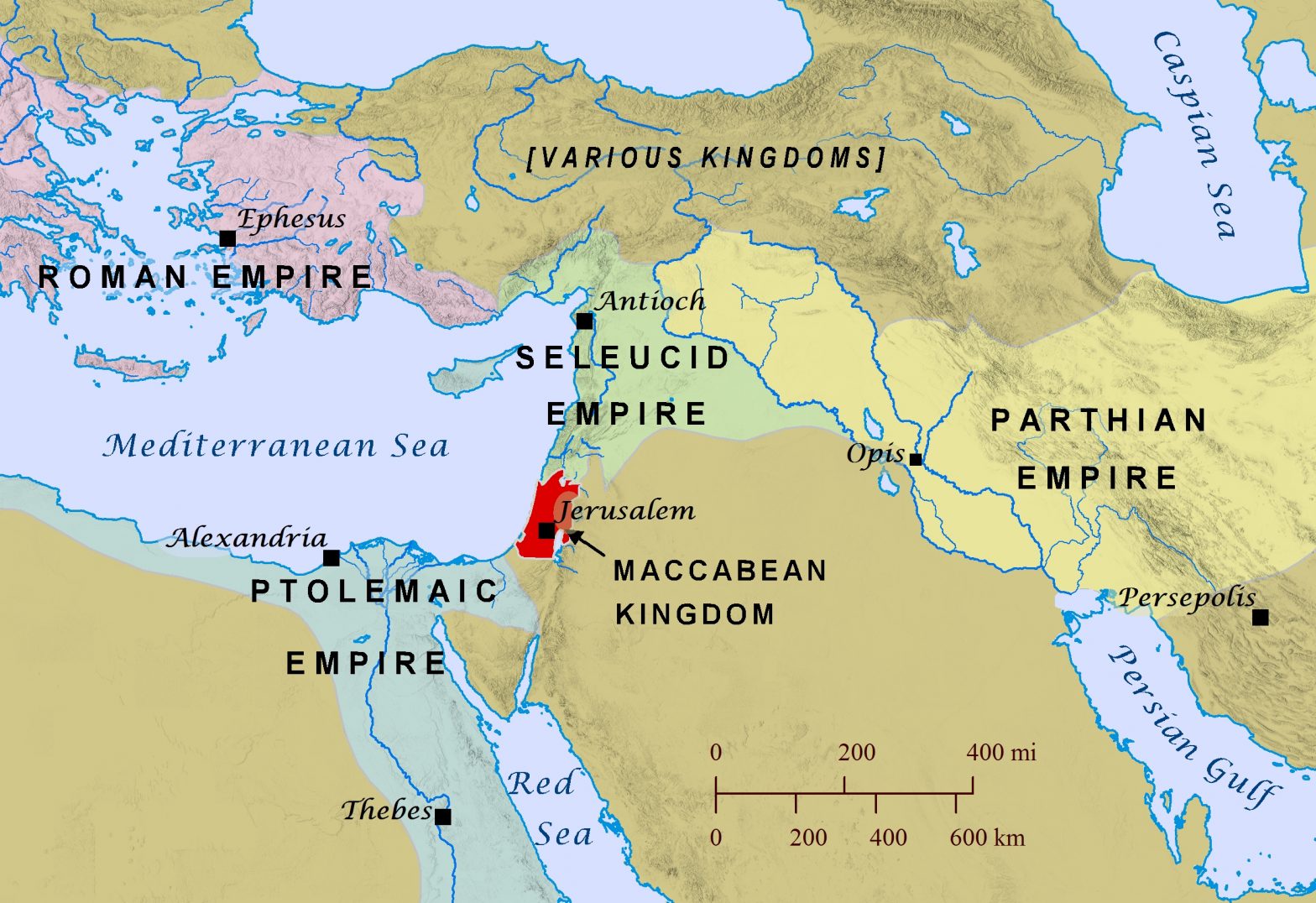
    The Romans eventually affirmed an alliance with the Maccabean leaders and encouraged other nations in the region to do the same.

    The map shown here displays this complex political world of the Near East around 90 B.C., shortly before the Romans absorbed the Seleucid Empire and the Maccabean Kingdom in 63 B.C.

    Source: Bible Mapper Atlas

    ~ 90 B.C.

    • After Alexander the Great died in 323 B.C., his empire was divided among his generals, including Ptolemy and Seleucus.
      • Seleucid Empire led Antiochus IV Epiphanes
    • open rebellion by faithful Jews under the leadership of Mattathias Maccabeus and his sons in 167 B.C.
    • The Romans eventually affirmed an alliance with the Maccabean leaders and encouraged other nations in the region to do the same. The map shown [above] displays this complex political world of the Near East ~90 B.C.,
    • the Romans absorbed the Seleucid Empire and the Maccabean Kingdom in 63 B.C.

    Antiochus IV Epiphanes sought to unify his diverse domain by forcing Greek religious and political practices upon all his subjects (1 Maccabees 1; 2 Maccabees 6-7) – source


    Division

    Before Christ, the GREAT Hellenist ALEXANDER had died in the BABYLON he conquered in a world to the EAST from where Judeans had earlier returned home to Jerusalem under Nehemiah.

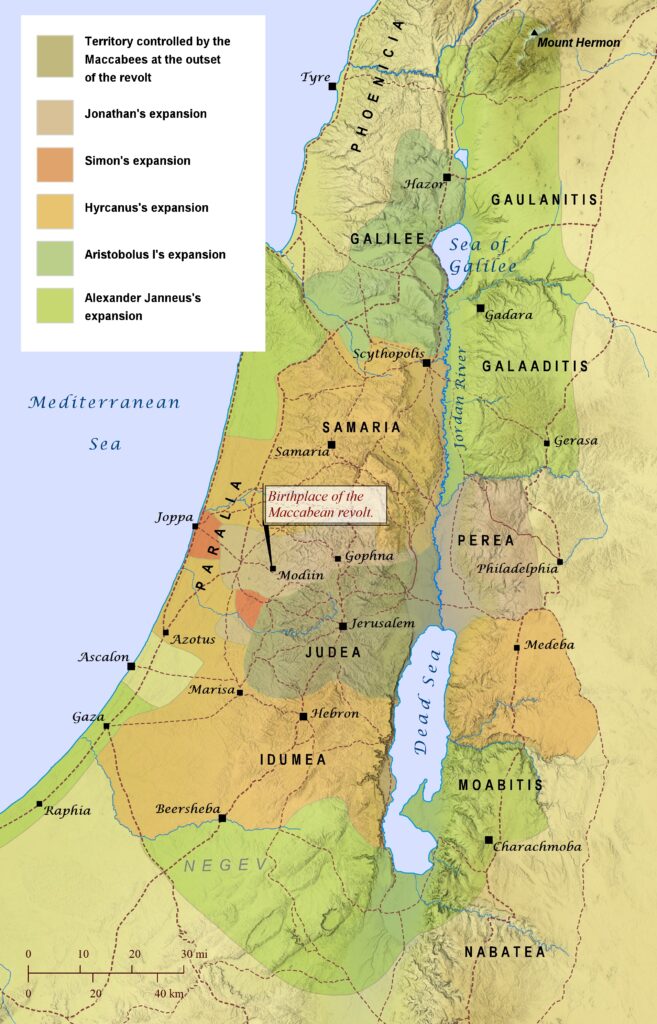
    Alexander’s thrice-divided Kingdom would eventually leave Jerusalem divided between Maccabean and Hellenist. The ruthless and GREAT builder King Herod also left legacy of a thrice-divided Kingdom to sons upon his death [~4 BC].

    The JUDEA (and Jerusalem) prominent in the times of JESUS and Paul does NOT include a separate Samaria (home of the Maccabean revolt) OR Galilee.

    Herod had not only named his great harbor and fortress CAESAREA (a clear concession to a Hellenist Rome) but had built a town and fortress to the north also named for the Hellenist father of Alexander, CAESAREA PHILLIPI.


    SAUL (Paulos) in Caesarea

    Arriving before Saul - Philip
    • Jerusalem:

    Now in those days, while the disciples were multiplying in number, there was grumbling from the Hellenists against the Hebrews, because their widows were being overlooked in the daily serving of food.

    Acts of the Apostles 6:1 LSB

    .. and they chose Stephen, a man full of faith and of the Holy Spirit, and Philip, Prochorus, Nicanor, Timon, Parmenas, and Nicolas, a proselyte from Antioch.


    Philip went down to the city of Samaria
    and began proclaiming the [Messiah] Christ to them.

    ACTS of the Apostles 8:5 NASB20
    This had been at about the same time Saul was persecuting the church.
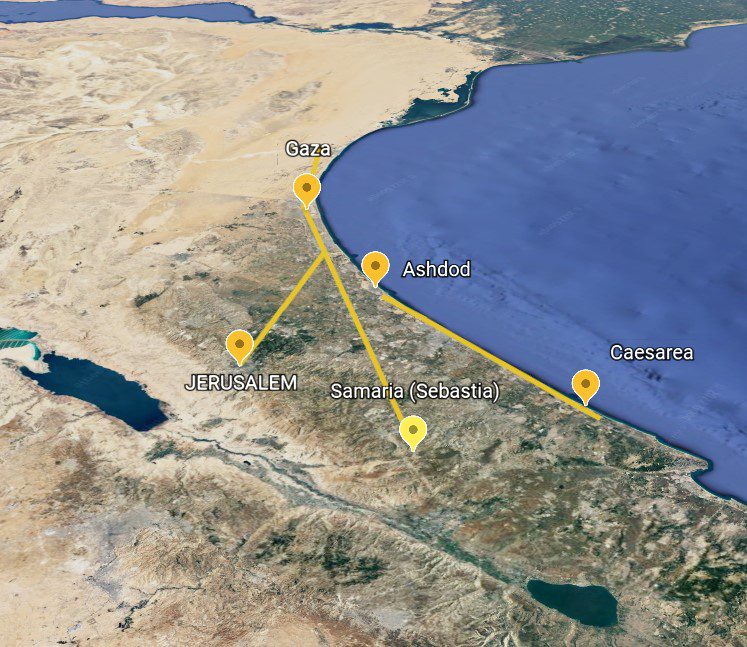
    Philip the Evangelist and deacon from Jerusalem had travelled to Gaza, then was miraculously taken up to take the Gospel north to Caesarea where he would reside.

    But Philip found himself at Azotus, and as he passed through he kept preaching the gospel to all the cities, until he came to Caesarea.

    Acts 8:40 NASB

    PAUL Returning 20 years later to Philip in Caesarea

    we reached Caesarea and stayed at the house of Philip the evangelist, one of the Seven.

    9 He had four unmarried daughters who prophesied.

    10 After we had been there a number of days, a prophet named Agabus came down from Judea. 


    ACTS of the Apostles 21 – Paul’s return from his third missionary journey – To be continued…

    Comment on Scripture – Share the Gospel

  • The Holy Ghost! Fear of GOD also ignites the Gentiles

    The Holy Ghost! Fear of GOD also ignites the Gentiles

    Can any man forbid water, that these should not be baptized, which have received the Holy Ghost as well as we?

    Acts of the Apostles 10:47 KJV

    The Question of those ‘chosen’

    Fact is that many religious men do NOT fear God.

    It is true of many ‘christians‘ in this 21st century — it was true of all but a remnant of faithful ‘jews in the first century in which the messiah Jesus lived, died and was risen — and it was true when His Apostles and disciples preached in the Spirit of God. Men and women do not naturally fear what we have been told about the LORD if we have not encountered Him personally.

    But the Comforter, which is the Holy Ghost, whom the Father will send in my name, he shall teach you all things, and bring all things to your remembrance, whatsoever I have said unto you.

    Gospel of John 14:26 KJV

    They certainly did not know what to expect when the Holy Ghost first came to various jewish disciples of Jesus.

    And, being assembled together with them, commanded them that they should not depart from Jerusalem, but wait for the promise of the Father, which, saith he, ye have heard of me.

    Acts of the Apostles 1:4 KJV

    Peter, John and the Apostles have proclaimed Christ boldly, first in Jerusalem.

    By the power of the Holy Ghost (KJV) many signs have accompanied the receiving of the Spirit among the faithful jewish followers of The Way of Jesus. Even Saul of Tarsus, zealous persecutor of The Way, has encountered the risen Lord Jesus personally and then retreated to Arabia to reconsider what the LORD has in store for him, returning to meet Peter some three years later.

    Everything seems to be looking up for these remnant ‘chosen‘ followers of Jesus as they now obediently ‘GO INTO THE WORLD TO PROCLAIM THE GOOD NEWS!’

    Beyond Jerusalem

    The Apostles had encountered some internal ‘church‘ problems with their new disciples in Jerusalem.

    And in those days when the number of the disciples was multiplied, there arose a murmuring of the Grecians against the Hebrews, because their widows were neglected in the daily ministration.

    Acts of the Apostles 6:1 KJ21

    However this ministry problem seemed to resolve quickly in spite of jewish cultural differences between Greeks and Hebrew traditions of those whose fathers had returned to Jerusalem from exile to rebuild the temple. Furthermore, at least two of new disciples became powerful preachers of the truth of the Gospel – Stephen and Philip.

    And the Word of God increased; and the number of the disciples multiplied in Jerusalem greatly, and a great company of the priests were obedient to the faith.

    Acts of the Apostles 6:7

    Like Gentiles (sort of)

    Samaria (to some jews) and also Galilee, as part of Israel separated from Judah long ago, had anunjewish‘ stigma to some religious Judeans.

    Philip the evangelist flees Jerusalem to Samaria, but then receives a command to go to Gaza, where he baptized an Ethiopian, is taken up from there to Ashdod and preaches along the coast in towns leading to Ceasarea

    Cities visited by Philip the evangelist

    Philip went down to the city of Samaria and began proclaiming the Christ to them. The crowds were paying attention with one mind to what was being said by Philip, as they heard and saw the signs which he was performing. 7 For in the case of many who had unclean spirits, they were coming out of them shouting with a loud voice.. – Acts 8:5-6a NASB

    Note this same sign of expelling UNCLEAN SPIRITS which Jesus had done! (Most 21st centuries don't quite grasp what to make of this, but think 'controlling ghosts' as real evil influences of behavior and you are on the right track. - RH

    [KJ21] 9 But there was a certain man called Simon, who earlier in the same city had used sorcery and bewitched the people of Samaria, claiming that he was someone great..

    When Peter and John came to Samaria, Simon asked Peter for this same power the Apostles and some disciples like Philip had demonstrated. 
    
    The Holy Ghost appears with more POWER than any force of darkness dictating the power of evil in mortal flesh.

    But Peter said unto him, Thy money perish with thee, because thou hast thought that the gift of God may be purchased with money.

    Acts of the Apostles 8:20 KJV – Peter’s response to Simon the Sorcerer

    THEN Philip goes much further than this: He baptizes an Ethiopian (in Gaza) – a gentile!

    Luke (our gentile physician) records in ACTS:

    But Philip found himself at Azotus, and as he passed through he kept preaching the gospel to all the cities, until he came to Caesarea.

    Acts 8:40 NASB

    Philip (the Hellenist deacon) & Peter (a Galilean Hebrew Apostle)

    So WHERE in the WORLD does all of this converge?

    Peter had come from Jerusalem to Samaria to meet with Philip when he also met Simon who wanted the power of the Holy Ghost. We have just learned that now Peter’s missionary journeys have brought the Apostle to Joppa, BUT a Roman calls the Apostle to come to the Roman (Herod-built) port of Caesarea.

    Peter and John had remained in Jerusalem for two years after Christ’s resurrection. Once Stephen was martyred most disciples of Jesus fled for other towns. But after Saul met the Lord on the road to Damascus the Gospel began to spread in different directions.

    And as we have just learned in the journeys of Peter to Lydda and Joppa, the Apostle now heads north to Caesarea where Philip has been proclaiming the Gospel for sometime now.

    Peter, the Hebrew-raised rock anointed by Jesus to lead His church goes to Caesarea after wrestling with the Voice of God telling this faithful jew to obey this new vision which led him to follow these Romans back to Caesarea, where these GENTILES would have worshiped PETER!

    Now that you have caught up on these long journeys and Peter is on his way back to Jerusalem you might think that all will go smoothly. It doesn’t.

    The HOLY Ghost

    Before we return to Jerusalem with Peter, I thought it important that we consider the NOW-INCREASING ROLE of THE HOLY SPIRIT.
    The "HOLY SPIRIT" AND the "HOLY GHOST" ARE the SAME, translated in New Testament from the SAME words in Greek: ἅγιος πνεῦμα [hagios pneuma]
    • HOLY – ἅγιος hágios, hag’-ee-os; from ἅγος hágos (an awful thing) (compare G53, G2282); sacred (physically, pure, morally blameless or religious, ceremonially, consecrated):—(most) holy (one, thing), saint.
      • I remind 21st c. christians of the AWESOMENESS of the SPIRIT of Almighty God by referring to the Holy Ghost here) – RH

    ἅγιος, -α, -ον, (from τὸ ἄγος religious awe, reverence; ἄζω, ἅζομαι, to venerate, revere, especially the gods, parents [Curtius, § 118]), rare in secular authors; very frequent in the sacred writings; in the Sept. for קָדושׁ;

    1. properly reverend, worthy of veneration: τὸ ὄνομα τοῦ θεοῦ, Luke 1:49; God, on account of his incomparable majesty, Revelation 4:8 (Isaiah 6:3, etc.), equivalent to ἔνδοξος.
    • Ghost πνεῦμα pneuma From πνέω (G4154)
      • – The KJV translates Strong’s G4151 in the following manner: Spirit (111x), Holy Ghost (89x), Spirit (of God) (13x), Spirit (of the Lord) (5x), (My) Spirit (3x), Spirit (of truth) (3x), Spirit (of Christ) (2x), human (spirit) (49x), (evil) spirit (47x), spirit (general) (26x), spirit (8x), (Jesus’ own) spirit (6x), (Jesus’ own) ghost (2x), miscellaneous (21x).
      • the third person of the triune God, the Holy Spirit, coequal, coeternal with the Father and the Son

    ACTS of the Holy Ghost

    ACTS: KJV – πνεῦμα pneuma

    • 1:2 Until the day in which he was taken up, after that he through the Holy Ghost G4151 had given commandments unto the apostles whom he had chosen:
    • 1:5 For John truly baptized with water; but ye shall be baptized with the Holy Ghost G4151 not many days hence.
    • 2:4 And they were all filled with the Holy Ghost, G4151 and began to speak with other tongues, as the Spirit G4151 gave them utterance.
    • 2:18 And on my servants and on my handmaidens I will pour out in those days of my Spirit; G4151 and they shall prophesy:
    • 4:18 And when they had prayed, the place was shaken where they were assembled together; and they were all filled with the Holy Ghost, G4151 and they spake the word of God with boldness.
    • 8:17 Then laid they their hands on them, and they received the Holy Ghost. G4151
    • 8:39 And when they were come up out of the water, the Spirit G4151 of the Lord caught away Philip, that the eunuch saw him no more: and he went on his way rejoicing.

    ACTS 10:

    You know of Jesus of Nazareth, how God anointed Him with the Holy Spirit and with power, and how He went about doing good and healing all who were oppressed by the devil, for God was with Him. We are witnesses of all the things that He did both in the country of the Jews and in Jerusalem.

    Acts of the Apostles 8:38-39a NASB

    38 how God anointed Jesus of Nazareth with the Holy Ghost and with power,

    Acts 10:38 KJ21

    43 To Him all the prophets bear witness, that through His name whosoever believeth in Him shall receive remission of sins.”

    44 While Peter was yet speaking these words, the Holy Ghost fell on all those who heard the Word.

    And the Messianic Jews who had come with Kefa were mishpoyel (standing in awe) that also upon the Goyim the matnat HaRuach Hakodesh has been poured out.

    Gevurot 10:45

    Orthodox Jewish Bible

    46 For they heard them speak with tongues and magnify God.

    Peter Baptizes the Roman Gentiles

    Then answered Peter,

    47 “Can any man forbid water, that these should not be baptized who have received the Holy Ghost, as well as we?”

    48 And he commanded them to be baptized in the name of the Lord.

    Then they entreated him to tarry certain days.

    Gevurot 11 – Orthodox Jewish Bible

    And the Moshiach’s Shlichim and the Achim b’Moshiach, the ones throughout Yehudah, heard that also the non-Jews received the dvar Hashem. But when Kefa went up to Yerushalayim, those of the faction of the Bris Milah were taking issue with him, 3 Saying, “You entered into a bais of anashim arelim (uncircumcised men) and you sat at tish with them.”


    Acts of Peter welcoming the Gentiles - To be continued...