Tag: Church

  • The Pervasiveness of Sin

    The Pervasiveness of Sin

    If you perceive the pervasiveness of sin,

    you will pour forth great gratitude for God’s grace

    and the cross of Christ.

    Revelation 18:  For your merchants were the greatest in the world,
    and you deceived the nations with your sorceries.
    24 In your streets flowed the blood of the prophets and of God’s holy people
    and the blood of people slaughtered all over the world.”

    … all the nations were deceived by your sorcery.

    So warns Christ’s Revelation to John of Babylon, a home for demons – the habitation of devils, and the hold of every foul spirit. Even Ezekiel had warned Jerusalem of these same evils (perhaps appropriate warning to a 21st c. church).

    3 For all nations have drunk of the wine of the wrath of her fornication, and the kings of the earth have committed fornication with her, and the merchants of the earth are waxed rich through the abundance of her delicacies.

    Disclaimer & Caution

    Researching the Revelation of Jesus Christ to John reconfirms a need for a note of caution to the reader.

    MUCH false teaching, speculative interpretation and agenda-driven preaching will easily mislead and confuse most believers, except believers well-versed scripturally in apologetics. Perhaps one of the greatest dangers is to accept an interpretation of just one man on the many important symbols John presents in Revelation – especially in the following chapters.

    The following is a continuation in my series on Revelation, begun with the Letters to the Seven Churches and now continuing from much later in John’s apocalypse in Chapter 17.

    May I suggest that you take my interpretation of scripture (or anyone’s interpretation) under consideration of:

    • the Holy Spirit
    • Scripture (including, possibly root meanings of the Greek or Hebrew)
    • prayerful consideration of application to your life and those in your life

    Roger Harned

    Central

    to the Judgment of Christ Jesus

    in the Apocalypse of John.

    Revelation is misunderstood and much misrepresented. Will the deception of these last days not increase with the pervasiveness of sin?

    BABYLON, the Harlot Queen,

    sits upon the scarlet beast –

    Revelation 17:5 And upon her forehead was a name written, Mystery, Babylon The Great, The Mother Of Harlots And Abominations Of The Earth.

    SIN is pervasive!

    Revelation begins with warning to the churches. Should the churches of these last days not heed the warnings of a time so near?

    The Apostle John describes Heavenly visions (none of which I will describe today):

    • The Scroll and Seven Seals (ch. 4-7)
    • Seven Angels with Seven Trumpets (ch. 8-11)
    • Seven Symbolic Histories (ch. 12-14)
    • Seven Bowls of God’s Wrath (ch. 15-16)

    All of this leads up to the drama of punishment, with its great symbolism. All of Revelation leads to a drama:

    CENTERED ON EVIL vs. GOOD

    SATAN vs. CHRIST JESUS.

    Though the FINAL BATTLE does not take place until Revelation 19, the familiar opponents of God confront the believer and unbeliever alike with the great symbolism of Revelation 17 and 18. What Jesus reveals is what our Lord has always revealed to those with ears to hear.

    Matthew 24

    dome and wall

    English Standard Version (ESV)

    Jesus Foretells Destruction of the Temple


    Signs of the End of the Age

    3 As he sat on the Mount of Olives, the disciples came to him privately, saying, “Tell us, when will these things be, and what will be the sign of your coming and of the end of the age?”

    4 And Jesus answered them, “See that no one leads you astray. 5 For many will come in my name, saying, ‘I am the Christ,’ and they will lead many astray.

    6 And you will hear of wars and rumors of wars. See that you are not alarmed, for this must take place, but the end is not yet. 7 For nation will rise against nation, and kingdom against kingdom, and there will be famines and earthquakes in various places.8 All these are but the beginning of the birth pains.

    9 “Then they will deliver you up to tribulation and put you to death, and you will be hated by all nations for my name’s sake. 10 And then many will fall away and betray one another and hate one another.

    egypt-violence-eu11 And many false prophets will arise and lead many astray. 12 And because lawlessness will be increased, the love of many will grow cold. 13 But the one who endures to the end will be saved.

    14 And this gospel of the kingdom will be proclaimed throughout the whole world as a testimony to all nations, and then the end will come…

    wolf23 Then if anyone says to you, ‘Look, here is the Christ!’ or ‘There he is!’ do not believe it.

    24 For false christs and false prophets will arise and perform great signs and wonders, so as to lead astray, if possible, even the elect.

    25 See, I have told you beforehand. 26 So, if they say to you, ‘Look, he is in the wilderness,’ do not go out. If they say, ‘Look, he is in the inner rooms,’ do not believe it. 27 For as the lightning comes from the east and shines as far as the west, so will be the coming of the Son of Man.

    Do NOT be deceived:

    1 Corinthians 6:9 Or do you not know that the unrighteous will not inherit the kingdom of God? Do not be deceived: neither the sexually immoral, nor idolaters, nor adulterers, nor men who practice homosexuality {note: The two Greek terms translated by this phrase refer to the passive and active partners in consensual homosexual acts.}

    2 Timothy 2:12-13 Indeed, all who desire to live a godly life in Christ Jesus will be persecuted, while evil people and impostors will go on from bad to worse, deceiving and being deceived.

    1 John 2:26 I write these things to you about those who are trying to deceive you.

    Do you with ears to hear understand how the world is being deceived?

    Do you sip from the cup of the Harlot?

    Hear and understand the wine of her cup.

    … all the nations were deceived by her ‘pharmakeia’ sorcery.

    Heed the warning of the punishment for those who partake of the sorcery of the Harlot:

    Revelation 21:8 But the fearful, and unbelieving, and the abominable, and murderers, and whoremongers, and sorcerers, G5332 and idolaters, and all liars, shall have their part in the lake which burneth with fire and brimstone: which is the second death.

    Let us continue to proclaim Christ crucified; for He IS and He will return in victory over Satan, the Harlot, and all the armies of evil which surround the believer every day.

    We have Great Grace in Christ Jesus and His Blood of the Cross, where by His death and resurrection we are victorious over sin and death.

    Christ Jesus our Lord has defeated the enemy. These last days will end and the faithful will be most thankful for the grace of the Cross.


  • How Should Christians Respond to Grief? – 2

    How Should Christians Respond to Grief? – 2

    In my previous post on grief, I ended with a series of questions about how Christians generally respond. I did not get many responses so I would like to briefly answer my own questions in hopes that it provides some insight for those who may not have much experience dealing with grief.

    1. Let’s look for a moment at the case of Job and how his friends reacted to his tragedy:

      When three of Job’s friends heard of the tragedy he had suffered, they got together and traveled from their homes to comfort and console him…Wailing loudly, they tore their robes and threw dust into the air over their heads to show their grief.  Then they sat on the ground with him for seven days and nights. No one said a word to Job, for they saw that his suffering was too great for words. (Job 2:11-13 excerpts)

      We often give Job’s friends a hard time for their words in later chapters but before they “spoke inaccurately” about God, they sat with Job for 7 days without a word and mourned with him. One of the biggest lessons I learned in school and in my internship was the power of presence. It is often more powerful than any words could ever be.

    2. This will probably go against the instinct of most people but your first comment should NOT attempt to be one of comfort, it should be one of support. When you are dealing with someone who has just recently lost a loved one or gotten a divorce or gone through any kind of struggle, they do not want to hear “it’s ok” because to them, it’s not ok. They often need to hear FIRST that their situation is difficult and they have a right to be sad.
    3. The next thing they need to know is that they’re not alone. They need to HEAR it but it is even better if there is a tangible way to SHOW it. At the church I attended when I was in college, there was an entire committee just for providing food for people who had a sickness or death in the family and another committee for sending cards to members of the church for all occasions, happy and sad. In that small town Baptist church, people always know they are cared for and are not alone but, in a lot of churches, that kind of awareness of individual situations is not there. When you know someone is having a rough time, can you offer to get them groceries or make a meal for them? Maybe you can offer to babysit their kids so they can have alone time. Even something as simple as giving them a non-judgmental listening ear has incredible value. There are many ways, verbal and practical, to help show people that they do not have to go through a difficult situation without support from other believers.
    4. Now, we can remind them of the HOPE we have in Jesus. BUT, be careful how you word that. Don’t discount the fact that what they are going through is difficult but you can tell them that there is a light at the end of the tunnel, even when they can’t see it. Remind them that God blesses those who mourn and that He does promise eternal life for whoever believes in Him but just remember as you tell them that this life is still painful and it’s ok for them to mourn that.
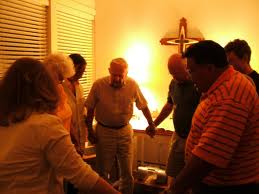
    5. Finally, don’t just pray FOR them, pray WITH them. I am convinced that when tragedy strikes, people either draw closer to God or they push Him away but they never stay in the same place. You could be that influence that pushes them towards God instead of away from Him. I am much less likely to pray when I am in my “Life isn’t fair” mindset so having someone else pray with me is a good way to re-focus on God’s character and his presence in that moment.
  • In God We Trusted – 2

    In God We Trusted – 2

    DavidKingdom

    Disclaimer & claim:

    WE the PEOPLE of the LORD trust God.

    Nations rise and nations will fall.  The Prophet Jeremiah had warned Judah of their impending fall.

    Lamentations is the record of their fall from the grace and mercy of God.

    Lamentations is indictment of rulers who do not hear the cries of their people or acknowledge the leadership of God.

    HOW? did our nation fall?

    c. 1007 Before Christ – a prophesy of David

    map_captivity_of_judah_babylon_shg

    David’s Lament for Saul and Jonathan

    17 And David lamented with this lamentation over Saul and Jonathan his son, 18 and he said it should be taught to the people of Judah; behold, it is written in the Book of Jashar. He said:

    19 “Your glory, O Israel, is slain on your high places!
    How the mighty have fallen!

    Historical Context

    historyofisrael1304984143189 (1)

    THE KINGS

    Jeremiah’s prophetic career spanned the reigns of five kings: Josiah, Jehoahaz, Jehoiakim, Jehoaichin, and Zedekiah. Like the structure of the book, the line of kings speaks of the chaos and growing confusion of the times as four of the five kings had short reigns.

    • Josiah reigned for 31 years, but died at the young age of 39.
    • Jehoahaz reigned for 3 months before the King of Egypt captured him.

    2 Chronicles 36:3 The king of Egypt prevented him from ruling in Jerusalem and imposed on the land a special tax of one hundred talents of silver and a talent of gold.

    • Jehoiakim reigned for 11 years before he died at the age of 36. Early in his reign, Nebuchadnezzar took captive many in the court (Daniel 1:1).

    2 Kings 24:1 During Jehoiakim’s reign, King Nebuchadnezzar of Babylon attacked. Jehoiakim was his subject for three years, but then he rebelled against him. 2 The Lord sent against him Babylonian, Syrian, Moabite, and Ammonite raiding bands; he sent them to destroy Judah, as he had warned he would do through his servants the prophets.

    • Jehoiachin, the son of Jehoiakim, reigned for 3 months before he was captured by Nebuchadnezzar. He and some 10,000 others were transported to Babylon. These were mostly craftsmen and smiths (2 Kings 24:16).
    • Zedekiah, the brother of Jehoahaz and Jehoiakim, then reigned for 11 years. His reign ended with the capture and destruction of Jerusalem (2 Kings 25:6).

    Since Jeremiah’s career began in the 13th year of Josiah’s reign and continued for an unspecified period beyond the fall of Jerusalem, we can infer a career lasting for more than 40 years (for the Prophet Jeremiah, who writes Lamentations after the fall of Jerusalem).

    Lamentations 2

    English Standard Version (ESV)

    The Lord Has Destroyed Without Pity

    2 How the Lord in his anger
    has set the daughter of Zion under a cloud!
    He has cast down from heaven to earth
    the splendor of Israel;
    he has not remembered his footstool
    in the day of his anger.

    2 The Lord has swallowed up without mercy
    all the habitations of Jacob;
    in his wrath he has broken down
    the strongholds of the daughter of Judah;
    he has brought down to the ground in dishonor
    the kingdom and its rulers.

    3 He has cut down in fierce anger
    all the might of Israel;
    he has withdrawn from them his right hand
    in the face of the enemy;
    he has burned like a flaming fire in Jacob,
    consuming all around.

    4 He has bent his bow like an enemy,
    with his right hand set like a foe;
    and he has killed all who were delightful in our eyes
    in the tent of the daughter of Zion;
    he has poured out his fury like fire.

    As Jeremiah had warned Judah before their destruction, a man whose importance is now hidden away from the truths before America’s former trust warned a new nation.

    jonathan edwards and posterJONATHAN EDWARDS was born into a Puritan evangelical household on October 5, 1703, in East Windsor, Connecticut.

    1716-1722) at Yale College, Edwards engaged all manner of contemporary issues in theology and philosophy.

    Edwards committed himself to vindicating his beliefs before the foreign luminaries of the Enlightenment by recasting Calvinism in a new and vital way that synthesized Protestant theology with Newton’s physics, Locke’s psychology, the third earl of Shaftesbury’s aesthetics, and Malebranche’s moral philosophy.

    In 1726, Edwards succeeded his grandfather, Solomon Stoddard, as the pastor of the church in Northampton, Massachusetts, the largest and most influential church outside of Boston.

    “The first and greatest homegrown American philosopher”

    Perry Miller, the grand expositor of the New England mind and founder of the Yale edition of the Works of Jonathan Edwards, described Edwards as the first and greatest homegrown American philosopher.

    Edwards cast theology into “a method entirely new” by showing God’s work as a history structured around God’s scriptural promises and periods of the outpouring of the Spirit. An Humble Attempt to Promote . . .Extraordinary Prayer(1747) was part of a larger movement towards Anglo-American “concerts of prayer” and was an important contribution to millennial thought. Scholars such as Alan Heimert have recognized the signal importance of these works in American history, particularly their contribution to revolutionary ideology.

    A Careful and Strict Inquiry into the Modern Prevailing Notions of that Freedom of Will…”(1754), in which he attempted to prove that the will was determined by the inclination of either sin or grace in the soul. This book, one of the most important works in modern western thought, set the parameters for philosophical debate on freedom and determinism for the next century and a half.

    In late 1757, he accepted the presidency of the College of New Jersey (later Princeton University). While at Princeton, Edwards hoped to complete at least two more major treatises, one that would show “The Harmony of the Old and New Testaments” and the other that would be an experiment in narrative theology, a much expanded treatise on “The History of the Work of Redemption.” However, he did not live to complete these works. After only a few months in Princeton, he died on March 22, 1758, following complications from a smallpox inoculation. He is buried in the Princeton Cemetery.

    John Adams:“What do we mean by the American Revolution? Do we mean the American War? The Revolution was effected before the War commenced. The Revolution was in the hearts and minds of the people; a change in their religious sentiments . . . This radical change in the principles, opinions, sentiments, and affections of the people was the real American Revolution.”

    excerpts from: Jonathan Edwards: A Life by George M. Marsden – review by Dr.  Samuel T. Logan, Jr.

    Edwards wrote and ministered during this “real” American revolution and his theological insights cut right to the quick of the values which define the nation we now call America. In his brilliant analysis of The Ideological Origins of the American Revolution (which volume won both the Pulitzer Prize and the Bancroft Prize for American History)

    To the degree that America, to this day, understands itself as “the land of the free” and to the degree that the highest of all American values and virtues (including some spiritual values and virtues) are defined in terms of freedom and liberty, to that very degree is Edwards’s Freedom of the Will, the most fundamental analysis of American culture. And to the degree that America seeks to export its values to the nations of the earth, to that very degree is Edwards’s The Nature of True Virtue, the most significant biblical critique of current global political and social issues.

    As for our founding fathers, in God they trusted.

    Returning to Jeremiah’s lament for Judahjeremiah-21st c

    17 The Lord has done what he purposed;
    he has carried out his word,
    which he commanded long ago;
    he has thrown down without pity;
    he has made the enemy rejoice over you
    and exalted the might of your foes.

    19 “Arise, cry out in the night,
    at the beginning of the night watches!
    Pour out your heart like water
    before the presence of the Lord!
    Lift your hands to him
    for the lives of your children,
    who faint for hunger
    at the head of every street.”

    Jeremiah/Contemporary timeline source:

    22 You summoned as if to a festival day
    my terrors on every side,
    and on the day of the anger of the Lord
    no one escaped or survived;
    those whom I held and raised
    my enemy destroyed.