Tag: culture

  • 3 Letters from the Apostle John

    3 Letters from the Apostle John

    The world cannot think of John without a picture of a young man next to JESUS who wrote,“God so loved the world…”

    For God so loved the world, that he gave his only begotten Son, that whosoever believeth in him should not perish, but have everlasting life. JOHN 3:16 green man
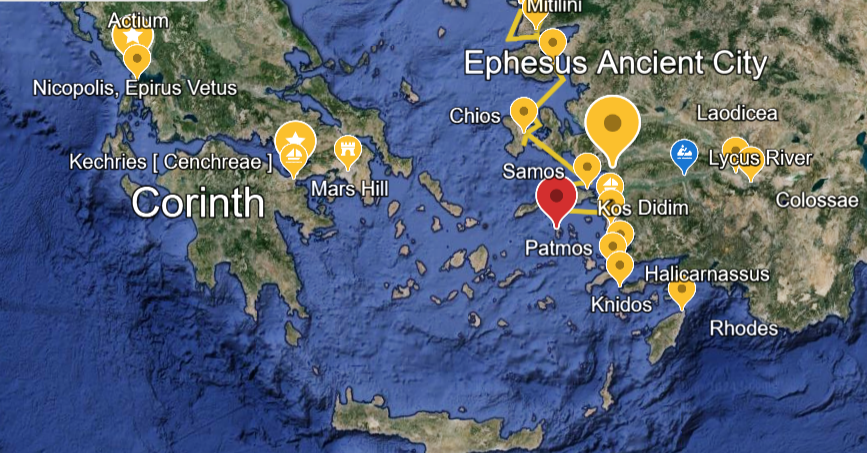
    John to the seven churches which are in Asia: map with cities pictured and the island of Patmos

    Or Christians perhaps recall the Revelation of Jesus Christ to John on Patmos with little consideration of his age or the path of the Apostle leading him to this isolated Greek island.

    Three intimate letters to believers

    The A.D. 90's - the END of an era 
    — JOHN's Apostolic love and truth for fidelity in the faith.

    The Elder John writes three letters — along with Jude, the LAST EPISTLES of the New Testament.

    Although our focus will be 2 John and 3 John, I will include 1 John in this overview written about the same time.

    In order to set the cultural stage of the Church enduring beyond the end of the A.D. first century, consider that the Elder writes his 3 Epistles some sixty years after the death, resurrection and ascension of Jesus Christ.


    map of Ephesus near the churches where John was an Elder "an epistle from John - Elder to the Churches 1 John 2 john 3 John

    Introduction to an Era not unlike our own:

    INTRO – MACARTHUR NEW TESTAMENT COMMENTARY 1-3 JOHN

    quoting Donald W Burdick

    Apart from the Judaeo-Christian sphere, the world was religiously inclusivistic. There was always room for a new religion, provided of course that it was not of an exclusive nature. Syncretism[‘s].. characteristic expression was in the combination of various ideas and beliefs from different sources to form new or aberrant religions. This was the age of of the developing mystery religions, the age of the occult, ane age of the proliferation of Gnostic sects.

    MACARTHUR Commentary 1-3 John, p.1

    Recall from Acts how the young Apostle Jesus loved also preached the Gospel of our risen Lord boldly along with Simon Peter in the Temple. But that was about sixty years ago .


    In the year of our Lord 90

    (approximately)

    Keep in mind that ALL dates used for comparison to various 1st c. events are approximate, but reveal a chronology of John's life.
    • John’s own Gospel account of the events of JESUS’s incarnate life had already been written and distributed to the churches some five to ten years ago.
    • Mark, Matthew and Luke had written and sent out their Gospel’s some thirty years before, back in the 50’s and 60’s.
    • Several missionary journeys of the Paul (begun in A.D. 47) along with many others had concluded prior to the Apostle’s death along with Peter in Rome [~ A.D. 66] also some twenty to thirty years before these final epistles of John.
      • Paul had founded this church in Ephesus where John now serves as an Elder.
      • Paul had written to it as well some forty years before, back in the early A.D. 60’s.

    Rome had political problems of its own.

    In addition to putting down a Jewish revolt in Jerusalem [A.D. 66] and destroying the Temple [A.D. 70], the Caesar’s frequently blamed and banished Christians for their political problems in Rome and other cities of the Empire.

    terrors of death of Jerusalem's defenders and destruction temple by Rome in A.D. 70

    An Apostolic Dogma of John

    The 21st c. Common Era church speaks so little of dogma that I must define it. 

    Dogma – 1. A doctrine or a corpus of doctrines relating to matters such as morality and faith, set forth in an authoritative manner by a religion.

    The American Heritage® Dictionary of the English Language


    This is what I refer to as Apostolic Faith, which includes all Apostolic authority continuing through Scripture to this day.

    Referring to the "we" statements of 1 John, the author speaks on behalf of the Twelve." 

    John Stott observes:

    He does not hesitate to call certain classes of people liars, deceivers or antichrists. .. they either have God or have not, know God or do not, have live or abide in death, walk in darkness or in the light, are children of God or children of the devil.

    This dogmatic authority of the writer is seen particularly in his statements and in his commands.

    John Stott commentary, quoted by MacArthur, p.4


    a culture combining aberrant and mystery religions

    Stick with me on some abridged definitions for your understanding of the A.D. 1st century, (again, not so unlike our 21st century of the Common Era).
    • syncretism
      • .. fusion of differing systems of belief, as in philosophy or religion, ..the result is heterogeneous – AHD
    • aberrant
      • 3. straying from the right way – AHD
    • mystery religions – (What typifies them?)
      • any of various secret cults of the Greco-Roman world that offered to individuals religious experiences not provided by the official public religions.
      • .. initiation in Greece became a matter of personal choice.
      • The mystery religions reached their peak of popularity in the first three centuries a.d. Their origin, however, goes back to the earlier centuries of Greek history.
        • Source: Britannica

    The DANGER of gnostics!

    For those of you who really don’t know much about false religions, before we begin John’s three strongly-worded epistles, I need to define this great threat to the Church — gnosticism.

    of a person (25 terms) gnostic 1607–
    Historical. (With capital initial.) Chiefly plural.

    The designation given to certain heretical sects among the early Christians who claimed to…

    source: OED

    Until fairly recently the term was generally applied collectively to the majority of those 2nd cent. movements which called themselves Christian or borrows heavily from Christian sources, but which were rejected by the main stream of Christian tradition.

    more..

    .. Gnostic systems which make testing intellectual demands, others which depend on mumbo-jumbo and sleight of hand.

    .. high-minded ascetic, and others who are licentious charlatans.

    “GNOSTICISM” – Tenney Encyclopedia of the Bible, pub. ZONDERVAN, vol.2, p.736-739


    The gnostic doctrine of God

    Gnostics borrowed from the anti-christian philosophers:

    • that God is so utterly transcendent that He can have no direct contact with the world;
    • and can have no contact with God..’
    • THEREFORE, they conclude:
    • ‘Man is thus a creature of mixed origin, a mixture of incompatibles.
    • Christianity is ‘self-condemned:’

    ..the claim that God became man is impossible, since God and Matter could not mix.

    ibid. p.736

    God is conceived as remote from all material creation..

    If God’s transcendence implies the impossibility of His contact with matter, how could God take a human body —(*that of Christ, whom the gnostics oppose) — still less suffer in one?

    ibid. p.737


    John’s opposition to developing heresies

    Various heresies of the A.D. first century antichrists creeping into the houses of worship in various places led John to write his epistles to the faithful who believed his Gospel of the the Lord Jesus Christ. The Elder’s purpose in writing is to urge the faithful to REJECT false gospels, false philosophies cloaked in christian garments and especially to send away FALSE teachers.

    MacArthur continues in his commentary on 1 John 1-4:

    He [the Elder John] clearly expected his readers to obey his commands unquestioningly. Only an apostle, known and respected by those whom he addressed, could have written such an authoritative letter and not given his name.

    ibid. p.5

    John’s first epistle clearly calls on those under his Apostolic authority to apply the test of faith he puts forth and to obey his commands of how to deal with these liars, deceivers and antichrists bringing false faith into the practices of their gatherings and worship.

    The Elder’s second and third epistles, the shortest of John’s letters (other than the brief tests revealed to the 7 churches in his apocalypse) addresses certain faithful leaders of the Church more personally with specific individual instructions.


    Key Scriptures from Epistles of the Elder

    John will reiterate some of his purpose in writing in his second and third Epistles, the focus of our Apostolic look at his last letters. The partial list from 1 John provides a larger context for the Apostle’s last two letters near the end of the A.D. first century.

    the First Letter of John the Elder and Apostle of Jesus Christ

    Key verses from 1 John

    1 John 1:3-5,9; 2:1,10-11,15,18,26,28-29; 3:5-6,8,18; 4:3-4,10,19; 5:1,13,18-19

    This is the message we have heard from him and proclaim to you, that God is light, and in him is no darkness at all.

    1 Letter of John 1:5 ESV

    Do you want to know IF someone truly believes that JESUS Christ is the Lord — the only Son of God?

    Without introduction, the Elder John writes to the Church in his own Apostolic authority with two tests for the saints of God to know if another has fellowship with God — the Father, Son and Holy Spirit.

    1. Belief in God
      • .. if we walk in the light, as he is in the light, we have fellowship with one another, and the blood of Jesus his Son cleanses us from all sin.
        • 1 John 1:7 (and in Paul’s letter to the Ephesians 5:8)
    2. Certainty of Sin
      • If we say we have no sin, we deceive ourselves, and the truth is not in us.
        • 1 John 8
      • If we confess our sins, he is faithful..
        • 1 John 9a

    If we say we have not sinned, we make him [Jesus Christ] a liar, and his word is not in us.

    1 John 1:10 ESV

    John provides a plumb line to delineate true faith in Christ.

    The beloved Apostle makes clear that those who claim falsely to have no sin, ‘lie and do not practice the truth,’ a direct affront on the claim of some that the body can sin while the spirit separately remains pure.


    Fellowship

    Love and fellowship permeate the Apostle’s larger focus not only in John’s Gospel, but in the 3 Letters from the Elder as well.

    κοινωνία – koinōnia is the share which one has in anything, participation; intercourse (between loved ones, but not eros), fellowship (between near friends), intimacy (as that of family members who live lovingly together with each other).

    BluueLetteBible.org – Strong’s G2842 – koinōnia *with parenthetical clarity added by RH

    What does this mean in relation to God?

    Perfect PERSONAL fellowship of the One Triune GOD in the Persons of the Father, the Son and the Holy Spirit.

    Fellowship between the Father and the Son.

    Fellowship between believers and the Holy Spirit.

    AND within the Church — the Body of Christ — fellowship of personal relationship in the love of the Light of life, our Lord Jesus Christ.

    John, in the authority of Christ, sows the seeds of the Father’s love given in the Person of the Son redeeming us from our sins.


    Do not love [agapaō] the world or the things in the world.

    If anyone loves the world, the love of the Father is not in him. ..the world is passing away along with its desires,

    but whoever does the will of God [theos] abides forever.

    1 John 2:15,17 ESV

    The Apostle urges a fellowship with the loving Person of the Father, not simply an acknowledgment of God, Who IS forever.

    Have fellowship with God.. and fellowship with Light.. fellowship AND love [agapaō  & phileō]…

    Obey God, because of His love for you and His holy ones..


    Propitiation of a Personal God

    Propitiation would seem to be a technical theological term unfamiliar to many Common Era Christians. 
    The concept is important.. and not so difficult.

    ἱλασμός – hilasmos

    from a Greek root word found only in John’s first letter

    English translations: propitiation, the sacrifice that atones, atoning sacrifice, expiation, sacrifice to take away

    Christ’s love for His Church.

    The ‘one Jesus loved’ (the Elder’s own self-identification) instructs believers in how to relate to God as your personal loving God, as John himself had experienced God in Jesus Christ.

    Herein is love [agapē],
    not that we loved God,
    but that he loved us,
    and sent his Son
    to be the propitiation
    for our sins.

    1 John 4:10 KJV

    What human father would do that?

    Is OUR love of God the reason Christ became the propitiation for our sins and the sins of the world? NO!

    It is the LOVE — agapē — of our Father in heaven, the Father of our Lord Jesus Christ, the Father who in His love for us Personally sacrificed Jesus to the Cross for the price of our sins.


    Jesus is The Christ!

    Therefore, in light of the cultural challenges we introduced as an impetus for the Elder’s epistles, John calls on the Church to identify antichrists among us — that is, heretics and gnostics.

    We will not again address end times today as before.

    The Elder addresses his beloved saints in Ephesus (and other churches):

    Little children, it is the last time: and as ye have heard that antichrist shall come,

    even now are there many antichrists; whereby we know that it is the last time.

    I have not written unto you because ye know not the truth, but because ye know it, and that no lie is of the truth.

    Who is a liar but he that denieth that Jesus is the Christ? He is antichrist, that denieth the Father and the Son.

    First Epistle of John 2:19-20.22 King James Version


    Now don't go calling any of your questionable 'christian' colleagues, 'antichrists.' 
    The Elder explains why some saints will sit under Godly teaching while others listen only for a time they hope to influence the body.. and then leave the church.

    ‘Do Not Love the World,’ ‘Beware of Antichrists,’ and ‘Remain in Christ,’ read the subheadings for these.

    Behold what manner of love..

    We recognize this same Apostle once nearest to Jesus as the Elder now embraces his fellow saints with the same concern for their souls as Christ held for His Disciples.

    Behold what manner of love the Father has given to us, that we should be called children of God. And that is what we are!

    The reason the world does not know us is that it did not know Him.

    Beloved, we are now children of God, and what we will be has not yet been revealed.

    1 John 3:1-2a BSB

    ‘You know that he [Jesus] appeared in order to take away sins, and in him there is no sin,’ John reminds [ESV].

    No one who abides in him keeps on sinning..

    1 John 3:6a ESV

    The Elder then continues in his delineation between the saints of Jesus and antichrists of the devil:

    By this it is evident who are the children of God, and who are the children of the devil:

    whoever does not practice righteousness is not of God, nor is the one who does not love his brother.

    1 John 3:10 ESV

    the Elder’s foundational exhortation of his epistle

    My little children,
    let us not love in word, neither in tongue;
    but in deed and in truth.

    1 letter of John 3:18 KJV

    On Denying the Incarnation

    This heading from the NIV addresses John’s concern for the saints holding fast to the truth of the Gospel in the recognition of the false teachers of tolerant gnosticism, inclusivist universalism and other antichrists posing as the godly.

    Dear friends,

    do not believe every spirit, but test the spirits to see whether they are from God, because many false prophets have gone out into the world. This is how you can recognize the Spirit of God:

    Every spirit that acknowledges that Jesus Christ has come in the flesh is from God, but every spirit that does not acknowledge Jesus is not from God.

    This is the spirit of the antichrist, which you have heard is coming and even now is already in the world.

    1 John 4:1-3 NIV

    John comforts: ‘You, dear children, are from God.. [v.4] and warns:

    They are from the world and therefore speak from the viewpoint of the world, and the world listens to them.

    1 John 4:5 NIV

    Of course the world entangled in sin will neither accept the Truth of Christ or His Incarnation and return in a final Judgment.

    Herein is love.. agapaō

    In this is love, not that we have loved God,
    but that He loved us and sent His Son to be the propitiation for our sins...

    We love,
    because He first loved us.

    1 John 4:10,19 LSB

    John the Elder

    John’s Conclusion to his First Letter

    Everyone who believes that Jesus is the Christ has been born of God, and everyone who loves the Father also loves those born of Him.

    We know that anyone born of God does not keep on sinning; the One who was born of God protects him, and the evil one cannot touch him.

    1 John 5:1,19 BSB

    That is, proclaims the Elder: Jesus Christ, the Son of Man and Son of God, protects you, beloved saint and holy one of His, from Satan and the anti-christs of this passing world.


    Next: the last 2 of 3 letters

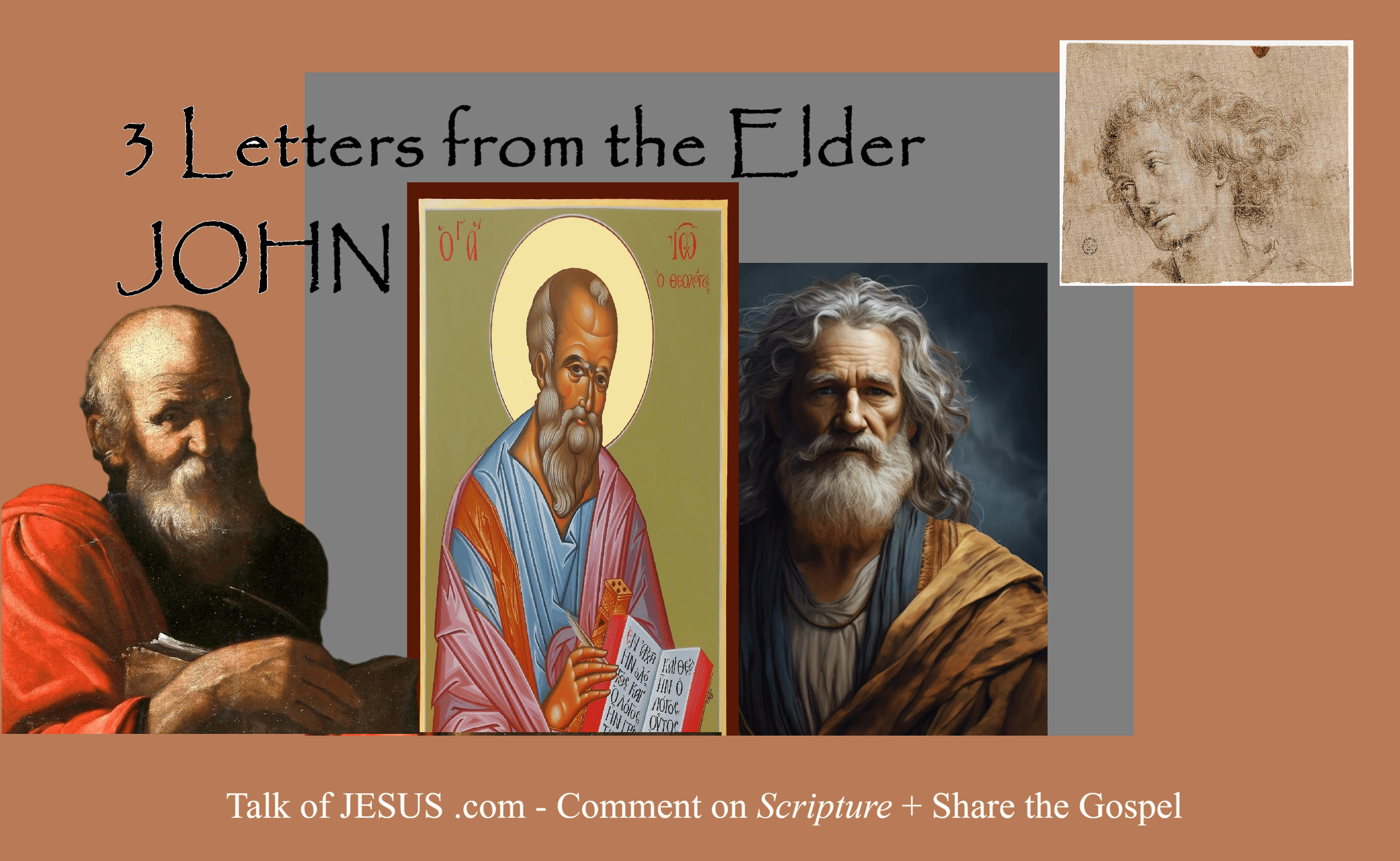
    3 Letters from the Elder John 3 paintings of the Apostle John as the Elder and one as a young Apostle of Jesus Christ

  • Am I not free? Religion 1 Corinthians 9

    Am I not free? Religion 1 Corinthians 9

    Am I not free? Am I not an apostle? Have I not seen Jesus our Lord? Are you not my work in the Lord?

    1 Corinthians 9:1 New Heart English Bible

    Freedom and Religion

    Eric Kress outlines two main points of application from the previous chapter of 1 Corinthians 8:

    Paul’s 4 questions intertwined in context and application

    Paul’s four-fold point (in the Apostle’s letter without chapter and verse) begins:

    οὐκ εἰμὶ ἐλεύθερος 

    ‘Not am I free?’ literally begins the Greek text.

    OR the King James begins:

    οὐκ εἰμὶ ἐλεύθερος

    ‘Am I not an apostle?’

    1 Corinthians 9:1 Bibles


    We won’t want to miss that the Apostle’s pivotal questions follow his concern regarding the idolatry of Corinth and communion between the saints of the Corinthian church with the revelers of the city.

    Freedom of religion

    Suppose for a moment that most every Sunday you go to some local church with an identifiable ‘christianNAME like:

    • such and such FREE church or
    • Our evangelical denomination brand church
    • City name Christian church
    • Korinthian cathedral and parish?

    Won’t most of the people who know you in town also know that:

    • you claim to be a saint,
      • part of you so-named christian church
    • worshiping some god JESUS
    • preached by some Apostle Paul

    • AND in this church occasionally inviting YOU
      • (of another sect celebrating other gods)
      • to go gather in community with these worshipers of One JESUS Christ their Lord?

    Shouldn’t these Corinthian christians come join our religious feasts and live the life of revelry and worship we do with our gods?

    Why should they?

    As we have learned previously in Paul’s letter, his question is not so much:

    • where the Corinthian saints go join in the community as much as
    • how they exercise their freedom publically as witnesses of Jesus Christ our Lord.

    To the Jews and by the Law food sacrificed to idols would seem to be the unlawful offence against the Lord God. (The Messiah Jesus [Yeshua] after all was hailed as the King of the Jews.)

    Community feasts and festivals were, after all, organized by Jews (a small minority in the city), Roman citizens, Hellenists or perhaps adherents of some other foreign religion.


    In a Common Era context, (perhaps Orthodox or Latin Catholic) religious communions and idolic festivals resemble that of the larger communities of like A.D. first century Roman Corinth.

    Authority of an Apostle

    4 Have we no right to eat and to drink?

    5 Have we no right to take along a wife who is a believer, even as the rest of the apostles, and the brothers of the Lord, and Cephas?

    8 Do I say these things according to human authority?

    Or does not the Law also say the same thing?

    Paul then quotes the Law of Moses. 

    And without getting into technical reasons why, the more authoritative KJV begins with Paul's apostleship. It then proceeds to freedom. And ALL of Paul's four questions lead us to his authority in personal witness of the risen Christ and the Apostle's ultimate authority over those gathered as the saints of the Corinthian church.

    Paul’s Deuteronomic illustration of the muzzled ox begs the question:

    .. Is God merely concerned about oxen?

    Or is He speaking altogether for our sake?

    Yes, for our sake it was written, because the plowman ought to plow in hope, and the thresher to thresh in hope of sharing the crops.

    If we sowed spiritual things in you, is it too much if we reap material things from you?

    1 Corinthians 9:11 LSB [context vs. 9-14]

    Paul’s Humble Witness of Christ

    If others share this authority over you, do we not more?

    Nevertheless, we did not use this authority, but we endure all things so that we will cause no hindrance to the gospel of Christ.

    1 Corinthians 9:12

    NO MAN IS FREE OF AUTHORITY.

    Paul points out that he and Barnabas, as apostles of the risen Jesus Christ, do NOT impose their true authority over the church for their own gain.

    Apostles of the Lord all take on the humility of Jesus for Christ’s sake.

    And Paul points out that community leaders who do have authority over feasts, festivals and cities must not see these ‘CHRISTIANS‘ as a hindrance to Christ — a Korinthian christian who becomes a stumbling block to true faith.


    14 So also the Lord directed those who proclaim the gospel to get their living from the gospel… For woe is me if I do not proclaim the gospel.

    The Religion of Paul’s saints

    Many of Paul's questions are rhetorical, designed to make us think through the logic connecting theology and religion,

    our knowledge of God with our witness of faith.

    Everyone practices religion. A Korinthian will get up early, stretch their mind and muscles, breathe in the life-giving air of mother self — and then go worship her at some celebration of community occasion of feasts in the name of some god of their passions.

    The Apostle knew the religion of Roman sailors and Corinthian guides to the temples of debauchery! So he cautions the saints of Corinth to abstain from such religion in all cases for the sake of Christ.

    Religion defined and maligned

    Men will write for religion, fight for It, die for it; anything but live for it.

    W. Cotton Commentary on James 1:26-27

    • I make myself a slave to everyone – 1 Cor 9:19b
    • To the Jews I became like a Jew v.20
    • To the weak I became weak -v.22

    Those who consider themselves religious and yet do not keep a tight rein on their tongues deceive themselves, and their religion is worthless.

    James 1:26 NIV

    Even James writes warnings against hypocrisy; not against the Jews but the Hellenists of every town.

    And like James, the Apostle Paul cautions the saints of Corinth against getting caught up in an inclusiveness of the local religious practices of other religions.

    Adherents of Christian religion are NOT free to practice any anti-Christ religion in order to win someone to Biblical freedom of religion.


    Why is religion most maligned in the name of freedom by preachers from other churches freely claiming Christ?

    Roger@talkofJesus.com

    I urge you, brothers and sisters, saints of our Lord and Saviour Jesus Christ, to drill down into thoughtful application of the definition of religion below. - RH 

    Strong’s G2356 – thrēskeia – feminine noun, From a derivative of θρησκός (G2357), adjective, from θροέω (G2360), verb

    θρησκεία – Religion, Worshipping –

    • religious worship
      • esp. external, that which consists of ceremonies
        • religious discipline, religion

    Strong’s G2357 – thrēskos adjective, (Probably from the base of θροέω (G2360): to cry aloud, make a noise by outcry

    religious (apparently from τρέω to tremble; hence, properly, trembling, fearful

    fearing or worshipping God

    to tremble, trembling, fearful


    Religious fear and worship such as this appears throughout the Bible.  (Today however we will not examine several religious encounters with the LORD from Old Testament.) 

    An Apostle claiming Corinthian saints for Christ

    Returning to Paul's first letter to the Corinthians: 

    Paul the Servant to All

    19 Though I am free of obligation to anyone, I make myself a slave to everyone, to win as many as possible.

    Imagine that! -- an Apostle and witness of the risen Christ Jesus -- a man with complete religious authority over the church, especially those saints who belong to Christ in places like Corinth to whom the Apostle writes his epistle. 

    23 I do all this for the sake of the gospel, so that I may share in its blessings.

    Paul has already stated clearly:

    For Christ did not send me to baptize, but to proclaim the gospel, not in wisdom of word, so that the cross of Christ will not be made empty.

    1 Corinthians 1:17 LSB

    In the opening of his epistle Paul continues:

    For the word of the cross is foolishness to those who are perishing, but to us who are being saved, it is the power of God.

    Consider that many who CLAIM "FREEDOM OF religion" truly argue for FREEDOM FROM RELIGION, which, of course, is "foolishness," since ALL men and women are religious about certain religious routines of   life and mortal limbs of dust. 

    .. you would not have many fathers, for in Christ Jesus I became your father through the gospel.

    Therefore I exhort you, be imitators of me.

    1 Corinthians 4:15b-16 LSB

    The Apostle claims the loyal saints of the Corinthian church for himself as their personal, loving father of the faith in Jesus Christ.

    If others share this authority over you, do we not more?

    Nevertheless, we did not use this authority, but we endure all things so that we will cause no hindrance to the gospel of Christ.

    1 Corinthians 9:12 LSB

    Are YOU a Korinthian falling down in your faith?

    What is your city of Corinth, with its festivals so licentious that that they call you Korinthian for your sins — what is the life here in Corinth like?

    And where does a saint of Christ Jesus fit into the milieu of these gods and your festivals?

    HOW WILL YOU ever reach the glory of the Lord Jesus Christ when the Lord calls to Himself all of His saints?


    Do you not know that in a race all the runners run, but only one receives the prize?

    Run in such a way as to take the prize.

    Everyone who competes in the games trains with strict discipline.

    They do it for a crown that is perishable, but we do it for a crown that is imperishable.

    The Apostle, father of the Corinthian saints once again makes an example of his own religion and faith:

    Therefore I do not run aimlessly;

    I do not fight like I am beating the air.

    27 No, I discipline my body

    and make it my slave,

    so that after I have preached to others,

    (And here is Paul's warning of our own witness to our community, neighbors, friends and family..) 

    I myself will not be disqualified.

    1 Corinthians 9:24-27 Berean Standard Bible


    And NEXT, the Apostle to the Gentiles will once again warn the Jews who have come to Christ AND again the local Greeks of the Corinthian Church.


    Comment on Scripture – Share the Gospel

  • A First Letter to the Corinthians Intro

    A First Letter to the Corinthians Intro

    in the year of our Lord ano Domini 55 [A.D. 55]

    & in the context of the culture of Corinth


    Intro

    PREVIOUSLY in this Talk of Jesus series from CHURCH LETTERS - IS HE WRITING TO ME? we have glanced at a few of Paul's LETTERS (Epistles) to the Church written during his just completed missionary journeys. 

    TODAY we continue with a brief look back at more letters already sent to the churches.
    And God wrought special miracles by the hands of Paul: Acts 19:11 ASV graphic map of Third Missionary Journey of Paul

    WHAT THE CHURCH HAS READ SO FAR:

    Just a reminder that all dates from reliable sources may vary but are used for chronological context only.
    • A.D. 49 – JAMES, the half-brother of Jesus and leader of the church in Jerusalem writes his LETTER
      • James also sends out a letter to the churches concerning gentiles from the Council in Jerusalem.
    • A.D. 49 – Paul writes his letter to the Galatians (actually, several new churches in Galatia)
    • A.D. 50 – 1 THESSALONIANS
    • A.D. 51 – 2 THESSALONIANS

    • during the A.D. 50’s or A.D. 60’s (actual date unknown) – The GOSPEL OF MARK

    1:1 Ἀρχὴ τοῦ εὐαγγελίου Ἰησοῦ Χριστοῦ υἱοῦ τοῦ θεοῦ

    The beginning of the gospel of Jesus Christ, the Son of God – Mark 1:1

    Consider the possibility that parts of the Gospel of John Mark, who had accompanied his uncle Barnabas and the Apostle Paul to Cypress, MAY HAVE been known even in Corinth where Paul has already travelled and whose FIRST LETTER we are about to examine.

    The GREAT COMMISSION of JESUS CHRIST to the CHURCH is recorded in the Gospel of Mark 16:15

    view of earth from moon

    1 Corinthians:

    This epistle was most likely written in the first half of A.D. 55 from Ephesus (16:8, 9, 19) while Paul was on his third missionary journey. The apostle intended to remain on at Ephesus to complete his 3 year stay (Acts 20:31) until Pentecost (May/June) A.D. 55 (16:8). Then he hoped to winter (A.D. 55–56) at Corinth (16:6; Acts 20:2). His departure for Corinth was anticipated even as he wrote (4:19; 11:34; 16:8).

    John MacArthur :: Bible Introductions – 1 Corinthians

    Paulus vocatus apostolus Christi Iesu per voluntatem Dei et Sosthenes frater

    1 Corinthios (1 Corinthians) 1 :: Latin Vulgate (VUL)

    in the context of the culture of Corinth

    CORINTH, ACHAIA is ROMAN; not Macedonian (as in the former Empire of Alexander the Great).

    Neither is the large city of Corinth simply Greek, as in ‘ancient Greece’ with ancient Athens whose glory had long ago been reduced to ruins.

    In 146 BC, the battle of Corinth signified a defining moment in the history of ancient Greece. Situated on the narrow strip of land connecting the Peloponnese to the mainland of Greece, Corinth was a city-state with a significant strategic and economic position.

    source:

    The language of Greek (thanks to the Great Macedonian Alexander) has become the international language of the Roman Empire.

    So in Corinth, Philippi, Ephesus, Antioch and even in Jerusalem the GOOD NEWS and Epistles [Letters] typically were written and read in GREEK.

    Παῦλος κλητὸς ἀπόστολος Ἰησοῦ Χριστοῦ διὰ θελήματος θεοῦ καὶ Σωσθένης ὁ ἀδελφός

    Α΄ Κορινθίους (1 Corinthians) 1 :: Textus Receptus (TR)

    Paulos klētos apostolos Jēsous Christos dia thelēma theos kai Sōsthenēs ho adelphos;

    To the church of God which is at Corinth,

    to those who are sanctified in Christ Jesus, called to be saints,

    with all who in every place call on the name of Jesus Christ our Lord, both theirs and ours:

    1 Corinthians 1:2 NKJV

    Here in CORINTH we immediately read the opening of Paul’s Epistle written in Greek to the CHURCH, beginning with the Apostle’s universal greeting to ALL and specifically to the saints separated to the calling of Christ Jesus our Lord.

    Paul had been there and wrote back to encourage these Christians in Corinth.

    See if this A.D. first century city of CORINTH sounds vaguely familiar to any city of destruction in our 21st century the Common Era.


    Once again, the commentary of John Macarthur on the culture of Corinth.

    Even by the pagan standards of its own culture, Corinth became so morally corrupt that its very name became synonymous with debauchery and moral depravity.

    To “corinthianize” came to represent gross immorality and drunken debauchery. In 6:9, 10, Paul lists some of the specific sins for which the city was noted and which formerly had characterized many believers in the church there.

    Tragically, some of the worst sins were still found among some church members.

    John Macarthur Commentary – the Background and Setting of Corinth

    Here the Apostle writes to a chosen few SAVED from the surrounding sinful culture of CORINTH (and most every other city in their culturally correct Roman Empire) in a CHURCH separated in worship yet living and working with all of those destined to the wrath of God’s punishment.

    These Corinthian Christians were taught and sought to live in complete contrast to sinful lifestyles hopefully left behind. 

    Later in his letter Paul will describe their love [ ἀγάπη ] more fully.

    1 Corinthians 13:4-8a on LOVE of the Christian who follows Jesus Christ

    Although some contemporary Christians include parts of Paul’s list of LOVE in ceremonies of Christian marriage, the love of which Paul writes is not romantic or specifically marital in any way.

    These CORINTHIANS were recognized in the city for their uniquely personal LOVE –

    ἀγάπη – agapē love,

    sometimes translated as CHARITY for each other and for others.


    Their agapē LOVE stood against a CULTURE OF SIN characterized in acorinthianizedcity, fallen nation or evil empire.


    Paul later writes what he knows of their Corinthian challenges warning:

    Or do you not know that the unrighteous will not inherit the kingdom of God?

    Do not be deceived; 

    .. neither the sexually immoral, nor idolaters, nor adulterers, nor effeminate, nor homosexuals, nor thieves, nor the greedy, nor drunkards, nor revilers, nor swindlers, will inherit the kingdom of God.

    And such were some of you…

    1 Corinthians 6:9-11 excerpt LSB

    Starting with Encouragement

    Paul begins his Epistle with an agape-rooted encouragement.

    Grace to you and peace from God our Father and the Lord Jesus Christ.

    Grace, for which Christians should be so well recognized, written χάρις in Greek charis is:

    • that which affords joy, pleasure, delight, sweetness, charm, loveliness: grace of speech
    • good will, loving-kindness, favour
    • of the merciful kindness by which God, exerting his holy influence upon souls, turns them to Christ, keeps, strengthens, increases them in Christian faith, knowledge, affection, and kindles them to the exercise of the Christian virtues
    CAN YOU THINK OF ANY GREETING WHICH ENCOURAGES MORE THAN 'GRACE?'

    I thank my God always concerning you for the grace of God which was given you in Christ Jesus, that in everything you were enriched in Him, in all word and all knowledge,
    even as the witness about Christ was confirmed in you, so that you are not lacking in any gift, eagerly awaiting the revelation of our Lord Jesus Christ, who will also confirm you to the end, beyond reproach in the day of our Lord Jesus Christ.

    Paul practically embraces these Corinthian believers in a personal prayer written for them.

    Could any introduction of LOVE and Grace be more encouraging?

    God is faithful, through whom you were called into fellowship with His Son, Jesus Christ our Lord.

    Paul’s first letter to the Corinthians 1:9 LSB [in context of 1:3-9]
    Theos is faithful, through Whom you were kaleō into koinōnia with His Son Ἰησοῦς Χριστός [iēsous christos] our kyrios.

    *Linked definitions of GREEK words from 1 Corinthians 1:9 from BlueLetterBible.org

    Reintroducing our Lord

    Paul begins his letter to a beloved church in a city caught-up in the sins of SELF and worshipping multiple gods of ME with encouragement in the Lord Jesus Christ.

    In the Apostle Paul’s two Epistles to the Corinthians he uses:

    • iēsous – 45x
    • christos – 111x
    • kyrios – 95x
    • θεόςtheos – an amazing 185x
    - king - only once in his second letter & not referring to Jesus
    - prophet - prophētēs - only once but referring to gifts of the saints
    - priest not at all in writing to the Corinthians

    TO:

    THOSE WHO HAVE BEEN SANCTIFIED ἁγιάζω – hagiazō – Paul uses this four times in this letter.

    Are YOU sanctified?

    ἅγιοςagios – sacred (physically, pure, morally blameless or religious, ceremonially, consecrated):—(most) holy (one, thing), saint.

    That’s what the apostle of Jesus Christ by the will of God asks the church of God which is at Corinth.

    (It's a good question for those claiming Jesus Christ facing a refining and sanctification of our sinful mortal flesh.)

    The Apostle Paul refers to the church as SAINTS, a most holy thing, TWENTY TIMES in his epistles to the Corinthians including his encouragement of the church in this introduction.

    To the church of God in Corinth, to those sanctified in Christ Jesus and called to be his holy people, together with all those everywhere who call on the name of our Lord Jesus Christ—their Lord and ours:

    τῇ ἐκκλησίᾳ τοῦ θεοῦ τῇ οὔσῃ ἐν Κορίνθῳ ἡγιασμένοις ἐν Χριστῷ Ἰησοῦ κλητοῖς ἁγίοις σὺν πᾶσιν τοῖς ἐπικαλουμένοις τὸ ὄνομα τοῦ κυρίου ἡμῶν Ἰησοῦ Χριστοῦ ἐν παντὶ τόπῳ αὐτῶν τε καὶ ἡμῶν·
    1 Corinthians 1:2 NIV, TR –

    The Apostle Paul has many more things to write to the Corinthians (and to you, God-willing).

    To be continued…

    Talk of JESUS . com

    Comment on Scripture – Share the Gospel