Tag: Gospel

The Gospel is Good News to all who will humbly accept Jesus and listen to His teaching.

We refer to the four books of the Bible which tell the story of Jesus Christ as the Gospels. These books are named for their authors: Matthew, a Jewish Apostle; Mark, a disciple of the first generation who recorded accounts of Peter and the Twelve; Luke, a gentile Physician and disciple of the first century; and John, one of the Twelve Jewish Apostles chosen by Jesus.

  • Rumors of Life & Death

    Rumors of Life & Death

    Reporters of News

    And this rumour of him went forth throughout all Judaea, and throughout all the region round about.

    Gospel of Luke 7:17 – KJV

    Sojourners become clarions of news to uninformed ears in new places from the places where they have witnessed life.

    The ‘rumour‘ to which the Gospel-writer Luke refers (above) is Jesus’ raising a young man from his coffin along his own funeral procession in Nain in remote Galilee. Other English translations of the same Greek word [λόγος] use “report.”

    When we return to John’s Gospel (Good News) we will encounter such reports again, some stories which veer from the truth.

    Good News/Bad News: True or False?

    The Disciples who traveled with Jesus from town to town reported the Good News of Jesus the Messiah of Israel to many who had not heard in places distant from the events they had witnessed. Reliable reports from other witnesses also reached the ears of thousands who had not yet seen Jesus in Person.

    The four written NEWS accounts of JESUS CHRIST are not the only news of the Savior. Many reports are oral, even many first-hand stories from witnesses to Jesus’ many miraculous events recorded by the Apostles.

    Picture the Apostles after Jesus’ death and resurrection as reporters and add to their number every saint of the Church who consequently believed their report of the Lord Jesus Christ, then you may realize why John and others had to address false reports of their time.

    While reading the Gospels we discover many who reject the “Good News” of Jesus which challenges one or more of their earthly embraces of sin. Many reject God and refuse to acknowledge or let go of their sins.

    Some will believe in anything in order to deny the Truth.

    Roger Harned – talk of Jesus .com

    All the REPORTERS of Jesus had to be taken at face value for their rumors (stories) of the Messiah. Those who did not witness an event had to ask themselves the same questions we would ask today.

    • Is this even possible?
    • Is their report TRUE or FALSE in some way?
    • If it is true, is this GOOD NEWS or BAD NEWS for me?
    • How should I react? (What must I do?)
    • What is my response to this NEWS to others who have not heard?

    Brief Vitae of the Good News Reporters

    As mentioned previously in Witnesses to Jesus Risen! John and the Apostles continue to report their GOSPEL to others until the end of their lives and John writes to some who have witnessed even more miracles than he reports in his Gospel.

    Briefly from our Gospel archives take a look at these dates of the reports.

    • Jesus was crucified around the year AD 30
    • John Mark’s Gospel – before AD 49; martyred AD 68
    • Matthew’s Gospel – as early as AD 50, before martyrdom ~AD 60
    • the physician Luke’s Gospel/Acts – AD 60-61, prior to the great persecution that began under Nero in A.D. 64; Luke likely martyred in AD 84
    • John writes his Gospel to the churches after AD 85 [~AD 90-100]
    • 2nd c. AD – many Church fathers, disciples of John, Peter & others, testify to the truth of their Gospels and oppose false reports by false teachers.

    Countering False Reports

    So this rumor spread to the brothers and sisters that this disciple would not die. Yet Jesus did not tell him that he would not die, but, “If I want him to remain until I come, what is that to you? ”

    John 21:23 CSB

    John 21:

    Recall from John’s previous report [Witnesses to Jesus Risen! – Peter] of a third time they encountered Jesus after His resurrection:

    5 So Jesus said to them, “Children, you do not have any fish to eat, do you?” .. 7 Therefore that disciple whom Jesus loved said to Peter, “It is the Lord!”

    • Peter enthusiastically dove into the water and swam to meet Jesus on shore before the other Disciples came onshore in a boat filled with fish.
    • Simon Peter and Jesus have a conversation about feeding His sheep and Simon hesitates in his answers to the Lord (our Shepherd).
    • Jesus asks:
      • “Simon, son of John, do you agapaō Me more than these?” then, “Simon, son of John, do you agapaō Me? and finally,
      • “Simon, son of John, do you phileō Me?”
    • Peter’s hesitates in answering Jesus call to agapaō and each time confirming that he loves Him (phileō differing slightly in meaning).
    • The Lord commands him with some subtlety after each response:
      1. Tend My lambs.
      2. Shepherd My sheep.
      3. Tend My sheep.

    And to the reader knowing that Peter has already died for his Lord, (Peter’s dearly departed friend) John offers an explanation.

    17 .. Peter was hurt because He said to him the third time, “Do you love Me?” And he said to Him, “Lord, You know all things; You know that I love You..

    Good News, Bad News

    John gives the reader some ‘bad news,’ which is no longer NEWS to most and the ‘good news,’ which the other Apostles also witnessed. (Most of them had also died for their witness of the risen Christ Jesus!)

    So the rumor spread among the community of believer that this disciple wouldn’t die.

    Rumor vs. TRUTH

    • Who said it?
    • What is the RUMOR?
    • Where were they when it happened?
    • When might this have taken place?
    • Why would your NEWS source tell you?
    • How does this impact you?

    WHO DO YOU BELIEVE?

    As the last surviving Apostle, John witnesses the Good News of Jesus Christ and His resurrection for decades!

    What happens when a rumor creates a myth short of truth?

    This would happen later when the Church tells stories not supported by Scripture.

    When the saying (or story or myth) multiplies, then eventually encounters truth what most certainly will happen? The rumor is crushed and faith along with it (when the aging Apostle dies).

    And remember, regardless of when or how the saying had started, it has already been around for a time since the original witness is some fifty years before John writes his Gospel truth.

    Many disciples of The Way and saints of the church might easily elevate John (or for that matter, Simon Peter, other Apostles or even family of Jesus) to glory and worship due only the LORD.

    John’s simple approach to false witness

    The always esteemed and ever truthful Disciple does two things:

    1. John states the false witness (translated: saying, rumor, story)
    2. He refutes it by his own authoritative true witness.

    WHO DO YOU BELIEVE? It’s as simple as that.

    The incident in question involves what JESUS said to Simon Peter. Only six other Disciples including John witness it first hand. So John states:

    • 21:23 Then went this saying abroad among the brethren, that that disciple should not die:
    • yet Jesus said not unto him, He shall not die;
      • (FALSE rumor – John categorically states: – Jesus said NOT)
    • but,
      • (here is the truth I witnessed, says John)
    • [Jesus said ..],
      • If I will that he tarry till I come, what is that to thee? [KJV] or
    • “If I want him to remain until I come, what is that to you?” – NASB

    The Disciple by quoting Jesus refutes the rumor of John’s alleged immortality told in this story circulating among early Christians.

    John squashes this rumor before it can multiply into false teaching which will cause us to doubt the ‘Gospel Truth.’

    His own witness, true to facts unknown through rumor, states what happened (decades ago):

    • 20 Peter turned around and saw the disciple whom Jesus loved following them—the one who also had leaned back on His chest at the supper and said, “Lord, who is the one who is betraying You?”
    • So Peter, upon seeing him, said to Jesus, “Lord, and what about this man?”
    • Jesus said to him, “If I want him to remain until I come, what is that to you? You follow Me!”
      • Peter turned around, John was following him and Jesus.
      • Peter asked the Lord about John, because Jesus had just told Peter:

    18b “.. when you grow old, you will stretch out your hands and someone else will put your belt on you, and bring you where you do not want to go.”

    • John tells the reader, who likely knows of Peter’s crucifixion, why Jesus said this.
    • After having refuted the rumor with the truth, John puts his seal on the whole truth of restating the ‘story.’

    This is the disciple who is testifying about these things and wrote these things, and we know that his testimony is true.

    John 21:24 NASB
    cross words Who's in charge? and a question of Authority

    John’s closing is comparable to Paul writing, “I sign this in my own hand.” At stake is the Authority & Truth of the Lord Jesus

    Rather than adding questions on this section of John,
    I leave you to question Truth vs. fiction.
    Please click PG 2 

    Pages: 1 2

  • Witnesses to Jesus Risen! – Simon Peter

    Witnesses to Jesus Risen! – Simon Peter

    The Gospel of John

    • What does a DEATH have to do with GOOD NEWS?

    Read any obituary of a famous teacher, even a celebrity leader of men and you will discover one thing: They left behind everything. Now the legacy of this body buried or scattered to the dust of the earth must decay.

    We memorialize men and women, especially the same many idolize in life. Those who loved any breathing soul speak of the dead in the past. Some ask, ‘IF there is a God, what hope does this departed soul have now?

    The Apostle John answers these deep longings of the souls of mortal man.

    More specifically, the LORD GOD reveals the only Good News about death and life is through the Lord Jesus Christ – born of man, buried like all who must suffer death.

    By His words we have hope, but by His death we have redemption from sin and judgment.

    For by Jesus’ RESURRECTION in BODY and SPIRIT, followers of the Way of Jesus in life will follow Him to certain resurrection of the body and of our soul.

    Do you desire an eternal after-life in the Presence of the LORD our GOD? Find it in the Good News of Christ Jesus.


    Witnesses to Jesus’ Resurrection

    In Him was life, and the life was the Light of men.

    The Light shines in the darkness, and the darkness did not comprehend it.

    The Good News of John 1:4-5 NASB

    John presents man as either belonging to one of two things: the darkness or the light. There is no in between. The darkness is associated with death, while the light is associated with life. – BlueLetterBible intro to John

    No Gospel addresses ‘LIFE’ more than John and no book of the Bible more than the 150 Psalms.

    Roger Harned talk of Jesus .com

    We now return to John’s witness of Jesus in a third appearance to Disciples along the shore of the Sea of Tiberias after His resurrection.

    Trusting that you read Witnesses to Jesus Risen! – the Eleven, a Passing Witness, recall the 1st. century A.D. events disciples of the Way of Jesus encountered even before John wrote his Gospel — after A.D. 85 & before A.D. 100.

    Remember to see John’s Gospel with eyes of a 1st. century believer who already knows that Peter was martyred for Christ perhaps decades earlier.

    Peter’s witness of Jesus’ Resurrection

    No Disciple of Jesus impacts the Church more than Simon Peter. After paying little attention to interactions between Peter and Jesus, today we will look closer into this loving relationship of discipleship.

    Previously in Witnesses to Jesus Risen! – the Eleven, a Passing Witness. the Apostles had seen Jesus in the flesh twice, except Thomas only once, in Jerusalem. John names five present now and mentions two others, but not by name.

    Simon Peter said to them, “I am going fishing.”John 21:3

    It’s now close to daylight after a night catching no fish.

    John 21:

    7 The disciple, the one Jesus loved, said to Peter, “It is the Lord!”

    Peter and John who humbly refers to himself as ‘the disciple Jesus loved’, along with his older brother James have been Jesus’ three closest Disciples. During three years of the Lord’s earthly teaching Jesus had often shared understanding He does not reveal to others.

    In his Gospel the beloved Disciple speaks of their close friend Simon Peter who has already been martyred for Christ with loving compassion; not eulogizing or elevating Peter in any way, but giving honest witness to Peter’s actions and failings in life.

    John’s empathy for Peter’s heart after denying the Lord is clearly evident. The Disciples remembered how Jesus had prophesied Peter’s denials before the cock crowed at dawn that fateful evening prior to His arrest. Peter of course had denied that it could ever happen.

    Peter, now with his former boldness, dives into Lake Tiberius and swims to shore (just two hundred cubits, about 100 yd. or 90 m.) away from Jesus who is broiling fish over a fire.

    The other six Disciples return in small boats with the catch of ‘the multitude of fishes’ [KJV], which they then account as a total of 153 large fish filling a net that remains untorn by the huge catch.

    Three Questions of Restoration

    Remember, John witnesses this to Christians after Peter’s faithful death for the Lord Jesus Christ. Here is what John testifies:

    15 Now when they had finished breakfast, Jesus said to Simon Peter, “Simon, son of John, do you love Me more than these?”

    (We will examine Peter’s answers separately.)

    16 He said to him again, a second time, “Simon, son of John, do you love Me?”

    17 He said to him the third time, “Simon, son of John, do you love Me?”

    The common language of the Apostles in addition to their local Aramaic is Greek. English translations lack subtle detail connecting context in these scriptures.

    Simon son of Jonas – Σίμων Ἰωνᾶ

    Andrew and Simon’s father is John, or Jonas.

    • John, Peter’s other friend of Jesus’ inner circle besides his own brother James, calls him Simon Peter or simply Peter.
    • however Jesus calls him only Simon or the Lord addresses John & Jamesfriend rather formally as: Simon son of Jonas.
      • Could Jesus also be reminding the Disciples of His many prophesies connecting His Resurrection to the Prophet Jonah?

    Note what Jesus asks Simon, yet note subtle differences in Simon’s responses which show the depth of wounds of Peter’s guilt before he understands Jesus’ tender requests.

    (Again recall that John tells this to readers who already know that Peter has died for his faith in Jesus.)

    Jesus’ questions to Simon Peter

    English also clouds our understanding of overlapping Greek meanings of love.

    1. “Simon, son of John, do you [e] love Me more than these?”
    2. “Simon, son of John, do you [g] love Me?”
    3. “Simon, son of John, do you [i] love Me?”
    [notes] Here is an instance where NASB & other notes may help.
    See the Greek text referenced below.
    1. ἀγαπάω – agapaō – Strong’s G25
      • egō polys hoytos
    2. ἀγαπάω – agapaō – Strong’s G25
      • egō
    3. φιλεῖς – phileō – Strong’s G5368
      • egō

    Three similar questions to Simon from Jesus in John 21: v.15, v.16 & v.17, but not quite the same.

    • Do you agapaō me more than these?
    • Do you agapaō me? (No comparison this time to the six Disciples who came to shore in the boat with the fish.)
    • Do you phileō me?
    Is your, “yes Lord” really your “yes?”
    Let's move on to Simon's responses. (Will his responses match?)
    1. “Yes, Lord; You know that I [phileō] love You.”
      • Jesus had asked, “Do you agapaō Me more than these?”
      • Do you [love] Me more than these (six) Disciples love Me?
      • Simon only confirms his phileō for Jesus.
    2. “Yes, Lord; You know that I [phileō] love You.”
      • Jesus now focuses on Simon asking simply, “Do you agapaō me?”
      • Simon simply repeats his previous response of “I [phileō] You.”
    3. “Lord, You know all things; You know that I [phileō] love You.”
      • Jesus has already asked Simon, “Do you [agapaō] me?”
      • Simon had twice responded, “I [phileō] You.”
      • Perhaps to contrast Simon’s answers to His other two questions the Lord now asks him, “Do you [phileō] me?

    What does Jesus mean by “love?”

    Having some understanding of the Greek words for LOVE is a pre-requisite for our 21st century understanding.

    Let’s begin with Simon Peter’s answer to Jesus.

    phileō love:

    It is the verb meaning:

    • to approve of, like, sanction, treat affectionately or kindly,
    • to welcome, befriend

    Are you only this to Jesus?

    To your fellow followers of Christ who also call Him Lord is your witness mere approval of Jesus?

    What a ‘friend’ we have in Jesus,‘ we once sang.

    • Is that what the Lord asks of Simon Peter?
    • Is Christ not so much more than ‘a friend’ to those who follow Him?

    ‘..All our sins and griefs to bear!” continues the old hymn proclaiming Jesus a friend, but urging us to take everything to God in prayer.

    Simon has just witnessed Jesus’ Sacrifice for our sins on the Cross.

    • What friend can bear your sins other than Jesus?

    “Greater love hath no man than this, that a man lay down his life for his friends.

    John 15:13 KJV – Jesus proclaiming His own death to the Disciples, of agapē love

    Simon Peter, once again emboldened by Jesus resurrection, offers no rock of confidence in his measured response to His Lord and Savior.

    Jesus was not asking Simon Peter for his renewed friendship. So what was the Lord asking him?

    agapē love:

    It is the noun for:

    • affection, good will, benevolence, brotherly love,
    • charity or a feast of charitability (like a generous family meal of Thanksgiving),

    All active, rather than passive acceptance of another. Jesus first question asks Peter to stand firm in His love of their friends.

    Jesus asks in effect,

    “Do you think (Simon), that because you greeted Me first (perhaps with an expected kiss of phileō just as Judas Iscariot had in Gethsemane), — do you therefore believe that you agapē Me more that those who did not jump from your boat to reach Me first?

    (And recall what John had witnessed of Peter when they first ran to the empty tomb.) Peter lost that physical race with John, but it did not matter who was first or who came to Jesus last. What did matter was the Lord’s commands.

    On the night in which He was betrayed Jesus gave them a new command.

    Commandment of Jesus Christ CHURCH "love one another

    In case you missed it, Church..

    from earlier in our series on the Gospel of John, April 29, 2020 A.D.

    John 13:

    33 “Little children, I am still with you a little longer…

    (It is this same endearing greeting of their Master the Disciples have just heard from Peter’s boat.)

    34 “I am giving you a new commandment, that you love one another; just as I have loved you, that you also love one another.

    • Which LOVE do you suppose Jesus uses in this NEW COMMANDMENT to the Disciples?
    agapaō:

    It is the verb root of agapē love. Yet its own root may also share in actions associated with the verb phileō. (We won’t take time to dwell on this.)

    • of persons
      • to welcome, to entertain, to be fond of, to love dearly
    • of things
      • to be well pleased, to be contented at or with a thing

    Three times Jesus uses agapaō in His New Commandment to the Apostles and then the Lord continues by applying agapē love as evidence to others that these are His disciples.

    “By this all people will know that you are My disciples: if you have love for one another.”

    John 13:35 – The New Command of Jesus – agapē

    Jesus’ New Commands to Simon Peter

    We have examined with some detail the context of Jesus’ questions to Simon that John witnesses in his Good News to believers long after Peter’s own death.

    NEXT: We will continue in John 21 with the Lord’s Commands to Peter and hear John’s empathy for Peter shared with saints of the 1st century A.D. Church.

    To be continued...
  • 11 Witnesses to Jesus Risen! –  the Eleven

    11 Witnesses to Jesus Risen! – the Eleven

    HE IS RISEN!

    ‘HE IS RISEN, INDEED,’ goes a traditional response.

    Christ Born & Witnessed, Crucified, Risen, Ascended..

    If you haven’t been following this series you will likely ask, “Why is he talking of Easter during this Advent season of Christmas in the year of our Lord, 2020?”

    My dear brother or sister in Christ,

    Allow me to ask you a question:

    manger with shadow of cross falling across

    Do you talk of Jesus OR ‘christmas’?

    Christians and non-Christians alike will focus on the ‘.COMmercial‘ obligations of this ‘holiday’ season so much more than the CHRIST of ‘christmas.’ And in fact, (in case you haven’t heard) Jesus, Emmanuel or God With Us was most likely NOT born DECEMBER 25.

    (Forget the .com technical choice of my Christian Social Witness – talkofJesus.com for my personal & shared talk of Jesus Christ.)

    Has Christmas not become MORE important than EASTER in the witness of the 21st c. Church?

    How like the world we have become.

    Many 21st c. ‘christians’ also witness the risen JESUS of the resurrection, celebrated by eggs and bunnies impersonalized and separated from the Person of God, without witness of the Person symbolized, He who died for sinners and defeated death!

    Yes, JESUS IS born as a man-child like no other. Yet our witness must remember the shadow of the Cross on a newborn’s manger and the glory and hope through CHRIST’s resurrection.

    Continuing Witness to Jesus’ Resurrection!

    Our journey through Scripture in this year of our Lord 2020, continues in the Good News of John. We have just begun to revisit the personal witness of many who testify to the resurrection of Jesus Christ.

    As a reminder to contemporary readers of John’s Gospel:

    • Jesus was crucified around the year AD 30
    • John writes his Gospel to the churches in about AD 85

    Witnesses to Jesus Risen! – Mary Magdalene

    Some who witnessed the risen Jesus fifty years earlier still lived!

    As we continue in John’s Good News and Mary’s announcement of Jesus’ resurrection, we begin to hear his Gospel through the ears of others. See Jesus with their eyes and experience the risen Christ through their personal touch and interaction with the risen Lord Jesus.

    Mary Magdalene came and announced to the disciples, “I have seen the Lord,” and that He had said these things to her.

    John 20:18 NASB

    What command had the risen Lord given Mary?

    “..go to My brothers and say to them, ‘I am ascending to My Father and your Father, and My God and your God.’”

    John and Simon Peter have already run to the empty tomb where the crucified Body of Jesus had been placed prior to celebration of the feast of the Passover and observing of the Sabbath. Then they returned not yet having seen the Lord.

    John 20 continued

    It had been morning when the women had first seen the empty tomb before summoning John and Peter.

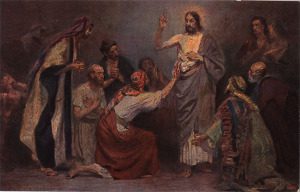
    19 Now when it was evening on that day, the first day of the week..

    .. and when the doors were shut where the disciples were together due to fear of the Jews, Jesus came and stood in their midst, and said to them, “Peace be to you.”

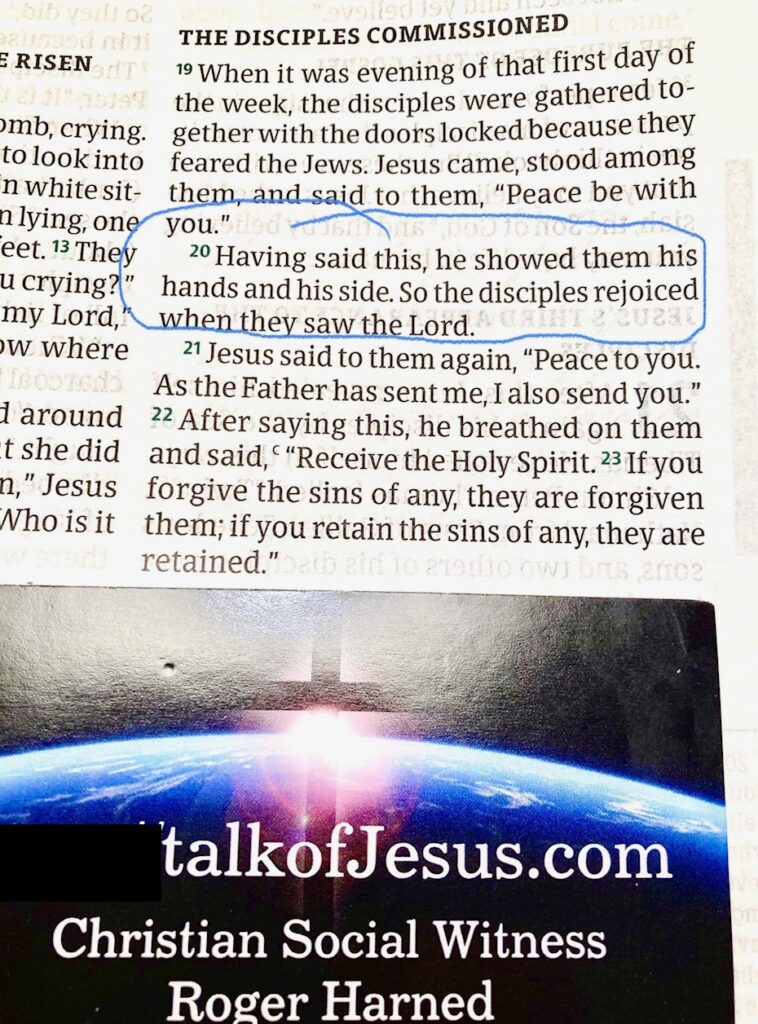
    20 Having said this, he showed them his hands and his side.

    So the disciples rejoiced when they saw the Lord.

    (Not Twelve, but the Eleven – one)

    We mentioned previously that Judas Iscariot, Jesus’ betrayer has hanged himself. John will mention shortly that Thomas also is not present.

    And just one additional reminder: 
    the eleven Disciples, Jesus and His family are all Jews.
    Though their common language is Greek or locally Arabic,
    the Complete Jewish Bible [CJB] (used here occasionally) gives flavor of Jesus as the Messiah of Israel.

    21 “Shalom aleikhem!” Yeshua repeated.

    “Just as the Father sent me, I myself am also sending you.”

    22 Having said this, he breathed on them and said to them,

    “Receive the Ruach HaKodesh!

    The Holy Spirit & Forgiven Sins

    “Receive ye the Holy Ghost,” translates the King James and most versions read, “the Holy Spirit.”

    What follows should sound familiar if you have followed the great commission of Jesus to the Twelve Disciples given earlier in His earthly ministry and all returned to Jesus amazed.

    23 If you forgive the sins of any, their sins have been forgiven them; if you retain the sins of any, they have been retained.”

    What an astounding authority Jesus has given to the Apostles through the Holy Spirit!

    Many Jewish disciples will know it well from the Psalms of David. Gentile Christians to whom John now also witnesses may know it from Paul’s letter [ca. AD 56.] to the Romans [4:7].

    לְדָוִד מַשְׂכִּיל אַשְׁרֵי נְֽשׂוּי־פֶּשַׁע כְּסוּי חֲטָאָֽה׃

    אַשְֽׁרֵי אָדָם לֹא יַחְשֹׁב יְהוָה לֹו עָוֹן וְאֵין בְּרוּחֹו רְמִיָּה׃

    Blessed is he whose transgression is forgiven, whose sin is covered.

    Blessed is the man unto whom the LORD imputeth not iniquity, and in whose spirit there is no guile.

    Psalm 32:1-2 WLC, KJV

    The Lord has instructed His Disciples on how they must judge their fellow saints and others with unfailing grace and mercy in His Name, especially forgiving those who also follow Jesus as their Lord and their God.

    Ministry of the Twelve (then Eleven)

    Eleven now and again Twelve Apostles after Mathias replaces Judas Iscariot

    Although John reveals much of the Holy Spirit, he does not reiterate what is already well known of the ministry of the Twelve prior to Jesus’ Crucifixion and Resurrection. (Remember John writes this decades later to his beloved fellow saints of the church.)

    Jesus had previously given the Twelve a taste of this awesome power over sin in the lives of others.

    Some eight days after these sayings, He took along Peter and John and James, and went up on the mountain to pray. And while He was praying, the appearance of His face became different, and His clothing became white and gleaming.

    Luke 9:28-29
    Most of the following is also witnessed in Luke's Gospel Chapter 9:

    Matthew 10:

    Jesus summoned His twelve disciples and gave them authority over unclean spirits, to cast them out, and to heal every kind of disease and every kind of sickness.

    Now the names of the twelve apostles are these:

    1. The first, Simon, who is called Peter,
    2. and Andrew his brother;
    3. and James the son of Zebedee,
    4. and John his brother;
    5. Philip
    6. and Bartholomew [son of Talmai];
    7. Thomas [not present for Jesus’ first appearance]
    8. and Matthew the tax collector;
    9. James the son of Alphaeus,
    10. and Thaddaeus;
    11. Simon the Zealot,
    12. and Judas Iscariot, the one who betrayed Him [who hanged himself].

    Matthew 10:5 continues:

    These twelve Jesus sent out after instructing them:

    “Do not go in the way of the Gentiles, and do not enter any city of the Samaritans; but rather go to the lost sheep of the house of Israel.

    (Of course Christ commissioned these to go to all of these after His resurrection.)

    “And as you go, preach, saying, ‘The kingdom of heaven is at hand.’

    It is Jesus’ urgent appeal to the Jews through the Twelve – Matthew 10:7 NASB
    Matthew 10: continued Complete Jewish Bible [CJB]

    7 As you go, proclaim, ‘The Kingdom of Heaven is near,’ 8 heal the sick, raise the dead, cleanse those afflicted with tzara’at, expel demons…

    12 When you enter someone’s household, say, ‘Shalom aleikhem!’ If the home deserves it, let your shalom rest on it; if not, let your shalom return to you. But if the people of a house or town will not welcome you or listen to you, leave it and shake its dust from your feet!

    Yes, I tell you, it will be more tolerable on the Day of Judgment for the people of S’dom and ‘Amora than for that town!

    16 “Pay attention! I am sending you out like sheep among wolves, so be as prudent as snakes and as harmless as doves.

    Be on guard, for there will be people who will hand you over to the local Sanhedrins and flog you in their synagogues. On my account you will be brought before governors and kings as a testimony to them and to the Goyim.

    19 But when they bring you to trial, do not worry about what to say or how to say it; when the time comes, you will be given what you should say. For it will not be just you speaking, but the Spirit of your heavenly Father speaking through you.

    Therefore when Jesus appears in Person to the eleven Apostles after His resurrection from the grave, He had already taught them what He is about to say.

    John 20 continued

    If you forgive the sins of any, they are forgiven them;

    if you retain the sins of any, they are retained.”

    John 20:23 CSB – Jesus’ authority given to the Apostles through the Holy Spirit

    Next:

    John is not making a list of miracles so that the Eleven (who will soon add Mathias as replacement to Judas Iscariot) can convince their first century A.D. followers that Christ IS Risen indeed!

    You will find many of these miracles of the Holy Spirit witnessed in the Acts of the Apostles.

    (Again, when John wrote his Gospel these had already taken place.)

    If you have been following John’s Gospel closely you may have noticed my intentional oversight of some detail about the Disciples. Thomas, who was not present with the other eleven will appears next [vs. 24-29].

    We will begin with Thomas next time.

    Also, John has much more to say about Peter and we will once again want to add more detail about other Apostles and especially John.

    30 Jesus performed many other signs in the presence of his disciples that are not written in this book.

    To be continued...