Tag: Gospel

The Gospel is Good News to all who will humbly accept Jesus and listen to His teaching.

We refer to the four books of the Bible which tell the story of Jesus Christ as the Gospels. These books are named for their authors: Matthew, a Jewish Apostle; Mark, a disciple of the first generation who recorded accounts of Peter and the Twelve; Luke, a gentile Physician and disciple of the first century; and John, one of the Twelve Jewish Apostles chosen by Jesus.

  • Are You a King?

    Are You a King?

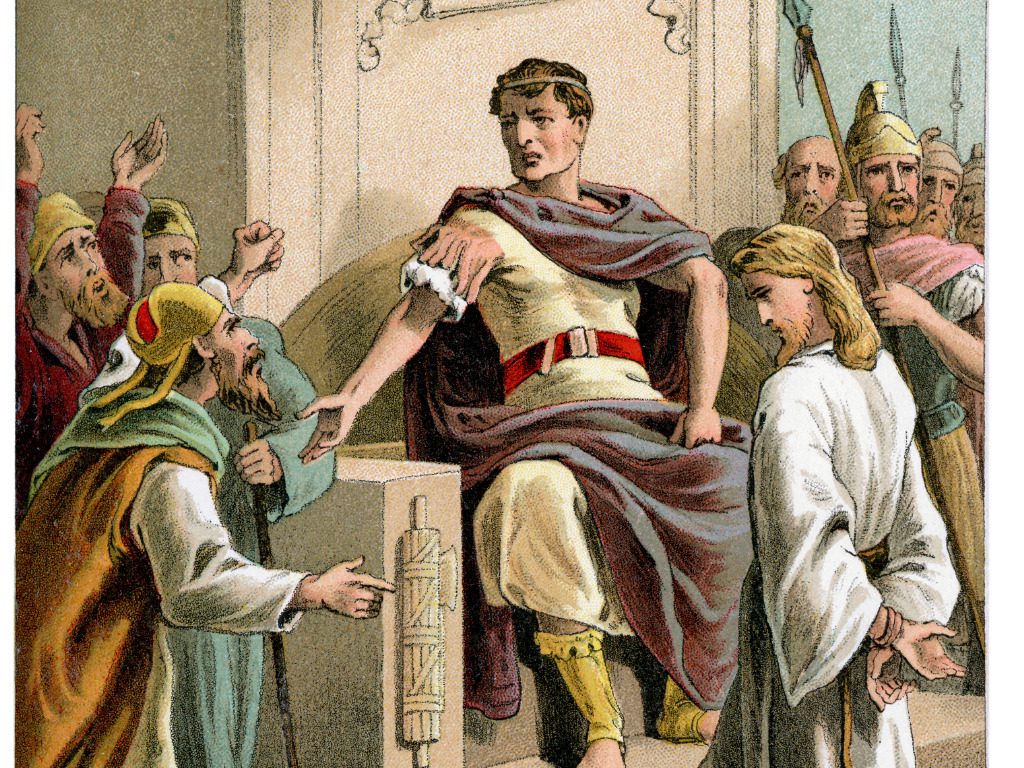
    Therefore Pilate entered again into the Praetorium, and summoned Jesus and said to Him,

    “Are You the King of the Jews?”

    John 18:33 NASB

    The Politically Charged Question

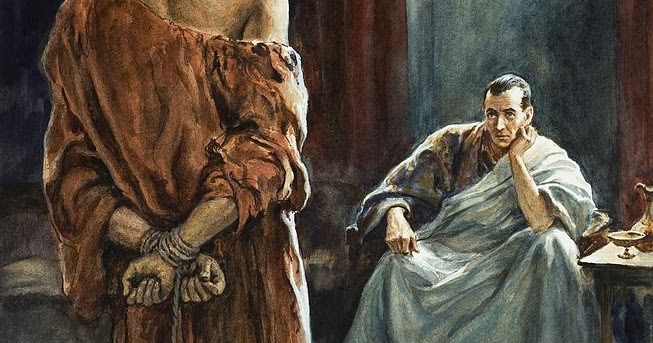
    Pilate interrogates Jesus by beginning privately with a loaded question.

    As Governor AND presiding judge (in chambers), the Prefect questions the defendant already declared guilty by the Jews, local leaders who have no authority in this Roman court of Judea.

    Pilate’s questions (to which he must have had prepared standard answers to usual responses) went to motive.

    • “What is your authority here?”
    • “Are you a threat to true authority, which as Governor I represent?”

    The Gospels do not record these words, but the timing and context of Jesus’ trial suggests to the Governor that he recognizes a political hot potato in dealing with this popular Rabbi during the religious festival of the Jews in Jerusalem.

    For further understanding of Pontius Pilate look back to: 
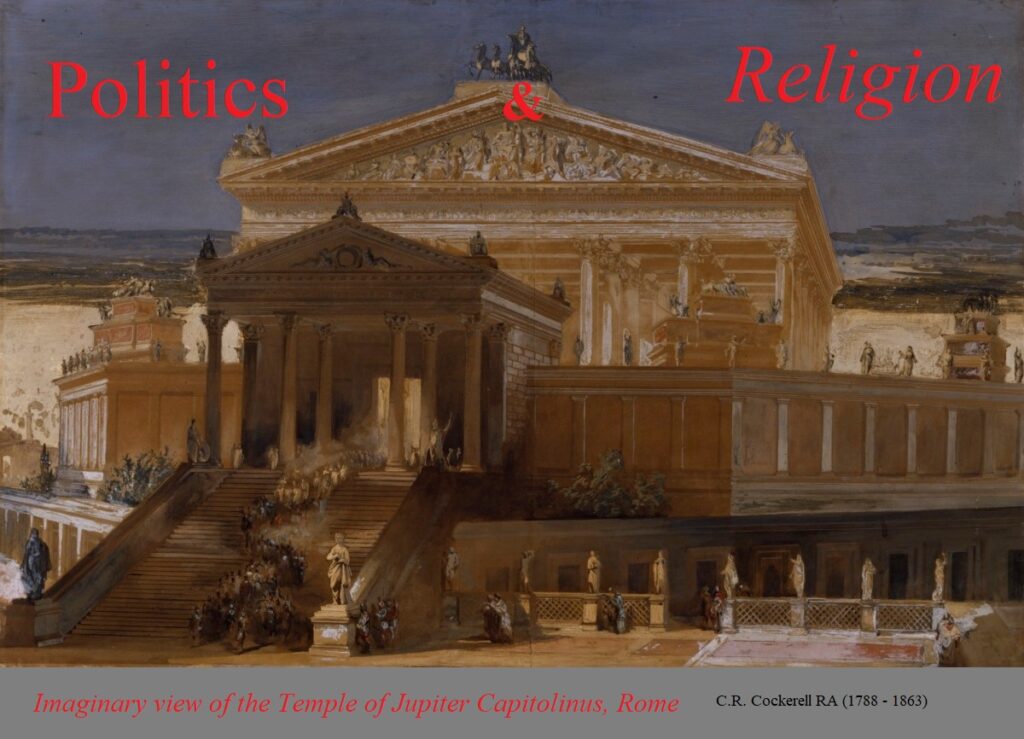
    1st century Rome – an awkward embrace of RELIGION & politics

    John 18:

    Very early that morning:

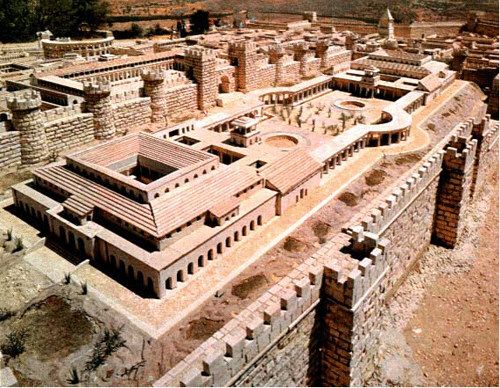
    praetorium in Jerusalem
    • As the Jewish officials brought Jesus to the exterior of the Praetorium Pilate came out to them.
    • .. and they themselves did not enter into the Praetorium so that they would not be defiled, but might eat the Passover.

    29 Therefore Pilate went out to them and said, “What accusation do you bring against this Man?”

    They answered and said to him, “If this Man were not an evildoer, we would not have delivered Him to you.”

    31 So Pilate said to them, “Take Him yourselves, and judge Him according to your law.”

    The Jews said to him, “We are not permitted to put anyone to death..”

    Sentenced to death by accusation

    We already know of the deceptive stealth of the Temple officials, ceasing Jesus at night then bringing the Messiah of Israel to trial before them.

    The Jews really had no authority in Judea and regardless of their predetermined verdict of guilt and sentence of death, Pilate dismisses their case. But now the politics come into play.

    These religious emissaries want to execute the man opposed to their religious positions of power, the Man who had ridden victorious into town on a donkey just a few days before, Jesus of Nazareth (a town not even in Pilate’s Judea).

    Although we seldom consider the passage of time within a single verse or two of scripture, consider this possibility in the scene about to take place:

    • Certainly the Jews with their prisoner Jesus on the outside and Pilate with his advisors inside the Praetorium must ponder what to do next.
    • Since Pilate is in charge of Jerusalem and responsible to Rome for any potential trouble, he makes the first move in trying to keep peace between the politics and religion of Jerusalem.

    Questions with political consequences

    33 Therefore Pilate entered again into the Praetorium, and summoned Jesus and said to Him…

    Although the trial of Jesus takes place like all Roman trials in the public square, Pilate begins his questioning of this prisoner of the Jews in private.

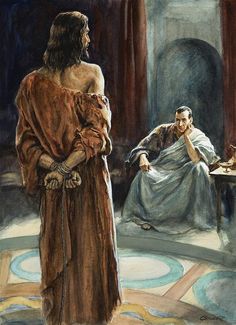
    painting of pontius pilate

    “Are You the King of the Jews?”

    Are you the King?

    Questions with political consequences are best asked first in private. Leaders must know the politically correct answer before asking it in public.

    Remember Jesus’ accusers were not present because they would not defile themselves by their self-righteous rule of separation from this gentile Governor responsible for every civic event in Jerusalem. The Jews needed to maintain their white-washed public image before their followers.

    • Pilate summoned Jesus to him.
    • As a result of his summons the Jews had to release Jesus into the governor’s custody.

    βασιλεύς

    What is the root meaning of Pilate’s question to Jesus?

    βασιλεύς basileús, bas-il-yooce’; probably from G939 (through the notion of a foundation of power); a sovereign (abstractly, relatively, or figuratively):—king.

    • leader of the people, prince, commander, lord of the land, king

    What are you, Jesus?

    (It’s a fair question — to which the Governor would have had a standard reply.

    Imagine some of these pre-prepared political answers of Pilate.)

    • We have no kings here. You are not a king of Egypt or even Herod who was once king in Jerusalem. Kings do not matter here.
    • Our king resides in Rome and I am his governor. What I say comes from our king: Tiberius Caesar.
    • Are you a king? It does not matter. Tiberius Caesar is king.

    Rather than being led into a conversation about who He is not, Jesus asks the Governor a question.

    34 Jesus answered,

    “Are you saying this on your own initiative, or did others tell you about Me?”

    • Is this really your question
    • or did someone tell you that I am a King?

    The Governor immediately reminds the accused that in fact he, Pilate, is Roman (and Rome governs Jerusalem).

    Pilate answered, “I am not a Jew, am I?

    Your own nation and the chief priests delivered You to me;

    what have You done?”

    John 18:38 NASB

    Pilate’s response confirms indictment by the chief priests, but the judge’s question, ‘What have you done?” is opportunity for the defendant to appeal His ill-gotten verdict.

    Israel’s Messiah Jesus answers the Governor’s original question about His Authority.

    My Kingdom – βασιλεία

    Jesus answered, “My kingdom is not of this world.

    John 18:36a

    The Accused makes no claim to Jerusalem or to Judea or any Syrian territory governed by Pilate.

    Rather Jesus claims an authority of the gods (in Pilate’s understanding). In this case:

    ‘royal power, kingship, dominion, rule, not to be confused with an actual kingdom but rather the right or authority to rule over a kingdom.’source: blueletterbible.org

    Jesus continues His assurance to Pilate that He is no threat to Rome as other kings and threatening rebels fight to gain influence in places like Jerusalem.

    “… If My kingdom were of this world, then My servants would be fighting so that I would not be handed over to the Jews;

    but as it is, My kingdom is not of this realm.”

    What Realm?

    • “..but as it is, My kingdom is not of this realm.” – John 18:36c NASB
    • “..but now is my kingdom not from hence.” – John 18:36c KJV
    • “..But as it is, my kingdom is not from here.” – John 18:36c CSB

    A King must have a country, a realm to rule here and now. Jesus Christ makes no such claim.

    The Lord Jesus when brought before Pilate confirms, ‘my kingdom is not from here.”

    ἐντεῦθεν

    Outline of Biblical Usage

    1. from this place, hence
    2. on the one side and on the other, on each side

    Luke records an incident from earlier in Jesus ministry describing it with the same Greek word.

    Just at that time some Pharisees approached, saying to Him, “Go away, leave here, G1782 for Herod wants to kill You.” – Luke 13:31

    Herod, of course, is a pawn not only of Jerusalem’s Jewish politics but also of Rome. Jesus continued at that time to prophesy the events of these three days:

    And He [Jesus] said to them [Pharisees who secretly followed Jesus],

    “Go and tell that fox [Herod],

    ‘Behold, I cast out demons and perform cures today and tomorrow, and the third day I reach My goal.’

    “Nevertheless I must journey on today and tomorrow and the next day; for it cannot be that a prophet would perish outside of Jerusalem.

    Luke 13:32-33 NASB

    οὐκοῦν, adverb, not therefore

    This is subtle, as well as a function of speech; but don’t miss it.

    Several translations of the original Greek from this passage read differently in attempts to convey the argument here of Jesus’ judge Pilate.

    37 Therefore Pilate said to Him, “So You are a king?”

    (You are a king, but from where {if not here}?)

    • .. but it is better to write οὐκοῦν, so that Pilate, arguing from the words of Christ, asks, not without irony, art thou not a king then? or in any case, thou art a king, art thou not? cf. Winer’s Grammar, 512 (477).
    • and since a speaker often introduces in this way his own opinion, the particle is used affirmatively, therefore, then, the force of the negative disappearing. Hence, the saying of Pilate οὐκοῦν βασιλεύς εἰ σύ must be taken affirmatively: – Source: Strong’s

    To this end was I born

    Jesus answered, Thou sayest that I am a king. To this end was I born, and for this cause came I into the world, that I should bear witness unto the truth. Every one that is of the truth heareth my voice.

    John 18:37b KJV

    In answer to Pilate’s restatement of his own question, “Art thou a king then?” Jesus clearly states His purpose to which He was born as Son of Man and Son of David, the Christ of Hebrew Scripture.

    John began his Gospel (Good News) of Jesus Christ stating this same purpose. It really has nothing to do with anything kinglike, as the Jews expected of their Messiah that He would be like King David or King Solomon.

    In the beginning was the Word, and the Word was with God, and the Word was God.

    And the Word became flesh, and dwelt among us, and we saw His glory, glory as of the only begotten from the Father, full of grace and truth.

    John 1:1,14 NASB

    Jesus proclaims privately to Pontius Pilate:

    “I was born for this, and I have come into the world for this: to testify to the truth… CSB

    Pilate is about to ask Jesus the question a Judge must ask himself honestly before concluding a trial, but first Christ continues with purpose for all:

    “… Everyone who is of the truth listens to my voice.”

    the words of Jesus Christ to Pontius Pilate – John 18:37c CSB

    Do you with ears to hear listen to the voice of Christ Jesus?

    To be continued...
    Page TWO - Please click Page 2 below for the questions.
    Pages: 1 2

  • Social Media is not the world

    Social Media is not the world

    Looking back & ahead

    Once you may have thought of the church as a building. Yet recall from reading your Bible that a true church is its people who love Christ Jesus.

    Continuing reflection back on my three-score and ten, briefly:

    Giving up each dream now beyond my reach and touched my the Hand of the Almighty, I press on to preach to Gospel exclusively to those whom the Lord has chosen. (You may not be one of these.)

    Those not saved by the grace of God have most likely scrolled past the Light of their salvation already.

    Roger Harned – reflection on why most will never talk of Jesus Christ

    Social Media is not the world

    social media

    Social media and broadcast media are the medium and the message to a world opposed to the Lord God.

    We are in the world and of the world, born into sin and continuing in sin, unless the Lord separates us into His holiness.

    Spokespersons for the world seek to sway our conversations to follow only their diverse distancing from God.

    Christians must not sway back into the ways of the world — ways which demand judgment and deny the grace of Christ Jesus.

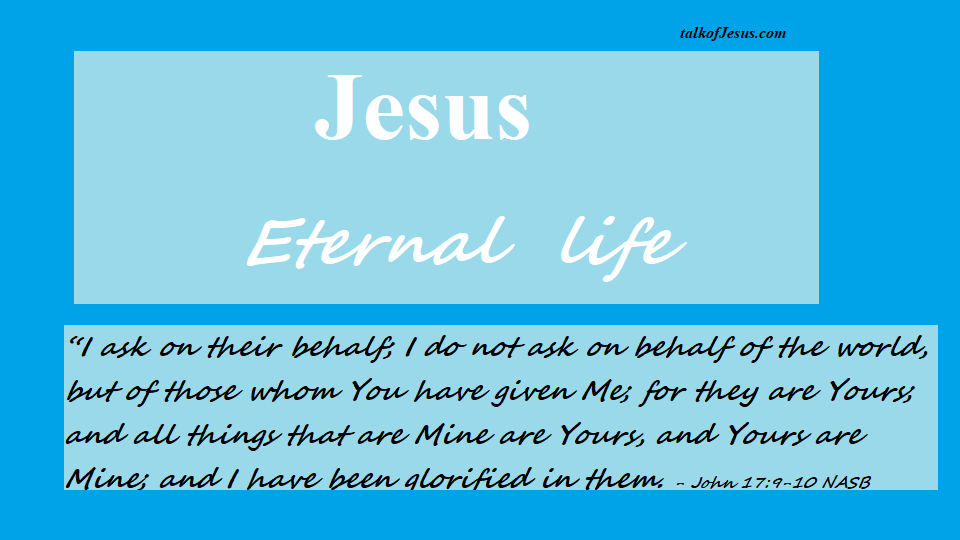
    Jesus eternal life John 17-9-10
    Jesus prays

    Christ, the sinless man

    Jesus is No More in the World (and was never of the world).

    As we hear in our Lord’s High Priestly Prayer from an upper room in Jerusalem just before His betrayal, Jesus prays for those given Him — the Apostles (except His betrayer) AND for those in generations to come who will need to be protected from the evil one.

    Are you one of these?

    Do you need protection by the Lord God Who IS and came to the world in the Person of Christ Jesus?

    Jesus, God in Person and One with the Father, prays NOT for the world but exclusively for those given to Him — souls chosen for eternal life.

    The world will hear its media but never the Truth of God.
    The world will read any diverse solution except that of Scripture.
    I no longer preach to a world which denies Christ Jesus.
    Roger@talkofJesus.com 

    You with ears to hear and eyes to see, read what John writes to the church.

    John’s Letter

    Do you have ears to hear challenging preaching directed specifically to Christians who see Christ Jesus through Scripture?

    If so, turn the page and read John’s first letter & my challenge to you, beloved brother or sister in Christ.

    Pages: 1 2 3

  • In case you missed it, disciple

    In case you missed it, disciple

    Disciples receive a New Command

    John witnessed previously a NEW COMMANDMENT of Jesus, who also said:

    You are My friends if you do what I command you.

     John 15:14

    The setting was the table of Communion of the ‘last supper,’ our picture of the scene most likely too Italian and not accurately set in first century Jerusalem. So for a moment let’s take a closer first century look at Jesus with His Disciples. But first, let’s define discipleship.

    Who is a disciple anyway?

    אֲדֹנָ֣י יְהֹוִ֗ה נָ֤תַן לִי֙ לְשֹׁ֣ון לִמּוּדִ֔ים לָדַ֛עַת לָע֥וּת אֶת־יָעֵ֖ף דָּבָ֑ר יָעִ֣יר בַּבֹּ֣קֶר בַּבֹּ֗קֶר יָעִ֥יר לִי֙ אֹ֔זֶן לִשְׁמֹ֖עַ כַּלִּמּוּדִֽים׃

    Isaiah 50:4 Masoretic Text

    Isaiah 50:

    The Lord God has given Me the tongue of disciples,
    That I may know how to sustain the weary one with a word.
    He awakens Me morning by morning,
    He awakens My ear to listen as a disciple.
    5 The Lord God has opened My ear;
    And I was not disobedient
    Nor did I turn back.

    Isaiah here refers to himself as a disciple of ‘Adonay Yĕhovah.

    ‘disciples’ – לִמּוּד – “taught, learned, discipled, from לָמַד – lä·mad’ – to learn. teach, exercise in

    That is to learn and exercise the teaching of the Lord God as in:

    Then Moses summoned all Israel and said to them: “Hear, O Israel, the statutes and the ordinances which I am speaking today in your hearing, that you may learn H3925 them and observe them carefully.

    Deuteronomy 5:1 – Strong’s H3925 – לָמַד

    Has the Lord God given you ‘the tongue of disciples’ ‘to sustain the weary one?’

    And are your beloved brothers and sisters in the Lord not weary ones in need of encouragement in the Word?

    Even Jesus’ example of obedience to our Father God can be seen in this same prophecy of Isaiah.

    Prophecy of the Suffering Servant

    6 I will offer my back to those who whip me
    and my cheeks to those who pluck hairs out of my beard.


    I will not turn my face away from those who humiliate me
    and spit on me.

    Who accuses me?
    Let him confront me!

    9 The Almighty Lord helps me.
    Who will find me guilty?

    11 But all of you light fires
    and arm yourselves with flaming torches.
    So walk in your own light
    and among the torches you have lit.

    “Listen to me, you who pursue righteousness,
    Who seek the Lord:

    Isaiah 51:1a NASB

    “It is written in the prophets, ‘AND THEY SHALL ALL BE TAUGHT OF GOD.’ Everyone who has heard and learned from the Father, comes to Me.

    The words of Jesus – John 6:45

    Who is Jesus’ disciple?

    Of course we correctly speak of Jesus’ twelve “Apostles” or “Disciples(with a capital ‘D’), even appropriately adding Matthias who replaced Judas and Paul, the “Apostle to the gentiles” (though he was a Jew among jews in all his jewish learning).

    These were all chosen by our Lord as an intimate inner circle of teachers to be sent into the world with the Gospel (except His betrayer, Judas Iscariot).

    Again, it comes down to a definition.

    μαθητής – ‘disciple

    • a learner, pupil, disciple

    The Greek, Hebrew and other concepts imply that a disciple is a student and follower of a teacher. The ONE teacher IS JESUS, Son of God, Son of Man, a Personal Teacher to His disciples.

    This, of course, includes the Twelve, includes Paul and also includes the many diciples who witnessed Jesus in the flesh (both before and after His resurrection of the Body).

    Those who call Him Master and Lord AND obey the Very Word of God.

    So Jesus was saying to those Jews who had believed Him, “If you continue in My word, then you are truly disciples of Mine; and you will know the truth, and the truth will make you free.”

    John 8:31-32 NASB

    Jesus is speaking to all the disciples following Him (just like now), however His lesson and command speak only to those who truly believe and obey our Master and Lord, the Teacher Who IS the Word.

    Disciples include those who continue to believe Jesus as our Lord, our Master and Teacher, those pupils schooled by the Living God.

    Therefore, Jesus’ disciples include any of all generations of faith who belong to Him, those who obey our Lord and Savior.

    The saints (small ‘s’) of the Church belong to Christ and therefore must obey the Lord’s command – including a new command to the church:

    that you love one another, even as I have loved you, that you also love one another.

    a new commandment from our Teacher and Lord that we LOVE ONE ANOTHER as Jesus has loved us.

    And to emphasis the importance of this relationship of pupils our Teacher Jesus adds His reason for giving us a new commandment:

    Why does Jesus give his disciples a NEW COMMANDMENT so specific to His Own love?

    So that we also love each other.

    Roger Harned – talkofJesus.com – on John 13:34
    To be continued, Lord-willing...
    What Jesus' New Commandment means to the church.