Tag: Gospel

The Gospel is Good News to all who will humbly accept Jesus and listen to His teaching.

We refer to the four books of the Bible which tell the story of Jesus Christ as the Gospels. These books are named for their authors: Matthew, a Jewish Apostle; Mark, a disciple of the first generation who recorded accounts of Peter and the Twelve; Luke, a gentile Physician and disciple of the first century; and John, one of the Twelve Jewish Apostles chosen by Jesus.

  • Preaching Good News then a Parting of Paths to the Gentiles

    Preaching Good News then a Parting of Paths to the Gentiles

    First Missionary Journey

    SUCCESS! So after their first missionary journey and years together witnessing the Gospel you wouldn’t expect a parting of paths of these apostles Barnabas and Paul, right?

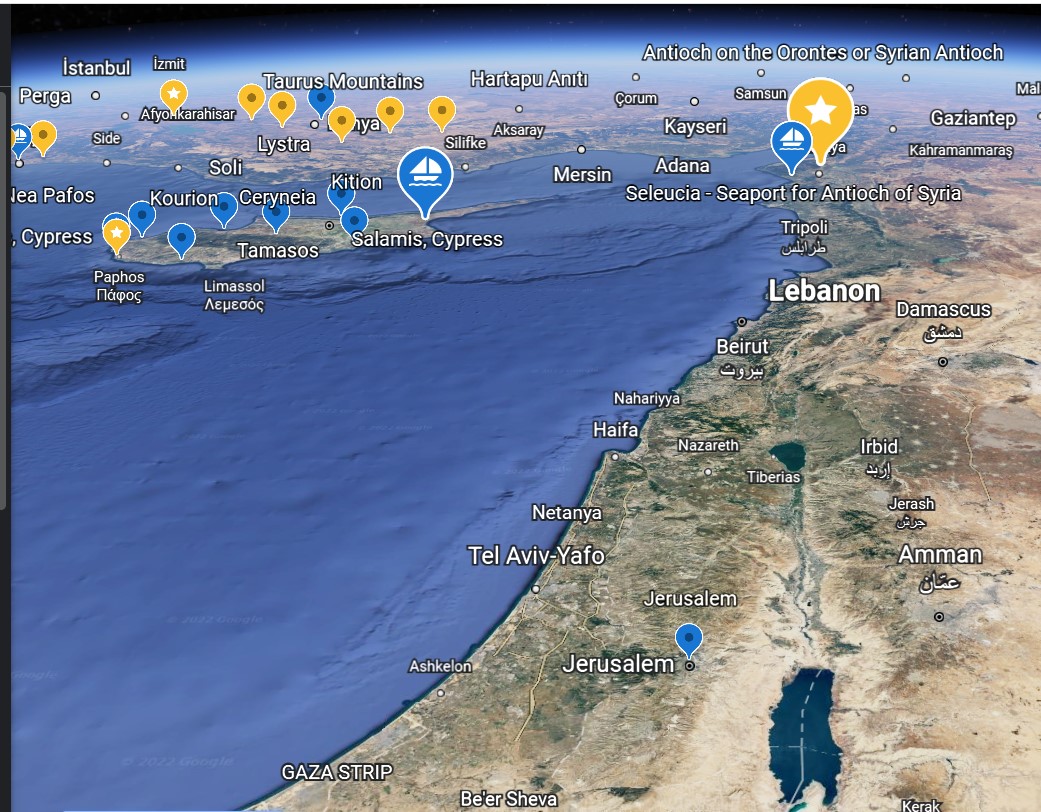
    map of Mediterranean coastline - Jerusalem, Antioch Syria Cypress & Antioch Pisidia on Paul's first missionary journey

    The Church at Antioch received exciting good news that their First Missionary Journey was successful. Then hey sent a delegation to Jerusalem to clarify some gentile issues in a Council meeting with the Apostles and Church. Barnabas and Paul return to Antioch with a clarification of doctrine and some brothers from the Jerusalem Church.

    The Council at Jerusalem sent Judas called Barsabbas, and Silas, leading men among the brothers.. down to Antioch.

    Then pleased it the apostles and elders, with the whole church, to send chosen men of their own company to Antioch with Paul and Barnabas; namely, Judas surnamed Barsabas, and Silas, chief men among the brethren – Acts of the Apostles 15:20 – KJV

    Previously:
    
    Acts 14:27 [in Antioch]
    And when they arrived and gathered the church together, they declared all that God had done with them, and how he had opened a door of faith to the Gentiles. And they remained no little time with the disciples. But some men came down from Judea [to the church at Antioch] ..
    
    And after Paul and Barnabas had no small dissension and debate with them, Paul and Barnabas and some of the others were appointed to go up to Jerusalem to the apostles and the elders about this question. 
    
    When they came to Jerusalem, they were welcomed by the church and the apostles and the elders, and they declared all that God had done with them.
    
    Excerpt from Acts of the Apostles 14:27 - 15:4

    A.D. 49 – Antioch Syria

    Acts 15:

    30 So when they were sent off, they went down to Antioch, and having gathered the congregation together, they delivered the letter. And when they had read it, they rejoiced because of its encouragement.

    Preaching the Gospel to all in Antioch

    32 And Judas and Silas, who were themselves prophets, encouraged and strengthened the brothers with many words. 33 And after they had spent some time, they were sent off in peace by the brothers to those who had sent them.

    35 But Paul and Barnabas remained in Antioch, teaching and preaching the word of the Lord, with many others also.

    [Let’s not miss this: Paul and Barnabas had spent some time with the Church in Jerusalem. Now Judas [Barsabas] and Silas ‘exhorted the brethren’ [KJV] in Antioch. And then they return [v.33b]

    Planning a Second Missionary Journey

    Take a look at our  map [cover]: 
    Barnabas and Paul preached the Gospel as they had sailed to Cypress, travelled along the coast and then sailed to Pamphylia where they journeyed to inland cities before sailing back to Antioch. ~A.D. 47-49
    

    36 And after some days Paul said to Barnabas,

    “Let us return and visit the brothers in every city where we proclaimed the word of the Lord, and see how they are.”

    37 Now Barnabas wanted to take with them John called Mark.

    38 But Paul thought best not to take with them one who had withdrawn from them in Pamphylia and had not gone with them to the work.

    route of sailing from Paphos Cypress to Perga Pamphilia
    Do you recall the incident prior to their inland journey? (It too had caused a parting of paths and as mentioned previously became a time when Mark would write his Gospel.)
    
    Acts of the Apostles 13:13 Now Paul and his companions set sail from Paphos and came to Perga in Pamphylia. And John left them and returned to Jerusalem
    

    Barnabas wants to have his young cousin who had served them in Cypress to go with them again. As a reminder, Barnabas had also mentored the younger Saul of Tarsus (Paul) in his early days. But Paul disagreed.

    This sharp disagreement between Christians, brothers who worked side by side proclaiming the Gospel — even suffering severe persecution for the sake of the Gospel of Christ Jesus — Paul and Barnabas would NOW agree to a parting of paths to the gentiles, making separate mission journeys with new travel companions to witness the Gospel in yet more cities and towns of the Roman-ruled world of MOSTLY gentiles.

    39 And there arose a sharp disagreement, so that they separated from each other. Barnabas took Mark with him and sailed away to Cyprus..

    Acts of the Apostles 15:39 – Second Missionary Journey of Barnabas and Mark begins.

    AD 49/50 {Between v.39 & v.40} It will take Paul some weeks or perhaps months to reorganize the 2nd mission to the Gentiles as the apostles and friends plan their parting of paths for two missions to MORE new Christians.

    A parting of paths of Barnabas (who sails again to Cypress) & Paul who now plans a 2nd missionary journey to Derbe by land through Syria and Cilicia.
    Cilicia – journey through Syria to Pamphylia

    40 but Paul chose Silas and departed, having been commended by the brothers to the grace of the Lord. And he went through Syria and Cilicia, strengthening the churches.

    Acts of the Apostles 15:40-41 – Second Missionary Journey of Paul and Silas begins.

    4 apostles De-parting on 2 Paths with 1 Gospel

    NEXT: A map of their NEW Missionary Journeys & Parting of Paths to the Gentiles, God-willing.

    ACTS on MISSION To Be Continued…


  • Advent for a too familiar Nativity

    Advent for a too familiar Nativity

    GOOD NEWS!

    Aren’t you glad you’re NOT a preacher this ‘Christmas’ season? After all, how much more can we say about the nativity of the Lord Jesus in Bethlehem.

    WE have preached the Gospel every year — the openings of the Gospels applicable to our pageants, programs, concerts, carolings, Christmas Eve services, Midnight Masses, Christmas Day dinner feasts — CHRIST-MASS — how much more can we possibly have to say about worship of a baby born in Bethlehem?

    εὐαγγέλιον – Good Tidings

    Lexicon :: Strong’s G2098 – euangelion

    • the glad tidings of the kingdom of God soon to be set up, and subsequently also of Jesus the Messiah, the founder of this kingdom. After the death of Christ, the term comprises also the preaching of (concerning) Jesus Christ as having suffered death on the cross to procure eternal salvation for the men in the kingdom of God, but as restored to life and exalted to the right hand of God in heaven, thence to return in majesty to consummate the kingdom of God
    • the glad tidings of salvation through Christ
    • the proclamation of the grace of God manifest and pledged in Christ
    • the gospel
    • as the messianic rank of Jesus was proved by his words, his deeds, and his death, the narrative of the sayings, deeds, and death of Jesus Christ came to be called the gospel or glad tidings

    Let’s get the GOOD NEWS right

    So because I’m NOT a pastor today’s ‘Advent’ message in the year of our Lord 2022 will simply point out an overlooked FACT or two concerning what the Gospels actually say about the birth of Jesus.

    The Gospel of Mark

    1 The beginning of the gospel of Jesus Christ, the Son of God. 2 As it is written in Isaiah the prophet..

    Mark does not address the manner and place of Jesus’ birth, but proceeds directly to the Lord’s ministry and teaching.

    The Gospel of John

    In the beginning was the Word, and the Word was with God, and the Word was God. He was in the beginning with God. All things were made through him, and without him was not any thing made that was made. In him was life, and the life was the light of men. The light shines in the darkness, and the darkness has not overcome it.

    The Apostle introduces Christ in genesis before creation and mortals. John adds his authenticated witness of Jesus the Messiah without reference to the nativity so oft’ told each ‘Christmass‘.

    (Christmas reminder for Protestants - the mass is a worship service)

    And the Word became flesh and dwelt among us, and we have seen his glory, glory as of the only Son from the Father, full of grace and truth.

    Good News of the Apostle John 1:14 English Standard Version

    Gospel of Matthew

    1 The book of the genealogy of Jesus Christ, the son of David, the son of Abraham..

    The Apostle Matthew begins his Gospel with a Jewish genealogy of Israel’s Messiah as introduction to Jesus’s birth. The Apostle then proceeds into some detail of the nativity in Bethlehem.

    18 Now the birth of Jesus Christ took place in this way..

    Matthew continues to set the scene with some marriage background involving Joseph and Mary.

    ..an angel of the Lord appeared to him in a dream, saying, “Joseph, son of David, do not fear to take Mary as your wife, for that which is conceived in her is from the Holy Spirit.

    She will bear a son, and you shall call his name Jesus, for he will save his people from their sins.”

    Gospel of Matthew 1:21 ESV
    Now after Jesus was born in Bethlehem of Judea

    Matthew jumps suddenly to a time AFTER the Lord was born. Once again he provides some historical context.

    .. in the days of Herod the king, behold, wise men from the east came to Jerusalem..

    2:1 Τοῦ δὲ Ἰησοῦ γεννηθέντος ἐν Βηθλέεμ τῆς Ἰουδαίας ἐν ἡμέραις Ἡρῴδου τοῦ βασιλέως ἰδού, μάγοι ἀπὸ ἀνατολῶν παρεγένοντο εἰς Ἱεροσόλυμα

    From Matthew 2:1 in the King James Version note the facts presented by the Apostle:

    behold, there came wise men from the east to Jerusalem

    • wise men – magos – wise men, teachers, priests, physicians, astrologers, seers, interpreters of dreams, augers, soothsayers, sorcerers etc.
    • from the east anatolē – the east (the direction of the sun’s rising)

    Wise men, plural without saying how many AND from the east, therefore NOT from the Roman Empire or African continent, likely Babylonians (Chaldeans), Medes, or Persians.

    “Where is he who has been born king of the Jews? For we saw his star when it rose and have come to worship him.”

    Gospel of Matthew 2:2 – Question of the wise men to King Herod

    Are there three wise men.. perhaps four, five or more?

    Why would these men from the east come to worship a Jewish king?

    (Could they be Jews of the diaspora to Babylon never returned to Jerusalem under the yoke of Rome?)

    Of course all of these questions don't fit into the choreography of our usual nativity pageantry too well but sticking close to the Scripture of Matthew let's observe a couple of other details.
    

    And behold, the star that they had seen when it rose went before them until it came to rest over the place where the child was. 10 When they saw the star, they rejoiced exceedingly with great joy. 11 And going into the house, they saw the child with Mary his mother, and they fell down and worshiped him. Then, opening their treasures, they offered him gifts, gold and frankincense and myrrh.

    • the star went before them to ‘the place where the child was
    • they went ‘into the house’
    • the wise men ‘fell down and worshiped him,’ *the wise men did not worship Mary, though she was with the child Jesus

    Matthew continues with a brief account of how Jesus got to Nazareth from Bethlehem via Egypt.

    Gospel of Luke

    Luke’s narrative like that of the Apostle Matthew sets the scene for us ‘in the days of Herod, king of Judea.’ He connects two signs of miraculous births: that of John the Baptist and of Jesus Christ.

    26 In the sixth month [of Elizabeth’s pregnancy] the angel Gabriel was sent from God to a city of Galilee named Nazareth, 27 to a virgin betrothed to a man whose name was Joseph, of the house of David. And the virgin’s name was Mary..

    “Do not be afraid, Mary, for you have found favor with God. And behold, you will conceive in your womb and bear a son, and you shall call his name Jesus.

    32 He will be great and will be called the Son of the Most High. And the Lord God will give to him the throne of his father David, 33 and he will reign over the house of Jacob forever, and of his kingdom there will be no end.”

    How?

    34 And Mary said to the angel, “How will this be, since I am a virgin?”

    35 And the angel answered her, “The Holy Spirit will come upon you, and the power of the Most High will overshadow you; therefore the child to be born will be called holy—the Son of God.

    36 And behold, your relative Elizabeth in her old age has also conceived a son, and this is the sixth month with her who was called barren. For nothing will be impossible with God.”

    38 And Mary said, “Behold, I am the servant of the Lord; let it be to me according to your word.”

    And the angel departed from her.

    Luke 2:

    Even unbelievers know this Nativity narrative from Luke as frequently read in many places from Scripture.
    
    Isn’t there anyone who knows what Christmas is all about?

    The Birth of Jesus Christ

    In those days a decree went out from Caesar Augustus that all the world should be registered. This was the first registration when Quirinius was governor of Syria. And all went to be registered, each to his own town.

    4 And Joseph also went up from Galilee, from the town of Nazareth, to Judea, to the city of David, which is called Bethlehem, because he was of the house and lineage of David, to be registered with Mary, his betrothed, who was with child. And while they were there, the time came for her to give birth.

    7 And she gave birth to her firstborn son and wrapped him in swaddling cloths and laid him in a manger, because there was no place for them in the inn.


    In this most familiar Nativity scene:

    Mary gives birth to Jesus, wraps the Christ-child in swaddling cloths (whatever those are) and lays Him away in a manger φάτνη (no crib for a bed, etc. etc..) BECAUSE Luke records, the small little town of Bethlehem had ‘NO ROOM’ in the inn. (No innkeeper of record here.)

    BUT (recalling Matthew’s gospel) when the wise men come to worship the Christ-child later:

    the star went before them to ‘the place where the child was’ AND they went ‘into the house.’

    NOT a discrepancy, but it doesn't fit neatly into a single scene (or manger set).
    

    YET NEAR-BY:

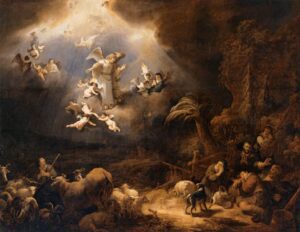
    there were shepherds out in the field, keeping watch over their flock by night.

    9 And an angel of the Lord appeared to them, and the glory of the Lord shone around them, and they were filled with great fear..

    And the angel said to them, “Fear not, for behold, I bring you good news of great joy that will be for all the people. For unto you is born this day in the city of David a Savior, who is Christ the Lord.

    12 And this will be a sign for you: you will find a baby wrapped in swaddling cloths and lying in a manger.”

    13 And suddenly there was with the angel a multitude of the heavenly host praising God and saying,

    “Glory to God in the highest,
    and on earth peace among those with whom he is pleased!”

    16 And they went with haste and found Mary and Joseph, and the baby lying in a manger. And when they saw it, they made known the saying that had been told them concerning this child. And all who heard it wondered at what the shepherds told them.


    The Childhood of the Christ-child

    Luke’s gospel provides some additional detail of the powerful signs and significance of events to follow. Without providing exact dates or itineraries of Joseph, Mary and the Christ-child he gives us some brief insight.

    21 And at the end of eight days, when he was circumcised, he was called Jesus, the name given by the angel before he was conceived in the womb. 22 And when the time came for their purification according to the Law of Moses, they brought him up to Jerusalem to present him to the Lord.

    And when the days of her purification according to the law of Moses were accomplished, they brought him to Jerusalem, to present him to the Lord (As it is written in the law of the Lord, Every male that openeth the womb shall be called holy to the Lord;) And to offer a sacrifice according to that which is said in the law of the Lord, A pair of turtledoves, or two young pigeons.

    Gospel of Luke 2:22-24, King James Version

    Mary’s purification by Mosaic Law would not have taken place until after forty days [ritually, 7 plus 33 more] after JESUS was born.

    THEREFORE, these two important signs involving Simeon and the prophetess Anna although extremely connected to Old Testament prophesy do not add detail to the nativity story of Jesus except as a connection between the birth of the Savior.


    Advent 4 – preparation of the nativity forgotten

    I close with a post-script to the Scripture of our all-too-familiar nativity story.

    When we were children we would open twenty-five windows on a December calendar focused on anticipation of Christmas. Churches typically redecorated for an Advent season leading up to Christmas Day. Many Christians worshipped Christmas Eve and/or Christmas Day.

    Gifts? Yes. But clearly the gift was JESUS born as a CHILD just like we were. (What an irony!)

    Shopping? Parents shopped (mostly Mom). Children just asked for gifts (NOT shopped for whatever our little hearts desired) and we really didn’t know what gift we might get EVEN IF we could just be ‘good.’ I think they shopped for others too, just like baking for neighbors or sending Christmas cards to good friends. GIFTS — for others, NOT shopping and shipping for our SELVES.

    JESUS was a gift of GOD the Father to the world.

    (Every good little Christian boy or girl knew at least that.)

    Santa, reindeer, elves and all the rest? Stories — fables like Aesop’s or the Nutcracker Ballet, not real.. but FUN enough for a bored kid in need of some imagination. BUT St. Nicholas, as nice as the story always shows, was never Jesus — the JESUS of the Gospels also read to us.

    – the Christ of Christmas was no Santa Claus, not a gift-giver but the Gift Himself. The songs and celebrations from the beginning of Advent to the joy of Christmas morning reflected a hope for more than just a merry Christmas, but a life of peace in our brief mortal years of growing up — growing through — growing into a more complete faith in Jesus Christ.

    AND

    WE children raised in a Christian household and local church didn’t have to take anyone’s word for it. WE believed because we believed God, whose very word was right in our hand in a BIBLE presented to us by our local church.

    NO preacher would ever feel the need to CHANGE any of the Gospel — not one jot or tittle of Scripture we could read for ourselves. Nor would a pastor dare reintroduce JESUS with some more personal persona than CHRIST or LORD.

    Do you wonder how Advent has nearly become archaic?

    I know that this previous ‘advent’ post from Matthew 25 in not related to the Nativity or birth of Jesus Christ..

    BUT has our PREACHING forgotten to fill the lamps for the more imminent coming of CHRIST for His Bride?

    Even so, come Lord Jesus.

  • Matthew 25 – Parable of the Ten Virgins

    Matthew 25 – Parable of the Ten Virgins

     Awake, the voice is calling us!

    "Wachet auf, ruft uns die Stimme" (literally: Awake, the voice is calling us) is a Lutheran hymn written in German by Philipp Nicolai, first published in 1599 together with "Wie schön leuchtet der Morgenstern". 
    
    It appears in German hymnals and in several English hymnals in translations such as "Wake, Awake, for Night Is Flying" (Catherine Winkworth, 1858), "Wake, O wake! with tidings thrilling" (Francis Crawford Burkitt, 1906), and "Up! Awake! From Highest Steeple" (George Ratcliffe Woodward, 1908). 
    
    The hymn is known as the foundation of J.S. Bach's chorale cantata Wachet auf, ruft uns die Stimme, BWV 140, as well as being the foundation of settings by other composers.
    
    P. Nicolai wrote the hymn in 1598, a time when the plague had hit. - Source:  BachCantatas.com

    Wake up, the voice calls us
    of the watchmen high up on the battlements,
    wake up, you city of Jerusalem!
    This hour is called midnight;
    they call us with a clear voice:
    where are you, wise virgins ?

    Get up, the bridegroom comes;
    Stand up, take your lamps! Hallelujah!
    Alleluia!
    Make yourselves ready
    for the wedding,
    you must go to meet him!

    Zion hears the watchmen sing,
    her heart leaps for joy,
    she awakes and gets up in haste.
    Her friend comes from heaven in his splendour,
    strong in mercy, mighty in truth.
    Her light becomes bright, her star rises.
    Now come, you worthy crown,
    Lord Jesus, God’s son!
    Hosanna!
    We all follow
    to the hall of joy
    and share in the Lord’s supper.

    May gloria be sung to you
    with the tongues of men and angels,
    with harps and with cymbals.
    The gates are made of twelve pearls,
    in your city we are companions
    of the angels on high around your throne.
    No eye has ever perceived,
    no ear has ever heard
    such joy.
    Therefore we are joyful,
    hurray, hurray!
    for ever in sweet rejoicing.


    Advent 1

    Advent, (from Latin adventus, “coming”), in the Christian church calendar, the period of preparation for the celebration of the birth of Jesus Christ at Christmas and also of preparation for the Second Coming of Christ.

    • In Western churches, Advent begins on the Sunday nearest to November 30 (St. Andrew’s Day) and is the beginning of the liturgical year.
    • In many Eastern churches, the Nativity Fast is a similar period of penance and preparation that occurs during the 40 days before Christmas. The date when the season was first observed is uncertain.
    • Bishop Perpetuus of Tours (461–490) established a fast before Christmas that began on November 11 (St. Martin’s Day), and the Council of Tours (567) mentioned an Advent season.

    Source: Britanica.com


    a woke christmas sunday 2022 CE with Charlie Brown and his broke tree

    a woke OR AWAKE?

    I’m uncertain in these last days of the Common Era (once commonly called Anno Domini, literally in the year of our Lord IF our church is woke or awake.

    (See link to ‘woke’ on TalkofJESUS.com cover page to learn more.)

    I’m also not certain if Linus reading Luke is the anti-inclusive message of the Gospel which offends the Holiday spirits of TV audiences, but I suspect that our aversion to ‘christmas‘ with a capital CHRIST (Christ-mass) is a deepening darkness as evident as the coming winter solstice.

    The title for this non-series for Advent ignored and ‘christian‘ ‘churches‘ CLOSED on christmas eve, christmas day or BOTH reflects my own nonplus question of why it seems so few christians really want to TALK OF JESUS at all, especially those of our local ‘church.’

    Roger@TalkofJESUS.com
    In previous years I have also prepared our hearts for Advent.
    From Advent in the year of our Lord 2014

    In fact, December in the year of our Lord 2022 seems to be a time to gather the oil for our lamps that at least some of the virgins might be prepared for Christmas .. in fact, prepared for more.


    the Gospel of Jesus Christ according to Matthew

    Doctrinally, it must be repeated that the belief in the Virgin birth of Christ is of the highest value for the right apprehension of Christ’s unique and sinless personality.

    R. A. Torrey :: The Virgin Birth of Christ

    The book of the generation of Jesus Christ, the son of David, the son of Abraham..

    Now the birth of Jesus Christ was on this wise: 

    When as his mother Mary was espoused to Joseph, before they came together, 

    she was found with child of the Holy Ghost.

    Gospel of Matthew 1:18 – King James Version

    Therefore, Sleepers AWAKE!

    Parable of Ten Virgins

    “Then the kingdom of heaven may be compared to ten virgins, who took their lamps and went out to meet the bridegroom. Now five of them were foolish, and five were prudent.

    “For when the foolish took their lamps, they took no oil with them, but the prudent took oil in flasks along with their lamps.

    “Now while the bridegroom was delaying, they all got drowsy and began to sleep. But at midnight there was a shout,

    ‘Behold, the bridegroom! Come out to meet him.’

    “Then all those virgins rose and trimmed their lamps. And the foolish said to the prudent, ‘Give us some of your oil, for our lamps are going out.’

    “But the prudent answered, saying, ‘No, there will not be enough for us and you too; go instead to the dealers and buy some for yourselves.’

    “And while they were going away to make the purchase, the bridegroom came, and those who were ready went in with him to the wedding feast;

    and the door was shut.

    “And later the other virgins also came, saying, ‘Lord, lord, open up for us.’

    “But he answered and said, ‘Truly I say to you, I do not know you.’

    “Therefore, stay awake, for you do not know the day nor the hour.


    A Caution of Jesus Christ to His betrothed, the Church

    This hour is called midnight;
    they call us with a clear voice:
    where are you, wise virgins ?

    Advent AD 2022: Are YOU awake?

    A Savior IS come.
    Christ died. Christ IS risen! Christ will come again.

    Are YOU preparing your soul with the oil of Christ’s anointing in the advent of His return?