Tag: Gospel

The Gospel is Good News to all who will humbly accept Jesus and listen to His teaching.

We refer to the four books of the Bible which tell the story of Jesus Christ as the Gospels. These books are named for their authors: Matthew, a Jewish Apostle; Mark, a disciple of the first generation who recorded accounts of Peter and the Twelve; Luke, a gentile Physician and disciple of the first century; and John, one of the Twelve Jewish Apostles chosen by Jesus.

  • Through Many Afflictions Saul and Joseph return to Antioch

    Through Many Afflictions Saul and Joseph return to Antioch

    What afflictions, which tribulations will we suffer for our witness of the Gospel of Jesus Christ?

    ~AD 49 - a return journey
    
    [Just a reminder that Paul is a more local name for Saul from Tarsus beyond the imposing Guyik and Taurus mountains and many brothers address Joseph of the island of Cypress by his encouraging nickname, Barnabas.]
    
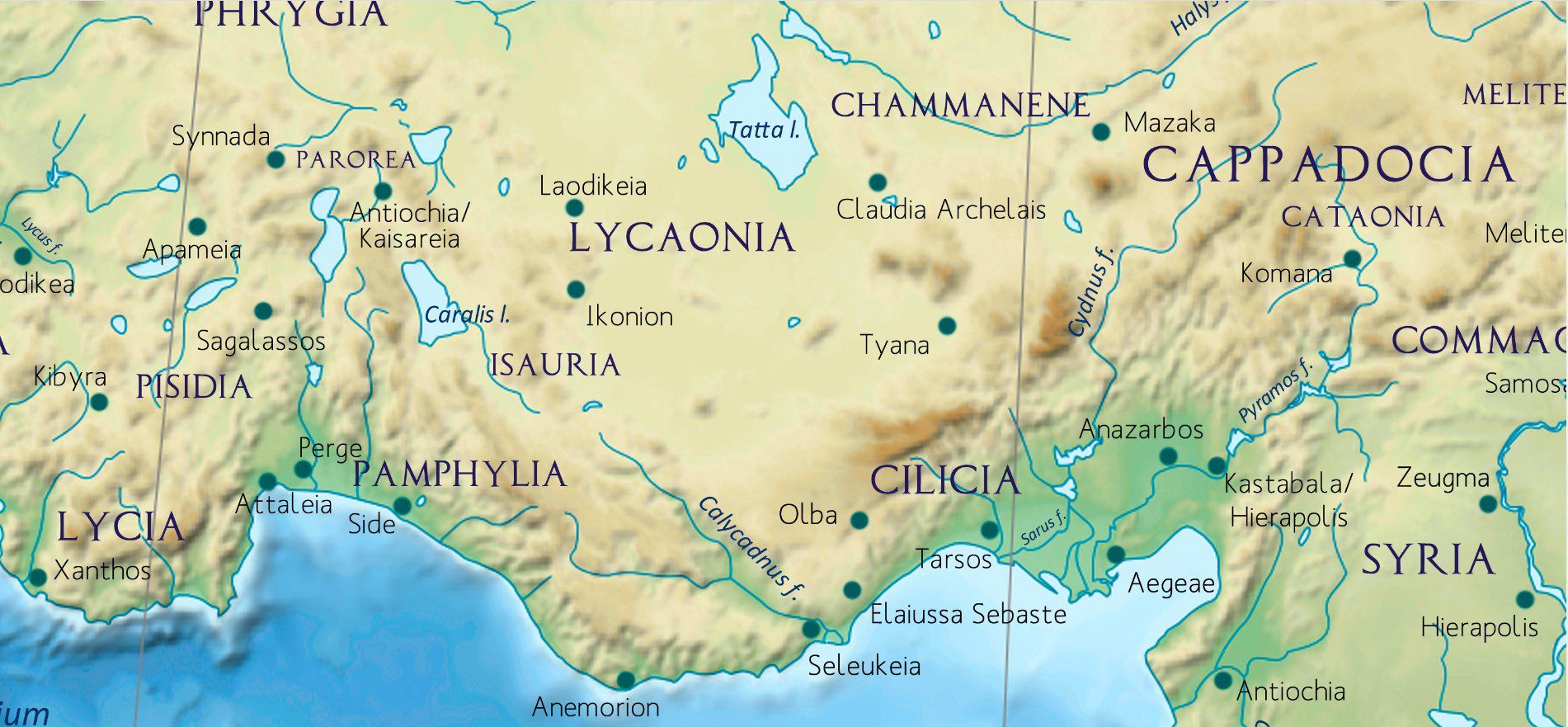
      - from remote Derby through Lycaonia to Antioch through Pisidia & Pamphylia to Perga and sailing from Attalia (without returning to Cypress) to their home port in Syria to Antioch.

    Joseph of Cypress and Saul of Tarsus have endured many afflictions for the Gospel, even a stoning of Saul (as he had once witnessed of Stephen in Jerusalem).

    Barnabas

    You’ll recall that Joseph of Cypress, known to his friends as Βαρναβᾶς or son of encouragement is a very Jewish Levite.

    Now Joseph, a Levite of Cyprian birth, who was also called Barnabas by the apostles (which translated means Son of Encouragement)

    Acts of the Apostles 4:36 LSB

    Joseph had devoted his life to the Apostles’ teaching and gave them money from selling a field. This highly respected older man from Cypress had brought the feared young and zealous Pharisee Saul to the Apostles vouching for the authenticity of his conversion and teaching since encountering Christ.

    Even then he was talking and arguing with the Hellenistic Jews, but they were attempting to put him to death.

    So the Church at Jerusalem, led by the Apostles, sent Saul off to the Church at Antioch, nearer to Tarsus as well as Cypress.

    Barnabas continues mentoring a young Saul of Tarsus known to the Gentiles as Paul.

    The Church at Antioch sends them out to Cypress along with Joseph’s nephew John Mark. From there these two apostles proceed to cities and small towns in the Taurus Mountains.

    As a reminder: 
    Luke publishes ACTS OF THE APOSTLES in about AD 62 as a historical account for a growing Church.
    
    This FIRST MISSIONARY JOURNEY of the Apostles PAUL & BARNABAS occurs over several months and many miles in about AD 47-49.
    

    Another Rising of Saul

    Not too many men or women ever suffer the afflictions of Saul OR the miraculous raisings of a man who seems to have been struck down by God and men to persevere in more persecution for the Gospel of Jesus Christ.

    conversion of saul on the road to Damascus

    and falling to the ground, he heard a voice saying to him, “Saul, Saul, why are you persecuting Me?”

    And he said, “Who are You, Lord?”

    And He said, “I am Jesus whom you are persecuting,

    Acts of the Apostles 9:4-5 LSB
    The Jews are divided by Paul’s Gospel of the Messiah Jesus

    Acts of the Apostles 14:

    19 But Jews came from Antioch and Iconium, and having persuaded the crowds, they stoned Paul and dragged him out of the city, supposing that he was dead.

    Derbe where Paul and Barnabas fled after they were first worshipped as Zeus & Hermes in Lystra then suffered afflictions by the crowds

    20 But while the disciples stood around him, he rose up and entered the city.

    The next day he went away with Barnabas to Derbe.

    21 And after they had proclaimed the gospel to that city and had made many disciples..

    Dr. Luke once again accounts for not only the miracle of Paul's rising after being stoned to death and his battered frame dragged out of Lystra, but again that they 'had made many disciples' of the risen Lord Jesus in Derbe.
    

    Their Return Journey to Antioch Pisidia

    map of return journey of Paul and Barnabas from first missionary journey
    [from Derbe] .. they returned to Lystra and to Iconium and to Antioch, strengthening the souls of the disciples..

    The Apostles’ Parting Message:

    .. encouraging them to continue in the faith, and saying,

    “Through many afflictions we must enter the kingdom of God.”

    θλῖψις – Afflictions, Tribulations, Pressure & Persecution

    So you want to enter the kingdom of God?

    You hope for THE LIFE in a risen KING- the Son of God JESUS.

    AND THIS IS the GOSPEL GOOD NEWS Paul proclaims?

    thlipsis STRONGS G2347:

    properly, a pressing, pressing together, pressure (Strabo, p. 52; Galen); in Biblical and ecclesiastical writings, a Greek metaphor, oppression, affliction, tribulation, distress, straits;

    Then shall they deliver you up to be afflicted, and shall kill you: and ye shall be hated of all nations for my name’s sake.

    Gospel of Matthew 24:9 KJV – a prophesy of Jesus to his disciples

    Paul and Barnabas have already seen much tribulation. But now others – Jewish converts, Hellenists, even Roman believers among so many saints of these growing churches will also suffer afflictions as disciples of the Gospel of Jesus Christ.

    The Gospel of Paul comes with more than a change of heart and soul – these Christians will see afflictions and tribulations — troubles never before encountered when they did not claim the risen Christ Jesus as their Lord.

    Galatia map with its capitol Pisidian Antioch

    The SOULS of the disciples of these NEW CHURCHES will need much STRENGTHING from leaders ENCOURAGING them to CONTINUE in THE FAITH.

    Paul and Barnabas will continue that work which they begun by returning to these new disciples on their return journey to the Church at Antioch from which they were sent out by the Holy Spirit and church.

    A foundational ministry in the mountains

    • they had proclaimed the gospel [in Derby] and had made many disciples,
    • they returned
      • to Lystra
      • and to Iconium
      • and to Antioch

    And when they had appointed elders for them in every church, having prayed with fasting, they commended them to the Lord in whom they had believed.

    Acts of the Apostles Paul and Barnabas 14:23
    Antioch Pisidia map
    And when they passed through Pisidia, they came into Pamphylia. – ACTS 14:24

    And when they had spoken the word in Perga, they went down to Attalia.

    route of Paul and Barnabas returning to Antioch Syria after first missionary journey
    Acts of the Apostles 14 – Paul & Barnabas’ return from first missionary journey

    And from there they sailed to Antioch, from where they had been committed to the grace of God for the work that they had fulfilled.

    Home in Antioch (Syria)

    This Ancient Roman road connected Antioch and Chalcis.

    And when they had arrived and gathered the church together,

    they began to report all things that God had done with them and how He had opened a door of faith to the Gentiles.

    And they spent not a little time with the disciples.

    This first missionary journey of Paul and Barnabas has taken about two years. The apostles (ones sent out) of the Gospel have much to share with the disciples (followers) of the risen Christ Jesus. 
    
    NEXT: In Acts of the Apostles 15 Luke will record some differences in worship yet to be worked out between Christians in Antioch and disciples of Christ in Judea and other parts of Syria.
    

    Acts Apostolos - Acts of the Apostles - the chronicles of Christ's Apostles - a history of Christ's Church

    To be continued…

  • The gods have become like men

    The gods have become like men

    Idolatry – Men create their gods

    Imagine an EMPIRE – like the powerful GREECE of Alexander the Great.

    Empire of Alexander the Great 336-323 BC
    This map shows the vast empire conquered by Alexander the Great in red highlight. The extent of the empire is an approximation of 320 BC.
    • The number of Greek gods may be more than 3000, with 1-4 dozen main gods including Zeus and other ‘family.’
    For a humorous look at the idol gods:
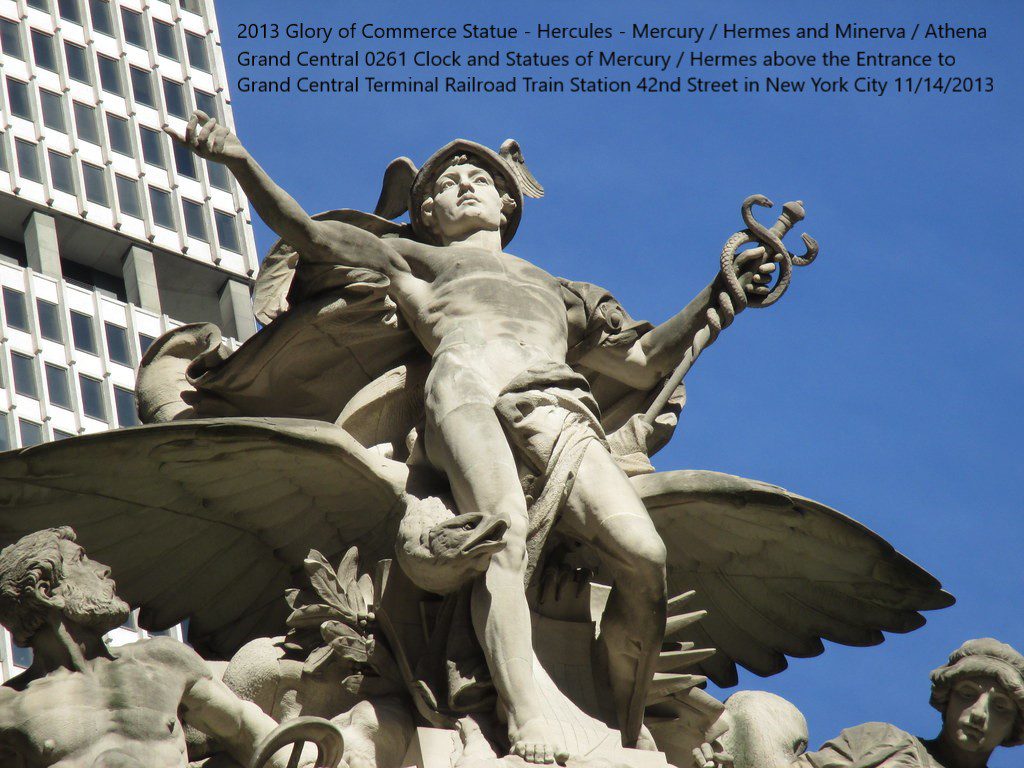
    - visit this source about the god Hermes [pictured in NYC for this post] from godchecker.com 
    
    Greek Mythology is a veritable blockbusting soap opera. What can Zeus possibly get up to next — and with whom? How will Hera take her next revenge? Where will Aphrodite discard her nightie? Who has been barred from Olympus lately — and why? When is the next big punch-up? And will Hermes be sued for selling counterfeit sheep? 

    Imagine an EMPIRE – like the powerful ROME of the Caesars.

    Roman Empire AD14 with Parthia to the east beyond Roman Syria
    Rome continually changed names of regions and borders they administered so some would have changed by AD 48 when Paul and Barnabas journeyed through the cities of the Taurus Mountains and yet again by the time Luke published Acts of the Apostles ~AD 62.
    • The multitudes of Roman gods include Jupiter as head of a dozen deities similar to several gods and goddesses of Greek mythology plus ancient gods and goddesses of captive cultures inclusively embraced in exchange for a Pax Roma.

    Julius Caesar was the first Roman leader to be called “god” and “savior,” which became dominant phrases in Roman Imperial theology.

    The idea behind these lofty titles was that while the Roman Republic collapsed in the first century BC, Julius Caesar but mostly his son Caesar Augustus resurrected Rome from the dead.

    Καισαρ Source for more interesting background – ABARIM Publications

    Imagine a 21st century EMPIRE – like THE UNITED STATES or others.

    Let Us Beat Swords Into Ploughshares is a bronze sculpture by artist Evgeniy Vuchetich (1908 ¬– 1974). Vuchetich was an esteemed Soviet sculptor and artist well-known for his heroic monuments.

    It stands outside the U.N. Building in New York City, United States of America as another empire wield their swords once more to destroy the plowshares of their enemies. – RH

    Beat your plowshares into swords, and your pruninghooks into spears: let the weak say, I am strong. Assemble yourselves, and come, all ye heathen, and gather yourselves together round about: thither cause thy mighty ones to come down, O LORD.

    Joel 3:10-11 KJV

    Micah 4:2 וְֽהָלְכוּ גּוֹיִם רַבִּים וְאָֽמְרוּ לְכוּ וְנַעֲלֶה אֶל־הַר־יְהוָה וְאֶל־בֵּית אֱלֹהֵי יַעֲקֹב וְיוֹרֵנוּ מִדְּרָכָיו וְנֵלְכָה בְּאֹֽרְחֹתָיו כִּי מִצִּיּוֹן תֵּצֵא תוֹרָה וּדְבַר־יְהוָה מִירוּשָׁלִָֽם׃

    And he [the LORD] shall judge among many people, and rebuke strong nations afar off; and they shall beat their swords into plowshares, and their spears into pruninghooks: nation shall not lift up a sword against nation, neither shall they learn war any more. – Micah 4:3 KJV

    Idolatry – Quick U-turns by Men claiming gods

    So you say that idolatry such as that Paul and Barnabas encountered in Lystra over two millennia ago no longer exists.

    Look a bit closer, you who have thus far survived 21st century multitudes of celebrity leader gods and goddesses who wield the swords of godless tongues and imagery of gods against the crowds they would overcome.

    ~48 AD

    Previously in Acts 14:8-10, a miracle of God in Lystra through Paul and Barnabas.
    And when the crowds saw what Paul had done, they raised their voice, saying in the Lycaonian language, “The gods have become like men and have come down to us.” Acts 14

    Acts of the Apostles Paul and Barnabas continued

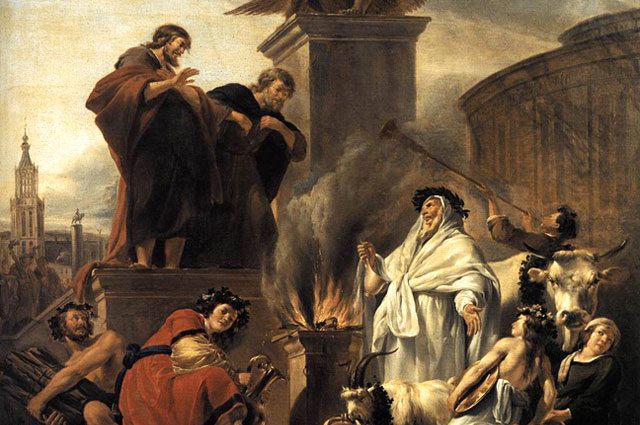
    “The gods have become like men and have come down to us.” And they began calling Barnabas, Zeus, and Paul, Hermes, because he was the chief speaker.

    And the priest of Zeus, whose temple was just outside the city, brought oxen and garlands to the gates, and was wanting to offer sacrifice with the crowds.

    The Statue of Zeus 41 feet tall made by the Greek sculptor Phidias around 435 BC at the sanctuary of Olympia, Greece, Temple of Zeus, the sky and thunder god in ancient Greek religion.
    The Statue of Zeus at Olympia was a giant seated figure, about 12.4 m (41 ft) tall,[1] made by the Greek sculptor Phidias around 435 BC at the sanctuary of Olympia, Greece, and erected in the Temple of Zeus there. Zeus is the sky and thunder god in ancient Greek religion

    But when the apostles Barnabas and Paul heard of it, they tore their garments and rushed out into the crowd, crying out and saying,

    “Men, why are you doing these things?

    We are also men of the same nature as you, proclaiming the gospel to you that you should turn from these vain things to a living God, WHO MADE THE HEAVEN AND THE EARTH AND THE SEA AND ALL THAT IS IN THEM who in the generations gone by He permitted all the nations to go their own ways;

    and yet He did not leave Himself without witness, in that He did good and gave you rains from heaven and fruitful seasons, filling your hearts with food and gladness.”


    WHAT has just happened?

    Two Jewish travelers walk into a Lycaonian town in the mountains of Greece where most men are probably not educated philosophers, priests or Roman officials who know something of the Hebrews and their religion which holds to only ONE GOD, an inconceivable concept to pagans led to worship stone idols in grand temples built long ago in their town.

    BUT, these two men perform a miracle which most certainly must be a sign from a MOST Powerful God of Heaven — to them, ZEUS.

    Is this ZEUS IN PERSON?

    IS THIS MAN in our midst a savior to be worshiped? (For he has done the impossible and we witnessed it.) We’ll go get this god’s priest from his temple at the gate of our city Lystra AND prepare a great sacrifice in honor of these two gods with us, Zeus and Hermes.

    THEN these two strangers tore their clothes and ran in among the multitude and gods don’t stoop down to such things even IF they have come among us to have a mortal man stand.

    SO these men who tricked us into thinking they were the gods Zeus and Hermes have told us to turn from OUR gods to their GOD.


    And saying these things, with difficulty they restrained the crowds from offering sacrifice to them.

    Acts of the Apostles Paul and Barnabas in Lystra 14:18
    To be continued...
    
  • The Lame Walk a Sign from God

    The Lame Walk a Sign from God

    A Sign of Faith in Capernaum

    ~A.D. 27Jesus in Galilee

    “Which is easier, to say, ‘Your sins have been forgiven you,’ or to say, ‘Get up and walk’?

    Gospel of Luke 5:43 LSB

    “But, so that you may know that the Son of Man has authority on earth to forgive sins,”—He said to the paralytic—

    “I say to you, get up, and, picking up your stretcher, go home.”

    Good News of Luke 5:44

    Of course, a paralyzed man obeying Jesus’ command to ‘get up and walk’ is a miracle to the man who can now stand up and walk AND a sign of God to those who witness it!

    Who can say such a thing to one born handicapped?

    And immediately he rose up before them, and picked up what he had been lying on, and went home glorifying God. And astonishment seized them all and they began glorifying God; and they were filled with fear, saying,

    “We have seen remarkable things today.”


    But this was a sign to the Jews.

    Luke records [5:17]:

    And it happened that one day He was teaching; and there were some Pharisees and teachers of the law sitting there, who had come from every village of Galilee and Judea and from Jerusalem, and the power of the Lord was present for Him to perform healing.

    After having healed others as well Jesus answered the Prophet John who had been baptizing in the wilderness of Judea with Good News sent by his messengers:

    “Go and report to John what you have seen and heard: the BLIND RECEIVE SIGHT, the lame walk, the lepers are cleansed, and the deaf hear, the dead are raised up, the POOR HAVE THE GOSPEL PREACHED TO THEM. 
    
    Blessed is he who does not take offense at Me.” - Gospel of Luke 7:22b-23, LSB
    

    But of course, these signs from the LORD God to the Jews were done by JESUS the Messiah.

    These signs for the Jews where witnessed in regions of Roman Syria AND that had been years ago.

    It’s about two decades later that Paul and Barnabas will enter Lystra.

    A.D. 30’s – The Apostle Peter

    But when Peter, along with John, fixed his gaze on him, he said, “Look at us!” – Acts 3:4

    And seizing him by the right hand, he raised him up; and immediately his feet and his ankles were strengthened. And leaping up, he stood upright and began to walk; and he entered the temple with them, walking and leaping and praising God.

    And all the people saw him walking and praising God; and they were recognizing him, that he was the one who used to sit at the Beautiful Gate of the temple to beg alms, and they were filled with wonder and amazement at what had happened to him. – Acts of the Apostles 3:


    More recent signs from God

    Keep in mind that Luke's two-part account of these events is recorded for a Roman-Hellenist world after A.D. 60, 
    + some thirty years after Jesus' resurrection [~A.D. 30],
    + perhaps twenty-five years after Saul's encounter with Christ on the road to Damascus,
    + about seven years [~A.D. 40] after the Apostle Peter baptizes a Roman Centurion in Caesarea Syria.
    And Peter said to him, “Aeneas, Jesus Christ heals you. Rise up and make your bed.” Immediately he rose up. – Acts 9:

    And all who lived at Lydda and Sharon saw him, and they turned to the Lord.

    Acts of the Apostles 9:35 LSB
    Roman Caesarea [pictured] where Peter baptized Roman believers who received the Holy Spirit!

    And what had Peter heard from the angel of God?

    “Get up..”

    ἀνίστημι – anistēmi

    It’s a command of some significance — a command by faith also used by Peter and the Lord Jesus. And it is part of what the Apostle Paul is about to say to the lame man in Lystra.

    • to rise, stand up
      1. of persons lying down, of persons lying on the ground
      2. of persons seated
      3. of those who leave a place to go elsewhere [of those who prepare themselves for a journey]
      4. of the dead

    GOD’S signs have many witnesses among the gentiles by the time Barnabas and Saul enter Lystra.

    ~A.D. 48

    In Lystra The Lame Walk!

    Lystra and Derbe in the Taurus Mountains of Turkey

    Acts of Faith in Lystra 14:

    And at Lystra a man was sitting who had no strength in his feet, lame from his mother’s womb, who had never walked.

    This man listened to Paul as he spoke, who, when he fixed his gaze on him and saw that he had faith to be [made well] said with a loud voice,

    “Stand upright on your feet.”

    Acts 14:10 of Paul commanding a lame man in Lystra

    And he leaped up and began to walk.

    And when the crowds saw what Paul had done, they raised their voice, saying in the Lycaonian language,

    “The gods have become like men and have come down to us.”

    Acts of the Apostles 14:11b – LSB

    In fact, these Lycaonian pagans were partially right.

    For the Gospel of Paul and Barnabas would reveal that the One God, Father of our Lord Jesus Christ sent his only Son down to us for redemption of sins for those who have faith to believe — even pagan gentiles.

    “Which is easier, to say, ‘Your sins have been forgiven you,’ or to say, ‘Get up and walk’?

    Gospel of Luke 5:43 LSB

    Acts of the Apostles in Lystra — To be continued…