Tag: jeremiah

  • 3 John – When Truth Prevails Among Friends

    3 John – When Truth Prevails Among Friends

    Is Truth the standard for preaching in your church?

    And is honesty concerning Christ a measure of your hospitality and love of other believers?


    Walking in Truth and Love

    Now that you are separated to holiness by the risen Jesus Christ, who must a saint believe?

    NOT every Rabbi — not every Bishop, any Priest or supposed Prophet; not every emotional pastor or passing spirit-led performance; not the powerful preacher of visionary change.

    Many would mislead you.

    map of Ephesus near the churches where John was an Elder "an epistle from John - Elder to the Churches 1 John 2 john 3 John

    The Elder of Ephesus and nearby church gatherings of saints in first century Asia Minor had already heard of or encountered many false teachers and their heretical teachings concerning the Lord Jesus Christ.

    At the time of his final epistle (most likely in the A.D. 90’s), John is the only remaining Apostle. John’s Apostolic authority is unquestionable, as is the Elder’s dedication in witness of the Way, the Truth and the Life of Christ.

    Jesus said to him [the Apostle Thomas],

    “I am the way, and the truth, and the life. No one comes to the Father except through me.

    John 14:6 ESV

    John’s witness of the Truth of Christ Jesus becomes immediately evident in this — the Apostle’s final letter.

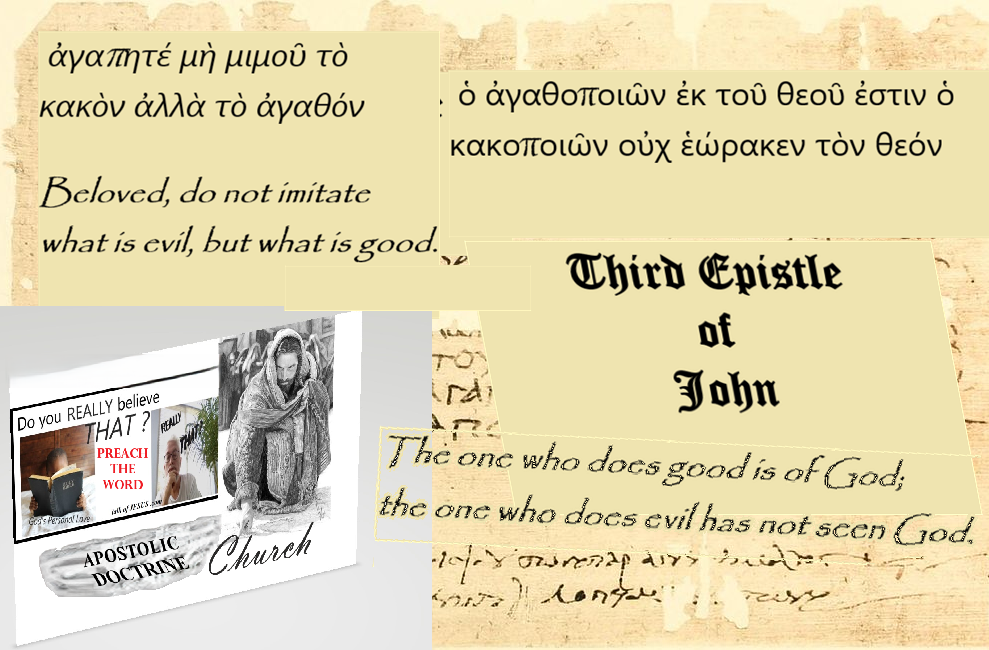
    Third Epistle of John Do you really believe that? The one who does good is of God; the one who does evil has not seen God.

    III John

    The elder

    πρεσβύτερος - presbyteros - elder

    to the beloved Gaius, whom I love in truth.

    Beloved, I pray that in all respects you may prosper and be in good health, just as your soul prospers. For I rejoiced greatly when brothers came and bore witness to your truth, that is, how you are walking in truth.

    3 John 1:2-3 NKJV


    Γάϊος – Gaius

    The Elder receives a letter from his dear friend [agapētos] Gaius responding positively that indeed John hopes to visit these believers personally soon after his response arrives.

    Gaius is a common Greek name and he could be:

    • a Macedonian delegate from Derbe who earlier had accompanied Paul to Jerusalem [Acts 20:4] or
    • a Corinthian, one of two men baptized by Paul and/or
    • later, Paul’s host (the Elder or Bishop of Thessalonica) [Acts 18:7]
    • or possibly yet another Gaius with this common name
    Referring to those Gaius leads in his local church John rejoices: 

    I have no greater joy than these things that I hear of my children walking in the truth.

    3 John 1:4 – Darby Translation


    Friendship Worthy of God

    The Apostles Peter, Paul and others had been executed for their faith some twenty years ago in Rome. Many more Christians were constantly martyred in since then throughout the Empire.

    The recipient of the Elder’s final epistle recognizes the witness of his hospitality to these evangelists — many who might soon die in witness to the gospel of the risen Lord Jesus Christ.

    Now (sometime around the year of our Lord 90-95), John commends the faithful boldness of his dear (and probably long-time) friend Gaius.

    Beloved, it is a faithful thing you do in all your efforts for these brothers, strangers as they are, who testified to your love before the church.You will do well to send them on their journey in a manner worthy of God.

    3 John 1:5-7 ESV

    The Elder is essentially putting his Apostolic seal of approval on the witness of these beloved, specific evangelists (missionaries).

    Therefore we ought to support people like these, that we may be fellow workers for the truth.

    3 John 1:8

    DO NOT MISS the lasting long relationship of more than twenty years between the Elder John and Elders of other churches throughout the Roman Empire.


    Followers of Christ must always expect an attack against Scripture. Church doctrine is a line in the sand. - How will a leader or council of leaders choose what the Church will teach?

    I have written something to the church

    .. but Diotrephes, who loves to have the preeminence among them, does not receive us.

    3 John 1:9 NKJV

    This is why, if I come, I will remind him of the works he is doing, slandering us with malicious words.

    And he is not satisfied with that!

    He not only refuses to welcome fellow believers, but he even stops those who want to do so and expels them from the church.

    3 Epistle of John 1:10 CSB


    The Elder has an enemy opposed to Apostolic doctrine and authority.

    True saints of Christ will recognize such evil gate-keepers of false faith as an antichrist! And John intends to correct their growing heresy in person with his beloved true Christian friend Gaius.

    Yield to Good but Not Evil

    Here the Apostle measures this heretical behavior of Diotrephes, who stands against the true gospel of Christ. John advises his faithful friend with this Apostolic standard:


    Beloved [agapētos] follow not that which is evil [kakos ], but that which is good.

    3 John 1:11a KJV

    Before we go forward with John's Apostolic rule, let's make certain that WE the saints of the Church understand both GOOD and EVIL. 

    Many versions of 3 John v.11 read:

    do not imitate what is evil

    Strong’s G2556 – kakos

    κακός, κακῇ, κακόν, the Sept. for רָע (from Homer down), bad (A. V. (almost uniformly) evil);

    (morally, i. e.) of a mode of thinking, feeling, acting; base, wrong, wicked: of persons,

    universally, of a bad nature; not such as it ought to be.

    John applies this to this wicked gate-keeper of his hometown church, comparing his own standard of judging who belongs in the Church and who does not to the true hospitality of of the Truth of Christ as the Shepherd of flocks, with the Apostles of Jesus as true witness of the Gospel and teachings of our Lord.


    A previous warning concurrently in circulation

    Although the later canon of Scripture places Revelation after this epistle (and that of Jude), some historical scholarship suggests that the Apocalypse of John may have been written prior to this brief letter — the Elder’s third epistle. Perhaps you might recognize a type of Diotrephes in the message to the angel of Ephesus:

    “I know your works, your labor, your patience, and that you cannot bear those who are evil. And you have tested those who say they are apostles and are not, and have found them liars;

    “and you have persevered and have patience, and have labored for My name’s sake [that of the risen Lord Jesus Christ] and have not become weary.

    The Revelation of Jesus Christ to John 2:2-3 NKJV

    but imitate good

    ἀγαθός – Strong’s G18 – agathos

    a primary word; “good” (in any sense, often as noun):—benefit, good(-s, things), well.


    This comparison between evil and good by the Lord Jesus calls believers to faithfulness imitating God our Father in heaven.

    “If you then, being evil, know how to give good gifts to your children, how much more will your Father who is in heaven give good things to those who ask Him!

    Gospel of Matthew 7:11 NKJV

    John in his gospel also quotes Jesus concerning good.

    For as the Father has life in himself, so he has granted the Son also to have life in himself. And he has given him authority to execute judgment, because he is the Son of Man.

    Do not marvel at this, for an hour is coming when all who are in the tombs will hear his voice and come out,

    those who have done good to the resurrection of life,

    and those who have done evil [φαῦλος phaûlos, “foul” or “flawy”, i.e. (figuratively) wicked:—evil]

    to the resurrection of judgment.


    Gospel of John 5:26-29 ESV, with a definition of evil


    Deciding between Friends

    John writes to a mutual brother faithful to the Lord Jesus and the teaching of the Apostles. But how does the Elder (and Apostle) advise his dear friend to lead?

    Short answer: enroll a second brother in the Lord known to be true to the truth of the Gospel.

    Demetrius is well spoken of by everyone—and even by the truth itself. We also speak well of him, and you know that our testimony is true.

    3 John 1:12 NIV

    John writes briefly with all the Authorithy of Apostolic leading of the Church. He enlists allies grounded in truth. And most of all John emphasizes that he and others must confront this controversy in person (lest it get out of hand at the leading of this wicked so-called christian).

    I have much to write you, but I do not want to do so with pen and ink. I hope to see you soon, and we will talk face to face.

    3 John 1:13-14a NIV


    εἰρήνη – eirēnēPeace

    The beloved Elder closes his final Apostolic Epistle with a seemingly common word of distant greeting; but it is indeed a peace that we do not understand and practice too little as the saints saved by the risen Christ Jesus.

    εἰρήνῃ σοί ἀσπάζονταί σε, οἵ φίλοι ἀσπάζου τούς φίλους κατ᾽ ὄνομα

    • Peace be to thee.
    • Our friends salute thee.
    • Greet the friends by name.

    3 John closing salutation – King James Version

    From Strong’s G1515 – eirēnē, PEACE

    is between individuals, i.e. harmony, concord; the Messiah’s peace, the way that leads to peace (salvation); the tranquil state of a soul assured of its salvation through Christ, and so fearing nothing from God and content with its earthly lot, of whatsoever sort that is; the blessed state of devout and upright men after death — as well as: a state of national tranquillity; exemption from the rage and havoc of war

    Do the saints of your church struggle with this?

    The Ephesians, to whom John writes did!


    And the Elder adds a call to reciprocal love as well:

    Our friends [Philos] salute you.

    Most certainly John would recall the words of Jesus from more than sixty years ago — again and again in correspondence as well as personal encounters with his fellow believers…

    Greater love hath no man than this, that a man lay down his life for his friends. G5384 Ye are my friends, G5384 if ye do whatsoever I command you.


    Gospel of John 15:13-14 KJV

    .. I have called you friends; G5384  for all things that I have heard of my Father I have made known unto you.

    Gospel of John 15:15b – the words of JESUS to His Apostles

    These things I command you, that ye love one another.

    John 15:17

    Philos, friend, obeys Christ’s commands of love and truth. Our salutation to each other is that of love and peace.


    Greet the friends by name. Again, a mutual and personal greeting between beloved friends, this translation of ‘greet’ using the same Greek word as ‘salute.’

    Certainly those receiving the Elder’s third epistle looked forward to Johns upcoming personal visit, God-willing. From the Apostle’s very lips they will receive the truth of Christ and follow The Way prescribed by John and the Apostles of JESUS.


    Apostles' Creed - TalkofJESUS.com Doctrine

    Would your church welcome the Elder IF the Apostle John and his friends were coming to challenge an errant teacher or preacher of your local gathering?


    What has happened to the TRUTH

    among worshippers of God?

    Each one betrays his friend;

    no one tells the truth.

    They have taught their tongues to speak lies;

    they wear themselves out doing wrong.

    Jeremiah 9:5 CSB

    It was a tragic punishment of the Jews to be exiled, it would become a tragic consequence for a church which would later abandon truth for control in a medieval world.

    He who saw this has testified so that you also may believe. His testimony is true, and he knows he is telling the truth.


    I have no greater joy than this: to hear that my children are walking in truth.

    Gospel of John 19:35; Third Epistle of John 1:4 CSB

    APOSTOLIC FAITH 2 Peter 2 Timothy from Paul 2 John & 3 John

    Comment on Scripture – Share the Gospel

    Talk of JESUS . com

  • a Roman Conclusion – Acts of the Apostles

    a Roman Conclusion – Acts of the Apostles

    Several missionary stops of the apostle Paul before going to Rome - Acts of the Apostles

    All roads lead to Rome

    Who has not heard the expression recalling a time of glory for the Roman Empire of the A.D. first century?

    But this second account of the Hellenist physician Luke records that the Gospel is sent out from Jerusalem and then Antioch.

    “But you will receive power when the Holy Spirit has come on you, and you will be my witnesses in Jerusalem, in all Judea and Samaria, and to the ends of the earth.”

    Acts of the Apostles 1:8 CSB – words of the risen Jesus to His disciples

    The apostles and the brothers and sisters who were throughout Judea heard that the Gentiles had also received the word of God.

    Acts 11:1 CSB

    For a whole year they [Barnabas and Paul] met with the church and taught large numbers. The disciples were first called Christians at Antioch.

    Acts of the Apostles 11:26 CSB

    Paul’s Previous 3 Missionary Journeys

    READ MORE about the timeline of Paul's missions with numerous maps of the Roman world of the A.D. 1st century. 

    An Apostle known by his Letters

    Epistle of Paul to the Romans 1 - the Apostles sends a church letter to Rome and the local saints of area churches
    Epistle of Paul to the Romans

    As did Peter, John, James and others, the Apostle Paul communicates with converts to Christ frequently by letter, in addition to their Apostolic missions to live and worship with these believers for a time.

    but we preach Christ crucified, to the Jews a stumbling block and to the Greeks foolishness - 1 Corinthians 1:23a

    • AD 57

    Two years BEFORE Paul is brought to Rome on spurious charges of the Jews and the Apostle’s appeal to Caesar Nero (as a Roman citizen), Paul writes his masterful theological Epistle to the Romans, instructing his fellow Roman citizens in the Gospel of Jesus Christ.

    We will read more of the Apostle's personal joy in meeting these Romans shortly. 
    • AD 60-62
      • From Rome (and possibly other cities away from Rome) the Apostle to the Gentiles writes to the church in:
        • Ephesus, Philppi and Colossae
        • a letter concerning Philemon
    • AD 62-66
      • Paul writes a first pastoral letter to Timothy
      • and also to Titus
    • July 19, AD 64 – Caesar Nero burns Rome, blames and persecutes the Christians, Apostle’s under house arrest face execution at Nero’s command
    • AD 66-67 – Facing imminent execution (as does the Apostle Paul, now in Rome), Peter writes a second and final pastoral epistle to Timothy to encourage and guide the Church.

    Paul brought to Rome

    Malta - Earth view of Malta in the Mediterranean Sea

    Previously, we left the Apostle having survived a shipwreck in Malta.

    The Centurion Julius, the Apostle Paul and now more than 300 men witness the power of God in Christ’s Apostle to the gentiles delayed in a violent storm on his way to Rome.

    In these few verses THREE MONTHS PASS.


    ACTS of the Apostles 28 – Conclusion

    After three months we set sail in an Alexandrian ship that had wintered at the island, with the Twin Gods as its figurehead.

    12 Putting in at Syracuse, we stayed three days.

    13 From there, after making a circuit along the coast, we reached Rhegium. After one day a south wind sprang up, and the second day we came to Puteoli.

    CSB

    Where we found brethren, and were desired to tarry with them seven days: and so we went toward Rome.

    Acts 28:14 KJV

    140 miles (225 kilometers) southeast of Rome. “Puteoli” literally means “little wells” in reference to the many hydrothermal wells that were in the city, which was well-known as a large port that could accommodate big ships.

    In fact, adjacent to Puteoli was Misenum, the Roman naval base that housed the largest naval fleet in the ancient world. Earthquakes have since sunk most of Puteoli under water.

    Source: Bibleversestudy.com


    And the brothers, when they heard about us, came from there as far as the Market of Appius and Three Inns to meet us.

    When Paul saw them, he thanked God and took courage.

    Paul escorted to Rome along the Appian Way

    And when we entered Rome,

    Paul was allowed to stay by himself,

    with the soldier who was guarding him.

    Acts 28:16 LSB

    Paul Addresses Prominent Jews of Rome

    And it happened that after three days Paul called together those who were the leading men of the Jews,

    and when they came together, he began saying to them,

    Brothers, though I had done nothing against our people or the customs of our fathers, yet I was delivered as a prisoner from Jerusalem into the hands of the Romans.

    And when they had examined me, they were willing to release me because there was no ground for putting me to death. But when the Jews [spoke against me], I was forced to appeal to Caesar, not that I had any accusation against my nation.

    Acts 28:17-19


    Note two points from Paul's self-introduction to the Roman Jews: 

    The Apostle refers to himself as a brother of these Jews, also referring to OUR people, customs and fathers [patrōos].

    Paul had identified with the fathers of the faith in defense of the Gospel before:

    “I am a Jew, born in Tarsus of Cilicia.. instructed .. according to the strictness of the law of our fathers, being zealous for God just as you all are today,

    Acts 22:3 excerpt LSB

    And hear Paul’s defense in his first Trial Before Felix:

    “But this I confess to you, that according to the Way which they call a sect,

    so I worship the God of my fathers, believing all things which are written in the Law and in the Prophets.

    Acts 24:14 NKJV

    Ethnos

    The APOSTLE and ROMAN CITIZEN parenthetically adds:

    .. not that I had anything of which to accuse my nation.

    Acts 28:19b NKJV

    Paul has NO extra-judicial accusation against his accusers with whom he identifies by calling them: ‘MY NATION” — ἔθνος – ethnos

    • a multitude [together]
    • the human family
    • tribe, nation, people group
    • Gentiles [OT]
    • Paul uses the term for Gentile Christians

    Source: BlueLetterBible.org Strong’s G1484 – ethnos

    HERE in his defense to the Jews, Paul uses ethnos to describe OTHER Jews including his Jewish accusers in Jerusalem AND those in Rome whom the Apostle has summoned.

    Luke opens Acts of the Apostles telling readers: 

    Now there were Jews living in Jerusalem, devout men from every nation G1484ethnos – under heaven.

    Acts of the Apostles 2:5 LSB


    מִקְוֵה יִשְׂרָאֵל מוֹשִׁיעוֹ

    Jeremiah 14:8a -yirmᵊyâ יִרְמְיָהוּ

    Understanding you (Paul) for ourselves

    These leading Jews of Rome of course know Scripture and realize that Paul preaches about the Messiah.

    And they said to him,

    “We have neither received letters from Judea concerning you, nor have any of the brothers come here and reported or spoken anything bad about you. But we desire to hear from you what you think;

    for concerning this sect, it is known to us that it is spoken against everywhere.”

    Acts 28:21-22 LSB

    Paul under house arrest with Luke, his scribe and physician and a Roman Centurian responsible for his prisoner

    And when they had set a day for Paul, they came to him at his lodging in large numbers..

    and he was explaining to them by solemnly bearing witness about the kingdom of God and trying to persuade them concerning Jesus, from both the Law of Moses and from the Prophets,

    from morning until evening.

    And some were being persuaded by the things spoken, but others were not believing.

    And when they disagreed with one another, they began leaving after Paul had spoken one word,

    Acts 28:23-25a LSB

    “The Holy Spirit rightly spoke

    through Isaiah the prophet to your fathers, saying,

    And He said, “Go, and tell this people:
    ‘Keep on hearing, but do not understand;
    Keep on seeing, but do not perceive.’

    “Make the heart of this people dull,
    And their ears heavy,
    And shut their eyes;

    Lest they see with their eyes,
    And hear with their ears,
    And understand with their heart,

    And return and be healed.”

    Isaiah 6:9-10 (quoted by Paul) NKJV

    Paul’s final word for the Roman Jews

    And when he had said these words, the Jews departed and had a great dispute among themselves.

    Then Paul dwelt two whole years in his own rented house, and received all who came to him,

    preaching the kingdom of God

    and teaching the things which concern the Lord Jesus Christ with all confidence, no one forbidding him.

    Acts 28:30-31 NKJV


    Acts Apostolos - Acts of the Apostles - the chronicles of Christ's Apostles - a history of Christ's Church including early leaders like Stephen, Philip the Evangelist, Paul, Barnabas and many others

    second account of Luke, the physician .


    Comment on Scripture – Share the Gospel


  • Lamentations of our past in a Lenten path forward

    Lamentations of our past in a Lenten path forward

    Jeremiah tells us [in Lamentations 3,4 & 5]:

    I am the man who has seen affliction
    Because of the rod of His wrath..

    Remember my affliction and my wandering, the wormwood and bitterness.

    Source: TalkofJesus.com category Old Testament History

    Kinoth-Ecah How? :אֵיכָה

    How doth the city sit solitary, that was full of people!

    how is she become as a widow! she that was great among the nations, and princess among the provinces,

    how is she become tributary!

    Lamentations 1:1 KJV – the sorrows of Zion

    stone wall "city of David" in Hebrew and English in Jerusalem
    Zion צִיּוֹן
    Gaza Israel war damage
    Gaza, Israel July 2018 CE

    The ways of Zion do mourn, because none come to the solemn feasts:

    all her gates are desolate: her priests sigh, her virgins are afflicted, and she is in bitterness.

    Her adversaries are the chief, her enemies prosper; for the LORD hath afflicted her for the multitude of her transgressions:

    her children are gone into captivity before the enemy.

    the Lamentations of Jeremiah 1:4-5 KJV


    Get the picture? Jerusalem completely destroyed and its people led captive into Babylon – 605-597 B.C.

    In A.D.70 it would be ROME that would again destroy a Jerusalem built under the Caesars by its Herodian kings who again rejected God. 

    Commentary on Lamentations

    timeline of prophets after David

    As noted in my introduction and outline to this SERIES for Lent 2025 CE, although JEREMIAH belongs to the timeline as a PROPHET predicting the destruction of Jerusalem by the LORD, Lamentations – written AFTER its fall — (like the Psalms) belongs with the Scriptures.


    Matthew Henry

    An Exposition, With Practical Observations, of
    The Lamentations of Jeremiah

    Since what Solomon says, though contrary to the common opinion of the world, is certainly true, that sorrow is better than laughter, and it is better to go to the house of mourning than to the house of feasting,

    we should come to the reading and consideration of the melancholy chapters of this book, not only willingly, but with an expectation to edify ourselves by them;

    and, that we may do this, we must compose ourselves to a holy sadness and resolve to weep with the weeping prophet.

    stone carving of the prophet Jeremiah reading Bible - Isaiah, Jeremiah, Ezekiel and Daniel are major Prophets of the Old Testament
    Jeremiah by Michelangelo
    • from the first word Ecah-How
    • Jewish commentators call it, as the Greeks do, and we from them, Kinoth-Lamentations.

    As we have sacred odes or songs of joy, so have we sacred elegies or songs of lamentation;

    such variety of methods has Infinite Wisdom taken to work upon us and move our affections, and so soften our hearts and make them susceptible of the impressions of divine truths, as the wax of the seal.

    We have not only piped unto you, but have mourned likewise, Mt. 11:17.

    Reverend Matthew Henry, minister of the Gospel in Chester, England,

    About Reverend Matthew Henry:

    Born 1662 the year that the Act of Uniformity was enacted, which saw over 2,000 Anglican clergymen ejected from their pulpits.

    In 1686, Matthew Henry was invited by a local Nonconformist minister to establish an assembly in Chester, England, While in Chester, Matthew Henry founded the Presbyterian Chapel on Trinity Street.

    June 22nd 1714, he went to be with God.


    The Lord Has Destroyed Without Pity

    ESV HEADING – Lamentations 2

    The elders of the daughter of Zion
    sit upon the ground, and keep silence:
    they have cast up dust upon their heads;
    they have girded themselves with sackcloth:
    the virgins of Jerusalem hang down their heads to the ground.

    Lamentations 2:10
    Authorized (King James) Version


    “I am the man:” – Before and After

    I'll remind us again of my discovery that the Hebrew Bible [Tanakh] includes Yirmiyahu (Jeremiah) Nevi'im (Prophets) and in a later section Eichah in Ketuvim (Scriptures).

    HERE we must see the Prophet in both his earlier identification with a chosen people turned against the LORD and later as a man suffering along with them after the prophesies had come true.

    You have persuaded me, O YHWH, and I am persuaded;

    You have hardened me, and prevail, “

    ” I have been for a laughter all the day,”” Everyone is mocking at me,

    Jeremiah 20:7 LSV

    Yet now the Prophet identifies with them as he surveys God’s people under the wrath and punishment of the LORD.

    Lam 3:1 – I am the man that hath seen affliction by the rod of his wrath.

    2 He hath led me, and brought me into darkness, but not into light …

    17 -18 And thou hast removed my soul far off from peace: I forgat prosperity. And I said,

    My strength and my hope is perished from the LORD:

    What HOPELESSNESS! What travail! 

    And HERE we find the thread connected to ASH WEDNESDAY and LENT — a dark and narrow inescapable path out of a dark garden toward a Cross overlooking Jerusalem’s refuse.


    Crushed – dāḵā‘ : דָּכָא

    Before we proceed and also show where Jeremiah uses this word both here and earlier in his prophesy, let's consider its DEFINITION: 

    Strong’s H1792 – dāḵā’ –

    dakā'- 
    ----------------
    * Lexicon numbers of Hebrew parts of speech in  Strong's H???? will help you apply these to English, Greek (G????) and other translations.

    verb – A primitive root (compare דָּכָה (H1794)) another verb (same pronunciation) [A primitive root (compare דַּךְ (H1790)-adjective, and דָּכָא (H1792))-another verb]


    To crush, be crushed, be contrite, be broken

    – be shattered, to be made contrite, (Hithpael) to allow oneself to be crushed

    • Have you found this most appropriate thread for the contrition of Lent?

    They are not humbled [H1792 – the same Hebrew word] even unto this day,

    neither have they feared,

    nor walked in my law, nor in my statutes, that I set before you and before your fathers.

    From the Prophesy of Jeremiah 44:10 KJV (Hebrew visible in the link)

    Therefore thus saith the LORD of hosts, the God of Israel; Behold, I will set my face against you for evil, and to cut off all Judah.

    Jeremiah 44:11 KJV

    Humble your-SELVES or be CRUSHED!

    Jeremiah, who served as both a priest and a prophet for decades even before 568 B.C. 

    The warning of the LORD is clear, yet still ignored. The Nation claimed for G_d already DIVIDED (captive Israel and soon to be captive Judah) — in spite of Jeremiah’s strong rebukes continues to reject the will of the LORD.

    Therefore, when Jeremiah wrote or dictated Lamentations during or soon after Jerusalem’s fall in 586 B.C. we observe that it is too late, for the LORD has crushed His own disobedient Nation.


    Lamentations 3:31-35 BSB


    To crush underfoot

    This phrase evokes imagery of oppression and domination, often used in the context of military conquest or tyrannical rule. In biblical times, crushing underfoot symbolized complete subjugation and defeat.

    .. as a metaphor for the spiritual and emotional oppression experienced by the people.

    In a broader biblical context, it reflects the consequences of sin and rebellion against God, as seen in other scriptures..

    Commentary ‘ Doth not the Lord look on this? 

    (34-36) To crush . . .—The triplet of verses forms one sentence dependent upon the final clause, “The Lord approveth not,” literally, doth not look on. ..The three forms of evil specified are (1) the cruel treatment of prisoners of war, such as Jeremiah had witnessed daily at the hands of the Chaldeans; (2) the perversion of justice in a public tribunal acting in the name of God (Exodus 23:6); (3) every form even of private injustice.

    Ellicott’s Commentary for English Readers


    HOW has Christ been sent to the CROSS?


    garden in darkness

    Consider Christ in the Garden of Gethsemane :

    as prophesied by Isaiah


    But he was pierced because of our rebellion,

    crushed because of our iniquities;

    punishment for our peace was on him,

    and we are healed by his wounds.

    We all went astray like sheep;

    we all have turned to our own way;

    and the LORD has punished him

    for the iniquity of us all.

    Isaiah 53:5-6 CSB


    Talk of JESUS . com

    a crushed worker

    Are you a CRUSHED worker for the Gospel of our Lord and Saviour CHRIST JESUS, who was crushed for us?

    Talk of JESUS .com logo with earth Mark 16:15 Comment on Scripture + Share the Gospel
    TalkofJESUS.com