Tag: jeremiah

  • Our Lament and Weeping -2- Judgment

    Our Lament and Weeping -2- Judgment

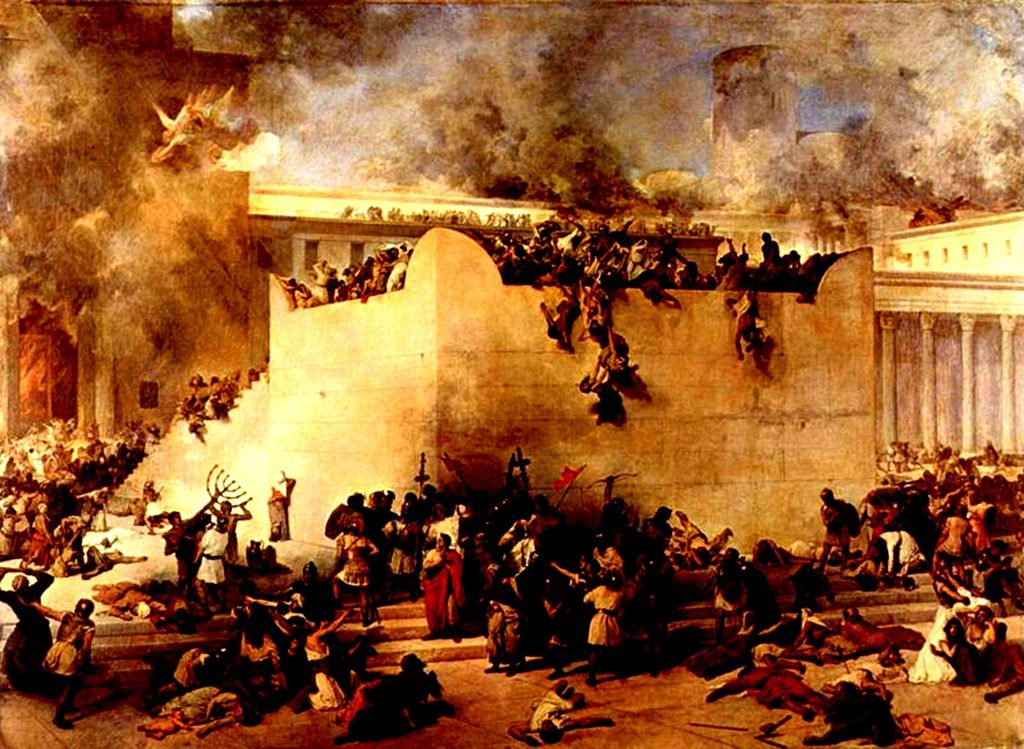
    Previously, we asked of Jeremiah’s lament for Jerusalem, “For what hope have any who have turned against the Lord?” He has just said, “For my groans are many, and I am sick at heart. – Lamentations 1:22b And now his elegy will address a just judgment on Jerusalem by the Lord.

    Judgment on Jerusalem

    Lamentations 2

    אֵיכָה֩ יָעִ֨יב בְּאַפּ֤וֹ׀ אֲדֹנָי֙ אֶת־בַּת־צִיּ֔וֹן הִשְׁלִ֤יךְ מִשָּׁמַ֙יִם֙ אֶ֔רֶץ תִּפְאֶ֖רֶת יִשְׂרָאֵ֑ל וְלֹא־זָכַ֥ר הֲדֹם־רַגְלָ֖יו בְּי֥וֹם אַפּֽוֹ׃ ס

    איכה 2 The Westminster Leningrad Codex (WLC)

    The Lord [אֲדֹנָי ‘Adonay] has overshadowed Daughter Zion with his anger!

    How hath the Lord covered the daughter of Zion
    with a cloud in his anger,
    and cast down from heaven unto the earth
    the beauty of Israel,
    and remembered not his footstool
    in the day of his anger!

    Lamentations 2:3 AKJV

    His daughter is Zion, Jerusalem, ‘the parched place.’ She receives the cloud of His anger over her beauty, as if she had never dwelled in the Light of His heavenly Throne as His beloved footstool. She no longer worships Him!

    2 … In his wrath he has demolished the fortified cities of Daughter Judah…

    Judgment on all of Judah

    And now another beloved daughter. So the Lord punishes not only Jerusalem but all of Judah. He cut off ‘all the horn of Israel,’ its strength and its rays of light on the high places.

    ה He
    5 The Lord is like an enemy;
    he has swallowed up Israel.
    He swallowed up all its palaces
    and destroyed its fortified cities.
    He has multiplied mourning and lamentation
    within Daughter Judah.

    ו Waw
    6 He has wrecked his temple
    as if it were merely a shack in a field,
    destroying his place of meeting.
    The Lord has abolished
    appointed festivals and Sabbaths in Zion.
    He has despised king and priest
    in his fierce anger.

    ז Zayin
    7 The Lord has rejected his altar,
    repudiated his sanctuary;
    he has handed the walls of her palaces
    over to the enemy.

    Can you imagine this happening to our nation, our religious and political leaders and to the security of our homes and families today?

    Jeremiah describes the dismay of their leaders.

    י Yod
    10 The elders of Daughter Zion
    sit on the ground in silence.
    They have thrown dust on their heads
    and put on sackcloth….

    Then Jeremiah points back to their former sin of hearing false prophets who predict with deceptive visions and do not mention our iniquities. Yet he laments, “Who can heal you?” So this is his intercession on their behalf.

    Hope through God’s Mercy

    I am the man who has seen affliction
    under the rod of God’s wrath.
    He has driven me away and forced me to walk
    in darkness instead of light.

    Lamentations 3:1-2

    Jeremiah recalls his own suffering when leaders of Jerusalem and all of Judah and Israel refused to listen to the Lord’s warnings spoken by him. And he asks for God’s mercy.

    19 Remember my affliction and my homelessness,
    the wormwood and the poison.

    Then he prays: “The Lord is my portion, therefore I will put my hope in him.” He then encourages others to hope in the Lord, even in their distress.

    Waiting for Judgment

    ט Teth
    25 The Lord is good to those who wait for him,
    to the person who seeks him.
    26 It is good to wait quietly
    for salvation from the Lord.

    Can you wait for the Lord in your suffering?

    Sin so often destroys us – the sin of others and our own sin. Do you listen to the rebukes of the Lord before your fall?

    Listen to some of Jeremiah’s encouragement, even in this lament.

    28 Let him sit alone and be silent, for God has disciplined him. 30 … let him be filled with disgrace.

    How we take an attitude against the Lord and against any who suggest that who ought to endure deserved scorn and reproach.

    We refuse to be shamed for punishment we rightfully deserve. Yet He will judge – He will judge if we protest our rebuke and He will judge even when we sit silently hoping in our Redeemer. May the Lord have mercy on us.

    Unless the Lord has ordained it

    מ Mem
    37 Who is there who speaks and it happens,
    unless the Lord has ordained it?
    38 Do not both adversity and good
    come from the mouth of the Most High?
    39 Why should any living person complain,
    any man, because of the punishment for his sins?

    Jeremiah’s question to fallen Israel could well apply to one fallen in our own sin today.

    So sit alone, be silent and consider the Lord’s discipline.

    Even we do not willingly allow our deserved shame and disgrace. Neither will we sorrowfully thank Christ for carrying our reproach to the Cross.

    I called on your name, Lord,
    from the depths of the pit.
    You heard my plea:
    Do not ignore my cry for relief.

    Lamentations 3:55-56 CSB

    59 Lord, you saw the wrong done to me; judge my case.

    Can you ask judgment (without Christ’s grace), as Jeremiah plead?

    66 You will pursue them in anger and destroy them under your heavens.

    Will the Lord also pursue you in your sins and iniquity, overshadowing all hope of deliverance from death?


    O, contemporary christian, how like those who would not listen to Jeremiah are we, when turning from the Lord.


    To be continued...

  • Our Lament and Weeping

    Our Lament and Weeping

    Our Lament and Weeping is a 5-part series taking most text from the Prophet Jeremiah as a lament for Lent in these last days. READERS may continue to the NEXT post at the bottom of each post by clicking NEXT.

    Have you ever considered the connection between Jeremiah’s two books or the cause of our lament and weeping?

    lamentations scroll page 1 - the lament and weeping of the Prophet Jeremiah after his predicted fall of Jerusalem takes place

    You may know Jeremiah as the weeping prophet. And perhaps you realize that he is also the author of Lamentations. “Why has this happened,” he would seem to ask the Lord? Yet to consider Jeremiah’s calling and the failure of God’s chosen to hear him shows both good reason for his lament and our weeping.

    Jeremiah’s Call as a Prophet

    4 The word of the Lord came to me:

    5 I chose you before I formed you in the womb;
    I set you apart before you were born.
    I appointed you a prophet to the nations.

    Jeremiah 1:5

    6 But I protested, “Oh no, Lord God! Look, I don’t know how to speak since I am only a youth.”

    7 Then the Lord said to me:

    Do not say, “I am only a youth,”
    for you will go to everyone I send you to
    and speak whatever I tell you.
    8 Do not be afraid of anyone,
    for I will be with you to rescue you.
    This is the Lord’s declaration.

    Prophesies Fulfilled

    These are the people Nebuchadnezzar deported: Altogether, 4,600 people were deported.

    Jeremiah 52:28a,30b CSB [WLC hebrew on link]

    Jeremiah’s unheeded warnings from the Lord caused him much lament and weeping. And well he should have wept for those lost souls and the defeated chosen people led from Jerusalem into exile.

    He had first warned them in his early days during Josiah’s reign in about 626 B.C. Jerusalem would finally fall nearly four decades later to Nebuchadnezzar, in 587 B.C. Plenty of time to repent, but they do not.

    Lamentations

    lamentations scroll page 1 in Hebrew
    איכה

    INTRODUCTION

    The commentary by A. R. FAUSSET explains:

    In the Hebrew Bible these Elegies of Jeremiah, five in number, are placed among the Chetuvim, or “Holy Writings” (“the Psalms,” & c., Luke 24:44 ), between Ruth and Ecclesiastes. But though in classification of compositions it belongs to the Chetuvim, it probably followed the prophecies of Jeremiah originally.

    He also helpfully explains the form of this poetic cry of lament and weeping later incorporated into synagogue worship on the ninth month Ab.

    How?

    The title more frequently given by the Jews to these Elegies is, “How” (Hebrew, Eechah), from the first word, as the Pentateuch is similarly called by the first Hebrew word of Gen 1:1. The Septuagint calls it “Lamentations,” from which we derive the name. It refers not merely to the events which occurred at the capture of the city, but to the sufferings of the citizens (the penalty of national sin) from the very beginning of the siege; and perhaps from before it


    The lament and weeping heard in each Hebrew letter:

    Referring to the alphabetical Hebrew letters beginning each stanza of the lament, Faussett continues quotes of an 18th c. scholar most pointedly:

    “Every letter is written with a tear, every word the sound of a broken heart.”

    Robert Lowth, Bishop of London


    Lament over Jerusalem

    א Aleph
    1 How she sits alone,
    the city once crowded with people!
    She who was great among the nations
    has become like a widow.
    The princess among the provinces
    has been put to forced labor.

    ב Beth
    2 She weeps bitterly during the night,
    with tears on her cheeks…

    Jeremiah’s cry for the lost glory of the Lord’s own chosen people and fallen city continues. So we hear the heart of this former priest and persecuted Prophet as he wails out words of lament and weeping.

    ד Daleth
    4 The roads to Zion mourn,
    for no one comes to the appointed festivals.
    All her gates are deserted;
    her priests groan,
    her young women grieve,
    and she herself is bitter.

    ה He
    5 Her adversaries have become her masters;
    her enemies are at ease…

    And how has this happened? Why?

    Because the Lord’s own worshipers failed to listen to the Lord.

    … for the Lord has made her suffer
    because of her many transgressions.

    Lamentations 1:5b

    We understand the relationship between transgressions and our sin, right?

    Our sins are punishable offenses. Consequently our rebellions against God justify our punishment, pain, suffering and even death.


    ח Cheth
    8 Jerusalem has sinned grievously…

    Is there any pain like mine,
    which was dealt out to me,
    which the Lord made me suffer
    on the day of his burning anger?

    Lamentations 1:12B

    Isn’t that how we finally feel once the Lord allows our punishment? Yet in fact, look around you as did Jeremiah. Many suffer. Therefore others weep with you, even for you.

    ע Ayin
    16 I weep because of these things;
    my eyes flow with tears.
    For there is no one nearby to comfort me,
    no one to keep me alive.
    My children are desolate
    because the enemy has prevailed.

    Why

    צ Tsade
    18 The Lord is just,
    for I have rebelled against his command.

    Justice requires fair punishment. But this lament and weeping cries out to the listener pleading for mercy:

    Listen, all you people;
    look at my pain.
    My young women and young men
    have gone into captivity.

    ק Qoph
    19 I called to my lovers,
    but they betrayed me.
    My priests and elders
    perished in the city
    while searching for food
    to keep themselves alive.

    ר Resh
    20 Lord, see how I am in distress.
    I am churning within;
    my heart is broken,
    for I have been very rebellious.
    Outside, the sword takes the children;
    inside, there is death.


    The Holy City cries out to the LORD!

    Their own lament and weeping with sorrow now includes confession.

    We brought on our own demise, therefore our lament and weeping have cause.

    Punishment for sin and death will surely follow as justice.

    For what hope have any who have turned against the Lord?

    To be continued...

  • Hebrews 10- Sacrifice and Offering

    Offering on the Altar


    I waited patiently for the LORD;
    40:6  זֶ֤בַח וּמִנְחָ֨ה לֹֽא־חָפַ֗צְתָּ אָ֭זְנַיִם כָּרִ֣יתָ לִּ֑י עֹולָ֥ה וַ֝חֲטָאָ֗ה לֹ֣א שָׁאָֽלְתָּ׃

    Sacrifice and offering You did not desire;
    My ears You have opened.
    Burnt offering and sin offering You did not require.

    Psalm 40:6 Masoretic Text; NKJV

    The Perfect Sacrifice

    The author of Hebrews states that in Christ we have a High Priest who does not need to repeatedly make offering and sacrifice. Therefore, the sacrificial blood of the Messiah on the Cross represents a new and better covenant.

    Once again, he logically makes his case supported by the evidence of well-known scripture.

    Hebrews 10:

    Since the law has only a shadow of the good things to come, and not the reality itself of those things, it can never perfect the worshipers by the same sacrifices they continually offer year after year. Otherwise, wouldn’t they have stopped being offered, since the worshipers, purified once and for all, would no longer have any consciousness of sins?

    He refers to the many rules and regulations of sacrifice and offering prescribed in the Mosaic law. Moses gave us a law of better things to come, a mere shadow of true worship. When we finally make the perfect sacrifice, becoming completely purified before the Lord, wouldn’t we then stop making more sacrifices? Wouldn’t our guilt be left covered?

    Sin remains in the shadow sacrifice of the Law, because the blood of bulls and goats cannot cleanse sin perfectly.

    We have awaited a Messiah.. patiently.. a High Priest Perfect for all time. From
    a thousand years before, the writer quotes David’s well known Psalm 40:

    Patience

    I waited patiently for the Lord,
    and he turned to me and heard my cry for help.
    2 He brought me up from a desolate pit,
    out of the muddy clay,
    and set my feet on a rock,
    making my steps secure.
    3 He put a new song in my mouth,
    a hymn of praise to our God.

    Think of this hope in the hearts of faithful Jews when the writer reminds us:

    6 You do not delight in sacrifice and offering;
    you open my ears to listen.
    You do not ask for a whole burnt offering or a sin offering.
    7 Then I said, “See, I have come;
    in the scroll it is written about me.

    Psalm 40:6-7A CSB

    ‘The Lord is trying our patience,’ they must have thought as Rome dominated their land, their city and culture. We wonder why the Lord has not blotted out evil and accepted faithful worshipers only – faithful in these last days.

    Those receiving this letter in the first century would have known the next verses of the Psalm as well. The writer of Hebrews continues:

    Hebrews 10:9 [quote of Psalm 40] he then says, See, I have come to do your will.

    He takes away the first to establish the second.

    The author’s firm reason taken in the second half of verse 9 compare the old and new covenants. He then follows this statement of God’s will with:

    By this will, we have been sanctified through the offering of the body of Jesus Christ once for all time.

    Hebrews 10:10 CSB

    The priest of their shadow sacrifices stands imperfectly at the altar day after day.

    12 But this man, after offering one sacrifice for sins forever, sat down at the right hand of God.

    Testimony of the Holy Spirit

    Then the writer of Hebrews then adds even more support from Scripture.

    15 The Holy Spirit also testifies to us about this. For after he says:

    16 This is the covenant I will make with them
    after those days,

    the Lord says,

    I will put my laws on their hearts
    and write them on their minds

    Hebrews 10:16 quote from Jeremiah 31
    By Микеланжело Буонаротти - Электронная библиотека.Музеи Ватикана., Public Domain, https://commons.wikimedia.org/w/index.php?curid=2284599
    Jeremiah by Michaelango

    A new covenant – ” Look, the days are coming”—this is the Lord’s declaration—

    The writer of Hebrews appeals to scripture of the prophet Jeremiah, 600 years before Christ, for support of the New Covenant where sacrifice and offering will no longer be required.

    He concludes:

    18 Now where there is forgiveness of these, there is no longer an offering for sin.

    Enter the Sanctuary through the Blood of Jesus

    Several editors of Hebrews take different directions for labeling the next section of chapter 10, which we will examine in my next post. Again the author quotes scripture known to faithful Jews as he pursues the argument for the Messiah Jesus.

    Note just a few headings for the section to come:

    • How We Should Live? – ISV
    • Hold Fast Your Confession – NKJV
    • Exhortations to Godliness – CSB
    • The Full Assurance of Faith – ESV
    • Let Us Come Near to God – GNT

    All, thoughtful considerations of scriptural application to our lives. If you would like to take a preview, take it from the Greek in verse 19.

    10:19 ἔχοντες οὖν ἀδελφοί παρρησίαν εἰς τὴν εἴσοδον τῶν ἁγίων ἐν τῷ αἵματι Ἰησοῦ

    To be continued...