Tag: king

  • Are You a King?

    Are You a King?

    Therefore Pilate entered again into the Praetorium, and summoned Jesus and said to Him,

    “Are You the King of the Jews?”

    John 18:33 NASB

    The Politically Charged Question

    Pilate interrogates Jesus by beginning privately with a loaded question.

    As Governor AND presiding judge (in chambers), the Prefect questions the defendant already declared guilty by the Jews, local leaders who have no authority in this Roman court of Judea.

    Pilate’s questions (to which he must have had prepared standard answers to usual responses) went to motive.

    • “What is your authority here?”
    • “Are you a threat to true authority, which as Governor I represent?”

    The Gospels do not record these words, but the timing and context of Jesus’ trial suggests to the Governor that he recognizes a political hot potato in dealing with this popular Rabbi during the religious festival of the Jews in Jerusalem.

    For further understanding of Pontius Pilate look back to: 
    1st century Rome – an awkward embrace of RELIGION & politics

    John 18:

    Very early that morning:
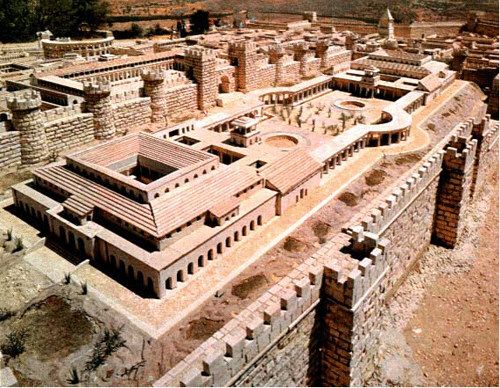
    praetorium in Jerusalem
    • As the Jewish officials brought Jesus to the exterior of the Praetorium Pilate came out to them.
    • .. and they themselves did not enter into the Praetorium so that they would not be defiled, but might eat the Passover.

    29 Therefore Pilate went out to them and said, “What accusation do you bring against this Man?”

    They answered and said to him, “If this Man were not an evildoer, we would not have delivered Him to you.”

    31 So Pilate said to them, “Take Him yourselves, and judge Him according to your law.”

    The Jews said to him, “We are not permitted to put anyone to death..”

    Sentenced to death by accusation

    We already know of the deceptive stealth of the Temple officials, ceasing Jesus at night then bringing the Messiah of Israel to trial before them.

    The Jews really had no authority in Judea and regardless of their predetermined verdict of guilt and sentence of death, Pilate dismisses their case. But now the politics come into play.

    These religious emissaries want to execute the man opposed to their religious positions of power, the Man who had ridden victorious into town on a donkey just a few days before, Jesus of Nazareth (a town not even in Pilate’s Judea).

    Although we seldom consider the passage of time within a single verse or two of scripture, consider this possibility in the scene about to take place:

    • Certainly the Jews with their prisoner Jesus on the outside and Pilate with his advisors inside the Praetorium must ponder what to do next.
    • Since Pilate is in charge of Jerusalem and responsible to Rome for any potential trouble, he makes the first move in trying to keep peace between the politics and religion of Jerusalem.

    Questions with political consequences

    33 Therefore Pilate entered again into the Praetorium, and summoned Jesus and said to Him…

    Although the trial of Jesus takes place like all Roman trials in the public square, Pilate begins his questioning of this prisoner of the Jews in private.
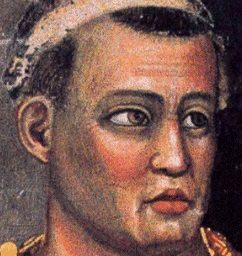
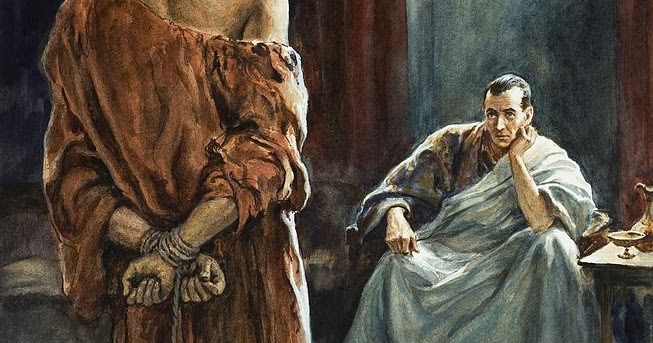
    painting of pontius pilate

    “Are You the King of the Jews?”

    Are you the King?

    Questions with political consequences are best asked first in private. Leaders must know the politically correct answer before asking it in public.

    Remember Jesus’ accusers were not present because they would not defile themselves by their self-righteous rule of separation from this gentile Governor responsible for every civic event in Jerusalem. The Jews needed to maintain their white-washed public image before their followers.

    • Pilate summoned Jesus to him.
    • As a result of his summons the Jews had to release Jesus into the governor’s custody.

    βασιλεύς

    What is the root meaning of Pilate’s question to Jesus?

    βασιλεύς basileús, bas-il-yooce’; probably from G939 (through the notion of a foundation of power); a sovereign (abstractly, relatively, or figuratively):—king.

    • leader of the people, prince, commander, lord of the land, king

    What are you, Jesus?

    (It’s a fair question — to which the Governor would have had a standard reply.

    Imagine some of these pre-prepared political answers of Pilate.)

    • We have no kings here. You are not a king of Egypt or even Herod who was once king in Jerusalem. Kings do not matter here.
    • Our king resides in Rome and I am his governor. What I say comes from our king: Tiberius Caesar.
    • Are you a king? It does not matter. Tiberius Caesar is king.

    Rather than being led into a conversation about who He is not, Jesus asks the Governor a question.

    34 Jesus answered,

    “Are you saying this on your own initiative, or did others tell you about Me?”

    • Is this really your question
    • or did someone tell you that I am a King?

    The Governor immediately reminds the accused that in fact he, Pilate, is Roman (and Rome governs Jerusalem).

    Pilate answered, “I am not a Jew, am I?

    Your own nation and the chief priests delivered You to me;

    what have You done?”

    John 18:38 NASB

    Pilate’s response confirms indictment by the chief priests, but the judge’s question, ‘What have you done?” is opportunity for the defendant to appeal His ill-gotten verdict.

    Israel’s Messiah Jesus answers the Governor’s original question about His Authority.

    My Kingdom – βασιλεία

    Jesus answered, “My kingdom is not of this world.

    John 18:36a

    The Accused makes no claim to Jerusalem or to Judea or any Syrian territory governed by Pilate.

    Rather Jesus claims an authority of the gods (in Pilate’s understanding). In this case:

    ‘royal power, kingship, dominion, rule, not to be confused with an actual kingdom but rather the right or authority to rule over a kingdom.’source: blueletterbible.org

    Jesus continues His assurance to Pilate that He is no threat to Rome as other kings and threatening rebels fight to gain influence in places like Jerusalem.

    “… If My kingdom were of this world, then My servants would be fighting so that I would not be handed over to the Jews;

    but as it is, My kingdom is not of this realm.”

    What Realm?

    • “..but as it is, My kingdom is not of this realm.” – John 18:36c NASB
    • “..but now is my kingdom not from hence.” – John 18:36c KJV
    • “..But as it is, my kingdom is not from here.” – John 18:36c CSB

    A King must have a country, a realm to rule here and now. Jesus Christ makes no such claim.

    The Lord Jesus when brought before Pilate confirms, ‘my kingdom is not from here.”

    ἐντεῦθεν

    Outline of Biblical Usage

    1. from this place, hence
    2. on the one side and on the other, on each side

    Luke records an incident from earlier in Jesus ministry describing it with the same Greek word.

    Just at that time some Pharisees approached, saying to Him, “Go away, leave here, G1782 for Herod wants to kill You.” – Luke 13:31

    Herod, of course, is a pawn not only of Jerusalem’s Jewish politics but also of Rome. Jesus continued at that time to prophesy the events of these three days:

    And He [Jesus] said to them [Pharisees who secretly followed Jesus],

    “Go and tell that fox [Herod],

    ‘Behold, I cast out demons and perform cures today and tomorrow, and the third day I reach My goal.’

    “Nevertheless I must journey on today and tomorrow and the next day; for it cannot be that a prophet would perish outside of Jerusalem.

    Luke 13:32-33 NASB

    οὐκοῦν, adverb, not therefore

    This is subtle, as well as a function of speech; but don’t miss it.

    Several translations of the original Greek from this passage read differently in attempts to convey the argument here of Jesus’ judge Pilate.

    37 Therefore Pilate said to Him, “So You are a king?”

    (You are a king, but from where {if not here}?)

    • .. but it is better to write οὐκοῦν, so that Pilate, arguing from the words of Christ, asks, not without irony, art thou not a king then? or in any case, thou art a king, art thou not? cf. Winer’s Grammar, 512 (477).
    • and since a speaker often introduces in this way his own opinion, the particle is used affirmatively, therefore, then, the force of the negative disappearing. Hence, the saying of Pilate οὐκοῦν βασιλεύς εἰ σύ must be taken affirmatively: – Source: Strong’s

    To this end was I born

    Jesus answered, Thou sayest that I am a king. To this end was I born, and for this cause came I into the world, that I should bear witness unto the truth. Every one that is of the truth heareth my voice.

    John 18:37b KJV

    In answer to Pilate’s restatement of his own question, “Art thou a king then?” Jesus clearly states His purpose to which He was born as Son of Man and Son of David, the Christ of Hebrew Scripture.

    John began his Gospel (Good News) of Jesus Christ stating this same purpose. It really has nothing to do with anything kinglike, as the Jews expected of their Messiah that He would be like King David or King Solomon.

    In the beginning was the Word, and the Word was with God, and the Word was God.

    And the Word became flesh, and dwelt among us, and we saw His glory, glory as of the only begotten from the Father, full of grace and truth.

    John 1:1,14 NASB

    Jesus proclaims privately to Pontius Pilate:

    “I was born for this, and I have come into the world for this: to testify to the truth… CSB

    Pilate is about to ask Jesus the question a Judge must ask himself honestly before concluding a trial, but first Christ continues with purpose for all:

    “… Everyone who is of the truth listens to my voice.”

    the words of Jesus Christ to Pontius Pilate – John 18:37c CSB

    Do you with ears to hear listen to the voice of Christ Jesus?

    To be continued...
    Page TWO - Please click Page 2 below for the questions.
    Pages: 1 2

  • Kings, Governors, Politicians & Priests – Power in the Palaces of Justice

    Kings, Governors, Politicians & Priests – Power in the Palaces of Justice

    Then led they Jesus from Caiaphas unto the hall of judgment: and it was early; and they themselves went not into the judgment hall, lest they should be defiled; but that they might eat the passover.

    John 18:28 KJV

    the Praetorium – in the Palace of Power

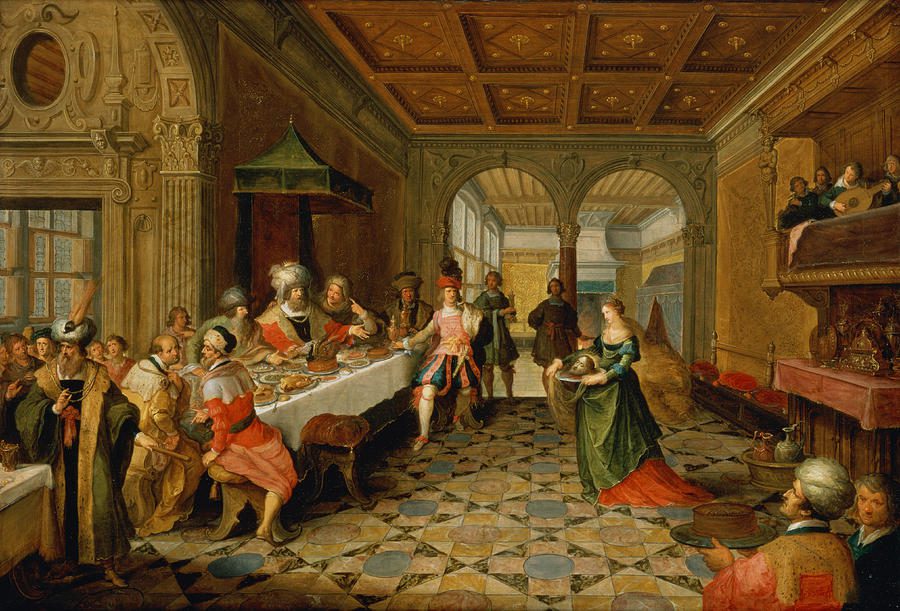
    painting of scene of banquet table of Herod with Salome presenting head of John the Baptist
    Herod’s Palace – Salome presents head of John the Baptist to Herod

    I don’t know about you, but the rapid-fire events of the conviction of the Messiah Jesus in so brief a time in the early hours of the day confuses me concerning the places these trials took place.

    If you have a comment of clarification please add it to this post.

    IF, unlike those present at the Lord’s first century trials you do not understand who is in charge, the venues of Jesus’ trials can get a little confusing.

    You may ask, ‘What does this banquet hall of Herod..’ (where King Herod had been presented the head of John the Baptist) ‘.. have to do with the Messiah Jesus on this morning following the betrayal of Judas?’

    The Praetorium is a semi-public place where Jesus has been sent — this place is on the grounds of the palace of King Herod.

    Let’s look back briefly at the history of the keys players in this developing drama which convicts the Messiah Jesus at night.

    King Herod

    Briefly, the history of the Herod’s gets complicated at times, but remember here that we are not talking about Herod the Great who navigated the complex politics of Rome with great agility.

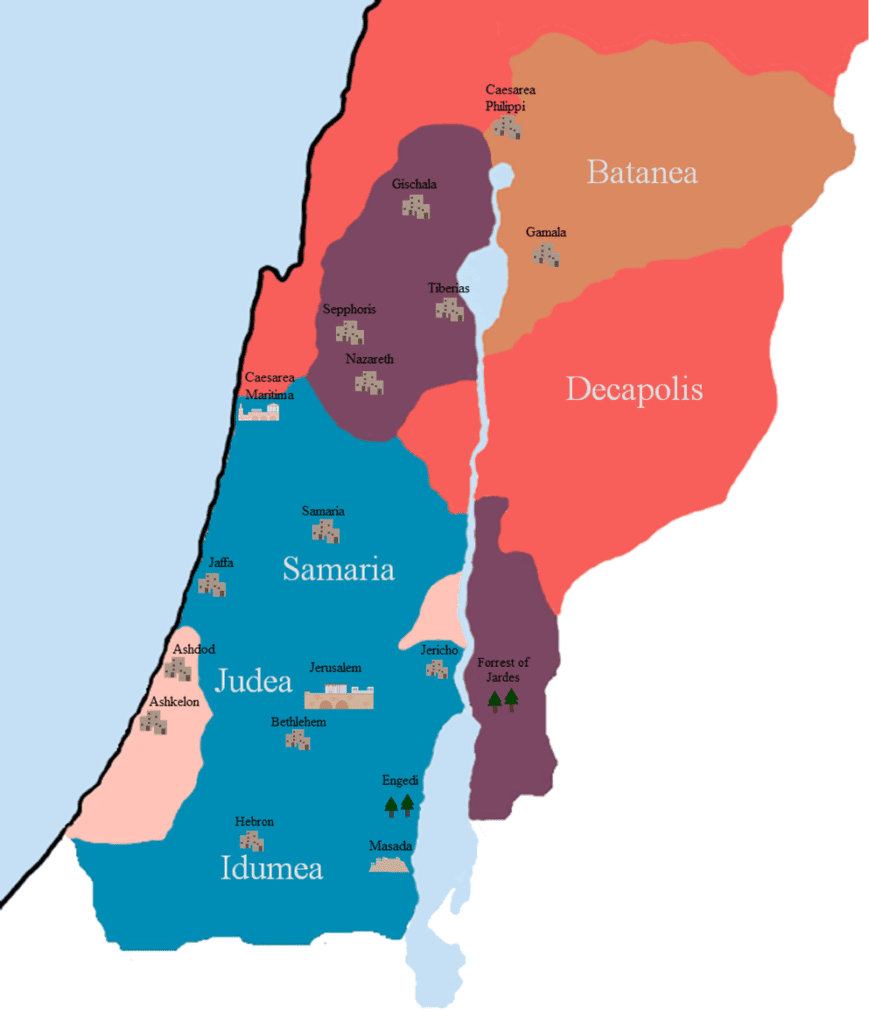
    After Herod’s death, Augustus Caesar ratified the wishes of his client king, Herod, to divide this eastern territory of Rome into three parts.

    Source: Herodian Tetrarchy
    From Wikipedia, the free encyclopedia
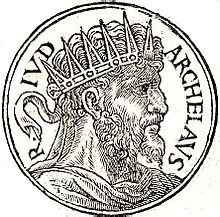
    1. Herod Archelaus was appointed Ethnarch (a governor & not king) of Idumaea, Judea (including Jerusalem) and Samaria.
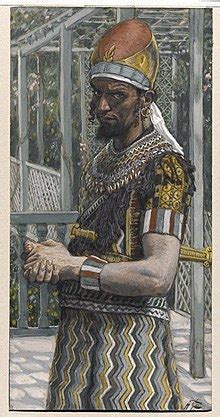
    2. Herod Antipas (simply, Antipas to the Romans & his subjects, but described as ‘Herod‘ in the Gospels) became Tetrarch of Galilee (including Nazareth and Capernaum) and Perea.
    3. Philip I, son of Herod the Great and Cleopatra of Jerusalem, became Tetrarch of the northern part of Herod’s kingdom (area in modern Lebanon & Syria).

    ‘Governor Herod

    You've never heard Herod called that, have you?

    This is no longer the Jerusalem of Herod the Great! Jews are now considered merely as an ethnic people and Judeans an ‘ethnic group’ similar to nearby client Roman states. They are now governed as a regional people rather than as a small kingdom allied to Rome for mutual military advantage.

    Ethnarch (technically) is a Roman rank just a little higher than Tetrarch. (Kind of like Arch-Bishop is to Bishop in the church.)

    Judean Governors (like Herod) sometimes appear politically and practically to be more Roman than like traditional sons of David.

    IF these Herod’s were officially governors of their respective Roman regions, i.e. Judea, Galilee, Ituria, etc., — who then governed the governors?

    Who governs these Jews?

    John now addresses the question of who’s in charge in Jerusalem, who’s in charge of Judea, which Tetrarch governor of which ethnic region has authority in what was once the Kingdom of Israel.

    As Jesus is dragged from place to place for trial the quiestions mount:

    Is He a Judean? A Galilean? A Jew with authority in Jerusalem? A would-be King? Who IS this Man?

    Other Gospel writers have hinted earlier how this delicate duality of rule in first century Jerusalem provided opportunity of great hypocrisy among the rulers of the Jews and their religious political parties, i.e. Sadducees, Pharisees, etc..

    The scribes and the chief priests tried to lay hands on Him…

    So they watched Him, and sent spies who pretended to be righteous, in order that they might catch Him in some statement, so that they could deliver Him to the rule and the authority of the governor.

    Luke 20:19a,20 NASB

    “Is it lawful for us to pay taxes to Caesar, or not?”

    But He detected their trickery and said to them,

    “Show Me a denarius. Whose likeness and inscription does it have?”

    They said, “Caesar’s.” – Luke 20:22-24 NASB

    John 18:

    28 Then they led Jesus from Caiaphas into the Praetorium, and it was early; and they themselves did not enter into the Praetorium so that they would not be defiled, but might eat the Passover.

    29 Therefore Pilate went out to them and said,

    “What accusation do you bring against this Man?”

    the Praetorium – palace of the Governor

    WAIT! Even knowing something of the political intrigue and complexity of the Herod’s, I’m still confused.

    Again, please comment if you can help or have a question.

    Note that the King James Version {at beginning of this post} states:

    ‘Then led they Jesus from Caiaphas unto the hall of judgment…’

    I get that a hall of judgment could be a large room in the palace.


    Note now in the NASB translation,

    ‘.. into the [a]Praetorium..’

    AND by definition:

    πραιτώριον = Praetorium [note a]

    ‘John 18:28 i.e. governor’s official residence’

    Why is Pilate there?

    Why does Pilate emerge from the Governor’s palace to greet the religious police who have taken the Messiah Jesus into custody?

    The CSB clearly calls it 'the governor’s headquarters.'

    Wasn’t Pilate’s headquarters outside Jerusalem’s walls with the Roman Legion he commanded?

    NO!

    When Rome moved into a captured land they ‘civilized’ its remaining residents to become supporting (taxed) residents (not citizens) under Roman rule. As long as they paid their taxes and did not rebel against Roman authority these local Jews could do what they want with their own ethnic people.

    What accusation?

    Roman custom is such that some public judgments are made from the court of the Governor in charge. Pilate asks the local Jewish leaders who have led a prisoner to him the reasonable question of a Governor and Judge:

    https://www.blueletterbible.org/nasb/jhn/18/1/t_concf_1015029Τίνα κατηγορίαν φέρετε κατὰ τοῦ ἀνθρώπου τούτου

    “Tis katēgoria pherō kata ho anthrōpos hoytos?

    John 18:29 – question of Pilate to the Jews who brought Jesus before him

    These Jewish leaders of Jerusalem have brought a prisoner to Pilate in the earliest hours of the morning. Pilatos, the sixth Roman procurator of Judah and Samaria, addresses them in the universal language of the vast Empire, Greek not his native Latin, the religious Hebrew tongue of these Jews or a local Aramaic language.

    Their prisoner bound for trial appears to be Jesus, who had led thousands of followers to Jerusalem’s gates just a few days ago. Pilate would already know that the Man has not caused any trouble, except one minor incident within the courts of the Jews own Temple.

    The Governor has plenty to be concerned about for the upcoming day in monitoring the massive multitudes here for the Jewish holiday Pesach.

    painting of pontius pilate

    Imagine the thoughts of Pilatos:

    You’ve brought a prisoner to the governor in these early hours of this busy day?

    What does your warrant accuse that I should imprison the Man now?

    I have more important things to do than trifle with such matters of your religious concern.

    So Pilate, the governor, went out to them and asked,

    “What is your charge against this man?”

    John 18:29 NLT
    To be continued...
    
  • He will give you another Helper

    He will give you another Helper

    Our situation now appears desperate in this place isolated from the world. In the past three years we have come to know what to expect, but now it seems that everything will change.

    Can you relate?

    In case you missed it, Church.., we’ve reached a pivotal point in the history of the world where the Lord will change all of our relationships to God and to each other.

    The Gospel of John

    The Apostle John now looks back on a pivotal moment in Jerusalem with the Lord Jesus in the seclusion of an upper room. He teaches the church the New Covenant relationship with God our Father, Jesus the Son our Lord and the Holy Spirit of the LORD God.

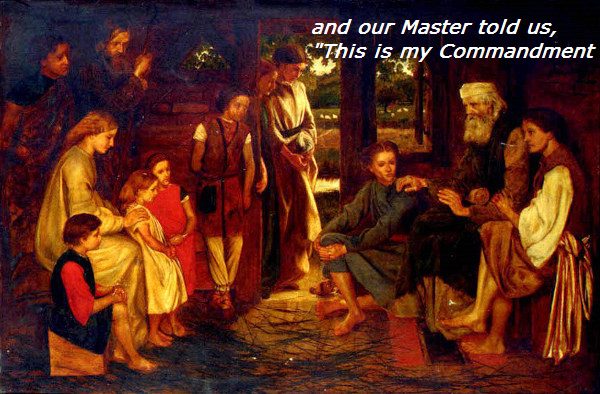
    and our Master told us, "This if my Commandment

    This is His commandment, that we believe in the name of His Son Jesus Christ, and love one another, just as He commanded us.

    The one who keeps His commandments abides in Him, and He in him. We know by this that He abides in us, by the Spirit whom He has given us.

    1 John 3:23-24 NASB

    Do you need help?

    John asks a persecuted church to love one another, as the Lord Jesus commanded us. (By this time all other Apostles of Jesus except John had already suffered death by the hand of this world’s powers and principalities.)

    The early church, a mere remnant of the unsettled sojourners of Abraham joined by faith in the Messiah, Son of David, with those of the world adopted in love by a New Covenant of forgiveness — these Christians also needed a helper just as you and I cry out for help. John’s Good News assures those who believe that in the Lord Jesus Christ we have help from above.

    Recalling Jesus’ ascent into Jerusalem

    Briefly recalling some of John’s journey with Jesus and the Apostles into Jerusalem, which would lead to the Lord’s trial after this pivotal moment before Jesus’ crucifixion, resurrection and ascension:

    In the third year of Jesus’ teaching on earth after having made many proofs of His Authority from God through the witness of many signs and wonders, the Messiah Jesus (John’s Teacher and Lord):

    • Came to Bethany and commanded Lazarus to come out of the grave after four days! John 11:
    • The High Priest Caiaphas prophesied that Jesus would ‘die for the people.’ John 11:47-53
    https://talkofjesus.com/12-men-texting-as-their-messiah-approaches-3/

    Now the Passover of the Jews was near, and many went up to Jerusalem out of the country before the Passover to purify themselves.

    John 11:55 NASB
    • Jesus and the Apostles travel to Ephraim then return to dine with Lazarus and his sisters before entering Jerusalem. John 12

    … the chief priests planned to put Lazarus to death also; because on account of him many of the Jews were going away and were believing in Jesus.

    • Jesus Enters Jerusalem

    12 On the next day the large crowd who had come to the feast, when they heard that Jesus was coming to Jerusalem, took the branches of the palm trees and went out to meet Him, and began to shout, “Hosanna! Blessed is He who comes in the name of the Lord, even the King of Israel.”

    • 27 “Now My soul has become troubled; and what shall I say, ‘Father, save Me from this hour’? But for this purpose I came to this hour. Father, glorify Your name.” Then a voice came out of heaven: “I have both glorified it, and will glorify it again.”
      • 31 Now judgment is upon this world; now the ruler of this world will be cast out. And I, if I am lifted up from the earth, will draw all men to Myself.”
    • These things Jesus spoke, and He went away and hid Himself from them.
    • 44 And Jesus cried out and said, “He who believes in Me, does not believe in Me but in Him who sent Me.
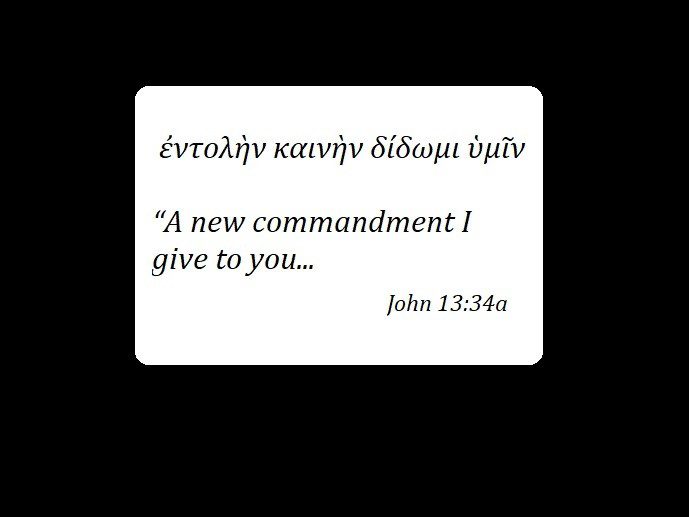
    A new commandment I give to youJohn 13:34

    Before continuing with Jesus’ New Commandment and promise of help, let us briefly witness from the Psalms of Ascent.

    Jesus and the Apostles and crowds would have sung these Psalms on ascent of Mount Zion, approaching Jerusalem from the valley below. The words of praise to the LORD would no doubt have been fresh in the memory of each Apostle later in the upper room.

    Psalms of Ascent

    As worshipers recognized their Messiah on the foal of a donkey, a sign of Jerusalem’s King, they near Zion’s gate.

    Recall now John’s Jewish understanding of these annual songs of worship as they now apply to the Messiah of Israel, our Lord Jesus.

    שִׁ֗יר הַֽמַּ֫עֲלֹ֥ות

    Woe is me, that I sojourn in Mesech, that I dwell in the tents of Kedar!

    The LORD shall preserve thee from all evil: he shall preserve thy soul.

    I was glad when they said unto me, Let us go into the house of the LORD.

    Psalm 122:1 KJV

    Our soul is exceedingly filled with the scorning of those that are at ease, and with the contempt of the proud.

    Our help is in the name of the LORD, who made heaven and earth.

    Do good, O LORD, unto those that be good, and to them that are upright in their hearts.

    They that sow in tears shall reap in joy.

    It is vain for you to rise up early, to sit up late, to eat the bread of sorrows: for so he giveth his beloved sleep.

    Blessed is every one that feareth the LORD; that walketh in his ways.

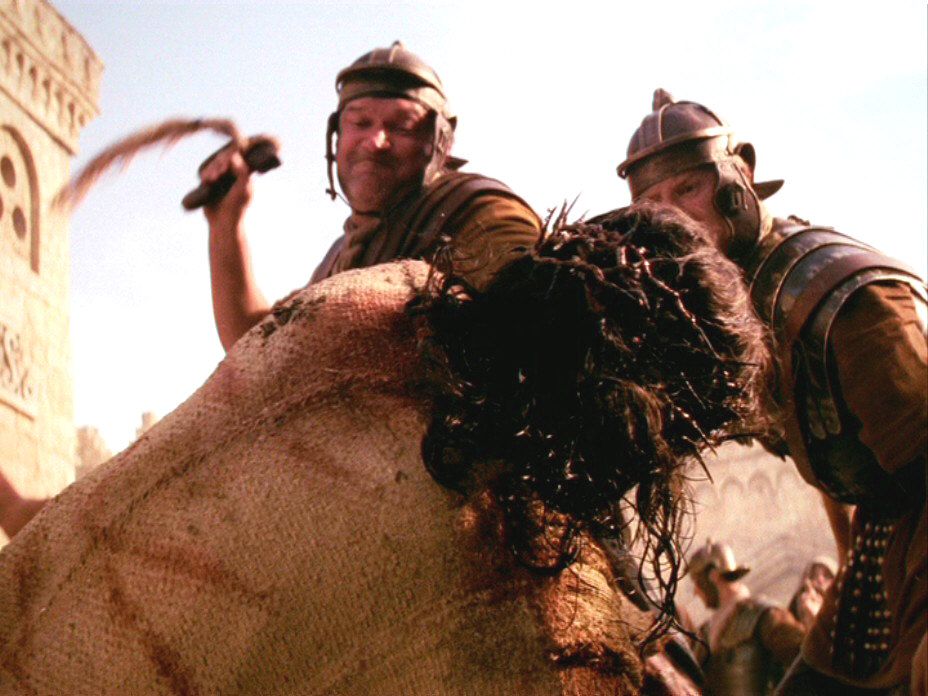
    soldger whipping Jesus Christ

    The plowers plowed upon my back: they made long their furrows.

    The LORD is righteous: he hath cut asunder the cords of the wicked.

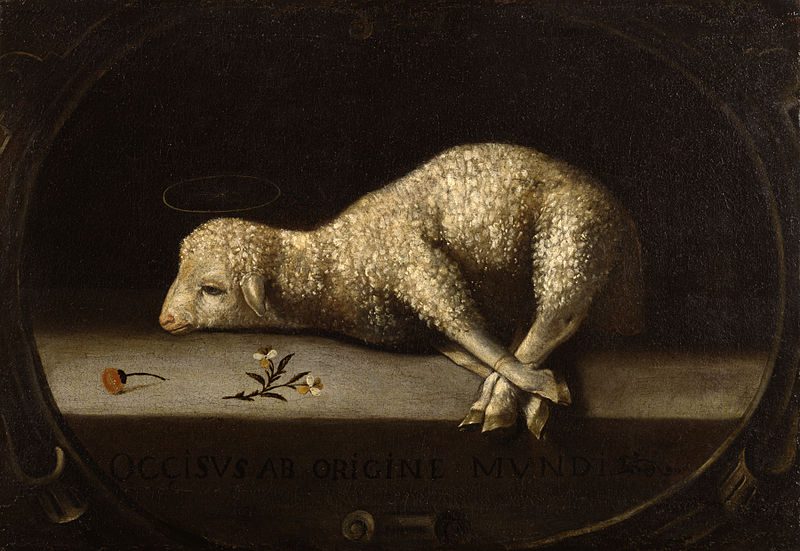
    lamb bound on the altar of sacrifice

    But there is forgiveness with thee, that thou mayest be feared.

    And he shall redeem Israel from all his iniquities.

    Surely I have behaved and quieted myself, as a child that is weaned of his mother: my soul is even as a weaned child.

    132:1 שִׁ֗יר הַֽמַּ֫עֲלֹ֥ות זְכֹור־יְהוָ֥ה לְדָוִ֑ד אֵ֝ת כָּל־עֻנֹּותֹֽו׃

    Lo, we heard of it at Ephratah…

    We will go into his tabernacles: we will worship at his footstool.

    Arise, O LORD, into thy rest; thou, and the ark of thy strength.

    אָרוֹן
    So Joseph died, being an hundred and ten years old: and they embalmed him, 
    and he was put in a coffin in Egypt. - Gen 50:26
    And thou shalt put into the ark the testimony which I shall give thee. Exodus 25:16

    Let thy priests be clothed with righteousness; and let thy saints shout for joy.

    I will also clothe her priests with salvation: and her saints shall shout aloud for joy.

    133:1  שִׁ֥יר הַֽמַּעֲלֹ֗ות לְדָ֫וִ֥ד הִנֵּ֣ה מַה־֭טֹּוב וּמַה־נָּעִ֑ים שֶׁ֖בֶת אַחִ֣ים גַּם־יָֽחַד׃

    Behold, how good and how pleasant it is for brethren to dwell together in unity!

    134:1 שִׁ֗יר הַֽמַּ֫עֲלֹ֥ות הִנֵּ֤ה בָּרֲכ֣וּ אֶת־֭יְהוָה כָּל־עַבְדֵ֣י

    יְהוָ֑ה הָעֹמְדִ֥ים בְּבֵית־֝יְהוָ֗ה בַּלֵּילֹֽות׃

    Lift up your hands in the sanctuary, and bless the LORD.

    The LORD that made heaven and earth bless thee out of Zion.

    Hosanna!

    “Hosanna! Blessed is He who comes in the name of the Lord, even the King of Israel.”

    Now that we recall the events leading up to Jesus’ New Commandment; NEXT, God-willing, we will return to the upper room where the Lord Jesus promises us HELP.

    To be continued...