Tag: Matthew

  • Reintroducing John – a Biography and Background

    Reintroducing John – a Biography and Background

    Biography of a Man

    I wrestle with my own autobiography, let alone writing about the ancestry of such an important man of God as John.

    We struggle to understand anyone once we read such titles or relational roles of JESUS or any of the Lord’s Apostles.

    For instance, who do you see when I refer to:

    • ‘Jesus’ DISCIPLE John’ or
    • ‘John, one the the TWELVE‘, or
    • even including John with Peter and his older brother James as one of just three disciples in JESUS’ inner circle?
    And that only covers three years of John's life during Jesus' incarnation, overlooking John's earlier time as a disciple of John the Baptist. 

    Call him: SAINT John or John the Elder — give John reverence for receiving the very word of God in the Gospel — look at this man in awe, who later on Patmos was given the Revelation of Jesus Christ as an Elder of the first century Church.

    But when all is said (or even little) about John, he was just a man like us, a man chosen by JESUS CHRIST, the Son of God.

    Picturing John accurately – Painting a True Portrait

    I have searched endlessly for a painting of the Apostle John more truly representing the one Jesus loved at various important times in his long life.

    Of course we have no photo or ‘selfie’ of John from any time.


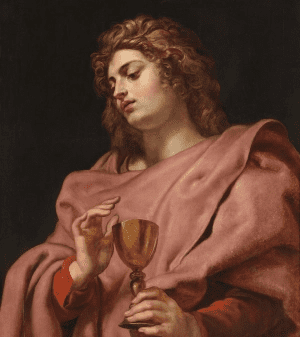
    Some renaissance depictions (often commissioned by the Roman Catholic Church) depict a very young John (even holding a cup of communion) making him appear similar to a French altar boy.

    The Apostle John
    Peter Paul Rubens, 1610-12 A.D.
    Jesus’ description of James and John as, ‘sons of thunder’ suggests two tough Galilean fisherman, tenaciously seeking the Messiah of captive Israel — two disciples of an Elijah-like prophet John the Baptist, who instructed these sons of thunder in the Judean wilderness.

    The young Apostle John, who accompanied Peter to preach in the Temple just after Christ’s ascension, certainly was not so silent as to be overlooked by powerful Jewish leaders, who included this young Disciple ofJesus with Peter in their summons to defend their public witness (or rather be silent about Jesus).

    Both Apostles would be imprisoned for the Gospel and then released by an angel to once again proclaim Jesus as the Messiah to the Jews and the all the world.

    IF YOU can suggest any painting or art which paints a true picture of JOHN at any stage of his life, how about letting us know in a COMMENT following this post. - RH 

    So in order to get a better picture of John, let’s look back at a few brief biographical facts mixed in with some scholarly speculation, hoping to see into the heart and life of the one Jesus loved.’

    Family and Ancestry

    John grew up in a small village (as it happened I did too). Everybody typically knows everyone (and much of everyone’s business). Family, of course, was important to the Jews as our families tend to identify ‘who we are’ to our own neighbors.

    When I was a young man my dad was a volunteer fireman and one of the older firemen always addressed me as, “Chief.” Our family name was attached to the business of Dad and his brother. John was in business with his brother James, both known to all as the sons of Zebedee, head of his family fishing business.

    Ancestry and Connection of Names

    Chief,’ immediately connected me to my dad, our volunteer fire chief and to his father whose name identified Dad’s family business.

    Certainly John’s vocation, faith and identity were rooted in his upbringing and like me, growing up as John the Son of Zebedee would identify Jesus’ Disciple into his early manhood.

    In fact, the younger of Zebedee’s sons probably felt more like ‘the brother of James , son of Zebedee;’ similar to an earlier unnoticed, Son of Jesse not even introduced to an important man such as Samuel.


    About Zebedee:

    Let's connect these family names: 
    • Ζεβεδαῖος – Zebedee
      • From זֶבֶד (H2065) – endowment (or my gift)
    • Ἰάκωβον τὸν τοῦ Ζεβεδαίου – James (son of Zebedee)
      • The same as Ἰακώβ (G2384), Jacob (meaning ‘supplanter’)
    • Ἰωάννης
      • pronounced: ee-o-an’-nace {original Greek doesn’t really sound at all like, “John,” in English}
      • from Hebrew: יוֹחָנָן Yôwchânân, yo-khaw-nawn’; a form of H3076; Jochanan, the name of nine Israelites:—Johanan.
      • John = “Jehovah is a gracious giver”
        • Same name as John son of Zacharias, ‘the Baptist’
        • root meaning: “Jehovah has graced”

    Source: Strong’s Concordance / BlueLetterBible.org


    Later we’ll connect some other Biblical names, but first let’s learn more about the fisherman father of James and John.
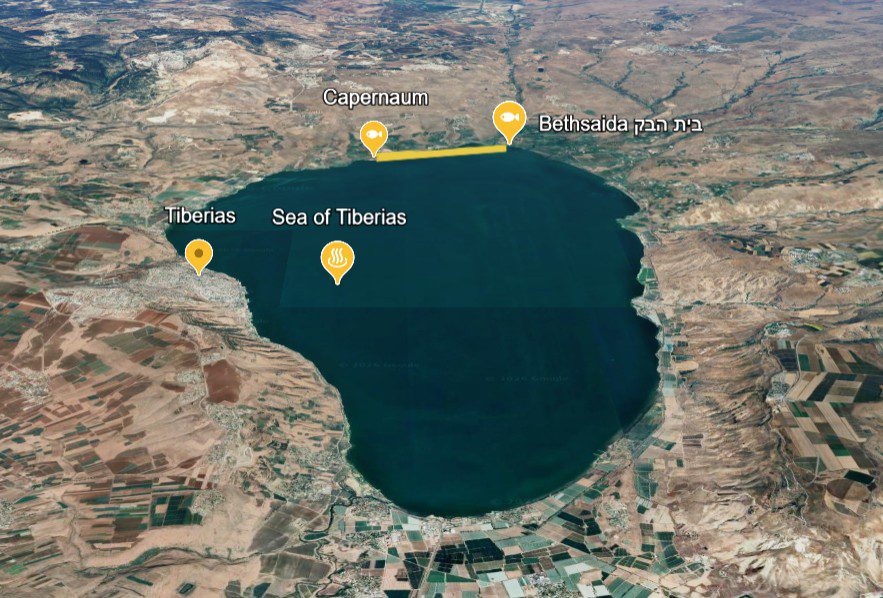
    the ‘Sea of Galilee’

    The Sea of Galilee provided a livelihood for many families, and fishing was a respected trade. Zebedee’s ability to employ hired men suggests a level of affluence and stability, which may have afforded his sons the opportunity to leave and follow Jesus without jeopardizing the family’s welfare.

    source: Biblehub.com

    Sometimes landmarks in the Bible can be as confusing as names, because in context over time the names change.

    Let’s zoom in on the home and livelihood of Zebedee —

    (James and John, Andrew and Simon, hired servants – local carpenters, boat builders, sail and tent makers, and more).

    Many families lived just north of Galilee’s most important body of water where the Jordan River flowed down from inland hills.
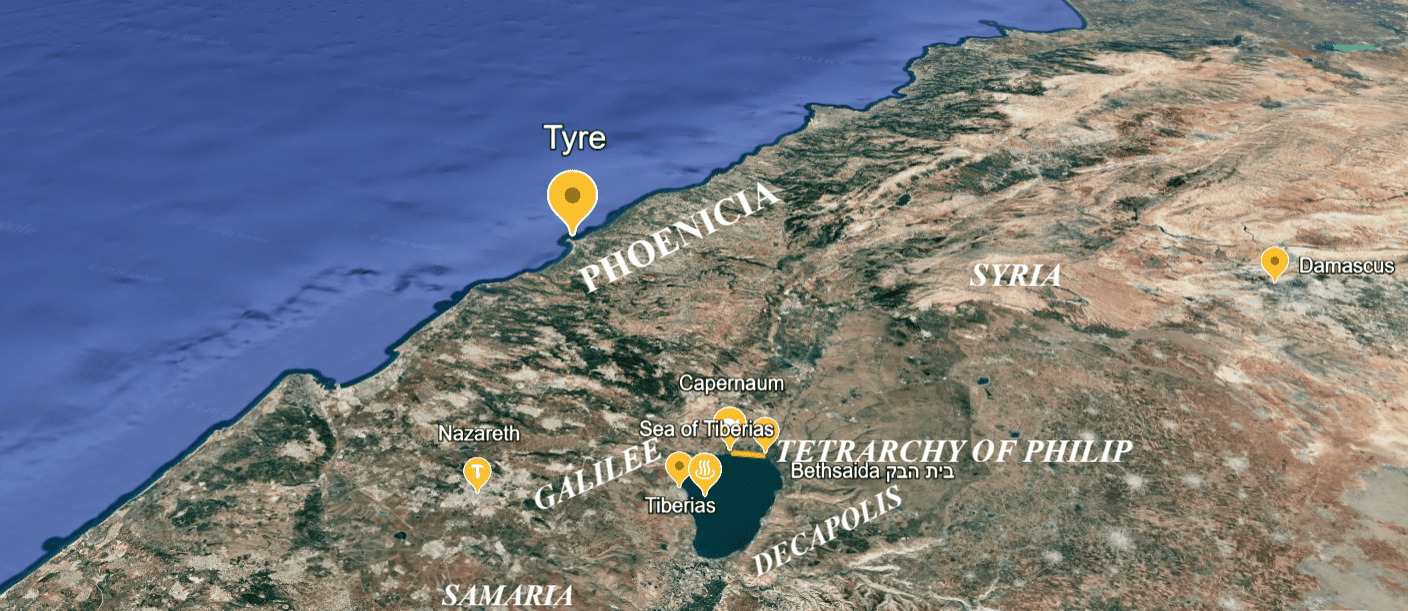
    Note some names of the inland body of water on our map.

    • ‘The sea of Chinnereth,’ Numbers 34:11,
    • ‘The sea of Genesar’
    • ‘The sea of Tiberiah.’
      • Source: BibleHub.com

    Herod Antipas, wanting to make a big name for himself, named this body of water the “Sea of Tiberius” after the Roman Emperor Tiberius Caesar.

    Once it was renamed, it was considered treason against Caesar for a Roman citizen to call the lake anything else.

    Non-Romans, however, were not held to that standard. Because the Jews hated Rome and their occupation of Israel they were not in any hurry to call their lake the Sea of Tiberius. So they continued calling the lake by the name most familiar to them and already widely accepted among the people who lived in the region of Galilee:

    “The Sea of Galilee.”

    source: NTBCStafford.org

    Rome controlled the coasts of the Mediterranean Sea and inland commerce. The strategic importance of the Sea of Galilee held military importance, perhaps even more than Jerusalem.

    Although sudden storms from winds sweeping down upon the sea could make it dangerous even for seasoned fishermen, in fact two other names more accurately described it:

    • Genezareth or Kineret Lake

    The lake has a surface area of 64 square miles .. Extending 13 miles (21 km) from north to south and 7 miles (11 km) from east to west, it is pear-shaped. Its surface elevation was long given as 686 feet (209 metres) below sea level..

    Source: Britannica

    The Sea of Galilee is a FRESH WATER LAKE, the largest in Israel, fed by the Jordan River and undground springs, with its surface ~700 feet below sea level making it the lowest fresh water lake on earth. From this important lake the lower Jordan flows south into the lowest body of water on earth - the Dead Sea. 

    Successful fishing businesses such as Zebedee’s were vital to the Roman army, even Jerusalem in the hills above the Jordan, as well as locally in villages of the rural Galilean hills.

    map of Jordan River and Bethany where John baptized Jesus

    James and John Sons of Zebedee

    When John followed his older brother James to become a disciple of John the Baptist it seems not to have affected the larger merchant enterprise of their father’s fishing business. They may have even traveled to Jerusalem previously with their father to deliver and sell fish to some of Jerusalem’s ruling families.

    Zebedee employed servants in his fishing enterprise and likely worked with other fishing families. Capernaum and Bethsaida are situated strategically (for fishing) less than three miles apart on the north shore of the lake.

    Sons and servants of other fishing enterprises, such as that of Jonah (also: Jonas or John), father of Andrew, who also had followed John the Baptist before becoming Jesus’ first Disciple, certainly all knew each other (as those in small towns tend to do).

    Sons of Salome

    Zebedee was married to Salome, who is believed to have been a follower of Jesus and possibly one of the women who supported His ministry.

    Source: BibleHub.com

    The Gospels of Matthew and Mark mention Salome’s presence along with others at the Cross of Jesus.

    Some commentators speculate that Salome may have been the sister of Mary, mother of Jesus.

    Therefore the soldiers did these things.
    But standing by the cross of Jesus were His mother, and His mother’s sister, Mary the wife of Clopas, and Mary Magdalene.

    Gospel of John 19:25 LSB

    It would be consist with the Apostle’s humility of not mention his own name in his Gospel for John to not mention his own mother by name.

    The Gospels reveal further evidence that Salome (wife of Zebedee) accompanied her sons.

    Then the mother of the sons of Zebedee came to Him with her sons, bowing down and making a request of Him.

    And He said to her, “What do you wish?” She said to Him, “Command that in Your kingdom these two sons of mine may sit one on Your right and one on Your left.”

    Gospel of Matthew 20:20-21 LSB

    John’s early days

    He was possibly born around 6 A.D. in the city of Bethsaida.

    If this is true, he would have been about twenty years old when he and Jesus met for the first time in late 26 A.D. .. What few realize is that Salome and Jesus’ mother Mary were likely sisters.

    “This means that Christ and John were first cousins as far as legal matters were concerned among the Jewish people” (Restoring the Original Bible, pg. 313).

    John’s possible bloodline relationship to Jesus also means that he and is older brother James the Greater (Matthew 4:21) were full cousins to the Lord’s half-brothers James and Jude. Both James and Jude wrote New Testament books and were leaders in the early New Testament church (see Acts 1:14, 15:13).

    source: BibleStudy.org


    John in his 20’s and 30’s

    Everything we read in the Gospels about John, beloved Disciple of Jesus, takes place when John is in his early twenties. Most of what we witness about John from Acts of the Apostles takes place when the Apostle is still in his late twenties or thirties.

    NEXT - We will observe Jesus' young Disciple John from the witness of all four Gospel writers, followed by observations of an Apostle sent out by the risen Christ in ACTS of the Apostles. 
    TalkofJESUS.com earth from space

  • Confront and Correct with a Clear Conscience

    Confront and Correct with a Clear Conscience

    Are you afraid of CONFRONTATION?

    (the Apostle Paul seems to imply by asking Timothy to be strong…)

    Remind them of these things:

    2 Timothy 2:14a

    Paul builds up Timothy and other pastors true to following the Way of Jesus Christ. And further, the Apostle would confront false teachers by binding them with an oath.

    .. and solemnly charge them in the presence of God

    2 Timothy 2:14b NASB

    Warn them before God against quarreling about words;

    2 Timothy 2:14b NIV

    and charge them before the Lord [God or theos] to avoid disputing about words, which does no good, but only ruins the hearers.

    2 Timothy 2:14b RSV

    It’s serious business, this work of pastors leading their church!

    Various Bible translations head this section:

    • An Unashamed Workman
    • A Worker Approved by God
    • Dealing With False Teachers
    • Approved and Disapproved Workers

    Which type of worker are you?


    Accurately Handle the Word of Truth

    Legacy Standard Bible

    Confronting the World

    Believe it or not, MOST Common Era christians do NOT like confrontation concerning the truth of the Gospel of Jesus Christ.

    WE THE PEOPLE of our certain JESUS-worshiping church don’t even talk about the Way OR the Truth .. even to each other.

    OR do most churches challenge the community we include in our worship: to confess our own sins, accept forgiveness in Christ and walk in a new and narrow way.

    THE WORLD, on the other hand, speaks sharp words against christians, seeking our conciliation to include their sins and gods of self as acceptable to God and the Lord Jesus Christ.

    But to borrow a frequent response of the Apostle to such an argument, I answer:

    “BY NO MEANS.”

    AND, as Jesus said, it is not you, beloved believer, that the world hates: 

    “The world cannot hate you, but it hates Me because I bear witness about it, that its deeds are evil.

    Gospel of John 7:7 LSB


    Therefore the Apostle Paul instructs Timothy and pastors:

    Be strong in the grace that is in Christ Jesus.

    2 Timothy 2:1a LSB

    Be diligent to present yourself
    approved to God as a workman
    who does not need to be ashamed,
    accurately handling the word of truth.

    Second Letter of of the Apostle Paul to Timothy 2:15 LSB

    Now the Apostle Paul instructs Timothy HOW and WHO to confront, making certain that his (or our) motives are pure since cleansed in Christ.


    But avoid worldly and empty chatter

    Paul begins by warning who NOT to debate. For the Apostle has already instructed this in his previous epistle.

    O Timothy, guard what has been entrusted to you, turning aside from godless and empty G2757 chatter G2757 and the opposing arguments of what is falsely called knowledge—

    1 Timothy 6:20 LSB – Strong’s G2757 – kenophōnia

    YES, the FALSE teachers seeking to challenge the purity of TRUTH in your church always claim knowledge that goes against God.

    So Paul begins again in this letter:

    Avoid godless chatter, because those who indulge in it will become more and more ungodly.

    2 Timothy 2:16 NIV

    Empty disputing, worthless babble. From a presumed compound of kenos and phone; empty sounding, i.e. Fruitless discussion.

    source: G2757 BibleHub.org

    Have you ever encountered anyone in a Bible study or Church gathering who always seems to go on about something that has nothing to do with you, what you are discussion or what a selection of Scripture says? 

    “and their talk will spread like gangrene, Paul warns, citing two men, Hymenaeus and Philetus.

    What truth do they challenge?

    This is an important question of discernment for the pastor up against false teaching. And the Apostle points to a common false teaching of these two men with knowledge spreading into Ephesus and beyond like gangrene.

    They have strayed from the truth by saying that the resurrection has already occurred, and they are undermining some people’s faith.

    2 Timothy 2:18 NET

    How does the Apostle assure us?

    19 Nevertheless, God’s solid foundation stands firm, sealed with this inscription:

    “The Lord knows those who are his,” and

    “Everyone who confesses the name of the Lord must turn away from wickedness.”

    2 Tim 2:19 NIV

    quoting Scripture: Numbers 16:5, Joel 2:23

    Paul and pastors encountering FALSE knowledge quote Scripture, God’s written word — accurately.

    Now the Apostle to the gentiles speaks to our own accountability, specifically that of Timothy as the pastor who must confront such patently false teaching.

    Sanctifying the saints

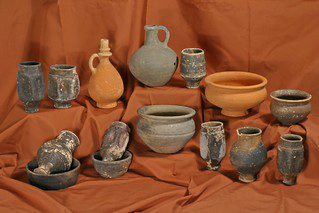
    Now in a great house there are not only vessels of gold and silver but also of wood and clay, some for honorable use, some for dishonorable.

    2 Timothy 2:20 ESV

    Common or Sanctified Honorable Vessels

    In his epistle to the Romans, Paul points to God – owner of the great house – as maker of every vessel formed regardless of its common use or honorable gilded gloss of silver or gold.

    Paul’s letter to the Romans 9:21 KJV

    Hath not the potter power over the clay, of the same lump to make one vessel unto honour, and another unto dishonour?

    Although the saints and servants of the Lord Jesus Christ understood a vessel as an implement made for household use, the Apostle uses the familiar metaphor for σκεῦος [skeuos] for a man of quality, as a chosen instrument (honorable) or ‘in a bad sense, an assistant in accomplishing an evil deed’ [dishonorable, as a false teacher would choose].

    Jesus remarks, as Paul and Timothy would well know:

    No man can enter into a strong man’s house, and spoil his goods, [G4632 – vessels]

    except he will first bind the strong man;

    and then he will spoil his house.

    Gospel of Mark 3:27 KJV

    The STRONG pastor, as the Apostle encourages Timothy, will CONFRONT any intruder with false truth

    AND as an honorable vessel sanctified by the Lord of the House, CORRECT his (or her) false teaching.


    But first, purify yourself

    What’s a church to do when a false teacher steps into the spotlight of doctrine and truth?

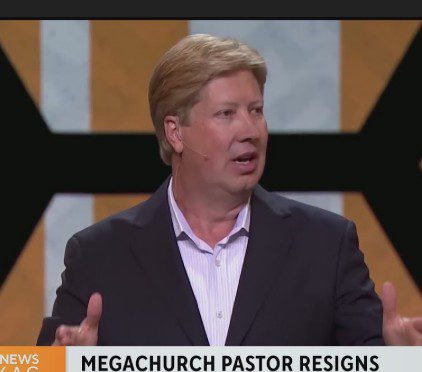
    Imagine Timothy making the NEWS..

    Or suppose that your church wants you to tolerate some leader’s unrepentant sin?

    The Apostle Paul points first to sanctification of yourself.

    DON’T be a common vessel, but an honorable one for Christ.


    Therefore, if anyone cleanses himself from these things, he will be a vessel for honor,

    sanctified, useful to the Master,

    having been prepared for every good work.

    Now flee from youthful lusts

    and pursue righteousness, faith, love, and peace, with those who call on the Lord from a pure heart.

    Paul’s Second Pastoral Epistle to Timothy 2:2:21-22 LSB


    9 Characteristics of a Faithful Believer

    In verses 21-26, Paul sets forth nine characteristics that mark a faithful, godly believer who is a vessel of honor.

    Source: MACARTHUR COMMENTARY ON 2 Timothy, p.88

    1. a cleansed life
    2. a sanctified soul
    3. be useful to God
    4. be prepared for service
    5. have a pure heart
    6. and have a discerning mind
    7. a gentle manner
    8. a humble spirit
    9. and a compassionate attitude.

    How’d you do?

    How many of these 9 honorable traits Paul suggests fit you as a ‘workman‘ in the large house with various vessels for use?

    Do YOU have a clear conscience?


    The clear conscience of a sanctified saint (believer).

    a good conscience and an unhypocritical faith

    The Apostle had already challenged Timothy and leaders of the Ephesian church in his first epistle:

    But the goal of our command is love from a pure heart and a good conscience and an unhypocritical faith.

    (later urging Timothy) 

    .. that by them you may fight the good fight, keeping faith and a good conscience, which some, having rejected, suffered shipwreck in regard to the faith.

    1 Timothy 1:5, 18c-19 LSB

    Now, after making certain that church leaders (some who have strayed from the faith), the Apostle commands them HOW to deal with those false teachers in their midst.

    When and How to Correct Them

    John MacArthur points to these leadership decisions as requiring A DISCERNING MIND.

    Paul instructs Timothy in this face-to-face conversational combat a strong Pastor faces.


    But reject foolish and ignorant disputes, knowing that they breed quarrels.

    2 Timothy 2:23 HCSB

    Foolish, an accusative plural adjective, Probably from the base of musterion; dull or stupid, i.e. Heedless, blockhead, absurd.

    Although we know what ignorant means, accusative adjective – Untrained, uneducated, showing a want of training or education, ignorant. Uninstructed, i.e. stupid.

    source:

    Why mention it?

    The Apostle warns, DON”T engage them.

    In fact, because of the conflicts such debates cause, leaders must refuse speculations that restart old battles.

    The Apostle reminds Timothy and church leaders that a slave (of the Lord’s household) not only must not quarrel, but also must be kind toward everyone.

    Have any trouble with that one?
    Does this sound familiar?

    Blessed are the meek:

    for they shall inherit the earth.

    Gospel of Matthew 5:5 KJV from the teaching of Jesus


    Teaching, rather than debating the ignorant

    but be kind to all, able to teach, patient when wronged, with gentleness correcting those who are in opposition..

    2 Timothy 2:24b-25a LSB

    The King James Version translates πραότης – praotēs, as meekness (rather than gentleness, or humility NKJV). And why not teach as the Master, the Teacher and Truth of those who may believe, as Paul suggests:

    .. if perhaps God may give them repentance leading to the full knowledge of the truth, and they may come to their senses and escape from the snare of the devil, having been held captive by him to do his will.

    2 Timothy 2:25b-26


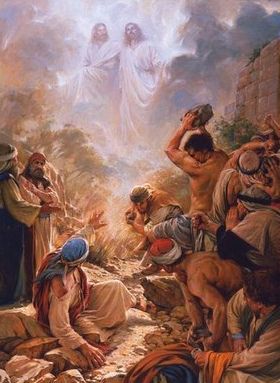
    Was it not lasting Truth and forgiveness spoken by Stephen that began bringing a senseless Saul from the snare of the devil?

    the acts of Saul begin as witness of the stoning of Stephen in Jerusalem .. and a young man Saul of Tarsus held the cloaks of the men who stoned him
    And they stoned Stephen, calling upon God, and saying, Lord Jesus, receive my spirit.

    The Apostle Paul encourages Timothy to remain strong in the Truth and to teach with a gentleness of words from his humble sanctified spirit.


    NEXT: Danger Within during Difficult Times


    Comment on Scripture – Share the Gospel


  • 2 Timothy 2 – Strong Teachers Charge them before God

    2 Timothy 2 – Strong Teachers Charge them before God

    More than thirty years earlier the Apostle Peter preaching on Pentecost had charged all Israel to accept JESUS as both God and Christ:

    “This Jesus God raised up, and of that we all are witnesses…

    And with many other words he bore witness and continued to exhort them, saying,

    “Save yourselves from this crooked generation.”

    Acts of the Apostles 2:32,40 ESV – Peter preaching on Pentecost ~AD 30

    You, therefore, my son, be strong in the grace that is in Christ Jesus.

    What you have heard from me in the presence of many witnesses,

    commit to faithful men who will be able to teach others also.

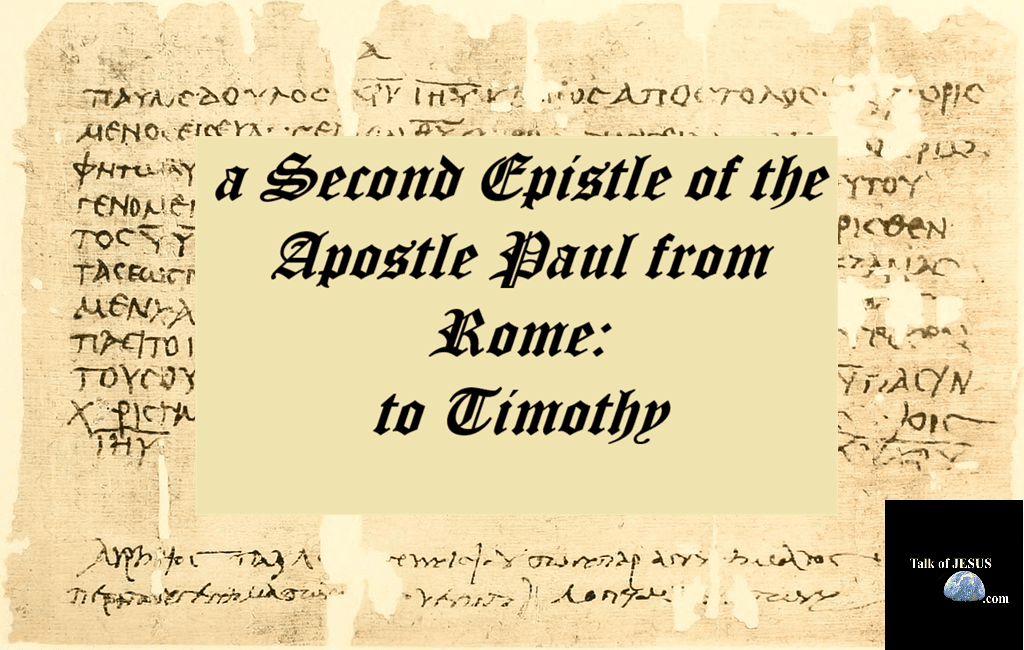
    Second Letter of Paul to Timothy 2:1-2 Christian Standard Bible


    The Elected Saints (among the Gentiles)

    By the grace of God, Paul — that is, Saul of Tarsus — was commissioned by Christ on a road to Damascus to fulfill his election as the Apostle to the Gentiles.

    It had been some thirty years ago and Timothy, who had first met Paul in Lystra and followed the Apostle is now a pastor to the church at Ephesus.


    Be Strong in the Lord

    Paul points to Christ, writing:

    Share in suffering as a good soldier of Christ Jesus.

    2 Timothy 2:3 CSB

    The Apostle had enlisted Timothy in the service of Christ back in Lystra.

    No one serving as a soldier gets entangled in the concerns of civilian life; he seeks to please the commanding officer.

    2 Tim 2:4 CSB

    In his humility and citing other witnesses Paul has pointed to Christ whom he serves as well. Certainly a soldier of Jesus Christ, risen from death, will be strong in the word given directly to the Apostle who enlisted his service.

    Also, if anyone competes as an athlete, he is not crowned unless he competes according to the rules.

    2 Tim 2:5

    If ever there was a zealous follower of the rules it would be Paul, that is, Saul. And the Apostle had even insisted on circumcising Timothy (though not other gentiles) to fulfill the Lord’s purposes among the Jews.

    Remember that Timothy’s absent biological father was Greek, but his grandmother had been a faithful Jew and his mother a Christ-follower.

    Why does the Apostle use these two illustrations and the work of the farmer which follows?

    Paul has written to the saints in Corinth:

    To the Jews..  I became as one under the law–though not being myself under the law–that I might win those under the law.

    To those outside the law (that is, Gentiles) I became as one outside the law.. but under the law of Christ–that I might win those outside the law. I have become all things to all men, that I might by all means save some.

    1 Corinthians 9 excerpt CSB

    The Apostle with whom Timothy also traveled to Corinth also writes words likely recalled now in Ephesus:

    I do all these things because of the gospel, so that I can be a participant in it.

    Do you not know that all the runners in a stadium compete, but only one receives the prize?

    So run to win. Each competitor must exercise self-control in everything. They do it to receive a perishable crown, but we an imperishable one.

    1 Corinthians 9:24-25 NET

    Paul will return to this before the close of this final pastoral epistle.

    The Gospel for the Elect

    Remember that Jesus Christ,

    of the seed of David,

    was raised from the dead according to my gospel, for which I suffer trouble as an evildoer, even to the point of chains;

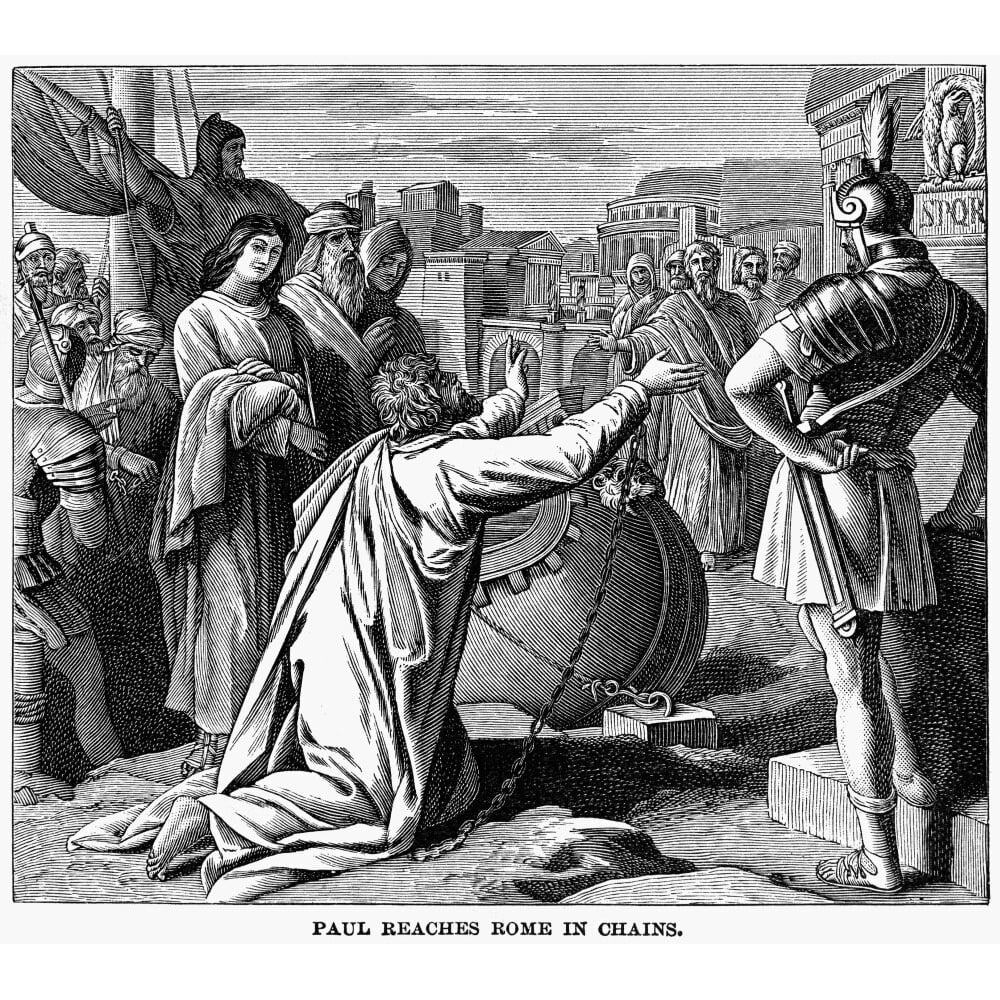
    Paul reaches Rome in chains

    but the word of God is not chained.

    Second Epistle of Paul to Timothy 2:8-9 NKJV


    As the Apostle nears the finish line of his race into the gentile world of the Roman Empire, Paul’s encouragement of Timothy as pastor of the elect Ephesian saints builds up a key church in a city of a quarter-million people, the third largest in the Empire.

    Clement of Alexandria, second largest city in the Empire, would be an important convert in the second century of our Lord Jesus Christ and of course Rome remained the Empire’s largest metropolitan area.

    For the Sake of Salvation of the Elect

    WHY do all these early Christian saints endure persecution, martyrdom and rejection by the vast majority of those in the cities in which they preach?

    Therefore I endure all things for the sake of the elect, that they also may obtain the salvation which is in Christ Jesus with eternal glory.

    The Apostle Paul writes in 2 Timothy 2:10 NKJV
    Rome was on top of the world when in AD 66 the Apostle Paul wrote to Timothy

    Among the millions of souls surrounding the Apostles and martyred saints in Rome, Ephesus, Corinth and throughout the Empire, Paul encourages pastors in what Christ Himself has promised in the salvation of the elect — believing Jew or pagan Gentile.

    The saying is trustworthy, for:

    If we have died with him, we will also live with him;

    Yet a little while and the world will see me no more, but you will see me. Because I live, you also will live. – Gospel of John 14:19

    if we endure, we will also reign with him;

    So Jesus said to them, “Assuredly I say to you, that in the regeneration, when the Son of Man sits on the throne of His glory, you who have followed Me will also sit on twelve thrones, judging the twelve tribes of Israel. – Gospel of Matthew 19:28 NKJV

    if we deny him, he also will deny us;

    but whoever denies me before men, I also will deny before my Father who is in heaven. – Matthew 10:33

    if we are faithless, he remains faithful— for he cannot deny himself.

    Heaven and earth will pass away, but my words will not pass away. But concerning that day and hour no one knows, not even the angels of heaven… – Matthew 24:35-36a

    Second Epistle of Paul to Timothy 2:12-14 ESV – quoting the Gospels and other Scripture


    Choose this day who you will follow

    24:15 וְאִם רַע בְּעֵינֵיכֶם לַעֲבֹד אֶת־יְהוָה בַּחֲרוּ לָכֶם הַיּוֹם אֶת־מִי תַעֲבֹדוּן אִם אֶת־אֱלֹהִים אֲשֶׁר־עָבְדוּ אֲבוֹתֵיכֶם אֲשֶׁר מֵעֵבֶר הַנָּהָר וְאִם אֶת־אֱלֹהֵי הָאֱמֹרִי אֲשֶׁר אַתֶּם יֹשְׁבִים בְּאַרְצָם וְאָנֹכִי וּבֵיתִי נַעֲבֹד אֶת־יְהוָה׃ פ


    You may recognize my Heading from Joshua's challenge to the Elect to remember the LORD of their Salvation. 

    (Remember that this successor[יְהוֹשׁוּעַ] of Moses has a name [yᵊhôšûaʿ] meaning: "Jehovah is salvation" — iēsous, the Greek name for Jesus having the same Hebrew root.)

    Then Joshua gathered all the tribes of Israel to Shechem and called for the elders of Israel, for their heads, for their judges, and for their officers; and they presented themselves before God.

    .. “Thus says the LORD God of Israel: ..

    “Now therefore, fear the LORD, serve Him in sincerity and in truth, and put away the gods which your fathers served…

    “And if it seems evil to you to serve the LORD, choose for yourselves this day whom you will serve, …

    But as for me and my house, we will serve the LORD.”

    Joshua 24 excerpt NKJV

    PAUL now encourages young Timothy — the Apostle builds up pastors and saints to follow until the Day of Jesus Christ.

    Remind them of these things, solemnly charging them in the presence of God..

    Second Letter of Paul to Timothy 2:14a LSB

    Many commentators cite the importance and difficulty of these key verses in 2 Timothy 2:10-13. We will close this section with these observations for your consideration (IF you are among the remnant elect saints of this Common Era):

    God must be sovereign in our salvation precisely because we are neither willing nor able to choose salvation for ourselves.

    John MacArthur – THE DOCTRINES OF GRACE

    Why did the world hate Christ?

    .. Earlier in John’s gospel, Jesus explained,

    “The world … hates Me because I testify of it, that its deeds are evil” (7:7)

    Fallen man does not want to be confronted with the true nature of his heart, he doesn’t want to face his inherent wickedness.

    He has to find a way to tolerate and excuse himself from the guild he naturally faces each day.

    So he falls back on his most dominant sin, pride, and imagines a version of himself that can escape condemnation. He spins a web of delusions, convincing himself that he is truly good and noble—anything to distract from the fact that his deeds are evil.

    ibid. pp 7-8

    It was true in Ephesus and Rome in the first century AD; it is true in this twenty-first century of the Common Era in Rome and in every other city.

    Salvation in God alone

    “It’s a well established reality that the doctrine of election is disturbing to many people,” observes MacArthur.

    He continues, “Numerous ministry leaders, pastors, and major authors harbor animosity toward the doctrine of election.”

    ibid. pp 55,56

    Note a later idolatry and heresies which crept quickly into the churches with false teaching seeking to include men as only interpreters of Scripture and intercessors for active sin through memories of saints gone before.

    MacArthur cites numerous Scriptures besides those here [2 Timothy 2:10]

    ibid. 68-

    Before we return to a brief MacArthur outline from this section from his commentary on 2 Timothy, note his QUOTE of Martin Luther introducing this section on:

    DIVINE ELECTION:

    NO MAN CAN BE THOROUGHLY HUMBLED UNTIL HE KNOWS THAT HIS SALVATION IS UTTERLY BEYOND HIS OWN POWERS, DEVICES, ENDEAVORS, WILL, AND WORKS, AND DEPENDS ENTIRELY ON THE CHOICE, WILL, AND WORK OF ANOTHER, NAMELY, OF GOD ALONE.

    MARTIN LUTHER


    2 Timothy – NEXT in our outline

    An overview Outline of 2 Timothy [Kress Biblical Resources] follows Paul’s brief prologue (2 Tim 1:1-2) with an extended section we have just completed:

    Persevere in the ministry and be unashamed to suffer for the gospel (1:3-2:13)

    The following extended section we will follow next pivots on 2:14.

    Proclaim the truth and be unashamed to confront error (2:14-4-8)


    John MacArthur in his NEW TESTAMENT COMMENTARY OF 2 TIMOTHY outlines this section of Paul’s second letter to Timothy:

    • The Elements of a Strong Spiritual Life [2 Tim 2:1-7]
    • Motives for a Sacrificial Ministry [2 Tim 2:8-13]
    • The Danger of False Teaching [2 Tim 2:14-19]
    • and completing 2 Tim 2 – An Honorable Vessel

    Remember

    Paul’s pivotal imperatives of this section of the Apostle’s second pastoral epistle.

    • BE STRONG – v.1
    • CONSIDER – v.7
    • REMIND – v. 14 (our pivotal hinge today)
    • AVOID, ABSTAIN, FLEE, PURSUE, REFUSE
      • ALL next in Paul’s commands to Timothy.

    MACARTHUR NT COMMENTARY 2 TIMOTHY, p. 55


    Looking for some more Apostolic controvery?

    NEXT – We’ll address these warnings against false doctrine.

    Followers of Christ must always expect an attack against Scripture. Church doctrine is a line in the sand. - How will a leader or council of leaders choose what the Church will teach?

    Talk of JESUS . com

    Comment on Scripture – Share the Gospel