Tag: paul

  • The Lame Walk a Sign from God

    The Lame Walk a Sign from God

    A Sign of Faith in Capernaum

    ~A.D. 27Jesus in Galilee

    “Which is easier, to say, ‘Your sins have been forgiven you,’ or to say, ‘Get up and walk’?

    Gospel of Luke 5:43 LSB

    “But, so that you may know that the Son of Man has authority on earth to forgive sins,”—He said to the paralytic—

    “I say to you, get up, and, picking up your stretcher, go home.”

    Good News of Luke 5:44

    Of course, a paralyzed man obeying Jesus’ command to ‘get up and walk’ is a miracle to the man who can now stand up and walk AND a sign of God to those who witness it!

    Who can say such a thing to one born handicapped?

    And immediately he rose up before them, and picked up what he had been lying on, and went home glorifying God. And astonishment seized them all and they began glorifying God; and they were filled with fear, saying,

    “We have seen remarkable things today.”


    But this was a sign to the Jews.

    Luke records [5:17]:

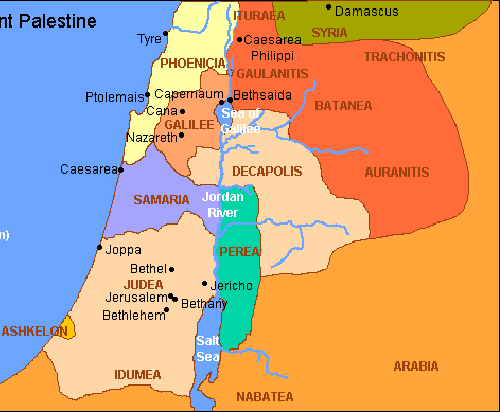
    And it happened that one day He was teaching; and there were some Pharisees and teachers of the law sitting there, who had come from every village of Galilee and Judea and from Jerusalem, and the power of the Lord was present for Him to perform healing.

    After having healed others as well Jesus answered the Prophet John who had been baptizing in the wilderness of Judea with Good News sent by his messengers:

    “Go and report to John what you have seen and heard: the BLIND RECEIVE SIGHT, the lame walk, the lepers are cleansed, and the deaf hear, the dead are raised up, the POOR HAVE THE GOSPEL PREACHED TO THEM. 
    
    Blessed is he who does not take offense at Me.” - Gospel of Luke 7:22b-23, LSB
    

    But of course, these signs from the LORD God to the Jews were done by JESUS the Messiah.

    These signs for the Jews where witnessed in regions of Roman Syria AND that had been years ago.

    It’s about two decades later that Paul and Barnabas will enter Lystra.

    A.D. 30’s – The Apostle Peter

    But when Peter, along with John, fixed his gaze on him, he said, “Look at us!” – Acts 3:4

    And seizing him by the right hand, he raised him up; and immediately his feet and his ankles were strengthened. And leaping up, he stood upright and began to walk; and he entered the temple with them, walking and leaping and praising God.

    And all the people saw him walking and praising God; and they were recognizing him, that he was the one who used to sit at the Beautiful Gate of the temple to beg alms, and they were filled with wonder and amazement at what had happened to him. – Acts of the Apostles 3:


    More recent signs from God

    Keep in mind that Luke's two-part account of these events is recorded for a Roman-Hellenist world after A.D. 60, 
    + some thirty years after Jesus' resurrection [~A.D. 30],
    + perhaps twenty-five years after Saul's encounter with Christ on the road to Damascus,
    + about seven years [~A.D. 40] after the Apostle Peter baptizes a Roman Centurion in Caesarea Syria.
    And Peter said to him, “Aeneas, Jesus Christ heals you. Rise up and make your bed.” Immediately he rose up. – Acts 9:

    And all who lived at Lydda and Sharon saw him, and they turned to the Lord.

    Acts of the Apostles 9:35 LSB
    Roman Caesarea [pictured] where Peter baptized Roman believers who received the Holy Spirit!

    And what had Peter heard from the angel of God?

    “Get up..”

    ἀνίστημι – anistēmi

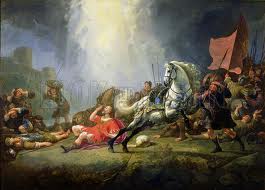
    It’s a command of some significance — a command by faith also used by Peter and the Lord Jesus. And it is part of what the Apostle Paul is about to say to the lame man in Lystra.

    • to rise, stand up
      1. of persons lying down, of persons lying on the ground
      2. of persons seated
      3. of those who leave a place to go elsewhere [of those who prepare themselves for a journey]
      4. of the dead

    GOD’S signs have many witnesses among the gentiles by the time Barnabas and Saul enter Lystra.

    ~A.D. 48

    In Lystra The Lame Walk!

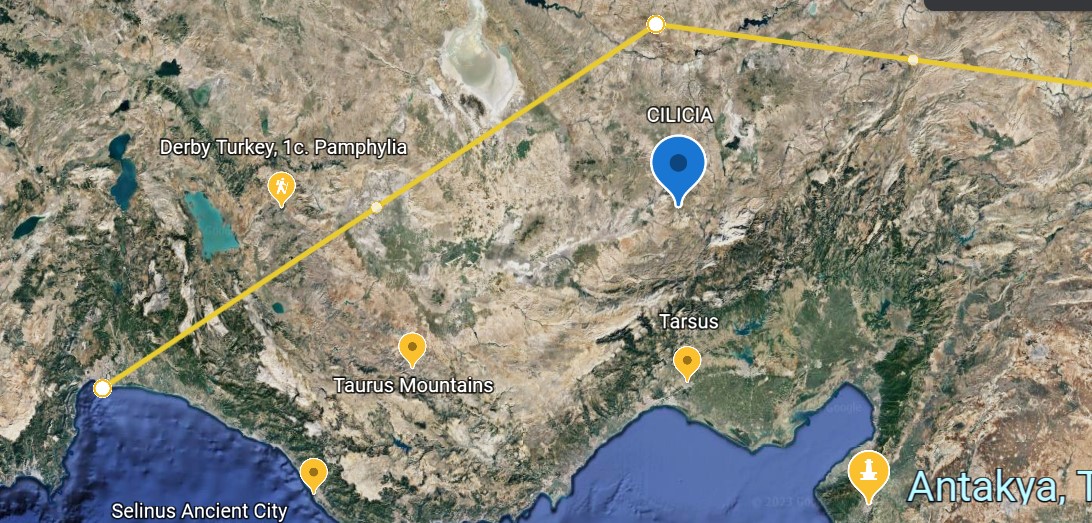
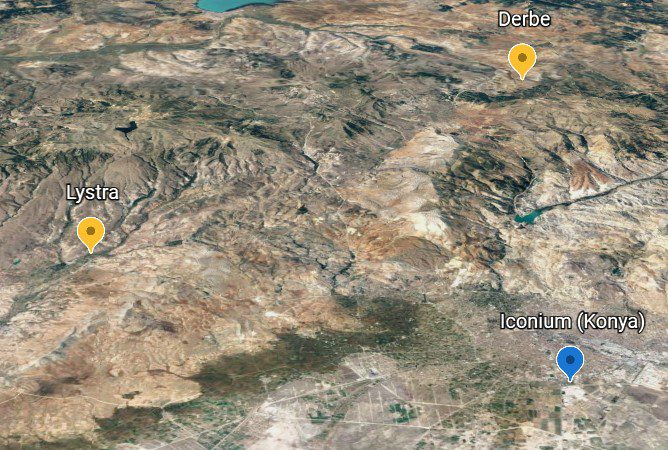
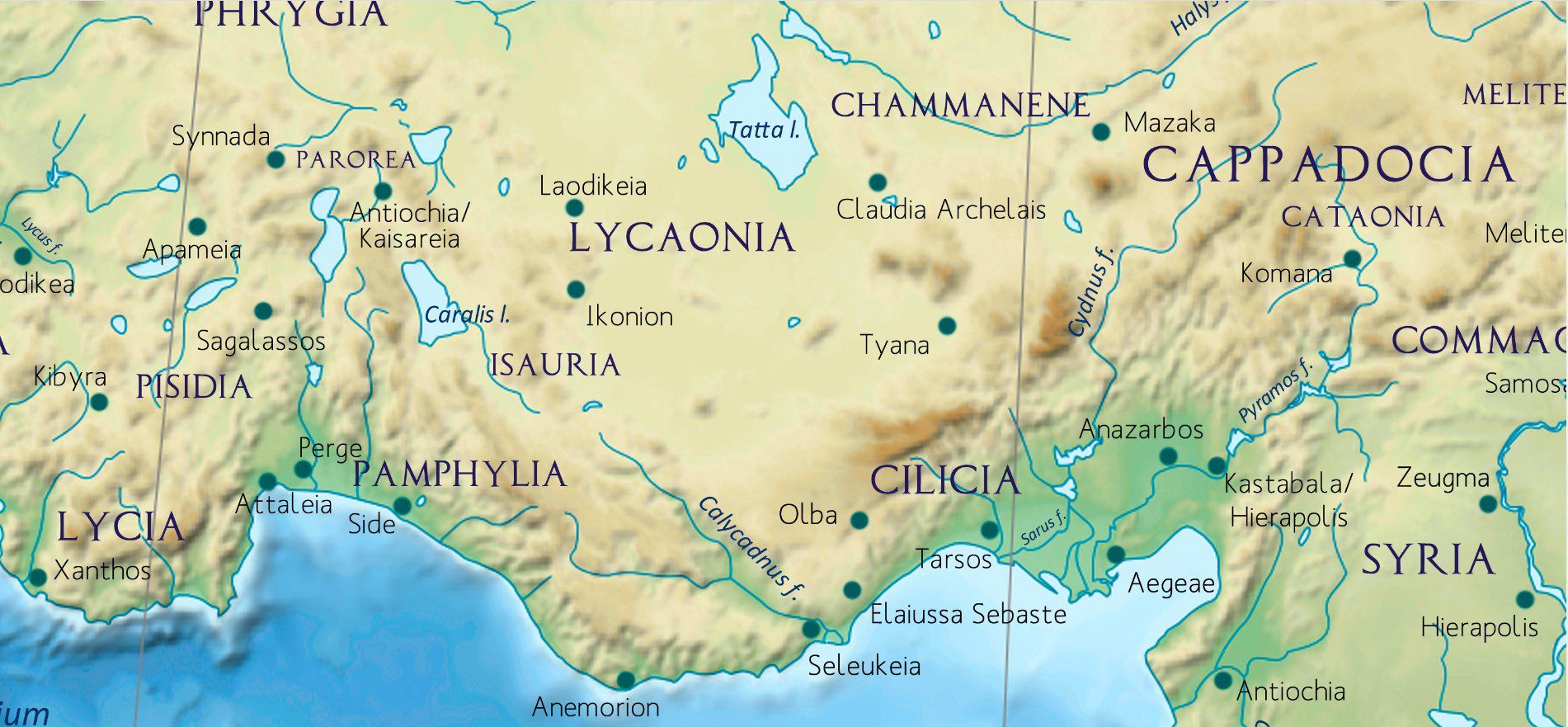
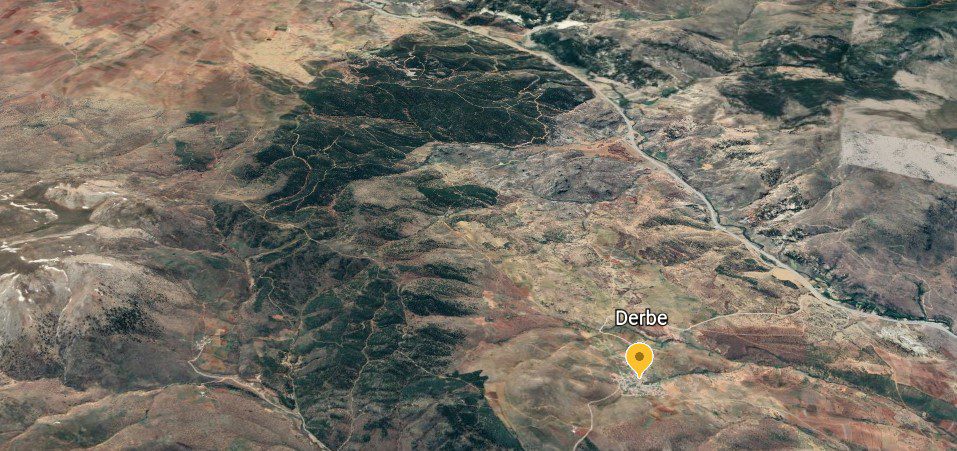
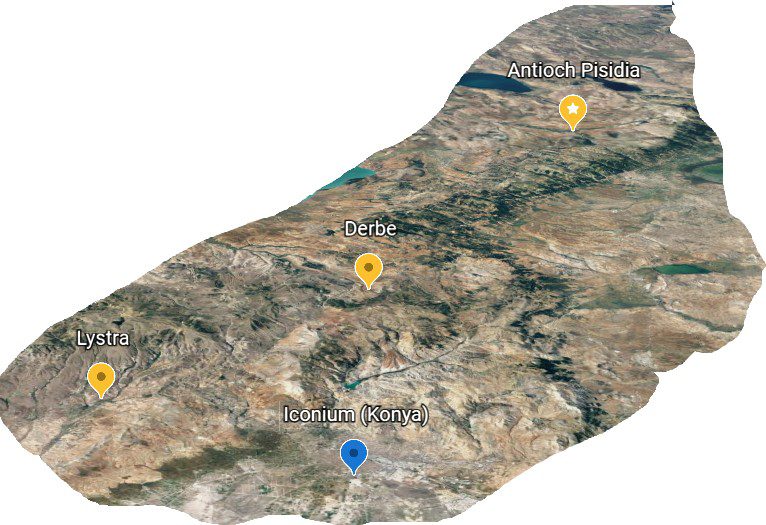
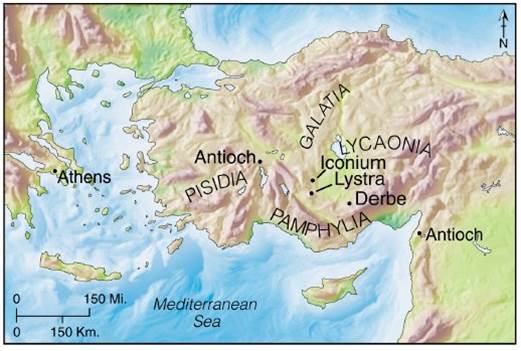
    Lystra and Derbe in the Taurus Mountains of Turkey

    Acts of Faith in Lystra 14:

    And at Lystra a man was sitting who had no strength in his feet, lame from his mother’s womb, who had never walked.

    This man listened to Paul as he spoke, who, when he fixed his gaze on him and saw that he had faith to be [made well] said with a loud voice,

    “Stand upright on your feet.”

    Acts 14:10 of Paul commanding a lame man in Lystra

    And he leaped up and began to walk.

    And when the crowds saw what Paul had done, they raised their voice, saying in the Lycaonian language,

    “The gods have become like men and have come down to us.”

    Acts of the Apostles 14:11b – LSB

    In fact, these Lycaonian pagans were partially right.

    For the Gospel of Paul and Barnabas would reveal that the One God, Father of our Lord Jesus Christ sent his only Son down to us for redemption of sins for those who have faith to believe — even pagan gentiles.

    “Which is easier, to say, ‘Your sins have been forgiven you,’ or to say, ‘Get up and walk’?

    Gospel of Luke 5:43 LSB

    Acts of the Apostles in Lystra — To be continued…

  • A Parting of Mission in Perga

    A Parting of Mission in Perga

    Acts of the Apostles 13:

    Acts 9 Joseph of Cypress aka Barnabas 'son of encouragement' meets Saul of Tarsus

    The first missionary journey of Paul seemed to get off to an amazing start.

    Barnabas took him and brought him to the apostles and recounted to them how he had seen the Lord on the road, and that He had talked to him, and how at Damascus he had spoken out boldly in the name of Jesus. – Acts 9:27

    .. the brothers learned of [an assassination attempt and] brought him [from Jerusalem] down to Caesarea and sent him away to Tarsus. – Acts 9:30

    .. the church at Jerusalem.. sent Barnabas off to Antioch – Acts 11:22

    And he [Barnabas] left for Tarsus to search for Saul; and when he found him, he brought him to Antioch. And it happened that for an entire year they met with the church and taught a considerable crowd.

    Acts of the Apostles 11:25-26a LSB
    https://talkofjesus.com/an-antioch-blueprint-of-church-evangelism/

    The Christians of the Church in Antioch sent a contribution to the brothers of the Church in Judea for famine relief by the hand of Barnabas and Saul of Tarsus [Paul]. – Acts 11:28-30

    They return to Antioch.

    And Barnabas and Saul returned to Jerusalem, fulfilling their ministry, taking along with them John, who was also called Mark.

    Acts of the Apostles 12:25

    In Antioch (of Syria):

    And while they were ministering to the Lord and fasting, the Holy Spirit said, “Set apart for Me Barnabas and Saul for the work to which I have called them.” Then, when they had fasted and prayed and laid their hands on them, they sent them away.

    https://talkofjesus.com/acts-13-4-sailing-salamis/

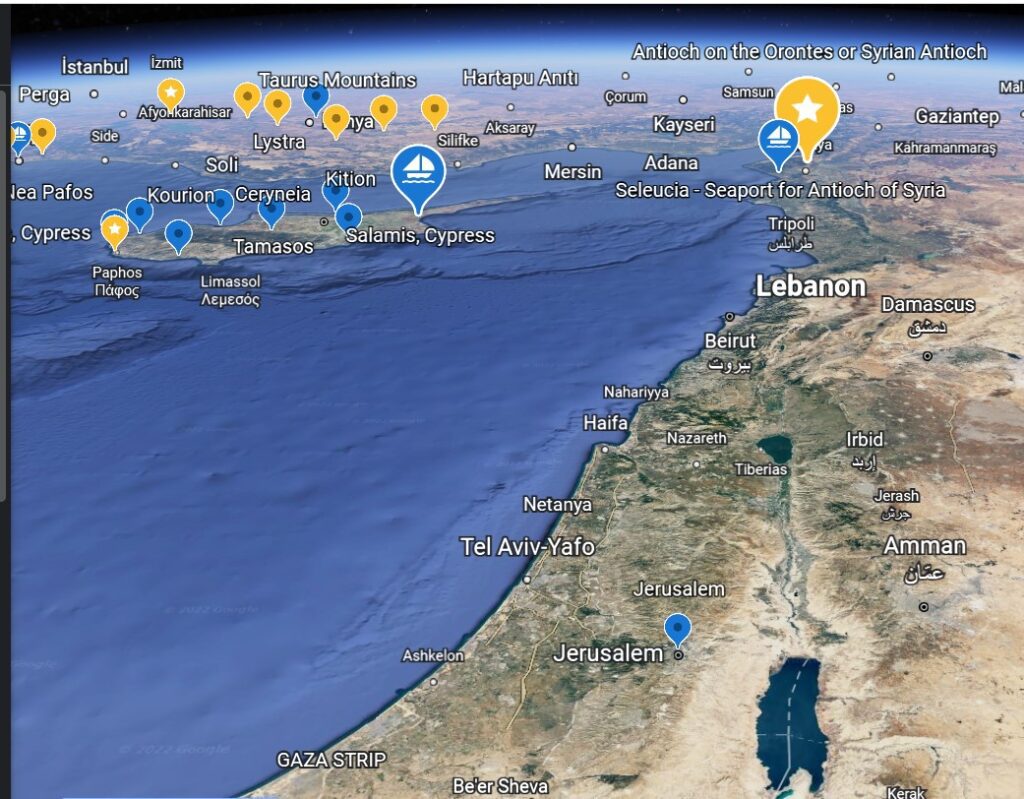
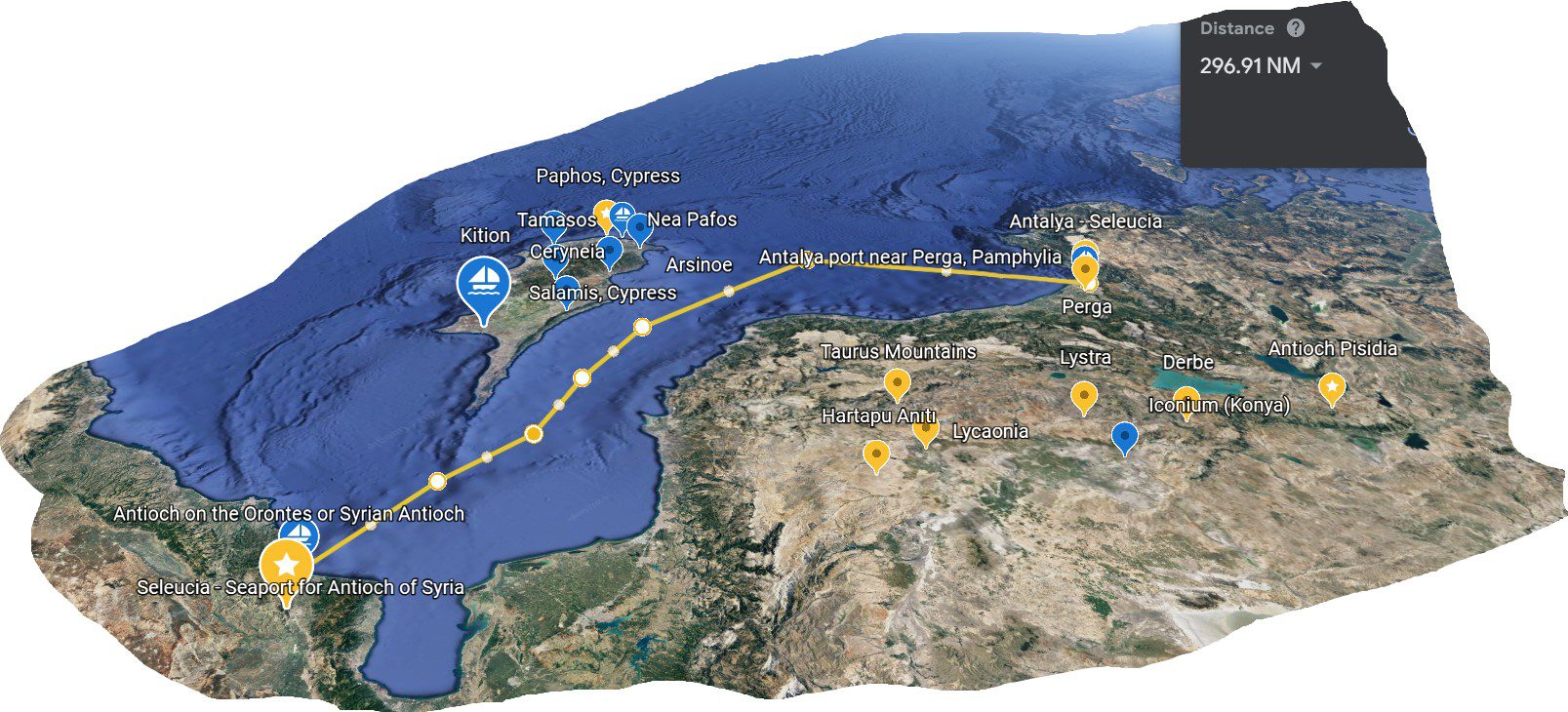
    What happened between Syrian Antioch and Pisidian Antioch?

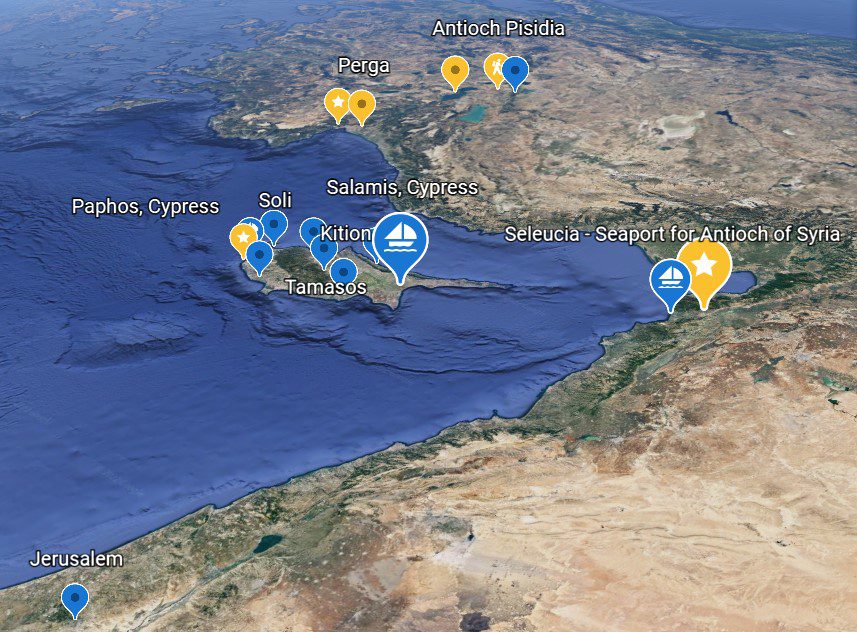
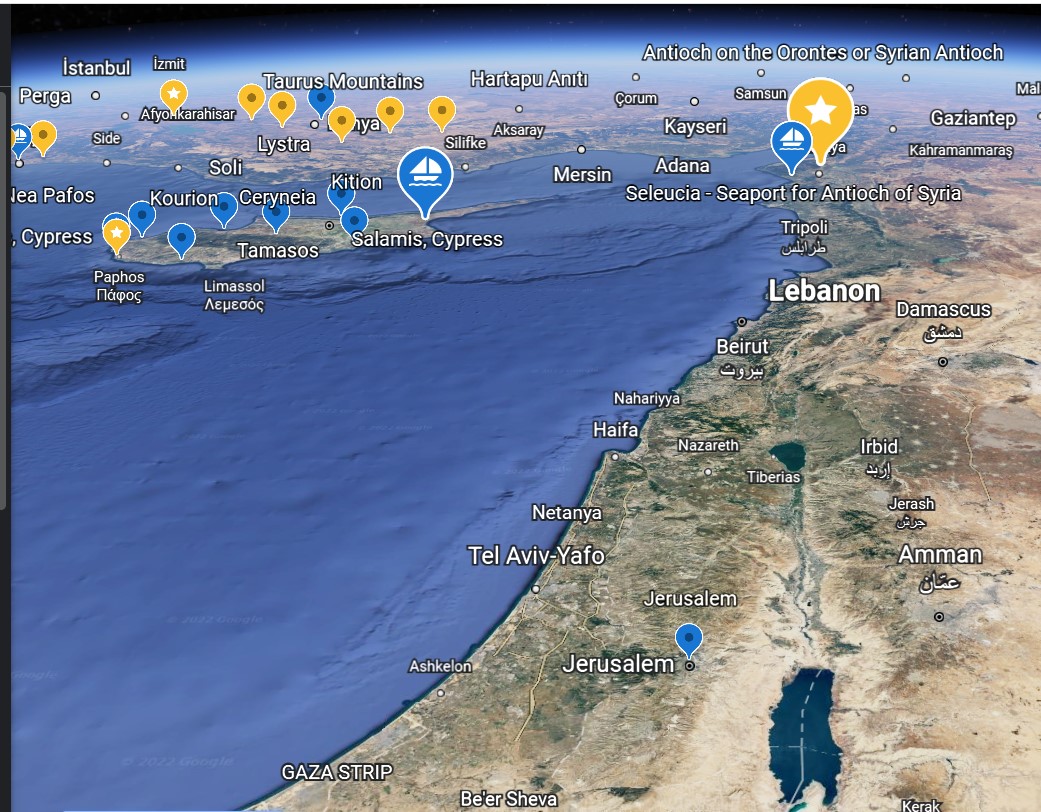
    Cypress cities Acts 13

    Cypress – Mixed Results

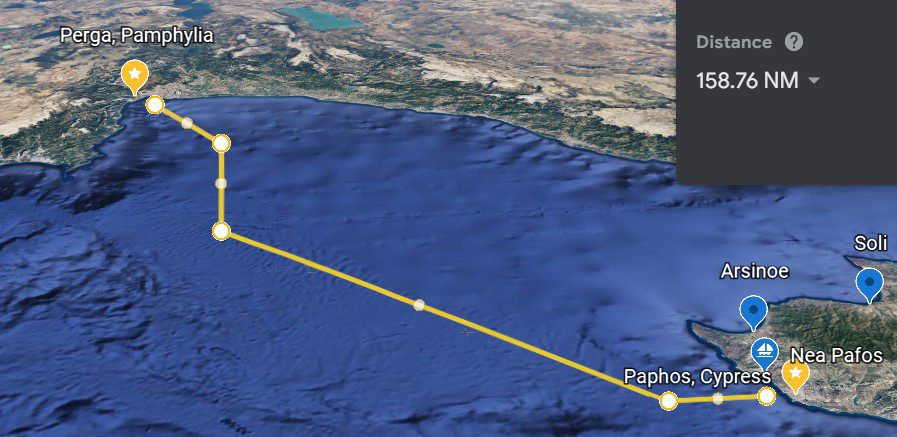
    So on a second sailing from Paphos Cypress to Perga, as on most journeys the missionaries must have talked about their most recent results from the towns on Cypress

    AND what these three will do next in Pisidia.

    I must share an astute observation of Tony Merida from his commentary: Exalting Jesus in Acts.

    He titles his chapter on missions covering Acts 13: The Holy Spirit, a Bible, a Passport, and a First-Aid Kit, Part 1.

    He points out about ‘Stop 1’ in Cypress:

    • Some people will be open to God’s Word
    • Some people will oppose God’s Word
    • Some people will embrace God’s Word

    We have already observed this in Luke’s introduction and the examples of Bar-Jesus and the proconsul, Sergius Paulus.

    Paul and Barnabas are the ‘commissioned‘ missionaries sent out by the Holy Spirit from the Church in Antioch. BUT they encounter a problem with ‘the help.’

    As you might guess Merida’s ‘Part 2’ description will also be applied to Acts 14 after the events which will take place NEXT in Perga and Pisidian Antioch–thus, our mission need for ‘a first-aid kit.’

    Not So Smooth Sailing – a Problem in Perga

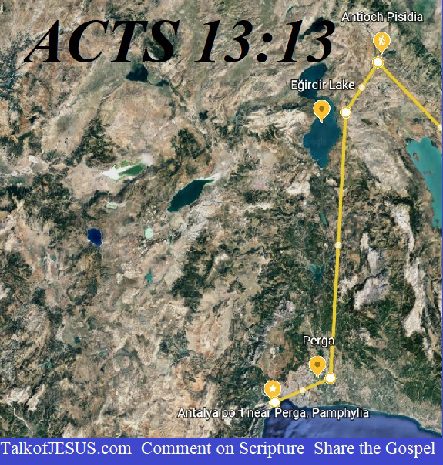
    Now after Paul and his companions set sail from Paphos, they came to Perga in Pamphylia, but John left them and returned to Jerusalem.

    Acts of the Apostles 13:13 LSB

    John MARK

    As I pointed out earlier, this young man is the Gospel-writer Mark whose Gospel would have already been published and known to some of the church when Luke published this second volume, Acts of the Apostles.

    So why would they have told Mark to go back home to Jerusalem rather than continuing on mission in Pamphylia?

    Alexander MacLaren :: John Mark (Acts 13:13)

    • He was the son of a well-to-do Christian woman in Jerusalem
    • The Church in Jerusalem met in their large home
    • He is a younger cousin of Joseph (Barnabas)
    • so he was naturally selected to be the attendant and secular factotum of Paul and Barnabas
      • Mark was NOT the anointed missionary sent, but a helpful servant to them.
        • For more: follow the link above to the source to the commentary of Alexander MacLaren.

    Luke does not tell us why they sent him back home before they began their hike to the cities before them, but later he records that Barnabas sought to enlist John Mark once more for a second missionary journey.

    (More about that after a few years and many miles later.)

    .. John left them and returned to Jerusalem. But going on from Perga, they arrived at Pisidian Antioch.

    Acts of the Apostles Paul and Barnabas 13:13b-14a

    To Be Continued…

  • Opposed to the Gospel at the Gate: Bar-Jesus

    Opposed to the Gospel at the Gate: Bar-Jesus

    Bar-Jesus is another name for a Jewish influencer on Cypress: Elymas the magician.

    Acts 13:

    • Luke chronicles THIS history of the first mission of the Church at Antioch published sometime around A.D. 60-62.
    • Many Christians may already have read John Mark’s Gospel written during the A.D. 50’s just a few years after this first missionary journey of Paul and Barnabas.
    • Luke’s account records events of A.D. 47.

    When they arrived at Cypress

    Cypress is Greek, NOT Roman

    (And certainly not Jewish)

    What the tourist visiting Cypress should know:

    Cyprus was allowed a large amount of autonomy remaining mainly Greek in culture while adopting and adapting Roman customs. No Roman colonies were settled on the island. 

    • The island is prone to earthquakes, several in the centuries prior to this missionary journey
      • including one as recently as A.D. 16.
    • Cypress had been an Egyptian (King Ptolemy) part of Roman Cilicia
      • a gift of Julius Caesar to Cleopatra
    • After Caesar Augustus defeated Marc Antony and Cleopatra, Rome made it a senatorial province
      • separate from Cilicia with Nea Paphos as its capitol

    5. And when they reached Salamis, they began to proclaim the word of God in the synagogues of the Jews, and they also had John as their helper.

    NOTE TWO POINTS HERE:

    1. .. they began to proclaim the word of God in the synagogues of the Jews
    2. Luke introduces John Mark as a helper to Barnabas and Saul.

    As you can see from the map of cities on Cypress at the time, this mission team would have traveled on land several times to preach the Gospel in synagogues of these Greco-Roman cities on Cypress. Not only was distance a factor in their travel but also mountains which rose to steep heights above the island. This took some time and not just a few days.

    In addition to noting last time that Cypress was mostly Greek and Phoenician with a few Jews, previously I pointed out that their ‘additional passenger,’ John, is the same John with earlier connections to Peter’s preaching and miracles.

    Luke notes that his fellow Gospel writer [John Mark] also begins this mission trip in A.D. 47.

    Paphos consisted of the Roman cites of Nea Pafos and Palaipafos on the southwestern coast of the island of Cypress

    6 And when they had gone through the whole island as far as Paphos, they found a magician, a Jewish false prophet whose name was Bar-Jesus…

    We'll introduce ourselves to this new character Bar-Jesus who they encounter on this mission shortly, but first let's take a quick look at Paphos.
    Aerial view of Paphos Cypress

    Paphos

    • Traveling roads across the whole island would have been a journey of 110 miles along the coast OR perhaps further if they traveled additional routes familiar to Joseph [Barnabas] and others through the mountains to other cities.
    • New Paphos (Nea Paphos), NW of old Paphos by 7.5 miles has a natural harbor and was built by Augustus of Rome for commerce and governing its Provence of Cypress.
    • Old Paphos was a centre for Aphrodite’s cult. Aphrodite’s mythical birthplace was on the island.
    • .. the grove and altar of Aphrodite at Paphos are mentioned in the Odyssey (700 BC).
    • Archaeology established that Cypriots venerated a fertility goddess in a cult that combined Aegean and eastern mainland aspects before the arrival of the mainland Greeks.

    Aphrodite of Cyprus

    • Every spring a festival was held here in honor of the goddess Aphrodite source
    • Phoenician merchants from Kition [Cyprus] who gained permission to found at Athens [Greece] a shrine of Aphrodite, whom they presumably looked upon as their ancestral deity Astarte – Aphrodite. READ MORE BELOW:
    (more…)