Tag: paul

  • Transporting Paul – Citizen Prisoner of Caesar- Acts 27

    Transporting Paul – Citizen Prisoner of Caesar- Acts 27

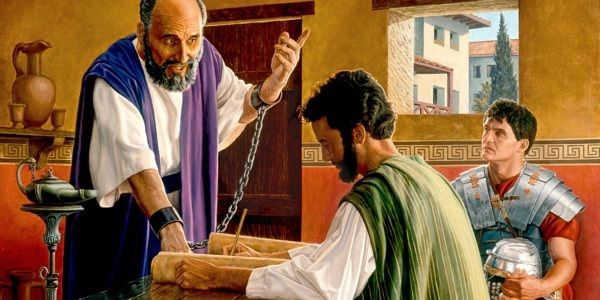
    The Apostle Paul, a Jew among Jews commissioned by Christ to go into all the world of the gentiles — after taking the Gospel to the Greeks since A.D. 47 — is now a prisoner sent to Rome.

    In the year of our Lord 59:

    Roman Prisoners (Chattel of Caesar)

    Make no mistake about it: ROME rules the world! Their ships have captured it since the days of Julius Caesar and although Judea claims a King, Jerusalem is no exception to Rome’s rule.

    Paul – a citizen under Roman rule

    In Paul’s lifetime thus far Caesar Augustus had been Emperor when he was a boy in Cilicia;Tiberius during his years studying under Gamaliel in Jerusalem and when Jesus was crucified and up until the day Christ appeared to Saul near Damascus.

    Paul had begun preaching the Gospel to the gentiles near the end of the reign of Caligua, who had declared himself a god in A.D. 37.

    The Emperor Claudius had made Judea a province of Rome after the death of Herod Agrippa I in A.D. 44, ruling the empire during many martyrdoms of several saints and some Apostle’s during the time of Paul’s missionary journeys.

    But on taking leave of them he said, “I will return to you if God wills,” and he set sail from Ephesus. Conclusion of the second missionary journey of Paul from Acts 18
    and he set sail from Ephesus.

    In the civil administration, many measures demonstrate Claudius’s enlightened policy. He improved in detail the judicial system, and, in his dealings with the provinces, he favoured a moderate extension of Roman citizenship by individual and collective grants..

    .. during a period of troubles Claudius expelled the Jews from Rome for a short time; Christians may have been involved. Elsewhere he confirmed existing Jewish rights and privileges, and in Alexandria he tried to protect the Jews without provoking Egyptian nationalism.

    Source: Britannica

    Claudius had ruled Rome and the world up until just five years ago, but Paul’s appeal is to a new Caesar.

    Roman Coin with profile of Nero Caesar Augustus

    Nero Claudius Caesar Augustus Germanicus

    Up to the year 59, Nero’s biographers cite only acts of generosity and clemency on his account. His government forbade contests in the circus involving bloodshed, banned capital punishment, reduced taxes, and accorded permission to slaves to bring civil complaints against unjust masters.

    Source: Britannica

    The Apostle Paul is about 54 years old now. He is a Roman citizen of Tarsus, Cilicia who would have been set free by the Roman Governor (with approval of the Judean King) had the Apostle not earlier appealed to Caesar — the 22 year old Nero now ruling Rome under his mother’s tutelage.

    Acts 27:

    Now when it was decided that we would sail for Italy, they proceeded to deliver Paul and some other prisoners to a centurion of the Augustan cohort named Julius.

    And getting aboard an Adramyttian ship, which was about to sail to the regions along the coast of Asia, we set sail accompanied by Aristarchus, a Macedonian of Thessalonica.

    Acts 27:1 prisoners of Roman Centurion Julius include the Apostle Paul
    Doctor Luke, the historian recording the Acts of the Apostles, tells us a few details of Paul's journey to Rome as a prisoner. 

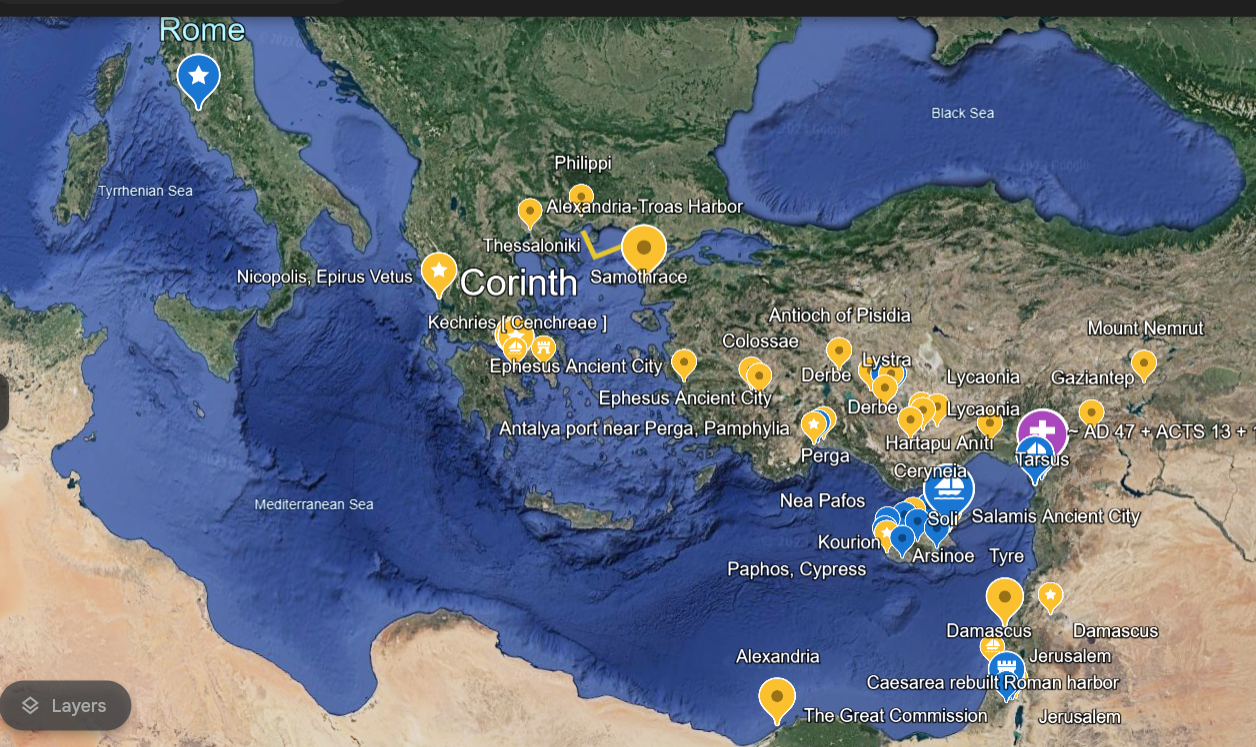
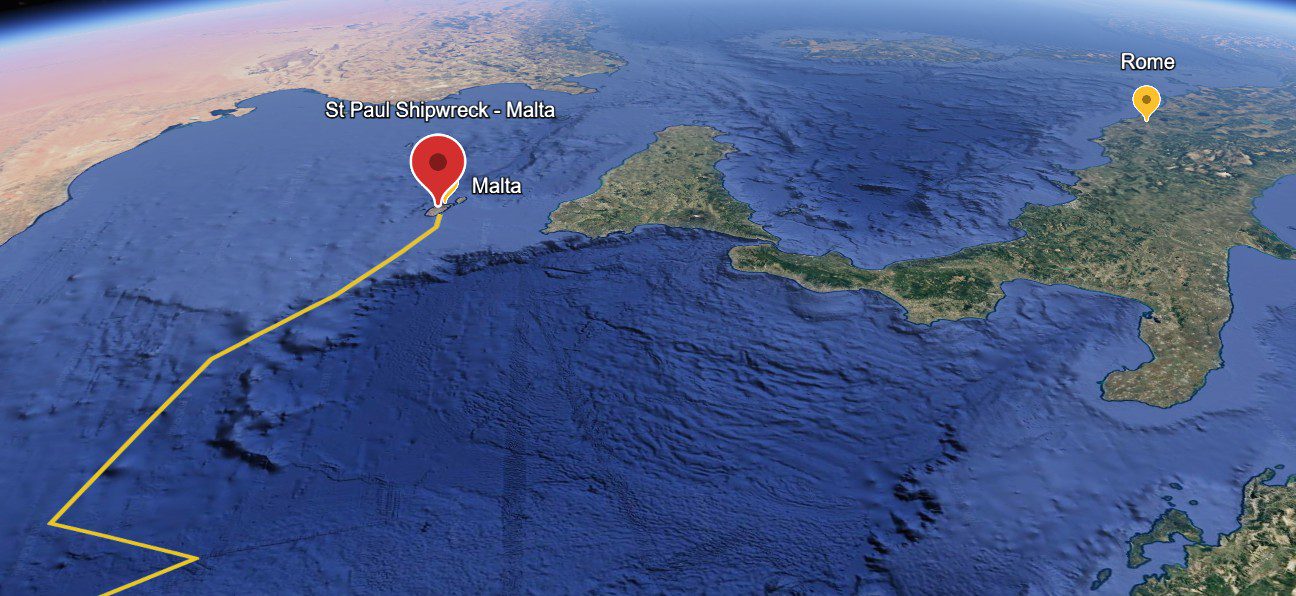
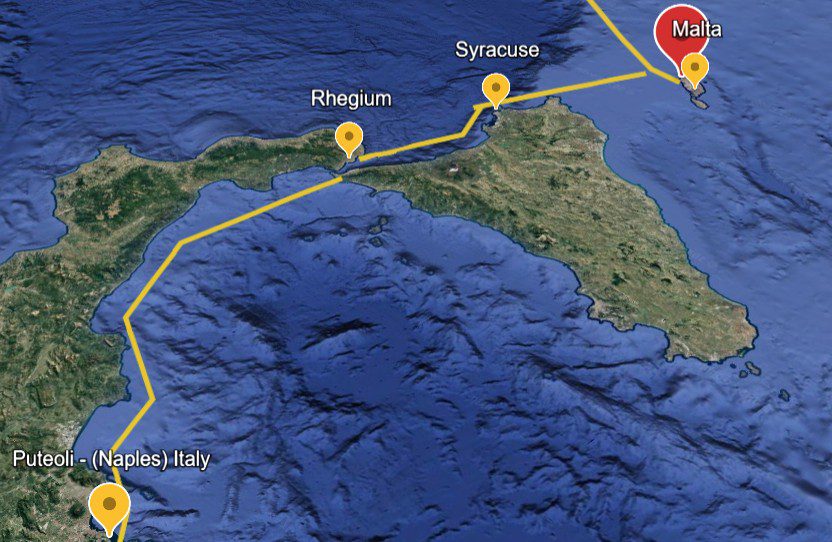
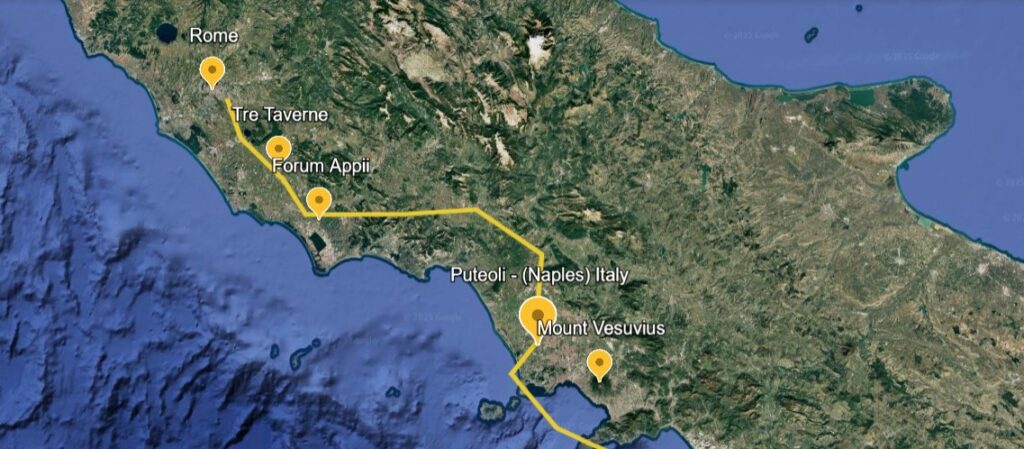
    We will proceed on this 2200 mile [3500 km] voyage taking into account the perspective of Iulius [Julius], Paul’s Roman Centurio Augustus’ responsible for all prisoners of Caesar Nero.


    The Writ of Porcius Festus

    Before sailing to Rome, the Centurion representative of Caesar —Julius would have been given an official writ of Paul’s court proceedings and judgment.

    Porteus Festus may have given written instructions and verbal administrative recommendations as the current Governor of Judea transferring this prisoner Paul into the direct jurisdiction of Nero.

    Julius probably would not have known that Paul had been rescued from the Jews two years ago by Judea’s former governor. Antonius Felix, you may remember, had left Paul in prison in Caesarea for two years after another Centurion had rescued the Apostle from an assassination plot of the Jews.

    Paul is a Jew (as one might expect of a resident of Judea). But the Governor would want this Centurion Julius to know that his prisoner being sent to Nero is a Roman citizen acquited of the Jewish charges.

    BUT, Paul had appealed to Caesar and could not be released until the Emperor agreed to hear or dismiss Paul’s case.


    Roman roads and shipping routes

    The Centurion Julius would have to plan a route to Rome to deliver his cargo — Paul, a prisoner and Roman citizen. Caesarea Maritime is a port and administrative center of Rome’s eastern army. Like any port ships arrive and depart with cargo and supplies for Rome’s army. Some smaller ships sailed from port to port on what you might call ‘the milk run’ delivering essentials for further transport inland along the extensive Roman roads.

    Julius gained passage on such a ship that sailed along the coast, first with a stop in nearby Sidon, with a terminus destination of Myra.

    Stop One of a long Voyage

    Voyage of Paul's first ship as a prisoner of Rome
    486 Nautical Miles [~ 900 KM or 660 Miles]

    .. aboard an Adramyttian ship, which was about to sail to the regions along the coast of Asia, we set sail..

    The next day we put in at Sidon,

    and Julius treated Paul with consideration and allowed him to go to his friends and receive care.

    Cypress cities Acts 13

    And from there we set sail [leeward] and sailed under the shelter of Cyprus [to the south of us] because the winds were against us.

    And when we had sailed through the sea along the coast of Cilicia and Pamphylia, we landed at Myra in Lycia.


    Finding a bigger ship in Myra

    The Centurion Julius, probably knowing not only the Mediterranean ports and Roman administrators but also which ships sail further to Rome, will book passage on a larger ship capable of sailing into deeper waters to continue their long voyage.

    To be continued... 

  • šā’ûl servant of the living Yeshua

    šā’ûl servant of the living Yeshua

    Saul’s defense of himself and the Gospel

    ἀπολογέομαι – apologeomai

    To the Greeks the Apostle to the gentiles is Παῦλος – Paulos or Paul. And to Romans encountering this fellow Roman citizen from Tarsus certainly fluent in the Latin of their heritage, the Apostle would be called Paulus.

    But to the Aramaic Jews of Jerusalem and Judea this illusive convert to Jesus of Nazareth is well-known as Sha’ul, the same name as Saul, Israel’s first king.

    It is now about A.D. 59 or 60. Some thirty years ago JESUS had fore-warned the Twelve:

    “Now when they bring you before the synagogues and the rulers and the authorities, do not worry about how or what you are to speak in your defense, or what you are to say..

    Gospel of Luke 12:11 LSB

    Two years later the Jews had stoned Stephen to death for proclaiming the risen Christ Jesus. Saul had been a young witness to this unjust execution and a leading authority in bringing many followers of The Way to justice for five years – that is, until the Lord met him on a road to Damascus.

    Saul disappears for a time and then makes his own defense to Peter and those in Jerusalem.

    And he was talking and arguing with the Hellenistic Jews, but they were attempting to put him to death.

    Acts 9:29 LSB

    All this prior to the Apostle being sent out to all the world of the gentiles on three missionary journeys for ten years. 

    So now back in Jerusalem by intention, the Apostle has already been detained by the Jews and held by the Romans.

    And when the governor [Felix] had nodded for him to speak, Paul answered:

    “Knowing that for many years you have been a judge to this nation, I cheerfully make G626 [apologeomai] my defense G626

    Acts of the Apostles 24

    “.. while Paul said G626 in G626 his own defense G626 [to Festus {who is also present here}], “I have committed no sin either against the Law of the Jews or against the temple or against Caesar.”

    Acts of the Apostles 25

    Saul’s third apologeomai before Herod Agrippa

    In Acts 25 Paul is brought before the Governor Festus with Herod Agrippa II and his Herodian sister Bernice with great pomp (even though the Apostle has already appealed to Caesar

    Agrippa said to Sha’ul,
    “You may speak for yourself.”

    Then Sha’ul stretched out his hand, and made his defense.

    Acts of the Apostles 26:1 Hebrew Names Bible

    Saul addressing King Herod Agrippa –

    Jew to fellow Jew

    continuing in his complimentary introduction: 

    Especially because I know thee to be expert in all customs and questions which are among the Jews: wherefore I beseech thee to hear me patiently.

    Acts 26:3 KJV

    Remember, Paul is speaking of events beginning some twenty years ago. 

    My manner of life from my youth, which was at the first among mine own nation at Jerusalem, know all the Jews;

    Which knew me from the beginning, if they would testify, that after the most straitest sect of our religion I lived a Pharisee.

    And now I stand and am judged for the hope of the promise made of God unto our fathers: Unto which promise our twelve tribes, instantly serving God day and night, hope to come. For which hope’s sake, king Agrippa, I am accused of the Jews.

    Acts 26:4-7 KJV

    Paul addresses the "Jewish" king caught in the middle of controversaries between the Saduccees, Pharasees and pagan Romans not part of the promise of the One God to Abraham. 

    Testimony of the Resurrection

    The Apostle now confronts Herod Agrippa with the politically divisive question concerning the Messiah Jesus.

    Why should it be thought a thing incredible with you, that God should raise the dead?

    Acts of the Apostles 26:8 KJV

    “Indeed, I myself thought I must do many things contrary to the name of Jesus of Nazareth. This I also did in Jerusalem, and many of the saints I shut up in prison, having received authority from the chief priests; and when they were put to death, I cast my vote against them.

    And I punished them often in every synagogue and compelled them to blaspheme; and being exceedingly enraged against them, I persecuted them even to foreign cities.

    Acts 26:9-11 NKJV

    What’s Paul doing here?

    The Apostle is confessing that as a leading Pharisee he was one of them – agreed with them – as zealous to put to death these blasphemers of Yahweh as now they seek to have Paul killed for his witness of the risen Messiah Yeshua.

    Herod Agrippa knows the Jesus controversy well. And Paul’s defense now presents evidence of why he has turned from his former disbelief (in the resurrection of the Messiah Jesus of Nazareth). So šā’ûl of Tarsus recounts his journey to Damascus and life-changing encounter with the risen Lord Jesus, the crucified Messiah.


    Saul sent out as the Apostle Paul

    Luke has previously recorded Paul's account (Acts 9:1–19; 22:6–16).
    • I journeyed to Damascus with authority and commission from the chief priests,
    • At midday I saw a light from heaven, brighter than the sun,
    • We all fell to the ground
    • I heard a voice speaking to me in the Hebrew dialect:

    ‘Sha’ul, Sha’ul, why are you persecuting me? It is hard for you to kick against the goads.’

    Acts 26:14b Hebrew Names Version

    Herod Agrippa would understand the significance of the Voice from heaven Who communicates with Paul in Hebrew. Sha’ul asks what any man might ask of an unknown person speaking:

    Τίς εἶ κύριε

    (tis ei Kyrios) Who are you, Lord?

    And He said (in the Greek of Luke’s account of Acts of the Apostles)

    egō eimi iēsous

    Or in the Hebrew šā'ûl likely heard from the Lord: 

    ănî yᵊhôšûaʿ

    “He said,

    ‘I am Yeshua, whom you are persecuting.

    Acts 26:15 b Hebrew Names Version

    Yeshua, the risen Son of God, commissions Paul

    As Paul knows, Herod Agrippa II, with his Roman and Jewish cultural upbringing, will full-well know and understand the implication of what he is about to say. (And note that this Voice from heaven commands Saul as a King (like Herod Agrippa) would command any subject. 

    And He said,

    ‘I am Jesus, whom you are persecuting.

    But rise and stand on your feet;

    for I have appeared to you for this purpose, to make you a minister and a witness both of the things which you have seen and of the things which I will yet reveal to you.

    Acts 26:14-15 NKJV

    Remember, Paul has already been witnessing Christ crucified and risen on three missionary journeys since about AD 47 (more than ten years after Christ's crucifixion in Jerusaalem) until now (~AD 59) for some twelve years.

    ‘I will deliver you from the Jewish people, as well as from the Gentiles, to whom I now send you, to open their eyes, in order to turn them from darkness to light, and from the power of Satan to God, that they may receive forgiveness of sins and an inheritance among those who are sanctified by faith in Me.’

    Acts 26:17-18 NKJV – account to Agrippa of the commissioning of Paul by the risen Christ Jesus


    It is significant that in sending Saul to the Gentiles that the Lord mentions their redemption – Gospel Good News!

    The Lord Jesus also points to our deliverance from original sin and Satan.

    And do not overlook His mention of holiness and how Jew and Gentile will now receive sanctification.

    Sanctification

    Just a reminder of God's HOLINESS and that of CHRIST JESUS

    ἁγιάζω – hagiazō –

    • to render or acknowledge, or to be venerable or hallow
    • to separate from profane things and dedicate to God
      • consecrate things to God
      • dedicate people to God
    • to purify

    From hagos G40 (an awful thing) – sacred (physically, pure, morally blameless or religious, ceremonially, consecrated):—(most) holy (one, thing), saint.

    Source: Lexicon :: Strong’s G37 – hagiazō – BlueLetterBible.org


    21st century Common Era christians tend to overlook Jesus’ role in sanctification of the redeemed saints of Christ, therefore missing the mark of showing ourselves saved from the sin so common in all of us.

    Roger@TalkofJesus.com

    OPEN YOUR EYES – SEE the implication of what the Lord says to Saul of Tarsus that changed him for all eternity:

    to open their eyes, that they may turn from darkness to light and from the power of Satan to God,

    that they may receive forgiveness of sins

    and a place among

    those who are sanctified by faith in me.’

    Acts 26:18 RSV

    Are YOU, like Saul, a SAINT — a most HOLY thing  

    by FAITH in the LORD CHRIST JESUS?


    Paul asks the Lord’s question of Agrippa and of Portus Festus.

    The Apostle asks JESUS’ question of you who seek forgiveness of your sins somewhere else than by faith in the Person of Him – the risen Christ Jesus.


    Next: Agrippa and Festus reject Christ

    Comment on Scripture – Share the Gospel
  • ACTS of the Herods 25

    ACTS of the Herods 25

    The not-so-great HEROD’s – client-kings of the Jews

    “BUT WAIT,” you may be thinking; “we were following ACTS of the APOSTLES and Paul.”

    Note the timeline above with its anti-Christian timeline bias utilizing BCE (Before the Common Era) rather than B.C. (Before Christ). 

    What IF history had recorded the politics of the JEWS and ROMANS in place of the truth of Christ?

    We would have read nothing of Herod’s killing of the innocents (trying to prevent the birth of the Messiah JESUS).

    • OR of Jewish and Roman injustice of the Cross of Jesus – KING OF THE JEWS!
    • OR any account of the leading Pharisee Saul of Tarsus proclaiming Christ risen to all the world as far as Rome.

    NO —  Luke’s detailed account of the Apostles would have been buried in the politics of A.D. 1st century Caesars and certain Kings preordained by the Lord God to fail in their temporal empires and kingdoms —  Herod’s and Caesar’s opposed to JESUS, the very Son of God redeeming a chosen remnant of sinners — sinners from every nation of the world and sinners from every time since the beginning of mortals and the end of our timeline in eternity.

    Acts from Herod the Great to Herod Agrippa II

    family tree of the Herod's from Herod the Great

    In order to understand Roman administration of captive kingdoms or Roman states of the Herod’s, as well as something of the fall of Jerusalem which will soon take place, let’s take a look at the WHO’S-WHO of this client dynasty as we proceed in the Acts of the Apostles.

    the politics of King Agrippa and Festus

    A PLEASING PUBLIC POLITICAL MEETING 

    Now several days later, Agrippa [II] the king and Bernice [his sister] arrived at Caesarea and paid their respects to Festus [the new governor].

    Acts of the Apostles 25:13 AMP

    While they were spending many days there [in the Roman capital of Caesarea] , Festus laid Paul’s case before the king…

    Make no mistake about it — Rome is in control, but in order to rule effectively Roman governors use local political powerhouses to govern public opinion.

    Political Protocol of the Pax Romana

    Luke refers to our main player in Paul’s case as, “King Agrippa,” but to Rome, Julius Marcus (AKA Herod Agrippa II) is simply one of several useful foreign kings.

    .

    Caesarea! a model of Roman incursion into all the world of the Mediterranean - a key port for Romans, a city where Cornelius, Philip, Peter, Paul and others brought the gospel

    He brings with him his sister, oldest daughter of Herod Agrippa I as they formally and publically meet Governor Porcius Festus in Caesarea.


    Luke continues with the political problem of Paul left to the new Prefect Festus:

    saying (to Agrippa) [NKJV],

    “There is a certain man left a prisoner by Felix, about whom the chief priests and the elders of the Jews informed me, when I was in Jerusalem, asking for a judgment against him.

    Note that this new Roman Prefect has already been in Jerusalem without meeting with King Agrippa. 

    To them I answered,

    ‘It is not the custom of the Romans to deliver any man to destruction [ἀπώλεια] before the accused meets the accusers face to face, and has opportunity to answer for himself concerning the charge against him.’

    Certainly this newly appointed Governor of Judea is familiar with the problem of the JUDGMENT of JESUS the King of the JEWS by a previous Governor Pontius Pilate.

    Therefore when they had come together, without any delay, the next day I sat on the judgment seat and commanded the man to be brought in.

    The Roman Governor has already judged the Roman citizen Paulos (in Jerusalem) before this political appeal of King Herod Agrippa II. 

    The Governor continues his account of Paul’s recent trial over which he presided:

    “When the accusers stood up, they brought no accusation against him of such things as I supposed, but had some questions against him about their own religion and about a certain Jesus, who had died, whom Paul affirmed to be alive.

    Now full-well knowing the controversies centered on the Christ of the Jews, Governor Porcius Festus addresses Julius Marcus Agrippa II as a politically impartial third party with interest in the case of the Governor's prisoner. 

    And because I was uncertain of such questions, I asked whether he was willing to go to Jerusalem and there be judged concerning these matters. But when Paul appealed to be reserved for the decision of Augustus [the title of the Roman emperors], I commanded him to be kept till I could send him to Caesar.”

    Roman Coin with profile of Nero Caesar Augustus

    Nero Claudius Caesar Augustus Germanicus, no friend of followers of The Way, had appointed Portus Festus as Governor of Judea.

    Herod Agrippa’s play for power

    Then Agrippa said to Festus,

    “I also would like to hear the man myself.”

    “Tomorrow, you shall hear him.”


    So the next day, when Agrippa and Bernice had come with great pomp, and had entered the auditorium with the commanders and the prominent men of the city [Caesarea], at Festus’ command Paul was brought in.

    And Paul said, “I would to God that not only you, but also all who hear me today, might become both almost and altogether such as I am, except for these chains.” - Paul addressing Festus, Herod Agrippa II and Bernice - Acts 26:29
    REMEMBER: 
    ROME's Governor is in charge. The Prefect of Judea repeats what he has already told King Herod Agrippa II.

    And Festus said:

    “King Agrippa and all the men who are here present with us,

    you see this man about whom the whole assembly of the Jews petitioned me, both at Jerusalem and here, crying out that he was not fit to live any longer.

    But when I found that he had committed nothing deserving of death, and that he himself had appealed to Augustus, I decided to send him.

    The Governor is confirming Paul's legal disposition as well as his own fair hand in his decision of the Court.

    “I have nothing certain to write to my lord concerning him.

    Festus, wanting to present some facts to his lord Caesar in Rome, invites these Jewish leaders and accusers of Paul to give him the facts. 

    The Governor would not have had to send any facts to Nero, but out of Festus' astute political savvy he has an audience of all who could object to his decision.

    Therefore I have brought him out before you, and especially before you, King Agrippa, so that after the examination has taken place I may have something to write. For it seems to me unreasonable to send a prisoner and not to specify the charges against him.”


    Brilliant! Let the local king provide their case to Caesar (who could only blame Felix or the Jews AND NOT him).

    Then Agrippa said to Paul, “You are permitted to speak for yourself.”

    So Paul stretched out his hand and answered for himself:

    Acts of the Apostles 26:1 NKJV

    Once again, the Governor sets the tone of his meeting of all who had accused Paul.

    Festus begins by allowing the defense of this Roman citizen already found innocent to proceed BEFORE hearing ANY Jewish charges.

    Furthermore, Governor Festus invites Paul to speak directly to him and to Herod Agrippa II (client king of the Jews) FIRST.

    “I think myself happy, King Agrippa, that I am to make my defense before you this day concerning all the things whereof I am accused by the Yehudim…

    Acts of the Apostles 26:2 – Hebrew Names Version


    The ACTS of the Apostle Paul (in court again) — To be continued…

    Talk of JESUS . com

    Comment on Scripture – Share the Gospel