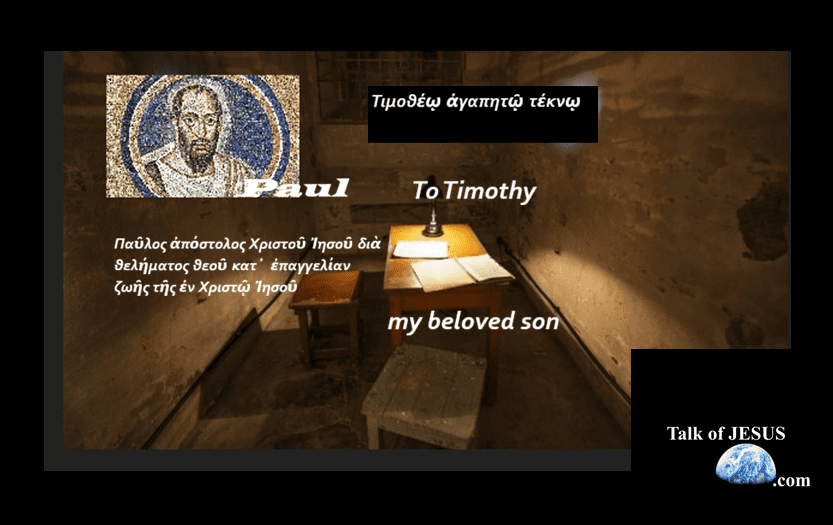
Strong’s G5043 – teknon – “a child” (akin to tikto, “to beget, bear”), is used in both the natural and the figurative senses. In contrast to huios, “son” (see below), it gives prominence to the fact of birth, whereas huios stresses the dignity and character of the relationship. Figuratively, teknon is used of “children” of
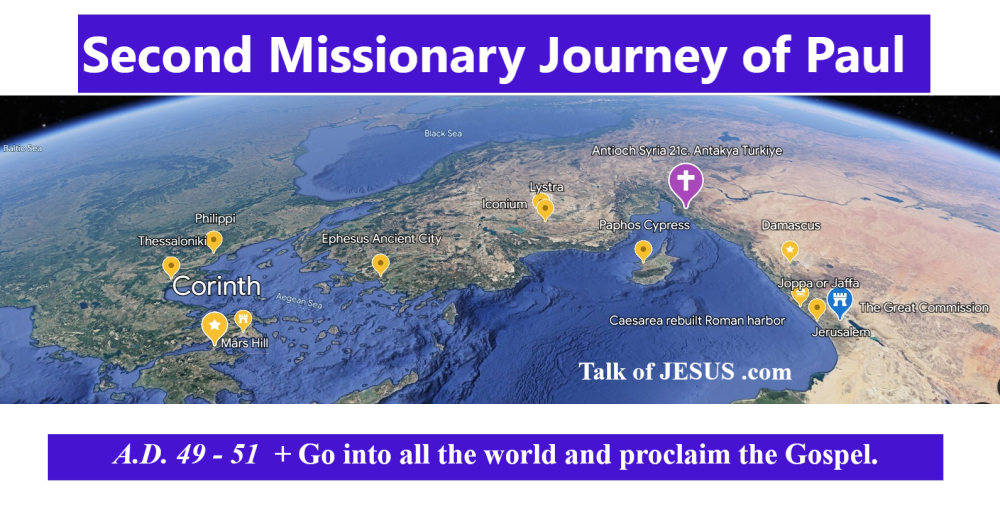
As mentioned in our introduction to Timothy, the Apostle Paul has adopted this young man of Galatia and mentored him along with others as trusted servants, sons and companions in his apostolic mission to the Gentiles.
Historical Context:
2 Timothy was likely written around AD 67, during Paul’s second imprisonment in Rome, shortly before his martyrdom. This period was marked by intense persecution of Christians under Emperor Nero. Paul, aware of his impending death, writes with a sense of urgency and finality.
Audience and Purpose:
Paul’s second letter to Timothy, left in Ephesus to oversee the church, guides both him and the broader Christian community. It encourages church leaders and believers in the face of persecution. Paul urges Timothy to protect the gospel, endure hardships, and teach sound doctrine.
As to the role of Timothy to the Church, we might in a later era address this esteemed son of the Apostle to the Gentiles as Bishop Timothy of Ephesus,
or possibly Arch-Bishop Timotheus of Asia.
But regardless of Timothy’s personal importance to Paul as a fellow servant of Christ and the Gospel, you can see from the definition of son above that his spiritual relationship to the Apostle and Christ’s Church stand foremost to any role of administrative authority (which he had, as did the Apostle Paul) or imaginative royal-like religious title.
and he set sail from Ephesus.
From Personal Sonship to Apostolic Responsibility for the Gospel
In the fifteen or so years since Timothy as a young man had first followed and served Paul, he has proven himself faithful, and a capable pastor (or shepherd trusted with local flocks of followers of The Way, loyal to Paul and true to the Gospel of Jesus Christ.
Hence I remind you to rekindle the gift of God that is within you through the laying on of my hands;
2 Timothy 1:6 RSV
“.. rekindle the gift of God that is within you..” – the word Paul uses here in this introduction of his pastoral epistle is: anazōpyreō
– stir up that by which the fire is kindled anew or lighted up, a pair of bellows);
Don’t you love Paul’s imagery of a fire of holiness, perhaps neglected and cooling to Christ as its last embers of your faith — REKINDLING through the Holy Spirit (received by the Apostle’s laying on of hands)?
Of course you know Paul’s word for ‘the giftof God’ – the charisma of Theos.
Paul reminds by building up in the power of the faith already well-known in and to Timothy:
for God did not give us a spirit of timidity
that is, fearfulness of cowardice
but a spirit of power and love and self-control.
THREE gifts of the Spirit required of pastors and the faithful of the flock of every church.
dynamis – strength power and ability
agapē – (not just any love, but agapē love) – affection, benevolence, good will, charity, love for the brothers and sisters of the church
sōphronismos – The KJV translates as sound mind (1x).
(this you may not know and in this the saints so often find ourselves lacking)
an admonishing or calling to soundness of mind, to moderation and self-control
Power in the Spirit, Agape Love and a yielding of the mind to God
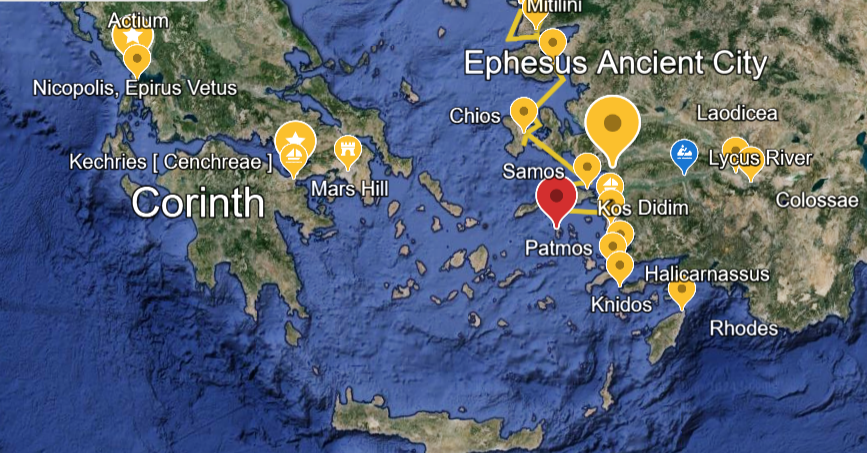
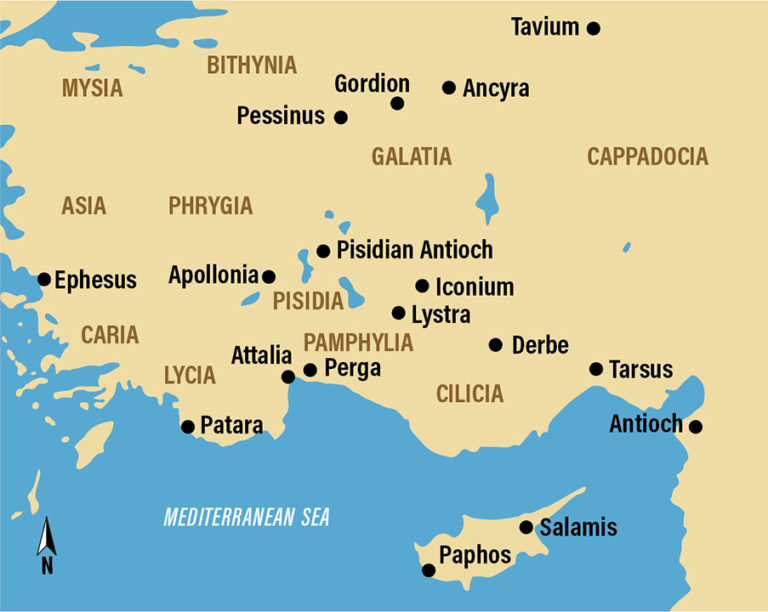
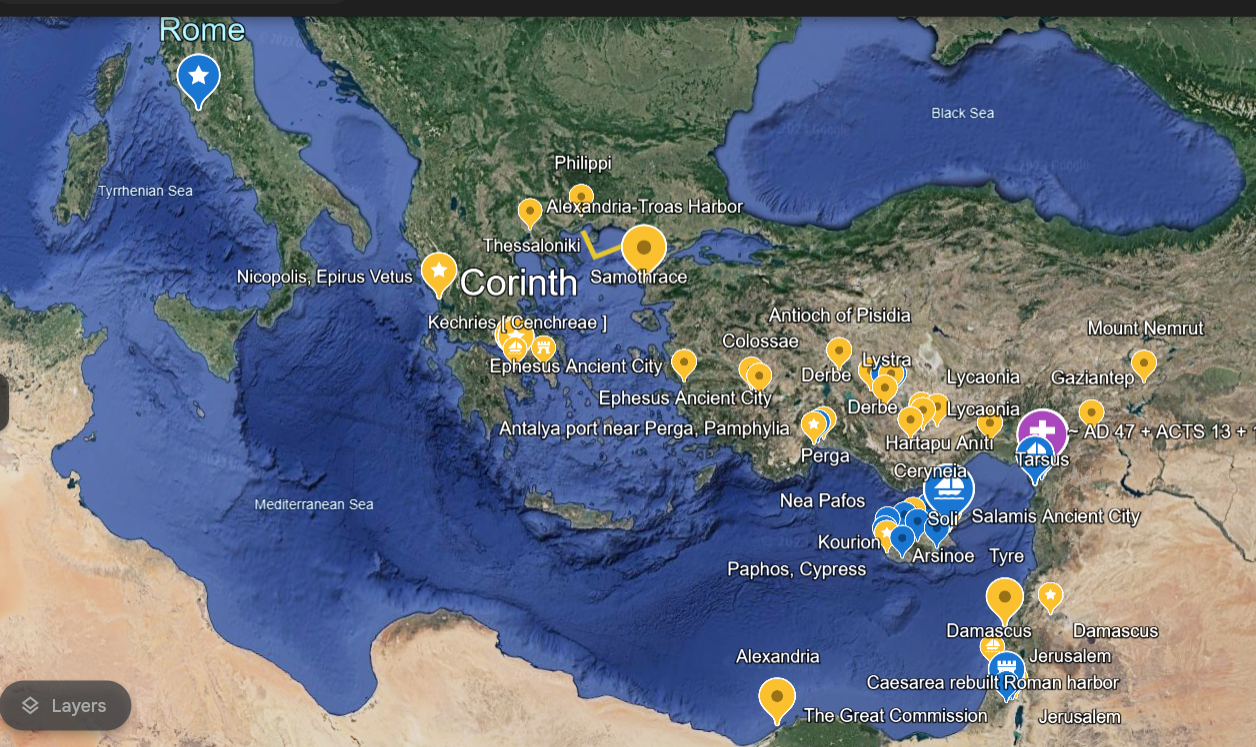
Paul could have easily been forgotten in his prison cell in Rome, even more distant in Europe across the Aegean — than Derbe and Antioch from Ephesus, all in Asia where Timothy remains pastoring the church.
Therefore, be not ashamed
So the Apostle writes:
Do not be ashamed then of testifying to our Lord, nor of me his prisoner, but share in suffering for the gospel in the power of God, who saved us and called us with a holy calling,
not in virtue of our works but in virtue of his own purpose and the grace which he gave us in Christ Jesus ages ago, and now has manifested through the appearing of our Savior Christ Jesus, who abolished death and brought life and immortality to light through the gospel.
2 Timothy 1:8-10 RSV
The faithful and unfaithful to Paul and Apostolic faith
Paul is about to begin an important point and reason for this second epistle (which we will study more next time), but here he lists some remembered for their works.
This you know, that all those in Asia have turned away from me,
among whom are Phygellus and Hermogenes.
The Lord grant mercy to the household of Onesiphorus, for he often refreshed me, and was not ashamed of my chain;
but when he arrived in Rome, he sought me out very zealously and found me.
The Lord grant to him that he may find mercy from the Lord in that Day—and you know very well how many ways he ministered to me at Ephesus.
We get it humanly – the relationship of a son (or daughter) to a father (or to our mother).
HumanAND ever-existing SON
Mortal men and women can relate to a Son of THE FATHER.
We understand, in part, that JESUS was flesh and blood, body and brain a perfect human son of man (Mary, actually: ‘man‘ as in human like all of us).
John, the Apostle who speaks so well relationally in the witness of his Gospel tells us:
But these [signs, proofs or miracles] are recorded so that you may believe that Jesus is the Christ, the Son of God, and that by believing you may have life in his name.
The Twelve, having loved their friend and Master whom they followed willingly, understood a relational link between JESUS and each of His disciples personally.
When the Lord in so many ways showed His Disciples His ever-existing relationship to Almighty God our Father — HIS Father from before the beginning — they could not have been more awe struck that GOD stood in their human presence.
My sheep hear my voice, and I know them, and they follow me: And I give unto them eternal life; and they shall never perish, neither shall any man pluck them out of my hand.
My Father, which gave them me, is greater than all; and no man is able to pluck them out of my Father’s hand.
Yet think from the witness of any of the Twelve of the impact of JESUS, the living Christ they follow, telling His disciples: “I and the Father are One.”
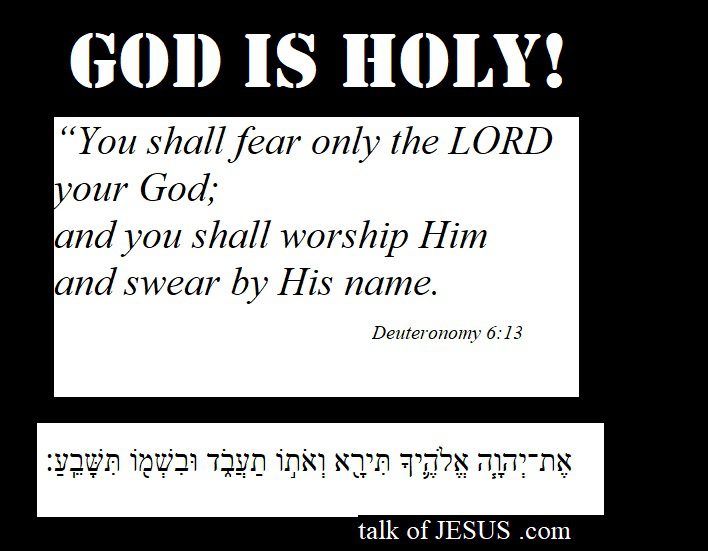
Just like all faithful Jews, these disciples had recited the Sh'ma since their childhood:
John’s Gospel continues with Jesus’ further explanation of the Spirit:
“But an hour is coming, and now is, when the true worshipers will worship the Father in spirit and truth; for such people the Father seeks to be His worshipers.
“God is Spirit, and those who worship Him must worship in spirit and truth.”
What is JESUS telling us about spirit and the Holy Spirit?
Although mankind is flesh and blood, created from dust and water,
and Man is created in God’s image;
Man, LIKE GOD, is also spirit.
What is Spirit?
John begins his Gospel with Jesus (the Word) and the Spirit.
In the beginning was the Word, and the Word was with God, and the Word was God. He was with God in the beginning. Through Him all things were made, and without Him nothing was made that has been made. In Him was life, and that life was the light of men.
READ MORE BELOW
NOTE:
Although I generally limit your reading time to ~5 minutes, today I'll expand our TOPIC of SPIRIT with additional definitions and more Biblical verses than we could cover in a single post on the SPIRIT.

Please continue and COMMENT at the end of this entire post.- RH
The KJV translates Strong’s H7307 in the following manner: Spirit or spirit (232x), wind (92x), breath (27x), (various additional)
Two additional uses in Genesis show both the Spirit of God and His quickening spirit in His creatures, including mankind:
And the LORD said, “My Spirit shall not strive with man forever, for he is indeed flesh; – Gen. 6:3a NKJV
And they went into the ark to Noah, two by two, of all flesh in which is the breath of life.. All in whose nostrils was the breath of the spirit of life, all that was on the dry land, died. – Gen. 7:15,22 NKJV
COMMENTARY
The Spirit of God; not the wind, which was not yet created, as is manifest, because the air, the matter or subject of it, was not yet produced; but the Third Person of the glorious Trinity, called the Holy Ghost, to whom the work of creation is attributed, Job 26:13, as it is ascribed to the Second Person, the Son, Joh 1:3 Col 1:16-17 Heb 1:3, and to the First Person, the Father, every where.
For the word of God is living and powerful, and sharper than any two-edged sword, piercing even to the division of soul and spirit, and of joints and marrow, and is a discerner of the thoughts and intents of the heart.
Before proceeding to the more powerful and most mysterious Holy Spirit of God,

consider beyond flesh and blood, mind and spirit --
that which is the same in Old and New Testaments, yet having subtle ungraspable distinction: spirit and soul.
“BEHOLD, MY SERVANT WHOM I HAVE CHOSEN;
MY BELOVED IN WHOM MY SOUL [psychē] IS WELL-PLEASED;
We hear it also in the heart of Isaiah, a Prophet of God:
With my soul [nep̄eš] I have desired You in the night, Yes, by my spirit [rûaḥ] within me I will seek You early; For when Your judgments are in the earth, The inhabitants of the world will learn righteousness.
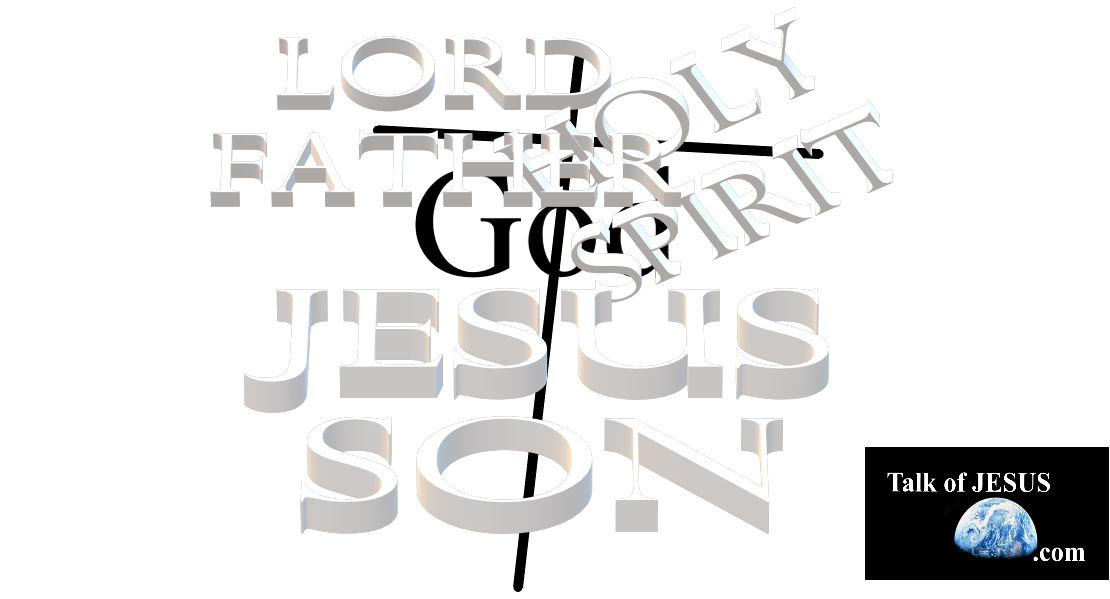
Spirit of God, the third person of the triune God, the Holy Spirit, coequal, coeternal with the Father and the Son
as inspiring ecstatic state of prophecy
as impelling prophet to utter instruction or warning
imparting warlike energy and executive and administrative power
as endowing men with various gifts
as energy of life
as manifest in the Shekinah glory
never referred to as a depersonalised force
Now the birth of Jesus Christ was as follows: After His mother Mary was betrothed to Joseph, before they came together, she was found with child of the Holy Spirit.
When you hear an ENGLISH translation of pneuma in the King James Version it will most often suggest an image of the Holy Ghost.
But the Comforter, which is the Holy Ghost, whom the Father will send in my name, he shall teach you all things, and bring all things to your remembrance, whatsoever I have said unto you.
As mysterious as Ghostor the Spirit may be to mankind, its root word [Strong’s G4154 – pneō] directs our thoughts
to breathe hard, i.e. breeze:—blow (of the wind)
Jesus answered, “Truly, truly, I tell you, no one can enter the kingdom of God unless he is born of water and the Spirit.
Flesh is born of flesh, but spirit is born of the Spirit. Do not be amazed that I said, ‘You must be born again.’
The wind blows where it wishes. You hear its sound, but you do not know where it comes from or where it is going. So it is with everyone born of the Spirit.”
I encourage you in the spirit to pray with ears to hear the Holy Spirit of the Lord God, who IS ONE with the Father and the Son our savior Jesus Christ.
Cast me not away from your presence, and take not your Holy Spirit from me.
Jesus’ High Priestly Prayer of intercession begins simply and humbly.
Even from the confines of a dark upper room in Zion which Judas has now left on the eve of Jerusalem’s great darkness, Jesus looks up to the light of a glory the Son once had – the glory of the LORD God our Father in heaven.
Glorify your Son
Father, the hour is come; glorify thy Son, that thy Son also may glorify thee…
When Jesus had finished saying these things, he looked upward to heaven and said,
“Father, the time has come.
… glorify your Son, so that your Son may glorify you— just as you have given him authority over all humanity, so that he may give eternal life to everyone you have given him.
John 17:1b-2a NET
Our eternal High Priest has much more to say in His prayer of high importance to sinners for whom He intercedes. These include eternal life and as previously mentioned who the Father has given to the Son.
Yet today let’s focus in on why Jesus prays for the Father to glorify the Son – His reason for entering the Holy of Holies beyond the veil of our distanced understanding, on behalf of these eleven witnesses and more.
What is GLORY?
The Apostle John, one of the Eleven remaining had previously witnessed the glory of Jesus.
The Transfiguration 28 Some eight days after these sayings, He took along Peter and John and James, and went up on the mountain to pray. And while He was praying, the appearance of His face became different, and His clothing became white and gleaming…
… when they were fully awake, they saw His glory and the two men standing with Him… a cloud formed and began to overshadow them; and they were afraid as they entered the cloud.
35 Then a voice came out of the cloud, saying, “This is My Son, My Chosen One; listen to Him!”
δόξα – doxa –
From the base ofδοκέω (G1380) – generally used meaning to ‘think.’
The LORD God is a thinking All-powerful, Ever-existing Being!
Think about it. As created and fragile beings our worship of the LORD God considers humbly our own humanity beneath His glory.
We who can think should glorify the LORD above all, but often we will not.
in a wide application (literal or figurative, objective or subjective):—dignity,
glory(-ious),
honour,
praise,
worship.
These humble acknowledgements so rare in men of flesh, yet plainly evident in all creation, reflect the glory of God. Therefore a soul who thinks about the LORD our Creator and glorifies Him is a worshiper, flesh and spirit looking up and bowing down to our Lord and God.
Jesus prays to the Father as a Son of Man.
Having been sent by the Father to the world He has completed the work for which He was sent by the Father. The hour now approaches for Him to return to His former glory.
His former GLORY with the Father
Never forget, beloved Christian disciple of Jesus, that He and the Father are One.
Prior to creation and in the early history of God’s chosen, Jesus had the same former glory. You have read of it. Yet so often we remain blind to the LORD’S glory. How rare the time men bow before it.
The GLORY of the LORD is perhaps as foreign to 21st c. christians as hebrew.
כָּבוֹד kâbôwd, kaw-bode’; rarely כָּבֹד kâbôd; from H3513; properly, weight, but only figuratively in a good sense, splendor or copiousness:—glorious(-ly), glory, honour(-able).
Exodus 24:
15 Then Moses went up to the mountain, and the cloud covered the mountain.
16 The glory of the Lord rested on Mount Sinai, and the cloud covered it for six days; and on the seventh day He called to Moses from the midst of the cloud.
17 And to the eyes of the sons of Israel the appearance of the glory of the Lord was like a consuming fire on the mountain top.
18 Moses entered the midst of the cloud as he went up to the mountain; and Moses was on the mountain forty days and forty nights.
“You said, ‘Behold, the LORD our God has shown us His glory and His greatness, and we have heard His voice from the midst of the fire; we have seen today that God speaks with man, yet he lives.
This is the former glory the Messiah Jesus knew with the Father!
Later the prophet Isaiah would write:
Sinners in Zion are terrified; Trembling has seized the godless. “Who among us can live with the consuming fire? Who among us can live with continual burning?”
Isaiah 33:14
Jesus knew a former glory with the Father, a fearful and awesome consuming fire which refines and humbles men made of dust and ashes.
The writer of Hebrews, restating Moses warning of keeping the covenant, reminds of this glory:
18 For you have not come to a mountain that can be touched and to a blazing fire, and to darkness and gloom and whirlwind, and to the blast of a trumpet and the sound of words which sound was such that those who heard begged that no further word be spoken to them. For they could not bear the command, “If even a beast touches the mountain, it will be stoned.”
21 And so terrible was the sight, that Moses said, “I am full of fear and trembling.”
Do you fear the LIVING GOD? And do you, O man, humbly bow down to the GLORY of the LORD?
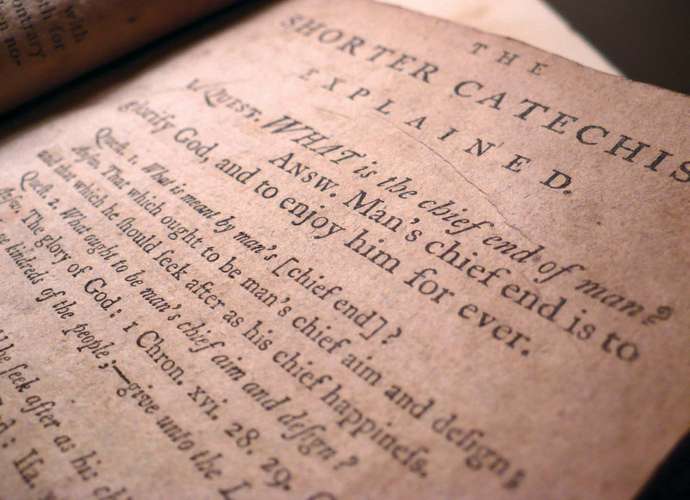
What is the chief end of man?
Any teaching of faith must begin from the glory of God and consequent worship of God by man, for we are nothing more than a created being glorifying our Creator.
We have glanced at a Hebrew origin, then New Covenant Greek.
Moving beyond millenia of teaching from ancient latin we receive an English version of this elemental Christian teaching since the 1640’s during the Reformation.
“Man’s chief end if to glorify God, and to enjoy him for ever.
Another foundational Protestant teaching, The Heidelberg Catechism, begins by asking, “What is your only comfort in life and in death?”
Perhaps the Disciples had wondered this often while following their Lord and Master Jesus for three years.
What is about to take place on the Cross will fully bring light to Jesus’ prayer to the Father asking Him to bring the Son His former glory along with the Father.
Jesus’ prayer for glory
4 I glorified you on earth, having accomplished the work that you gave me to do. And now, Father, glorify me in your own presence with the glory that I had with you before the world existed…
10 All mine are yours, and yours are mine, and I am glorified in them…
(John no doubt realizes that Jesus includes the Eleven here, but our Lord’s prayer of intercession goes much further than praying just for the Disciples in the room.)
22 The glory that you have given me I have given to them, that they may be one even as we are one, I in them and you in me, that they may become perfectly one, so that the world may know that you sent me and loved them even as you loved me.
(Much to think about here even beyond the glory of the Lord.)
24 Father, I desire that they also, whom you have given me, may be with me where I am, to see my glory that you have given me because you loved me before the foundation of the world.
High Priest of the New Covenant
Jesus intercedes as High Priest on our behalf — between the Father and all sinners given to Him
From here the Son our High Priest will move deeper into the unseen Holy of Holies where Jesus will present Himself as a living and acceptable Perfect Lamb of Godthat takes away the sins of the world.
To be continued...
Cookie Consent
We use cookies to improve your experience on our site. By using our site, you consent to cookies.
Used to monitor number of Google Analytics server requests
10 minutes
__utmb
Used to distinguish new sessions and visits. This cookie is set when the GA.js javascript library is loaded and there is no existing __utmb cookie. The cookie is updated every time data is sent to the Google Analytics server.
30 minutes after last activity
__utmc
Used only with old Urchin versions of Google Analytics and not with GA.js. Was used to distinguish between new sessions and visits at the end of a session.
End of session (browser)
__utmz
Contains information about the traffic source or campaign that directed user to the website. The cookie is set when the GA.js javascript is loaded and updated when data is sent to the Google Anaytics server
6 months after last activity
__utmv
Contains custom information set by the web developer via the _setCustomVar method in Google Analytics. This cookie is updated every time new data is sent to the Google Analytics server.
2 years after last activity
__utmx
Used to determine whether a user is included in an A / B or Multivariate test.
18 months
_ga
ID used to identify users
2 years
_gali
Used by Google Analytics to determine which links on a page are being clicked
30 seconds
_ga_
ID used to identify users
2 years
_gid
ID used to identify users for 24 hours after last activity
24 hours
_gat
Used to monitor number of Google Analytics server requests when using Google Tag Manager
1 minute
_gac_
Contains information related to marketing campaigns of the user. These are shared with Google AdWords / Google Ads when the Google Ads and Google Analytics accounts are linked together.