Tag: titus

  • The Elder John and Leadership of the Church

    The Elder John and Leadership of the Church

    The A.D. First Century Church

    I tend to look at the Acts of the Apostles and oversimplify the History of the Church,

    STARRING THE APOSTLES — Peter and Paul.


    Although Jesus says of Peter, “Upon this Rock I will build My Church,” we tend to miss the frequency of John at Peter’s side throughout the early acts of all of the Apostles in Jerusalem.
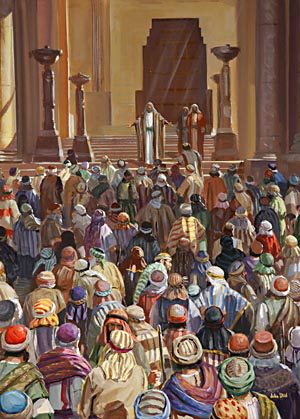
    Peter preaching from Solomon's Porch
    Peter, John and the healed lame beggar

    Epistles from Apostles to Elders

    Even while reading the Epistles of Paul outlining a developing leadership structure of the A.D. 1st century Church, Elders seem to get lost somewhere between Apostolic authority (at the top) and dynamic Deacons (such as Stephen).
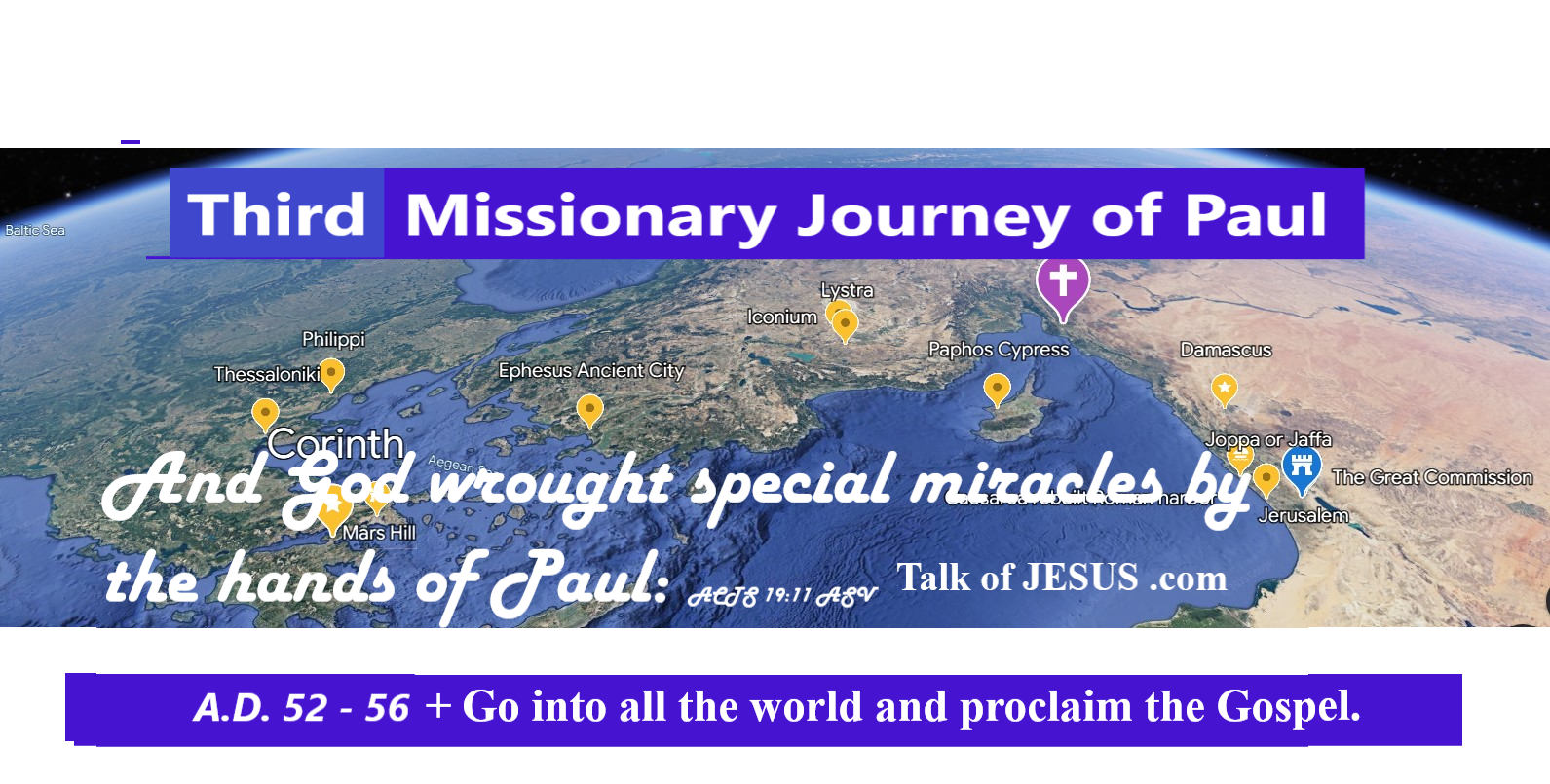
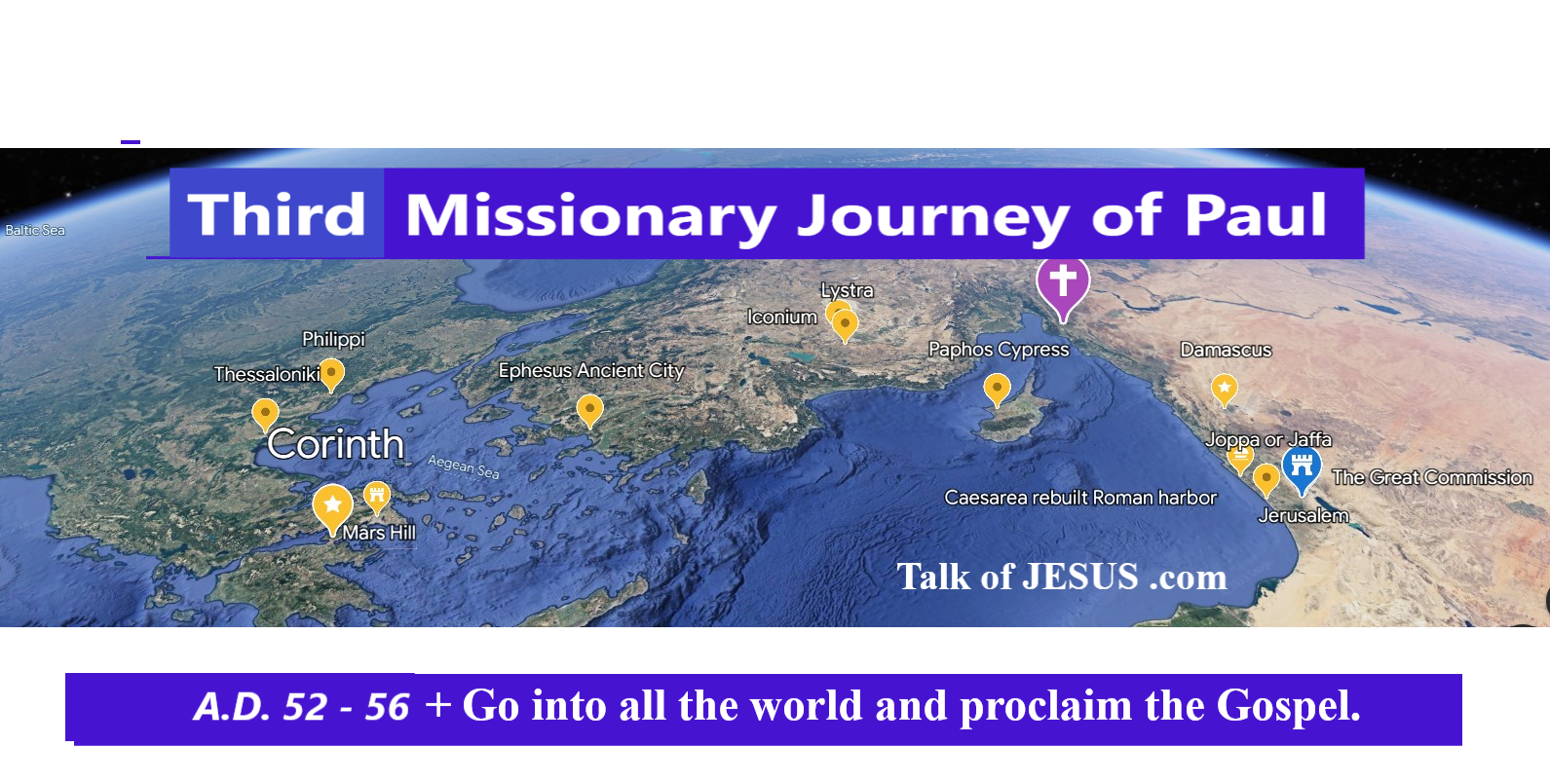
    And God wrought special miracles by the hands of Paul: Acts 19:11 ASV graphic map of Third Missionary Journey of Paul
    Elders, Deacons and other Apostolic leadership 

    Paul writes in his first pastoral letter to Timothy:

    Let the elders who rule well be counted worthy of double honor, especially those who labor in the word and doctrine.

    1 Timothy 5:17 NKJV


    Other English translations help us apply the same Scripture into responsibilities 21st century C.E. churches consider as leadership jobs.

    The elders who are good leaders are to be considered worthy of double honor, especially those who work hard at preaching and teaching.

    1 Timothy 5:17 CSB

    We need to think of the Apostles John, Peter, Paul and others in these dual roles in relation to the developing churches they establish.

    Mediterranean Sea near Phoenix Cypress

    Paul offers a precedent and example of which churches need elders in a pastoral epistle to (the pastor) Titus.

    The reason I left you in Crete was to set right what was left undone and, as I directed you, to appoint elders in every town.

    Epistle of Paul to Titus 1:5 CSB

    Timothy, Titus, Barnabas, Silas and especially the Apostles often deserved double honor for serving as pastor and teacher of a specific local church for a time, in addition to their commission and titles as apostles, disciples, deacons and elders.

    JOHN, during his long years of Apostolic ministry to many churches served as an Elder (probably in several towns) in addition to his chosen commission by Christ as an Apostle.
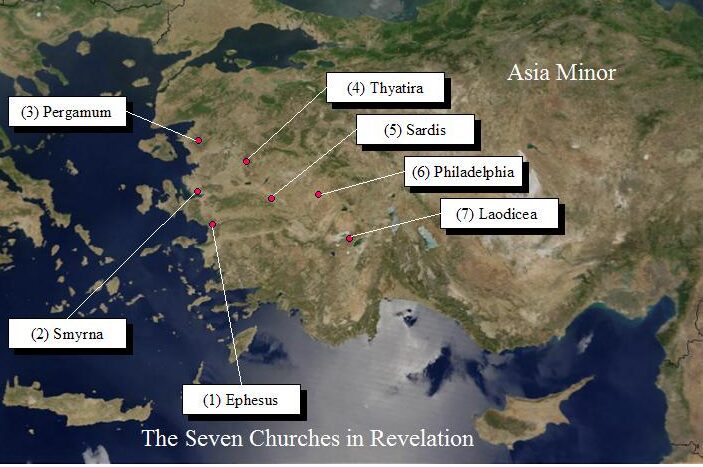
    map of the seven churches of revelation
    John to the seven churches that are in Asia: Grace to you and peace from Him who is, and who was, and who is to come, and from the seven spirits who are before His throne,

    Elders Leading the Family of God

    Before we look at letters from John the Elder or the role of an Elder in the New Testament families of God and Christ, let’s honor the tradition into which James and John, Sons of Zebedee, Andrew and Simon Peter and other first century Jews were born.

    Elders of Jewish Scripture (the Old Testament)

    “You stand today, all of you, before Yahweh your God [יְהוָה אֱלֹהֵיכֶם]:

    your heads, your tribes, your elders, and your officers, even all the men of Israel, your little ones, your wives, and the sojourner who is within your camps..

    Deuteronomy 29:10-11a KJV

    Included with the elders [the old men, some leaders of clans or families] yᵊhōvâ ĕlōhîm includes officers [foremen] and many others.
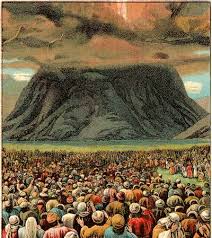

    The LORD Visits Sinai Exodus 19 congregation of the Hebrews at Mount Sinai

    Assemble to me all the elders of your tribes and your officers, that I may speak these words in their ears and call heaven and earth to witness against them.

    Deuteronomy 31:28 ESV


    Then all the elders H2205 of Israel gathered together and came to Samuel at Ramah

    1 Samuel 8:4 LSB

    So Samuel did what Yahweh said and came to Bethlehem. And the elders H2205 of the city came trembling to meet him and said, “Do you come in peace?”

    1 Samuel 16:4 LSB

    Princes are hanged up by their hand: 
    the faces of elders were not honoured.
    They took the young men to grind,
    and the children fell under the wood.
    The elders have ceased from the gate,
    the young men from their musick.
    The joy of our heart is ceased;
    our dance is turned into mourning.
    The crown is fallen from our head:
    woe unto us, that we have sinned!

    Lamentations of the Prophet Jeremiah 5:12-16 KJV

    “But you shall select excellent men out of all the people, those who fear God, men of truth, those who hate greedy gain; and you shall place these men over them as leaders of thousands, of hundreds, of fifties, and of tens.

    Exodus 18 & Deuteronomy 1 LSB

    Elders lead the thousands, the hundreds, the fifties and the tens..


    Elders of a developing or disintegrating church

    Before we breeze through the years of the ACTS OF THE APOSTLE JOHN, let’s recall the chronology mentioned previously in a look at John’s Gospel — a timeline taking the young Disciple at the foot of the Cross, past his proclaiming the Gospel with Peter on Pentecost and up to the time the Elder writes his Gospel.

    An account of ACTS in the life of John

    All dates and ages of John are approximate
    • ~A.D. 30 – Jesus’ ascension, Pentecost, Peter & John preaching in the Temple
      • The Apostle John is only about 25 years old.
    • ~A.D. 44 –
      • John is now in his upper 30’s

    About that time King Herod violently attacked some who belonged to the church, and he executed James, John’s brother, with the sword.

    Acts of the Apostles 12:1-2 CSB

    • ~A.D. 49 – Council at Jerusalem (Acts 15)
      • The Apostle John, ~ age 43
      • Peter, who an angel released at the time James was execution, would have been present, along with James, half-brother of Jesus and leader of the Jerusalem church.
      • Paul and other Elders present to decide how Jews and Gentiles will worship Jesus the Lord as one body of Christ

    Then it seemed good to the apostles and the elders, with the whole church, to choose men from among them—Judas called Barsabbas, and Silas, leading men among the brothers—to send to Antioch with Paul and Barnabas, and they sent this letter by them,

    “The apostles and the brothers who are elders, to the brothers in Antioch and Syria and Cilicia who are from the Gentiles, greetings.

    Acts 15:22-23 LSB

    • ~ A.D. 55 – Mark, (John Mark, gentile nephew of Barnabas who had accompanied his uncle and Paul on Cypress & became a scribe to Peter) – writes his Gospel.
      • The Apostle John is about 50 years old
      • Paul and others write Epistles to various churches
    • ~ A.D. 61 – Luke, gentile physician of Paul, writes his Gospel and Jesus’ Apostle Matthew Levi writes his Gospel
      • The Apostle John is now in his upper 50’s
      • The Apostles Peter and Paul continue to write Epistles
    • ~ A.D. 62 – James, half-brother of Jesus and leader of the Jerusalem church is martyred
    • ~ A.D. 66
      • John is now 60 years old
      • The Jews revolt against Rome
        • Christians flee Jerusalem
      • The Apostles Paul and Peter are Martyred in Rome
        • Jude (Jesus’ half-brother) writes an Epistle
        • Epistle “to the Hebrews” written (anonymously)
    • ~ A.D. 86
      • The Elder John is now 80 years old
      • ALL of the other Apostles are dead and as Jesus had told Simon Peter, is the only one remaining.
      • The Lord has saved John even from torture, exiled on a Greek island of Patmos.
      • John will now write three Epistles…
        • ten, if you count brief greetings to seven in his apocalypse from the Lord Jesus Christ.

    Elders of the New Testament

    In the New Testament, the role of elders becomes more defined within the structure of the early church. Elders, also known as overseers or bishops, are responsible for shepherding the flock, teaching sound doctrine, and maintaining church discipline.

    Plurality and Accountability:
    The New Testament model for church leadership often emphasizes a plurality of elders, suggesting that multiple elders should lead each congregation. This plurality provides a system of accountability and shared responsibility, ensuring that no single individual holds excessive power. The collective wisdom and diverse gifts of multiple elders contribute to the health and growth of the church.

    Conclusion:
    The biblical concept of elders encompasses a rich tradition of leadership and service, rooted in both the Old and New Testaments. Elders are called to be shepherds, teachers, and examples, guiding the people of God with wisdom, humility, and integrity.

    Their role is vital to the spiritual well-being and doctrinal soundness of the church, as they seek to honor God and serve His people faithfully.

    source: BibleHub.com


    NO man was more directly accountable to our risen Lord Jesus Christ, with a lasting impact on the saints of an expanding second century church who had met him, than the ELDER JOHN.


    Comment on Scripture – Share the Gospel

  • Personal Letters from Nicopolis – Intro

    Personal Letters from Nicopolis – Intro

    Personal Instructions and Greetings

    When I send Artemas or Tychicus to you, be diligent to come to me at Nicopolis, for I have decided to spend the winter there.

    Letter of the Apostle Paul to Titus 3:12 Legacy Standard Bible

    We have been following the missions of Paul and others in Acts of the Apostles for some time now and might easily miss a small personal instruction such as this found at the end of one of the Apostle’s many letters.

    Just a brief record of one winter:

    • Paul will stay in Nicopolis for one winter.
    • He instructs Titus that he will send one of two others to him, either Artemas or Tychicus.

    I emphasize in my pause in ACTS by this introduction to Paul’s letters in context that during these historical missional journeys all of the apostles nurtured both personal and community relationships with those won to the Lord Jesus Christ.

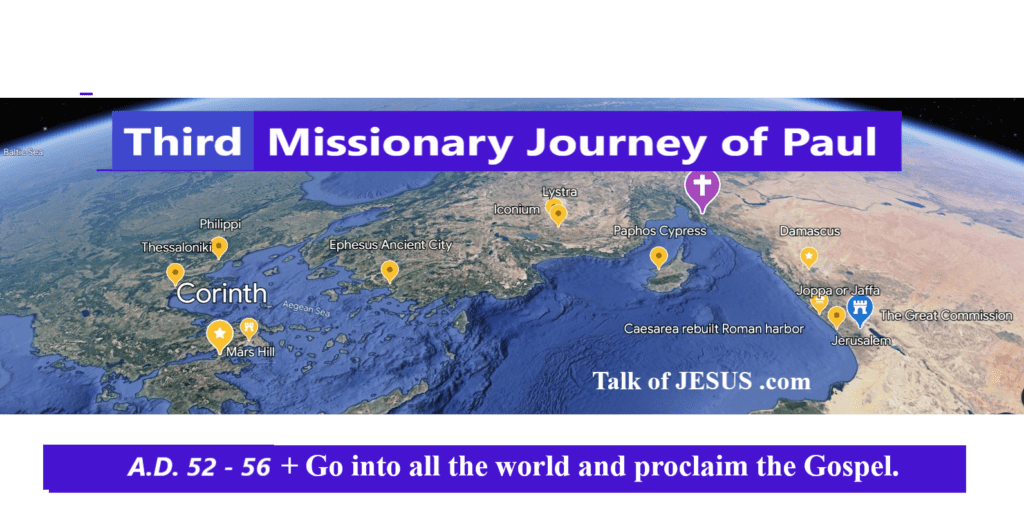
    google earth map of third missionary journey of Paul - TalkofJESUS.com
    A.D. 52-57
    Paul's THREE missions over ELEVEN years from ~ A.D. 49 to ~ A.D. 57 would have included 10 winters. 
    
    Please COMMENT if YOU can pinpoint the actual YEAR or place in ACTS when this occurred. 

    Further Personal Greetings, Blessings, Thanks & Instructions

    Diligently help send Zenas the lawyer and Apollos on their way so that nothing is lacking for them.

    And our people [that is, followers of the Lord Jesus Christ] must also learn to lead in good [occupations] works to meet pressing needs, so that they will not be unfruitful.

    All who are with me greet you.

    [Paul does not say who these disciples of The Way traveling to Nicopolis for their winter stay might be, but through the Holy Spirit they remain connected to the church and those who receive his letter through Titus. The Apostle then asks them to extend their love to others in the faith.

    Greet those who love us in the faith.

    Grace be with you all.

    Titus 3:13-15 – closing of Paul’s letter


    Greetings and Grace

    Note Paul's humility in Christ and tenderness toward those to whom the Apostle writes:

    Paul, a slave of God

    and an apostle of Jesus Christ,

    according to [for] the faith of God’s elect and the full knowledge of the truth which is according to godliness, in the hope of eternal life, which the God who cannot lie promised before times eternal [from all eternity]..

    And in Paul's 'sent out' purpose as Christ's apostle to the Gentiles here he connects his servitude to the risen Jesus as they must receive his gospel from God, even referring to Christ as God.

    .. but at the proper time manifested [made known] His word in preaching,

    with which I was entrusted

    according to the commandment

    of God our Savior,

    Titus 1:1-3 LSB
    All this deep connection and theology in just a brief introduction and closing of a short letter written to a fellow beloved leader of the church.

    To Titus, my genuine child according to our common faith:

    Grace and peace from God the Father and Christ Jesus our Savior.


    Νικόπολις

    Nicopolis

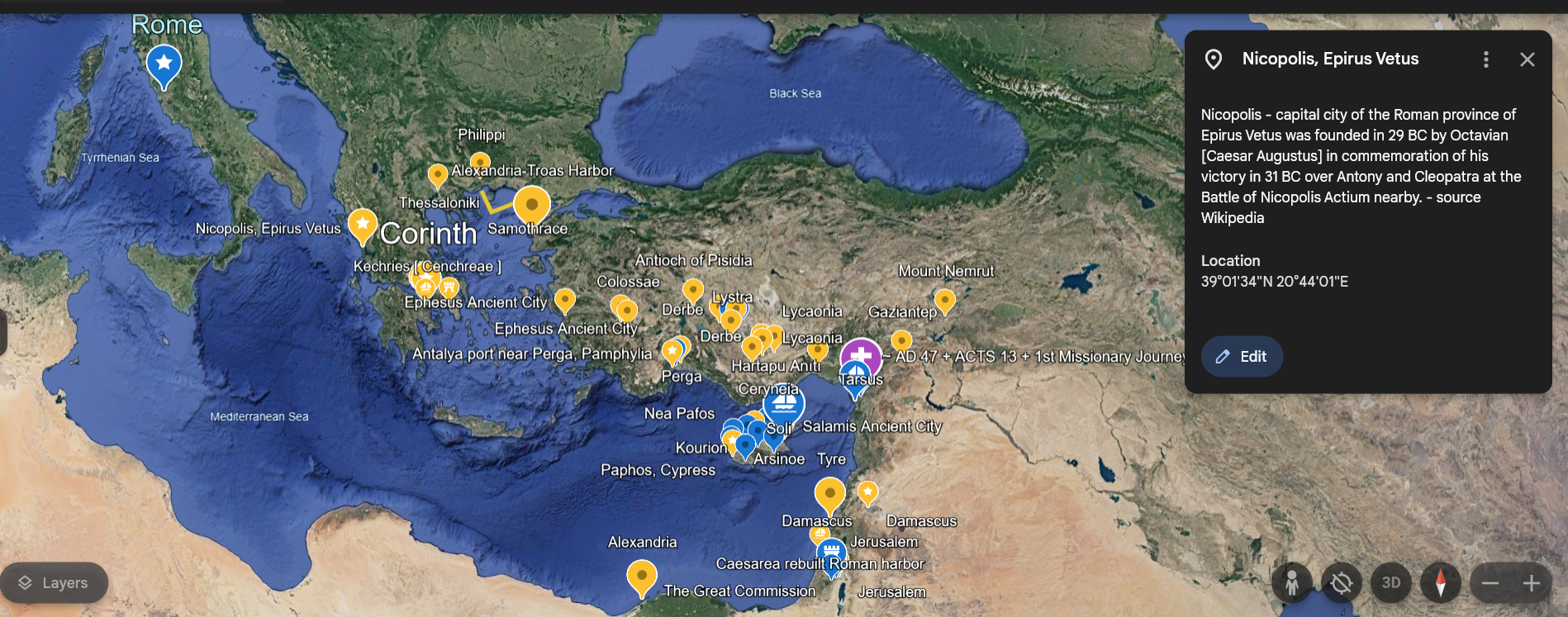
    Nicopolis meaning “city of victory”

    There were many cities by this name, — in Armenia, Pontus, Cilicia, Epirus, Thrace —

    The one in Titus 3:12 seems to refer to the city was built by * Augustus in memory of the battle of Actium on a promontory of Epirius.

    • Before Augustus Caesar seized power he was known as Octavian. His victory on 2 September 31 B.C. at Actium (pictured above on map near Nicopolis) secured Rome’s strategic position as rulers of the Mediterranean.
    • Paul, as a Roman citizen, would have felt at home in such Roman cities.

    The one in the subscription of Titus seems to refer to Thracian Nicopolis, founded by Trojan on the river Nestus, since he calls it the city of Macedonia.


    When did Paul write?

    Our focus in this overview of Paul’s letters is more toward the relationships the Apostle and disciples of The Way create with each other than the how, where and when he wrote.

    Paul may have been in Thrace or Macedonia. Perhaps some of these letters were written in part on his journeys abord ships between destinations. And in these ten years having spent extended time in so many towns and cities Paul’s letters may well have been composed from his guest quarters in some of the homes of recipients (perhaps even Titus) to whom the Apostle wrote on a later occasion and circumstance.

    What we do know is the approximate times and chronology of most of Paul’s letters.

    This chronology and connection to events Luke records in ACTS of the APOSTLES will be the focus of our series looking at Paul’s letters.

    Time to Write to Loved Ones

    ALL dates approximate.
    • A.D. 30
      • Resurrection & Ascension of JESUS CHRIST
    • A.D. 37
      • JESUS appears to Saul (Paul)
    • A.D. 47
      • Paul and Barnabas depart on their first missionary journey
    • A.D. 49
      • ACTS 15

    THE COUNCIL AT JERUSALEM

    & Letters to the CHURCH sent out into all the world

    THESE INCLUDE LETTERS (or Epistles)

    from: James the brother of Jesus & leader (in A.D. 49) of the Jerusalem church

    from: Paul to the Galatians

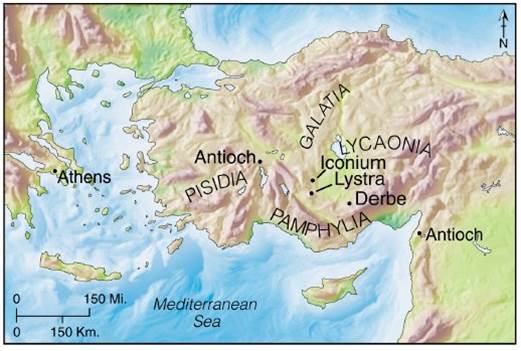
    Galatia map with its capitol Pisidian Antioch

    Letters of the A.D. 50’s

    a generation (~20-30 years) after the Lord's resurrection
    
    All dates approximate:
    
    • A.D. 50 – John Mark, who had accompanied Barnabas and Paul on Cypress writes his GOSPEL.
    • Paul writes two letters to the Thessalonians
    During Paul’s SECOND missionary journey
    google earth map of third missionary journey of Paul - TalkofJESUS.com

    And during Paul’s THIRD missionary journey (where we have once again paused briefly) THESE LETTERS:

    • Paul writes TWO letters to the Corinthians living in the Achaian city larger and more important that Athens.
    • The Apostle Paul, a Roman citizen, also writes to the Romans around the end of his third missionary journey (A.D. 57) and two years prior to his own journey to Rome.

    Later Letters of the A.D. 60’s – 80’s

    Our introduction to these Church Letters is NOT expositional but topical. And these are personally relational to those Christians to whom the Apostles wrote.

    I will also point to Scripture from other Epistles yet to be written (as of this pause in ACTS of the APOSTLES ) when later events will connect the Church in many more ways to our struggles of a 21st century C.E. faith.

    These include Titus written around A.D. 64-66 on which I have focused today

    AND other important ‘personal letters’ instructing leaders and others of the church including:

    an Epistle to Philemon and TWO letters to Timothy.

    Several letters written in the early A.D. 60’s to churches Paul has already visited on his current and previous missions.

    Ephesians

    Philippians

    Colossians


    Luke will also complete his Gospel in the early A.D. 60’s as does the Apostle Matthew.


    Nero has been Emperor of Rome during most of these times (A.D. 54-68) and things are about to get much worse for all of the Empire including Jerusalem, which revolts against ROME beginning in A.D. 66 and will eventually be destroyed in A.D. 70 as the Jewish Wars continue on into A.D. 73.

    As the world of ROME begins to disintegrate while Paul and Peter and every other Apostle except John are executed, the Gospel and Letters of a New Testament go into all the world — a world to which the Lord Jesus Christ came and died for sinners like you and like me — that we might have eternal life in Him.


    MORE Letters arriving SOON… God-willing…

  • Why Submit? – a letter from Peter – 4

    Why Submit? – a letter from Peter – 4

    Why should we submit to anyone? If a follower of Christ Jesus encounters difficulty from your community, your boss, your spouse or anyone else, why submit to their will rather than your own?

    We began last time with Peter telling us the purpose of our good works through Christ Jesus:

    Submit to every human authority because of the Lord… For it is God’s will that you silence the ignorance of foolish people by doing good. Submit as free people, not using your freedom as a cover-up for evil, but as God’s slaves.

    1 Peter 2:13a,15-16 CSB

    The Apostle opened his first letter to the persecuted church with blessings and encouragement concerning this salvation through Christ Jesus. But Peter quickly proceeds, warning the faithful against those opposed to the risen Savior.

    He assures us that Jesus is the cornerstone of the church and that faithful followers of Christ are living stones. Yet because of Christ some will stumble because they disobey our Lord.

    Peter now adds specific applications to their lives and ours.

    Remember Our Example Before Men

    No witness is better than a personal witness.

    For you were called to this, because Christ also suffered for you, leaving you an example, that you should follow in his steps.

    1 Peter 2:21

    Although Peter had been part of the inner circle of the Lord, most first century believers had only the good works of the Apostles as their image of Christ risen and the power of the Holy Spirit.

    Part of Peter’s authenticity becomes evident by his own admissions of failings. We first hear of this humility in Peter when Jesus first called him.

    Luke 5:

    The crowds are pressing into Jesus who is teaching near Lake Tiberias, as the Romans called this Sea of Galilee. He sees two boats having returned from less than successful fishing that day.

    3 He got into one of the boats, which belonged to Simon, and asked him to put out a little from the land. Then he sat down and was teaching the crowds from the boat.

    Peter, of course, also listens to Jesus preach from his boat.

    4 When he had finished speaking, he said to Simon, “Put out into deep water and let down your nets for a catch.”

    5 “Master,” Simon replied, “we’ve worked hard all night long and caught nothing. But if you say so, I’ll let down the nets.”

    6 When they did this, they caught a great number of fish, and their nets began to tear…

    When Simon Peter saw this, he fell at Jesus’s knees and said, “Go away from me, because I’m a sinful man, Lord!”

    Luke 5:8 CSB

    Peter, James and John that day all became Jesus’ closest Disciples and friends. Surely believers who witnessed Peter during his brief years following the Lord’s resurrection came to know this humble, yet sometimes boisterous redeemed sinner who writes this letter.

    1 Peter 2:

    9 But you are a chosen race, a royal priesthood, a holy nation, a people for his possession, so that you may proclaim the praises of the one who called you out of darkness into his marvelous light.

    1 Peter 2:9 CSB

    If you are the one receiving this letter doesn’t this make you feel special, that is, set aside for God?

    God chooses you through Christ! Peter is just the Lord’s humble messenger of the Good News. But then he explains this further to the largely gentile or non-jewish hearers of his letter.

    10 Once you were not a people, but now you are God’s people; you had not received mercy, but now you have received mercy.

    In Christ Jesus we are chosen, therefore we must act differently than the world around us. By God’s grace we have received mercy and can show our good works to others.

    How to submit to others

    13 Submit to every human authority because of the Lord…

    We have already looked at the list of those we resist by our lack of humility. Peter will remind us later in his letter:

    Since Christ had to suffer physically for you, you must fortify yourselves with the same inner attitude that he must have had.

    1 Peter 4:1 JB Phillips New Testament

    In this sense we feel the prescribed holiness of the priest made possible only by the grace of God through the Holy Spirit.

    Masters

    We abhor slavery. Yet in a sense all are slaves of servants to someone; Christians moreso, as Peter insists.

    19 For it brings favor if, because of a consciousness of God, someone endures grief from suffering unjustly. 20 For what credit is there if when you do wrong and are beaten, you endure it?

    This is a fair question the Apostle asks. For such a situation, whether physically or metaphorically, our beating is punishment for sin, a transgression of some law of man or a Law of God.

    But when you do what is good and suffer, if you endure it, this brings favor with God.

    Christ’s example before men

    21 For you were called to this, because Christ also suffered for you, leaving you an example, that you should follow in his steps.

    This witness of Jesus by Peter stands as a question to new Christians for every example to follow his mention of slaves or servants.

    • Are you a servant of God? Then the Father is your Master.
    • Is Christ Jesus your Lord? Then Jesus must be your new Master.

    Why then do you not follow Jesus’ example before men?

    22 He did not commit sin, and no deceit was found in his mouth; 23 when he was insulted, he did not insult in return; when he suffered, he did not threaten but entrusted himself to the one who judges justly.

    We just have trouble doing that, new Christian or long-time believer, don’t we?

    Then Peter reminds us of the reason Christ came to us as a man, the suffering servant predicted by scripture.

    24 He himself bore our sins in his body on the tree [cross]; so that, having died to sins, we might live for righteousness.

    The sinless Son of Man, Jesus, became the sacrificial lamb, His Blood the covering for our own sins. Therefore, we must live to righteousness.

    For you were like sheep going astray, but you have now returned to the Shepherd and Overseer of your souls.

    1 Peter 2:21 CSB

    Submission to Husbands

    In the same way, wives, submit yourselves to your own husbands…

    Once again, a topic perhaps as malaligned as slaves serving masters.

    Some translations soften the blow of this topic offensive to some women of the church. Wives are often more zealous for Jesus than their husbands.

    It may be helpful for Christian wives to remember that Peter was a devoted husband, who called Jesus his Master. MacArthur’s outline heading: Submission in the Family may be most appropriate.

    1 Peter 3:

    Peter tells our sisters in the Lord why they must submit and how they must act to reflect Christ’s glory.

    … so that, even if some disobey the word, they may be won over without a word by the way their wives live when they observe your pure, reverent lives.

    Pure and reverent lives. How often do we hear this call even to Christian men? Other translations shed additional light on Peter’s meaning:

    • While they behold your chaste conversation coupled with fear. KJV
    • when they see your respectful and pure conduct. ESV
    • as they observe your chaste and respectful behavior. NASB

    Twenty-first century culture nearly everywhere has strayed far from these original meanings and we must not devalue Christian women in any way simply because the Bible clearly states the roles of both men and women.

    Chaste and respectful behavior

    ἁγνός – hagnos chaste – exciting reverence, venerable, sacred, pure; pure from carnality, chaste, modest; pure from every fault, immaculate; clean (in the Hebrew sense of cleansed)

    Paul, in his letter to Titus uses this same word for wives when he encourages older women to mentor younger women in the church:

    ‘to be sensible, pure, G53 workers at home, kind, being subject to their own husbands, so that the word of God will not be dishonored.’

    Titus 2:5 Strongs Concordance BlueletterBible.org

    φόβος – phobos respectful – fear, dread, terror or alarm, that which strikes terror; also: reverence for one’s husband

    What does it mean to reverence the Lord God? Or reverence Jesus Christ as your Lord?

    Let us not confuse fear and dread with respect and reverence, not even of husbands, who must honor their wives. For the enemy of Christ would have some men fear their wives, having no reverence for Christ or God our merciful Father.

    ἀναστροφή – anastrophē behavior – manner of life, conduct, behaviour, deportment” from G390; behavior:—conversation.

    Of course our good works (or evil works) quickly become most evident by our words in women and especially in men. Peter’s additional encouragement to wives faithful to their husband and faithful to the Lord points toward a Christ-like example from women as well. The writer of Hebrews uses this same word also translated as conduct when he writes:

    Remember those who led you, who spoke the word of God to you; and considering the result of their conduct, G391 imitate their faith.

    Hebrews 13:7 NASB Strong’s concordance from BlueLetterBible.org

    Your inner beauty

    Remember, Peter is married. He may also have a sister or daughter – the Bible does not confirm this. Many, perhaps most of the Apostles were married, had daughters and sons, sisters and brothers.

    Isn’t it most familial that in Christ the early church referred to each other as “brother” and “sister,” and greeted each other with a kiss?

    Therefore acknowledging our humility of role, as Christ also humbled Himself as a servant, Peter points inward to our soul rather than the desirable outward appearances of the world.

    3 {NASB} Your adornment must not be merely external…

    The cultural particulars of the time or locale carry less importance, but reflect the appropriateness of the saints.

    The imperishable qualities of a wife in Christ

    4 [NASB] but let it be the hidden person of the heart, with the imperishable quality of a gentle and quiet spirit, which is precious in the sight of God.

    She is a quiet and gentle soul. Oh, such a compliment to her husband, such a witness to a gentle Jesus. She also will submit to the Father – a bruised reed she will not break.

    Peter puts forth the example of Sarah, wife of Abraham, as a holy example of a wife who does submit to her husband. She called him ‘lord,’ the Apostle reminds. A servant calls their master, lord.

    Do you call Jesus Lord?

    Peter also calls upon husbands to ‘live with your wives in an understanding way.’ What does he mean?

    The Apostle presumes that as a brother in Christ that you have a gnosis of scripture and the Lord; that is, a deeper more perfect and enlarged knowledge of this religion, such as belongs to the more advanced.

    She is ‘the weaker vessel,’ knowing less about God while she submits to you. It may have been so in the first century, yet in this day I must ask you, husbands who claim Christ, is it so?

    Do you know more about the Bible and about the Lord than your wife? Who is truly ‘a weaker vessel’ in knowledge of Christ our Lord?

    Is Christ your Lord?

    Are you an unrepentant sinner or by grace a sinner saved in Christ Jesus?

    In addition to living honorably as a witness to unbelievers, the Apostle next suggests how to live honorably among other Christians.

    Beloved Christian brother, dear sister in the Lord,

    Peter will next call upon all brothers and sisters in the Lord to do no evil. He has more instruction to those of us who submit to the teaching of Jesus.

    To be continued...