Category: 4 Gospels + Good News of the NEW Testament

What are the Gospels?

FOUR Gospels:

GOOD NEWS! (That’s what Gospel means.)

Matthew, Mark, Luke & John begin the New Testament proclaiming the Good News of Israel’s long-awaited Messiah and talk of JESUS Christ.

The four Gospels are first hand witness + proclaiming GOOD NEWS

  • by two Jewish Apostles of the Messiah JESUS, Matthew & John
  • Two gentile (non-Jewish) followers of THE WAY of Jesus Christ, Mark & Luke, who proclaim the GOSPEL recorded from witness of Peter, Paul and other Apostles and disciples of JESUS in the first century.

READ the Good News of the Messiah and Savior Jesus from accounts of His twelve Apostles & others witnessing the resurrection of the Lord Jesus from the four Gospels of the New Testament: Matthew, Mark, Luke and John.

SHARE the Gospel

  • with your Christian friends and those who do not yet believe in JESUS CHRIST.
  • Comment on a Talk of JESUS post and SHARE in your social media world.
  • The Multitudes He Did Not Serve

    The Multitudes He Did Not Serve

    Sometimes we just don’t get it. We only want to see the nice things Jesus did. We only want to hear the nice things Jesus had say and even now speaks through Scripture and the Spirit.

    In case you missed the beginning of this series, we are following the early days of Jesus’ public ministry. We have looked at His early calling of the people to repentance and followed Jesus to his rejection (and near murder) by the people of Nazareth.

    Doctor Luke records in chapters 5 and 6 a list of some of Jesus’ early miracles. (How we use these all-too-frequently to attract the multitudes to our church buildings! The bigger the blessings for the multitudes, the bigger the building we need.)

    I related an often used part of a favorite teaching of Jesus in an Advent preparation series on The Beatitudes. Oh how we love to point out the miracles of His feeding the 5000 and the feeding the 4000; while we forget that Jesus’ message is to REPENT! Turn back to God, our Father. He sends us the bread from Heaven. Jesus is the Bread of Heaven. His Word is what we MUST digest.

    “Blessed are you… Happy are you: This we want to hear. 🙂

    We turn now to Luke 6.

    Jesus has been preaching repentance. He has performed many miracles. He has shown compassion for many individuals and even compassion for the hungry crowds.

    People will follow Jesus anywhere, IF only He will keep performing miracles for them. (You remember, his own neighbors and friends in Nazareth were angry enough at Jesus to want to throw Jesus off the cliff to His death.) Why? We want to be entertained. We want blessings and not curses. We want proof.  (Forget faith!) He would NOT perform for the multitudes of for even his hometown neighbors and family.
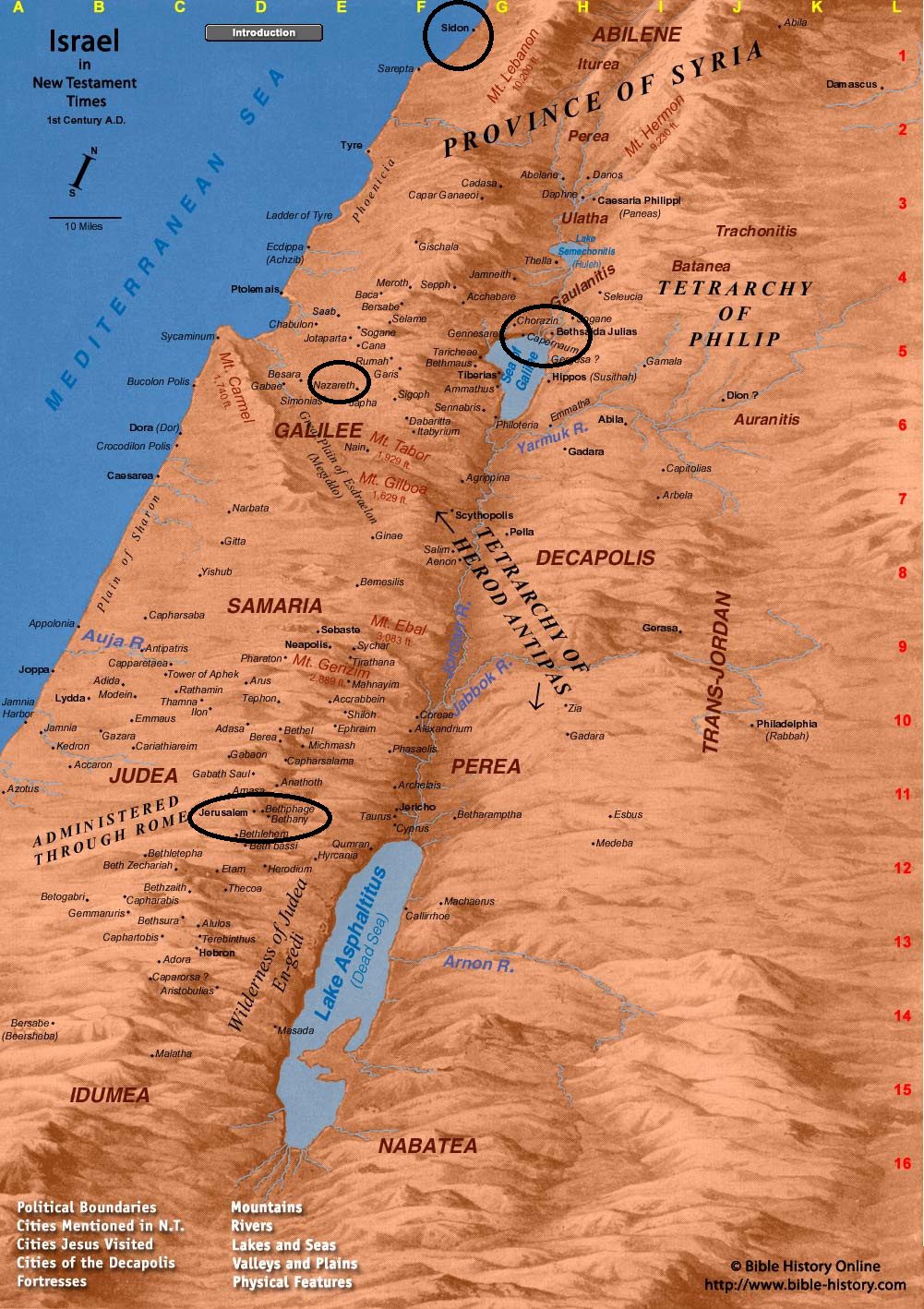
    Jesus of Nazareth - Tyre to the N. - Israel, Judea map
    Jesus of Nazareth – Tyre to the N. – Israel, Judea map


    Jesus Ministers to a Great Multitude

    17 And he came down with them and stood on a level place, with a great crowd of his disciples and a great multitude of people from all Judea and Jerusalem and the seacoast of Tyre and Sidon, 18 who came to hear him and to be healed of their diseases. And those who were troubled with unclean spirits were cured. 19 And all the crowd sought to touch him, for power came out from him and healed them all.

    [Here is the nice part we all love:]

    The Beatitudes

    20 And he lifted up his eyes on his disciples, and said:

    “Blessed are you who are poor, for yours is the kingdom of God.

    21 “Blessed are you who are hungry now, for you shall be satisfied.

    “Blessed are you who weep now, for you shall laugh.

    22 “Blessed are you when people hate you and when they exclude you and revile you and spurn your name as evil, on account of the Son of Man! 23 Rejoice in that day, and leap for joy, for behold, your reward is great in heaven; for so their fathers did to the prophets.

    Amen! Yes, we need this Jesus.

    (Lord bring us a miracle and bring us your reward. Prove you Power to us and we will follow You.)

    Ah, but you with ears to hear, hear what Jesus says next:

    Jesus Pronounces Woes

    24 “But woe to you who are rich, for you have received your consolation.

    25 “Woe to you who are full now, for you shall be hungry.

    “Woe to you who laugh now, for you shall mourn and weep.

    26 “Woe to you, when all people speak well of you, for so their fathers did to the false prophets.

    So you want to be rich, do you? You want Jesus to bless your house with plenty and laughter and good reputation for you and your family… Are you sure? Do you really want it all NOW?

    Dear brothers and sisters of His church, of the multitudes of christians;

    Hear what you do not recall (and I will shorten it for our short memories; but read it all, if you will:)

    Love Your Enemies

    27 “But I say to you who hear, Love your enemies, do good to those who hate you, 28 bless those who curse you, pray for those who abuse you.

    Have you been abused? Sexually? Physically?  Verbally? Financially? Emotionally?

    Do some hate you? (Certainly a fellow believer or sister who claims Christ ought not?)

    LOVE THEM.

    Though they are your enemies, love them. That is what Christ Jesus commands. (Are you still with us, christian of the crowds and multitudes?)

    What is this ‘love’ to which Jesus (IF He IS our Lord) calls us?

    • Welcome them (perhaps into your homes, but certainly into your life. (How else will they see Christ in you?)
    • Entertain them. No, not like TV or a sport or your cell phone; just do not ignore your enemies as if they are not real people created by God, perhaps for a later winning into His Kingdom.
    • Be fond of them. Admit it; you know people who are enemies of Christ Jesus whom you admire and like. Are they not also deserving as you of His love as shown through you?
    • Love them dearly. Yes, your enemy; that the love of Christ Jesus may shine into the darkness of their life.

    Not only, “love them,” do good to them.

    Sure, we all remember the story of the good Samaritan; but Jesus’ point was not so much that a hated man did good for a man, but that men (and women) who claim to be “good” do not often do the good act of mercy, as had the Samaritan unbeliever. Therefore Jesus continues in Luke 6:32

    32 “If you love those who love you, what benefit is that to you? For even sinners love those who love them. 

    33 And if you do good to those who do good to you, what benefit is that to you? For even sinners do the same…  35 But love your enemies, and do good, and lend, expecting nothing in return, and your reward will be great, and you will be sons of the Most High, for he is kind to the ungrateful and the evil. 

    36 Be merciful, even as your Father is merciful.

    Jesus’ personal love is also personal love for the unbeliever and for the unsaved, as you and I were once unsaved and an enemy of God (though our profession may have been false and our faith rebellious).

    REPENT! Show mercy, as our Heavenly Father has shown us mercy.

    and LOVE, as Christ Jesus has loved us.

    For if, when we were enemies, we were reconciled to God by the death of his Son, much more, being reconciled, we shall be saved by his life. – Romans 5:10 KJV

    No, repentance is not such a bad message for each of us; therefore, be reconciled to your brother in Christ. Be reconciled to your sister in Christ. Be reconciled even to your enemy! Love them.

    And just two additional things (from Luke 6:27) added next in v. 28:

    28 bless those who curse you, pray for those who abuse you.

    Abuse (of all kinds and of varying degrees) is a terrible thing, an offense between two human beings, both created by God. The word often translated ‘abused’ by this and other versions of the Bible in the KJV reads: “them which spitefully use (you).” It is a better translation (unencumbered by the world’s spin on the meaning). Listen to the meaning from Jesus’ words:

    Outline of Biblical Usage

    1. to insult

    2. to treat abusively, use despitefully

    3. to revile

    4. in a forensic sense, to accuse falsely

    5. to threaten

    ALL of these are abuses of the enemy; and the enemy is Satan. Do you use these spitefully in retaliation against those who spitefully use you? Do you respond to your enemies (or even a brother or sister in Christ) in a spiteful way?

    Stop it! Jesus commands us: LOVE them. DO good to them. BLESS them. (and here is the hard one for us:) PRAY for them.
    Oh how I pray for enemies who have spitefully used me. One of them may be you… or your loved one.
    I pray that they will repent.
    I pray that they might confess their sin and turn back to God (that’s what repent means, you know; turn back).
    I pray that they might be that lost sheep.
    I pray that they might be that one you never believed would REPENT and hear the word of Jesus over the hatred and ways of the world and the sin of who we also once were before He also saved us.
    Oh, dear one, REPENT of your sin. I pray for you.
    Pray also for me.
    Forgive us our trespasses,
    As we forgive those who trespass against us.

    Are our enemies not our worst offenders?
    Forgive us, for the many times we, too have been an enemy of our Lord, Christ Jesus who teaches us:
    Pray for our enemies.
    +
  • Who Welcomes His Ministry? – 2

    Who Welcomes His Ministry? – 2

    Returning now to the Gospel of Luke, we look back from Jesus’ move to His fast-growing early ministry in Capernaum on the Sea of Galilee to His hometown of Nazareth and the event of His departure.

    Luke 4

    English Standard Version (ESV)

    15 And he taught in their synagogues, being glorified by all.

    22 And all spoke well of him and marveled at the gracious words that were coming from his mouth. And they said, “Is not this Joseph’s son?” 23 And he said to them, “Doubtless you will quote to me this proverb, ‘Physician, heal yourself.’

    What we have heard you did at Capernaum, do here in your hometown as well.”

    24 And he said, “Truly, I say to you, no prophet is acceptable in his hometown.

    Let us pause here to speak of an earlier Prophet of the Old Testament (approx. 850-870 B.C.): Elijah.

    1 Kings 16:

    old israel n kingdom map21 Then the people of Israel were divided into two parts. Half of the people followed Tibni the son of Ginath, to make him king, and half followed Omri. 22 But the people who followed Omri overcame the people who followed Tibni the son of Ginath. So Tibni died, and Omri became king. 23 In the thirty-first year of Asa king of Judah, Omri began to reign over Israel, and he reigned for twelve years; six years he reigned in Tirzah. 24 He bought the hill of Samaria from Shemer for two talents of silver, and he fortified the hill and called the name of the city that he built Samaria, after the name of Shemer, the owner of the hill.

    25 Omri did what was evil in the sight of the Lord, and did more evil than all who were before him…

    NOTE the proximity of this area in the two maps between this area of divided Israel and the beginning ministry of Jesus in Nazareth.

    Ahab Reigns in Israel

    29 In the thirty-eighth year of Asa king of Judah, Ahab the son of Omri began to reign over Israel, and Ahab the son of Omri reigned over Israel in Samaria twenty-two years. 30 And Ahab the son of Omri did evil in the sight of the Lord, more than all who were before him.

    (It’s an ongoing theme in scripture: ‘And __ did evil in the sight of the Lord.’

    Against this the Prophets called all to repentance. 

    Elijah Predicts a Drought

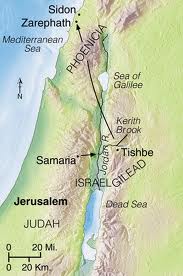
    elijah map17 Now Elijah the Tishbite, of Tishbe in Gilead, said to Ahab, “As the Lord, the God of Israel, lives,before whom I stand, there shall be neither dew nor rain these years, except by my word.” 2 And the word of the Lord came to him: 3 “Depart from here and turn eastward and hide yourself by the brook Cherith, which is east of the Jordan.

    7 And after a while the brook dried up, because there was no rain in the land.

    The Widow of Zarephath

    8 Then the word of the Lord came to him, 9 “Arise, go to Zarephath, which belongs to Sidon, and dwell there. Behold, I have commanded a widow there to feed you.” 10 So he arose and went to Zarephath. And when he came to the gate of the city, behold, a widow was there gathering sticks. And he called to her and said, “Bring me a little water in a vessel, that I may drink.” 11 And as she was going to bring it, he called to her and said, “Bring me a morsel of bread in your hand.” 12 And she said, “As the Lord your God lives, I have nothing baked, only a handful of flour in a jar and a little oil in a jug. And now I am gathering a couple of sticks that I may go in and prepare it for myself and my son, that we may eat it and die.” 13 And Elijah said to her, “Do not fear; go and do as you have said.

    Returning now to Nazareth and Jesus’ mention of this Prophet after His hometown asked for miracles:

    Luke 4

    24 And he said, “Truly, I say to you, no prophet is acceptable in his hometown. 25 But in truth, I tell you, there were many widows in Israel in the days of Elijah, when the heavens were shut up three years and six months, and a great famine came over all the land, 26 and Elijah was sent to none of them but only to Zarephath, in the land of Sidon, to a woman who was a widow.


    divided israel and syriaAnd of successor to  Elijah, the Prophet Elisha, Jesus said:

    27 And there were many lepers in Israel in the time of the prophet Elisha, and none of them was cleansed, but only Naaman the Syrian.”

    Yes, Jesus is preaching an active and insistent call to the people of Nazareth: REPENT!

    And Luke continues to tell us how well Jesus’ call to his own best known and most beloved neighbors responded to His call to repent:

    28 When they heard these things, all in the synagogue were filled with wrath.

    Angry at the hometown Messiah? (Think of the tourist possibilities… Well, maybe in a few centuries we can whitewash the truth of Jesus reception in Nazareth.)

    29 And they rose up and drove him out of the town and brought him to the brow of the hill on which their town was built, so that they could throw him down the cliff.

    old nazareth wall above cliff30 But passing through their midst, he went away.
    What people would welcome the ministry of one of their own by seeking to kill him?

    Does Jesus’ ministry and call to repent not meet with the same reception in our own town in these last days?


  • Who Welcomes His Ministry?

    Who Welcomes His Ministry?

    Luke 4:

    Jesus Begins His Ministry

    nazareth zabulon map14 And Jesus returned in the power of the Spirit to Galilee, and a report about him went out through all the surrounding country. 15 And he taught in their synagogues, being glorified by all.

    Jesus Rejected at Nazareth

    16 And he came to Nazareth, where he had been brought up.

    Generally, Doctor Luke provides us with great detail of proof from eye witness accounts of Jesus and the Acts of the Apostles; however in this chronological glance at the beginning of Jesus’ three-year ministry on earth after being led into the wilderness by the Holy Spirit a look through the eyes of the Apostle Matthew is more helpful.

    Matthew 4

    English Standard Version (ESV)

    Jesus Begins His Ministry

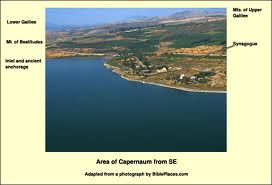
    capernaum from se12 Now when he heard that John had been arrested, he withdrew into Galilee. 13 And leaving Nazareth he went and lived in Capernaum by the sea, in the territory of Zebulun and Naphtali…

    Jesus of Nazareth, as He was known, then moved to and lived in Capernaum by the sea of Galilee.

    17 From that time Jesus began to preach, saying, “Repent, for the kingdom of heaven is at hand.”

    Let us speak to the vocation and mission of the Prophet for a moment.

    To begin, God appoints Prophets, generally separate of the Priestly office and official leadership of God’s own people. Prior to John the Baptist, the Prophet spoke and wrote to and of the fallen Nations: Israel, Judah and the gentile nations who God used to humble and punish His own people into repentance.

    Isaiah was probably an aristocrat with influence of kings. He lived about 700 years before Christ.

    Jeremiah and Daniel ( both about 600 B.C.) were both young when God used them as prophets to their own people and both older as God used them to show His glory to the rulers of conquering gentile nations. Ezekiel is also an exile around the same time.

    These men are not in charge; yet all, through the voice and power of God, call men to repentance.

    Amos is just a farmer and a shepherd in Judah (about 800 B.C.) who God uses to announce the fall of the northern Kingdom Israel. Micah was just a countryman in Israel who lived near the Philistine border about this same time.

    Hosea gets his marriage advice from God who instructs him to marry a whore, as His people have become. Jonah did not even want to be God’s Prophet and ran away (though God pursued and saved him.) We know almost nothing about the Prophet Joel.

    Although Zechariah and Haggai were connected to the office of Priest, it was at a time after repentance during the rebuilding of the Temple by Ezra and Nehemiah (about 500 B.C.). Malachi warns of too casual of an attitude toward worship of God (about 460-430 B.C.).

    The Second Temple is destroyed.  God keeps silent for over 400 years – 20 generations!

    Herod the Great, by alliance with gentile Rome, builds yet another Temple in captured Jerusalem.

    Along comes John the Baptist telling another Herod, Pharisees, Sadducees, Scribes, Temple authorities and the people everywhere: REPENT!

    He dresses and acts like a madman and lives in the wilderness; but the people believe and follow John. He baptizes and witnesses that Jesus of Nazareth is the one on whom the Spirit of God descends. He IS the Promised One.

    Now Jesus, who they all knew since boyhood, a man raised as a carpenter moves away from His hometown. He travels a few miles, moving His belongings to a little inland fishing village, Capernaum. And what was Jesus’ first message to his new hometown?

    Matthew 4:17 From that time Jesus began to preach, saying, “Repent, for the kingdom of heaven is at hand.”

    Jesus left His mother and brothers and family, their carpenter business and comes to a fishing village. Jesus doesn’t look like the wild Prophet John. He is gentle. He looks like his new neighbors. He dresses like them. He eats with them. And Jesus worships with them.

    Why would Jesus have that same crazy message for these new neighbors and new friends as He had for his family back home in Nazareth? Repent, you of Capernaum (also known as Chorazin). Repent Bethsaida (a neighboring fishing town on Chinnereth (the Sea of Galilee.)

    Jesus calls His Disciples to leave their fishing businesses to follow Him. They do. And among them another local resident, resented by almost every working man: Mathew Levi, a tax collector, who continues his narrative Gospel:

    Jesus Ministers to Great Crowds

    23 And he went throughout all Galilee, teaching in their synagogues and proclaiming the gospel of the kingdom and healing every disease and every affliction among the people. 24 So his fame spread throughout all Syria, and they brought him all the sick, those afflicted with various diseases and pains, those oppressed by demons, epileptics, and paralytics, and he healed them. 25 And great crowds followed him from Galilee and the Decapolis, and from Jerusalem and Judea, and from beyond the Jordan.

    We, too, focus on these wonderful miracles witnessed by many and refuted by none. We look to follow this Jesus;He IS the same Jesus who comes to us, as did John the Baptist, saying: Repent!

    To be continued…