
We believe in ..the communion of saints, the forgiveness of sins…
The Apostles’ Creed — foundational to our Apostolic Christian faith
Today we have reached the second to last points of our brief look at the Apostles’ creed, the forgiveness or remission of sins.
(We’ll also take a brief glance at ‘the communion of saints,’ mentioned in part in our previous look at the Church.)
For an overview and more instructive view of the outline of our SERIES, take a look at the Roman Creed below:
Structure of Christian CREEDS
Here’s a brief outline found originally in The Roman Creed:
- I BELIEVE IN God almighty (or the Father almighty)
- And in Jesus Christ, his only Son, our Lord
- Who was born of the Holy Spirit and the Virgin Mary
- Who was crucified under Pontius Pilate and was buried
- And on the third day rose from the dead
- Who ascended into heaven
- Siteth at the right hand of the Father
- Whence He cometh to judge the living and the dead
- (I or WE believe in:) The Holy Ghost
- The Holy Church
- The remission of Sins
- The resurrection of the flesh
- (and life everlasting).
source: apostles-creed.org
The early church taught what is basically in the Apostles creed…
It was not till heresies and divisions in the church that any creeds were established.
The Apostles’ Creed
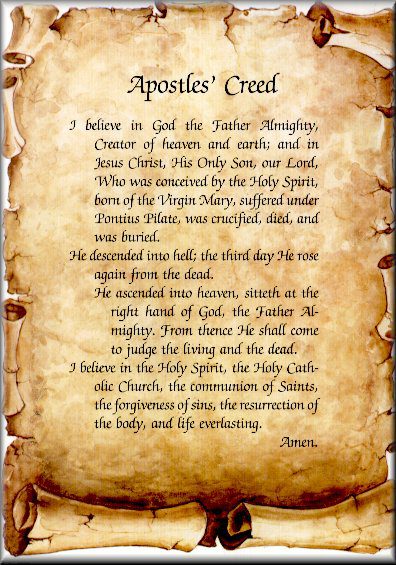
I believe in
the communion of the Saints,
If you haven't read our previous post about the Church you may find helpful definitions not repeated here.
Last time we addressed one of the two definitions included in this section of the Apostles Creed:
- hagios
- most holy thing, a saint
Today let’s also take a brief look at what the Creed means by communion.
(In a sense, it’s not what you think of first.)

Then they that gladly received his word were baptized..
Acts of the Apostles 2:41a KJV
(Now they are the saints or Holy ones of Christ, because of the remission of their sins.)
And they continued stedfastly in the apostles’ doctrine
and fellowship, G2842
and in breaking of bread,
and in prayers.
Acts of the Apostles 2:42 KJV
Note that communion here is the fellowship of the saints whick follows learning the teaching or doctrine of the Apostles.
AND that Communion (as we call it) is a corporate breaking of the bread [klasis artos], a symbolic remembrance of Christ’s broken body.
They devoted themselves to
(from the CSB) (and in addition to;)
- the apostles’ teaching,
- to the fellowship (communion of the saints),
- to the breaking of bread,
- and to prayer.
ALL these together, as Christ’s local church, to keep them holy and separate from the sin and surrounding sinners of whom they once embraced.
κοινωνία koinōnía, koy-nohn-ee’-ah; from G2844; partnership, i.e. (literally) participation, or (social) intercourse, or (pecuniary) benefaction (giving to the benefit of the church):—(to) communicate(-ation), communion, (contri-)distribution, fellowship.
I believe in
the forgiveness of sins
Nehemiah 9:
After the Hebrews had abandoned the Law of Moses and their priest Ezra reads it to the people.
.. the children of Israel were assembled with fasting, and with sackclothes, and earth upon them.
repentant prayer
.. And the seed of Israel separated themselves from all strangers,
sanctification or holiness apart from the sin of their former life
and stood and confessed their sins, and the iniquities of their fathers.
Confession to God precedes asking for forgiveness.
But they and our fathers dealt proudly, and hardened their necks, and hearkened not to thy commandments,
And refused to obey, neither were mindful of thy wonders that thou didst among them; but hardened their necks, and in their rebellion appointed a captain to return to their bondage:
but thou art a God ready to pardon, gracious and merciful, slow to anger, and of great kindness, and forsookest them not.
Nehamiah 9:16-17 KJV
the remission of sins,
Admittedly 'remission from the Creed is a little 'King James' in its sound. But recognize the New Testament application with which you may be able to relate from a familiar prayer and Scripture.
Forgive us our debts
(Which comes from this OT application of the Law)
“At the end of every seven years you shall grant a remission of debts.
מִקֵּץ שֶׁבַע־שָׁנִים תַּעֲשֶׂה שְׁמִטָּה׃
Deuteronomy 18:1 LSB
‘And forgive us our debts,
Gospel of Matthew 6:12 LSB
as we also have forgiven our debtors.
“For if you forgive others for their transgressions,
your heavenly Father will also forgive you.
“But if you do not forgive others,
then your Father will not forgive your transgressions.
Matthew 6:14-15 LSB – the teaching of Jesus, the Son of Man, to followers
paraptōma – transgressions
- to fall beside or near something
- a lapse or deviation from truth and uprightness
- a sin, misdeed
Do you imagine that God, in His Holiness and perfect justice, can allow any of these sins or transgressions — without Someone paying your debt?
And you were dead in your transgressions G3900 and sins..
Apostle Paul to the Ephesians 2:1
For the wages of sin is death,
Romans 6:23 NIV
but the gift of God is eternal life in Christ Jesus our Lord.
The remission of Sins through Christ
- the concept of “wages,” which implies a payment or consequence that is earned. In the biblical context,
- sin refers to any action, thought, or attitude that falls short of God’s holiness and commands.
- Death here is both physical and spiritual, indicating separation from God.
- Theologically, this underscores the seriousness of sin and its inevitable outcome without divine intervention.
Contrasting with the earned wages of sin, the “gift of God” emphasizes grace, which is unmerited favor. Eternal life is not something humans can earn; it is a gift freely given by God.
It is only through Jesus Christ, His death, and resurrection, that believers receive this gift. Jesus is seen as the fulfillment of Old Testament types and prophecies, such as the Passover Lamb (Exodus 12) and the Suffering Servant (Isaiah 53).
In Him we have redemption through His blood,
the forgiveness of sins, according to the riches of His grace.
Ephesians 1:7 NKJV
NEXT: Resurrection!
Talk of JESUS . com
Comment on Scripture – Share the Gospel

Leave a Reply